
preachers
All posts tagged preachers
The following link is to a video on Rev. Pastor John B. Meachum taken at the Bellefontaine Cemetery where John Meachum and his wife are buried. I also have a video on this blog about Rev. Meachum where I am reading from This Day in Baptist History for May 3.
This is from the same page as the above link.
‘Bellefontaine Cemetery and Arboretum is a key cultural institution in St. Louis, offering visitors a beautiful atmosphere for exploring history, art, architecture, and nature. We have a 3.7-mile newly painted white line to follow while in your car, on your bike, or on foot for your own self-guided tour. An interactive map is available on our website, or you can find a paper copy outside of our office doors highlighting 38 historic stops along the white line.
Stop 24 on the white line tour belongs to Reverend John Berry Meachum, founder and pastor of First African Baptist Church in St. Louis, the oldest continuously operating black church in Missouri. John and his wife Mary established a school for free and enslaved Black students in the basement of their church. Disguised as a Sunday school, the school became known as the “Candle Tallow School.” In 1847, the state of Missouri banned education for all Black people–free or enslaved–and the police forced the Meachums to shut down their school. John and Mary then moved their classes to a steamboat in the middle of the Mississippi River, which was beyond the reach of Missouri law. They provided the school with a library, desks, and chairs, and called it the “Freedom School.”
The Meachum’s used proceeds from John’s carpentry and barrel-making business to purchase freedom for twenty enslaved individuals. Their home on Fourth Street in St. Louis was a safe house on the Underground Railroad. John and Mary also helped slaves escape to Illinois, where slavery was outlawed. Their work involved considerable risk due to the passage of the Fugitive Slave Act of 1850, a law that authorized the hunting and capture of escaped slaves and required that they be returned to their masters.’
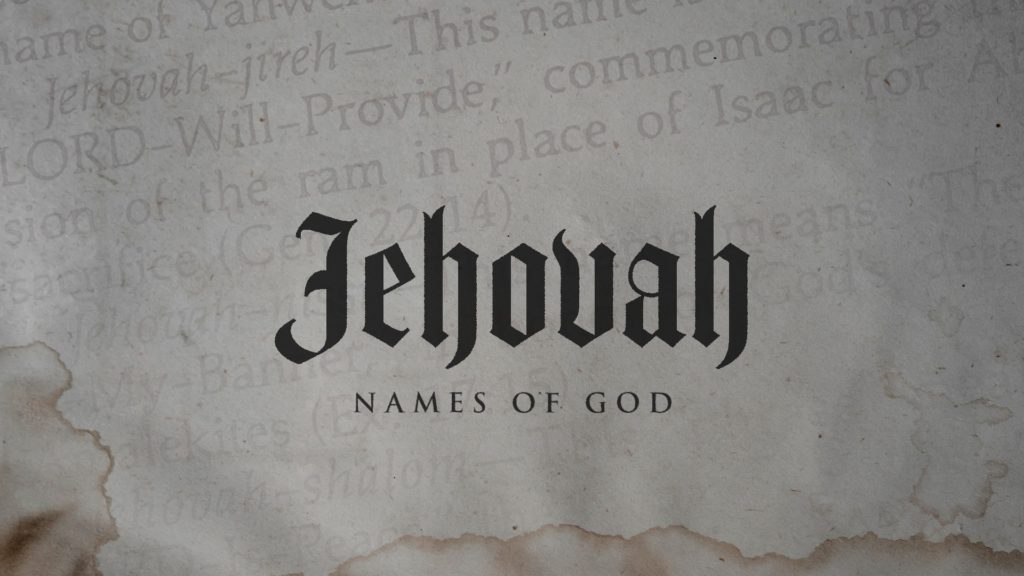
‘Often people ask does the King James Bible say Jehovah. More and more lately, thanks to the rise and popularity of internet “ministries,” people ask questions about the name of God due to doubts and errant teachings being spread online. So, it is valid to ask is Jehovah mentioned in King James Bible? The answer is Yes! The King James Bible says “Jehovah” in four separate verses:
Exodus 6:3 And I appeared unto Abraham, unto Isaac, and unto Jacob, by the name of God Almighty, but by my name JEHOVAH was I not known to them.
Psalms 83:18 That men may know that thou, whose name alone is JEHOVAH, art the most high over all the earth.
Isaiah 12:2 Behold, God is my salvation; I will trust, and not be afraid: for the LORD JEHOVAH is my strength and my song; he also is become my salvation.
Isaiah 26:4 Trust ye in the LORD for ever: for in the LORD JEHOVAH is everlasting strength:
There are also four places where “Jehovah” is part of a name and therefore is transliterated:
Genesis 22:14 And Abraham called the name of that place Jehovah-jireh: as it is said to this day, In the mount of the LORD it shall be seen.
Exodus 17:15 And Moses built an altar, and called the name of it Jehovah-nissi:
Judges 6:24 Then Gideon built an altar there unto the LORD, and called it Jehovah-shalom: unto this day it is yet in Ophrah of the Abi-ezrites.
Interestingly, there is another verse where the name of God is presented differently:
Psalms 68:4 Sing unto God, sing praises to his name: extol him that rideth upon the heavens by his name JAH, and rejoice before him.
In the King James Bible, most of the appearances of the Tetragrammaton (the four letter abbreviated name of God) are translated instead as “the LORD” instead of transliterated as “Jehovah.” It is likely that this was done out of respect for the Personal Name of God, since it only appears a total of seven times (including the three place names). This article from Chick Publications gives a short explanation and also responds to the “Jehovah vs. Yahweh” issue.
Many times, those who ask about the the name Jehovah are asking for other reasons: they are challenging the deity of Jesus Christ who IS Jehovah. This is a fundamental doctrine, the deity of Christ. The most obvious example of those who deny this truth are the “Jehovah’s Witnesses,” who take their name from Isaiah, assuming that they are witnesses for Jehovah God and not Jesus Christ (Acts 1:8).
Yet the Bible truth is that the King James Bible tells us Who Jehovah is! While the Jehovah’s Witnesses’ translation (the New World Translation) obfuscates the identity of Jehovah, the King James Bible makes it clear who He is:
Zechariah 12:10 And I will pour upon the house of David, and upon the inhabitants of Jerusalem, the spirit of grace and of supplications: and they shall look upon me whom they have pierced, and they shall mourn for him, as one mourneth for his only son, and shall be in bitterness for him, as one that is in bitterness for his firstborn.
Revelation 1:7 Behold, he cometh with clouds; and every eye shall see him, and they also which pierced him: and all kindreds of the earth shall wail because of him. Even so, Amen.
The NWT intentionally hides this clear cross reference to Jehovah who is speaking in Zechariah 12 (a monologue starting with verse 1) and Jesus who is speaking in Revelation 12. The NWT says “and they will look to the one whom they pierced.” Jehovah Himself was pierced with a spear (John 19:34, 37) on the cross. It was on the cross that God’s own blood was shed to purchase His church (Acts 20:28). So, is Jehovah mentioned in King James Bible? Yes! Not only that, but the King James Bible clearly indicates who He is: Jesus Christ is Jehovah, revealed to us.
There are many other ways to identify Who Jehovah is. When He first revealed Himself to Moses in the desert, He told Moses that His name was “I AM THAT I AM” and to tell Israel that “I AM” had sent Moses (Exodus 3:14). The idea here is that God is defining reality and temporal existence by His own being. This goes along with “For in him we live, and move, and have our being” (Acts 17:28) and “he is before all things, and by him all things consist” (Colossians 1:17; see also Hebrews 1:1-4). So, when Jesus was speaking to the Jews, who knew the Old Testament very well, He enraged them by saying “Verily, verily, I say unto you, Before Abraham was, I am” (John 8:58). He was identifying Himself as the “I AM” of Exodus 3:14, and they knew it, which is why they tried to stone him (John 8:59; 10:31-33).
So, yes, the King James Bible says “Jehovah,” and it also tells us Who He is. Do you know Jehovah? Have you believed on Him to receive eternal life? ‘https://www.kjvchurches.com/does-the-king-james-bible-say-jehovah/
‘John Dunn, a street preacher, had Public Order Act charges dropped after prosecutors claimed parts of the Bible are ‘abusive’ and ‘no longer appropriate in modern society.’
John, a cancer survivor from Swindon who has served in the British Army’s Special Forces, was interviewed under caution and subsequently summonsed by the police for alleged ‘homophobia’ after preaching on Swindon High Street in November 2020.
Mr Dunn, who regularly preaches despite having lost his voice box following throat cancer, is a Bible-believing Christian who preaches in Swindon town centre. He considers preaching on the streets and speaking God’s truth to be an essential part of his Christian calling, which he has been doing for 15 years.

After an interaction with two women who said they were in a same-sex marriage, John was reported to police and then charged under the Public Order Act.
The Crown Prosecution Service argued when charging him that there are “references in the Bible which are simply no longer appropriate in modern society and which would be deemed offensive if stated in public.”
However, the case against him was thrown out after the two women reportedly ‘refused to engage with the case’ after making the initial allegations.
Following the outcome, Mr Dunn said: “Before I became a Christian, I hated people, I served with the Special Forces and I made it my mission to learn how to best kill people, that was my job. But when I met Jesus Christ, he changed my heart, took away my hatred and filled it with love. Jesus was the answer for me, and I believe the world needs to know and experience this hope. That is why I do what I do, to help everyone to find the light of Jesus out of the darkness we all live in.
“When I preach, I only ever say what is in the Bible. When they told me they were in a same-sex marriage, I was concerned for them. I had to communicate the consequences of their actions based on what the Bible says. I wanted to warn them, not out of condemnation, but out of love. I wanted to them to know that there is forgiveness through the love of Jesus.”‘https://christianconcern.com/cccases/john-dunn/
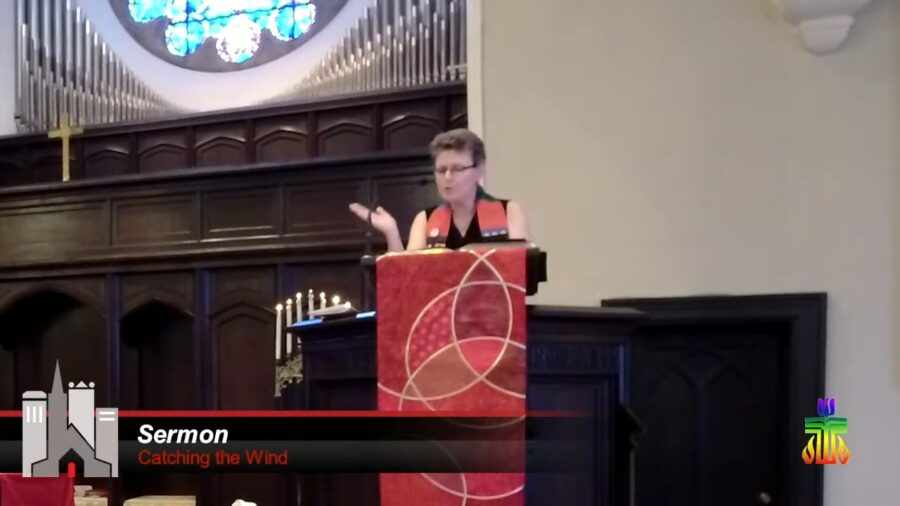
The Lord Jesus said ‘Sanctify them through thy truth: thy word is truth.’ Jesus also said of Himself “I am the way, the truth, and the life: no man cometh unto the Father, but by me.” Sadly, some “twist” God’s truth and thereby many miss the ONLY way to Heaven. The following article concerns a woman who leads First Presbyterian in Birmingham, AL https://www.fpcbham.org/projects.
The article states ‘We’ve seen a lot of scripture twisting in our day, but nothing quite like the dark arts performed by Pastrix Terry Hamilton Poore, Head of Staff at the Crypt Church of Birmingham, Alabama, which is a PCUSA Church. Poore gained prominence when she led the fight in her state AGAINST restrictive anti-abortion laws, declaring ” The religious community needs to stand with women, work for just laws, and demonstrate respect for women’s abilities to make decisions about their own lives.”
While we typically see the story of Zacchaeus used by critical theorists and wokesters as a prooftext for reparations, Poore uses it for novel purposes. She starts off by recounting the story of Jonah and the fact that he wanted God to smite the Ninevites, comparing pro-life advocates to the mean old Jonah who just wants to see people punished, then saying Christians ought to be like Zacchaeus and give their money to women to fund their birth control and other social programs.’https://protestia.com/2022/07/20/pro-abortion-pastrix-says-stories-of-jonah-and-zacchaeus-are-proof-we-should-subsize-birth-control/
If you have read the “About” me for this blog you know I am an independent Baptist. I was saved (accepted the Lord Jesus Christ) when I was a very young lad through the ministry of an independent Baptist Church where I also followed the Lord in baptism and heard some good preaching from His Word. However, having now walked with the Lord these many, many years I have seen a lot of “things” within “Christianity” that did and do bother me. Today, I came across the following and thought I would share it with you. This is only the first Part so i will share the others later.
‘Over the last few years there has been a significant movement to rethink “fundamentalism,” a term often applied to churches that would qualify to be listed in our database here at KJV Churches. Largely driven by younger believers, mostly Millennials, this movement has questioned many of the positions and attitudes held by a number of prominent figures who purport to hold to “Old Time Religion” or the “Old Paths,” and without a doubt there are many valid questions and rebukes necessary in many sectors of “fundamental” Christianity.
In this series, we intend to deal with a number of the real issues that should be addressed with regard to the supposed “Old Time Religion” and “fundamentalism,” but at the same time it is our desire to inspect the attitudes displayed by the “Recovering Fundamentalist” movement. As with most things, there are ditches on both sides of the road, and while a strong argument can be made against the traditional model that frequently covers up sin, overlooks abuse, and welcomes “fallen” men while ignoring and blaming the victims, we must be careful not to allow a knee-jerk reaction that will result in the same rotten attitudes, ungodly spirit, and combative approach that is many times the fruit of the “fundamentalists.”
Meddling Millennials
The generational divide between the majority of the church leadership, made up of Generation X and Baby Boomers (of disrespectful “OK, Boomer” fame), and the up-and-coming Millennials, the generation to which this author belongs, has been the cause for a lot of conflict. We Millennials have a very different approach to certain things which makes us appear to be a threat to many people, especially those who appreciate their authoritative positions and perceive any question as a threat or assume that any disagreement is an attack. The older generations must understand that a person presenting a question is not necessarily seeking to supplant whoever is in authority. Often it is done in a spirit of reconciliation, hoping to correct a wrong, perceived or real, and to restore respect for whoever was in error. Simply put, most Millennials aren’t interested in sweeping things under the rug, regardless of the consequences.
My generation experienced the Internet as young people, so we remember the days before instant, worldwide communication was possible even though many of us met our spouses and best friends online. We’re the pre-Internet generation that has in a very real sense shaped the Internet as it exists today. Our unique experiences have created a group of people, from 25-40 years old, that believe that respect is earned and can be lost, authority does not automatically deserve respect, and that age does not automatically mean wisdom (Job 32:9) when it departs from the word of God. As a result, our generational perspective does not automatically follow that of our predecessors. We are more likely to investigate a man’s character and testimony, and not just assume that he was a great man because he was a “great soul winner”. We’ve seen too many “great men” go to prison to assume that large numbers of “conversions” or a big Bible College are the marks of spirituality.
Personally, I’ve long since stopped identifying with men or movements, since many that I respected as a child turned out to be problematic, to say the least, once I reached adulthood. It’s true that there are Biblical commands to respect those that have positions of authority, but all too often the warnings and responsibilities of those tasked with those positions have been ignored, while the man in question hides behind a “man of God” moniker and rejects all criticism as an attack on “the ministry.” I don’t even know how many times as a child that I heard my pastor preach grave warnings about speaking out against the pastor (him, of course), talking about she-bears, lightning strikes, and leprosy attacks, as if he himself were Elisha, Elijah, or Moses. Another shocking recollection is of the pastor (same man) claiming that the church funds were low because he had chosen not to receive his salary, and that God wasn’t blessing the church as a result.
It is the unfortunate reality of modern “Christianity” (“Churchianity” is much more accurate, since it’s more about the “church” than it is about Christ) that those in places of authority heartily accept the “benefits” that come with being the CEO of a government-recognized 501(c)(3) charity, yet ignore the stern warnings in the Scriptures about how to deal with God’s flock (Acts 20:28-29; 1 Peter 5:2-3; 2 Peter 2:3; Hebrews 13:7, 17, etc.). Too many pastors have assumed the right to skin God’s sheep at will, abusing Christ’s flock and manipulating the LORD’s heritage for their own benefit, be it physical (just look at the average BMI of Baptist pastors), monetary, or spiritual, seeking the preeminence that belongs exclusively to the LORD. Now, lest the reader assume that fingers are being pointed at Generation X or the “Boomers,” allow me to clarify: this danger exists in any generation, for any pastor, who ignores the scriptures and seeks his own benefit instead of that of the body of Christ.
Assuming anyone is still reading at this point, there may be some anger in that so far nothing has been said against those meddlesome “Recovering Fundamentalists.” Don’t worry, we’ll get there. But since the “Recovery” movement is a response to the real problems in so-called “Fundamentalism,” those issues should be addressed first, which will allow us to see how this new movement started and why, and we’ll be better prepared to address the issues that they themselves face and the problems they are causing for themselves and for the body of Christ. Don’t worry: there are plenty of problems to go around, and there is plenty of blame to be shared.
What’s the Big Deal?
Over the last few decades the focus of self-professed fundamentalist churches has shifted from the glory of God, edification of the body, and the evangelization of the lost to a pragmatic approach to maintaining the status quo of church attendance, bus ridership, and financial giving. Paris Reidhead’s warning against pragmatism in his famous sermon Ten Shekels and a Shirt (listen to it if you haven’t already) has been completely ignored by the body of Christ. While it may be easy for “conservative” churches (traditional music, KJV only, etc.) to point fingers at “megachurches” with their sports complexes, coffee shops, and polo-shirt-wearing “campus pastors,” we must take stock of our own attitudes and recognize that our own religious system focuses on itself and its own self-propagation more than the glory of God and the spiritual edification of the body.
The results of this sad state of “Christianity” is that young people have started to look behind the curtain and realize that the “Holy Spirit” that is talked about so frequently is really just emotionalism dressed up as spirituality in order to sell a religious program. Thus, it’s no wonder that the sales tactics of a sleazy used car salesman are employed to fill the pews, and that the same approach to maintaining the membership is used, despite the differing content. Don’t believe me? Consider this question:
“What if we take away the cool music and the cushioned chairs? What if the screens are gone and the stage is no longer decorated? What if the air conditioning is off and the comforts are removed? Would his Word still be enough for his people to come together?” – David Platt
The question is valid regardless of who said it; many “fundamentalists” revere serial adulterers and child molesters, so I don’t care what you think about Platt, nor does it matter what I think about him. Consider about the question and imagine how many of the “members” of your church would still faithfully attend if there were no comfortable seats, if there were no heating or air conditioning. How many of the young people would come if it wasn’t for the goodies or fun activities? If all your church did were to assemble, stand together for two or three hours, sing a few hymns a cappella, and listen to the word preached and Christ glorified for two hours, how many would be left at the end of a year? What would the tithing records look like? How many missionaries would you be able to support? How would you pay the mortgage?
You see, we Millennials were sold a bill of goods. We were told that Christ was all that mattered, but we saw that the reality was very different. Just so that we’re clear, that’s called hypocrisy and it’s one of the things that irritates the LORD the most. And, it’s not very appreciated by young people that believed you when we were young and then saw the results of your hypocrisy. So, it’s understandable when young people who would have served God wholeheartedly if they had an example to follow, instead leave church, develop a resentful attitude, or look for a place where they can truly serve God without the humanistic impediments that are so rampant in many “fundamental” churches.
Conclusion (don’t worry, there’s more to come)
So, we haven’t gotten around to bashing those pesky “Recovering Fundamentalists” yet. That’s ok, there’s plenty of blame and rebuke to go around. In a future post we will start to unpack the response, good and bad, of the Millennial generation to the problems we addressed in this post. Just keep in mind that the most important problem to deal with is OUR problem, just like Christ said:
Either how canst thou say to thy brother, Brother, let me pull out the mote that is in thine eye, when thou thyself beholdest not the beam that is in thine own eye? Thou hypocrite, cast out first the beam out of thine own eye, and then shalt thou see clearly to pull out the mote that is in thy brother’s eye. (Luke 6:42)
Do you want to “see clearly” to deal with the issues that someone else has? Great! Start with yourself, just like I must start with myself. When you recognize and deal with the problems at home, you’ll both be more objective and more merciful with the errors of others (Galatians 5:1). But if you start in the flesh and only look at the mistakes of others, you’ll just create more strife, division, and contention (Proverbs 13:10).’https://www.kjvchurches.com/recovering-part-1-meet-the-millennials/


 whatyareckon