
King James Bible
All posts tagged King James Bible
‘The Trinitarian Bible Society held its first Text & Translation Conference at its headquarters in London, UK on 15 September 2022. In this message, the first of four lectures given at the conference, Mr Thackway discusses the doctrine of the Holy Scripture, considering its divinity, clarity, and sufficiency.’
This is the introduction to a five part series by David Daniels on the Septuagint. This is subject is very important as the use of the Septuagint has affected many areas of study. Dr. James J. S. Johnson wrote in a 2019 Dean Burgon Society article that “There is a growing potential in Christian circles, especially within the creation science community for promoting and advocating the Greek Septuagint (“LXX”) version of the Old Testament, as if the LXX’s content was more reliable than the content of the providentially preserved Masoretic Text (MT) of the Old Testament.”
Please take time to go and watch the other five parts of this video series! https://www.youtube.com/watch?v=I9dztt0evpQ&list=PLhmAbEGx-AnRh2YgrQvayYlEItaAoISWA&index=2
Trinitarian Bible Society Conference 11 Nov 2022. speaker Rev Christian McShaffrey
“Glory to God in the highest, and on earth peace, good will toward men.” (Luke 2:14)
‘Editorial introduction: The verse above is well-known to all. It has been read in the churches since the time of the Apostles and sung by congregations since the second century. It can therefore be mentally jarring to hear modern translations of it read during the advent season.
Some translations even seem to be communicating an entirely different message. Were the angels continuing to proclaim God’s universal benevolence toward all people (v. 10) or only his particular grace to “those with whom he is pleased” (ESV)?
This confusion is due not to any difference in translation philosophy, but to a textual variant. A textual variant is a difference between the wording of two or more manuscripts of the Greek New Testament and, in the case of Luke 2:14, the difference consists of a single letter.
Many claim that textual variants affect no doctrine, but this is clearly a case in which the interpretation and application of a verse is affected by the presence or absence of a single letter. So which reading is correct? What did the angels actually say?
Below is an essay (lightly edited) by the late John William Burgon (1813-1888) in which he defends the traditional reading by tracing its consistent use throughout church history and by showing how the few witnesses against its authenticity are at discord among themselves.
We encourage all Christians to study his argument and also to share it with their pastors so that the good news which rang out of heaven on the night Jesus was born will continue to be heralded in the churches and to all mankind.
– Christian McShaffrey
A more grievous perversion of the truth of Scripture is scarcely to be found than occurs in the proposed revised exhibition of Luke 2:14, in the Greek and English alike; for indeed not only is the proposed Greek text (ἐν ἀνθρώποις εὐδοκίας) impossible, but the English of the Revisionists (“peace among men in whom he is well pleased”) “can be arrived at” (as one of themselves has justly remarked) “only through some process which would make any phrase bear almost any meaning the translator might like to put upon it.” [1]
More than that, the harmony of the exquisite three-part hymn, which the angels sang on the night of the nativity, becomes hopelessly marred, and its structural symmetry destroyed, by the welding of the second and third members of the sentence into one.
Singular to relate, the addition of a single final letter (ς) has done all this mischief. Quite as singular is it that we should be able at the end of upwards of 1700 years to discover what occasioned its calamitous insertion.
From the archetypal copy, by the aid of which the old Latin translation was made (for the Latin copies all read “pax hominibus bonæ voluntatis”), the preposition ἐν was evidently away — absorbed apparently by the ἀν which immediately follows. In order therefore to make a sentence of some sort out of words which, without ἐν, are simply unintelligible, εὐδοκία was turned into εὐδοκίας. It is accordingly a significant circumstance that, whereas there exists no Greek copy of the Gospels which omits the ἐν, there is scarcely a Latin exhibition of the place to be found which contains it. [2]
To return however to the genuine clause: “Good-will towards men” (ἐν ἀνθρώποις εὐδοκία)
Absolutely decisive of the true reading of the passage—irrespectively of internal considerations—ought to be the consideration that it is vouched for by every known copy of the Gospels of whatever sort, excepting only ℵ A B D: the first and third of which, however, were anciently corrected and brought into conformity with the Received Text; while the second (A) is observed to be so inconstant in its testimony, that in the primitive “Morning-hymn” (given in another page of the same codex, and containing a quotation of Luke 2:14), the correct reading of the place is found. D’s complicity in error is the less important, because of the ascertained sympathy between that codex and the Latin.
In the meantime, the two Syriac Versions are a full set-off against the Latin copies; while the hostile evidence of the Gothic (which this time sides with the Latin) is more than neutralized by the unexpected desertion of the Coptic version from the opposite camp. The Armenian, Georgian, Ethiopic, Slavonic, and Arabian versions, are besides all with the Received Text.
It therefore comes to this: We are invited, on the one hand, to make our election between every other copy of the Gospels, every known Lectionary, and (not least of all) the ascertained ecclesiastical usage of the Eastern Church from the beginning, or, on the other hand, the testimony of four Codices without a history or a character, which concur in upholding a patent mistake.
Will anyone hesitate as to which of these two parties has the stronger claim on his allegiance?
Could doubt be supposed to be entertained in any quarter, it must at all events be borne away by the torrent of patristic authority which is available on the present occasion:
Second Century
– Irenaeus [3]
Third Century
– Origen, in three places [4]
– Apostolical Constitutions, in two [5]
Fourth Century
– Eusebius, twice [6]
– Aphraates the Persian, twice [7]
– Titus of Bostra, twice [8]
– Didymus, in three places [9]
– Gregory of Nazianzus [10]
– Cyril of Jerusalem [11]
– Epiphanius, twice [12]
– Gregory of Nyssa, four times [13]
– Ephraem Syrus [14]
– Philo, bishop of Carpasus [15]
– Chrysostom, in nine places [16]
– A nameless preacher at Antioch [17]
Note: All these were contemporaries of B and ℵ, and are therefore found to bear concurrent testimony in favor of the commonly received text.
Fifth Century
– Cyril of Alexandria, fourteen times [18]
– Theodoret, four times [19]
– Theodotus of Ancyra, five times [20]
– A homily preached at the Council of Ephesus on Christmas-day, AD 431 [21]
– Proclus, archbishop of Constantinople [22]
– Paulus, bishop of Emesa (preached before Cyril of Alexandria on Christmas-day) [23]
– The Eastern bishops at Ephesus, collectively, AD 431 [24]
– Basil of Seleucia [25]
Note: These witnesses were contemporaries of codex A.
Sixth Century
– Cosmas, the voyager, five times [26]
– Anastasius Sinaita [27]
– Eulogius, archbishop of Alexandria [28]
Note: These were contemporaries of codex D.
Seventh Century
– Andreas of Crete, twice [29]
Eighth Century
– Cosmas, bishop of Maiuma near Gaza [30]
– John Damascene [31]
– Germanus, archbishop of Constantinople [32]
To these twenty-nine illustrious names are to be added unknown writers of uncertain date, but all of considerable antiquity; and some are proved by internal evidence to belong to the 4th or 5th century [33] — in short, to be of the date of the fathers whose names sixteen of them severally bear, but among whose genuine works their productions are probably not to be reckoned.
One of these was anciently mistaken for Gregory Thaumaturgus [34], a second for Methodius [35], a third for Basil [36]. Three others, with different degrees of reasonableness, have been supposed to be Athanasius [37]. One has passed for Gregory of Nyssa [38]; another for Epiphanius [39]; while no less than eight have been mistaken for Chrysostom [40], some of them being certainly his contemporaries.
Add one anonymous church father [41], and the author of the apocryphal Acta Pilati, and it will be perceived that eighteen ancient authorities have been added to the list, every whit as competent to witness what was the text of Luke 2:14 at the time when A B ℵ D were written, as Basil or Athanasius, Epiphanius or Chrysostom themselves. [42]
For our present purpose, they are Codices of the 4th, 5th, and 6th centuries. In this way then, far more than forty-seven ancient witnesses have come back to testify to the men of this generation that the commonly received reading of Luke 2:14 is the true reading, and that the text which the Revisionists are seeking to palm off upon us is a fabrication and a blunder.
Will anyone be found to maintain that the authority of B and ℵ is appreciable, when confronted by the first fifteen contemporary ecclesiastical writers above enumerated? Or that A can stand against the seven which follow?
This is not all however. Survey the preceding enumeration geographically, and note that besides one name from Gaul, at least two stand for Constantinople, while five are dotted over Asia Minor; ten at least represent Antioch; and six other parts of Syria, three stand for Palestine, and twelve for other churches of the East: at least five are Alexandrian, two are men of Cyprus, and one is from Crete.
If the articulate voices of so many illustrious Bishops, coming back to us in this way from every part of ancient Christendom and all delivering the same unfaltering message — if this be not allowed to be decisive on a point of the kind just now before us, then pray let us have it explained to us — what amount of evidence will men accept as final? It is high time that this were known.
The plain truth is, that a case has been established against ℵ A B D and the Latin version, which amounts to proof that those documents, even when they conspire to yield the self-same evidence, are not to be depended on as witnesses to the text of Scripture. The history of the reading advocated by the Revisionists is briefly this: It emerges into notice in the 2nd century; and in the 5th disappears from sight entirely.
Enough and to spare has now been offered concerning the true reading of Luke 2:14, but because we propose to ourselves that no uncertainty whatever shall remain on this subject, it will not be wasted labor if, in conclusion, we pour into the ruined citadel just enough of shot and shell to leave no dark corner standing for the ghost of a respectable doubt hereafter to hide in.
Now, it is confessedly nothing else but the high estimate which Critics have conceived of the value of the testimony of the old uncials (ℵ A B C D), which has occasioned any doubt at all to exist in this behalf. Let the learned reader then ascertain for himself the character of codices ℵ A B C D hereabouts, by collating the context in which Luke 2:14 is found, viz. the thirteen verses which precede and the one verse (v. 15) which immediately follows.
If the old uncials are observed all to sing in tune throughout, hereabouts, well and good: but if on the contrary, their voices prove utterly discordant, who sees not that the last pretense has been taken away for placing any confidence at all in their testimony concerning the text of v. 14, turning as it does on the presence or absence of a single letter?
He will find, as the result of his analysis, that within the space of those fourteen verses, the old uncials are responsible for fifty-six “various readings” (so-called). Singly, for forty-one; and in combination with one another, for fifteen.
So diverse, however, is the testimony they respectively render, that they are found severally to differ from the Text of the cursives no less than seventy times. Among them, besides twice varying the phrase, they contrive to omit nineteen words, to add four, to substitute seventeen, to alter ten, and to transpose twenty-four.
Lastly, these five codices are observed (within the same narrow limits) to fall into ten different combinations: viz. B A, for five readings, B D for two, ℵ C, ℵ D, A C, ℵ B D, A ℵ D, A B ℵ D, B ℵ C D, A B ℵ C D, for one each.
A, therefore, which stands alone twice, is found in combination four times, C, which stands alone once, is found in combination four times [43], B, which stands alone five times, is found in combination six times, ℵ, which stands alone eleven times, is found in combination eight times, D, which stands alone twenty-two times, is found in combination seven times.
And now — for the last time we ask the question — with what show of reason can the unintelligible εὐδοκίας (of ℵA B D) be upheld as genuine, in defiance of the whole body of Manuscripts, uncial and cursive, the great bulk of the Versions, and the mighty array of (upwards of fifty) church fathers exhibited above?’https://www.textandtranslation.org/the-textual-variant-in-luke-2-14/
‘”God didn’t talk in person to His creation anymore after the Fall in Genesis 3.”
Hearing my professor say this, in his Unity of the Bible course, wouldn’t have been so shocking if it hadn’t happened in Fuller Seminary, which was once considered one of the most conservative seminaries in the country.
As we all know, God spoke directly to Cain in the very next chapter, Genesis 4! But this professor never changed his notes to match the Bible. His mind was made up.

The professor was Dan Fuller, son of the founder, Charles E. Fuller (whose preaching had led to Jack Chick’s salvation).
At Fuller, it wasn’t long before I found myself questioning everything I had believed about God and the Bible. We were frequently challenged to think differently and question our currently held beliefs. I think you will be quite surprised by what other Fuller Bible “scholars” believed.
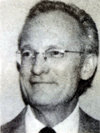
This is Paul Jewett. He taught us that Adam didn’t find a companion until he looked and saw one of the apes. He said, and I quote, “That one over there. I think it’s something in the eyes.” So Dr. Jewett, this champion of women as pastors, taught that the first woman was literally an ape.

This is Dr. Ralph P. Martin. He changed the meaning of a couple of Greek words in Acts 1 to make it as if Luke and Acts were written in the 2nd century, contradicting the Bible, which says Luke was an eyewitness.

This is Dr. Lewis B. Smedes. Like a confrontational talk-show host, he would try to tear down each class member’s faith in the 10 Commandments. He’d arrange us in a circle and make up tear-jerking scenarios, where breaking a commandment seemed like the only thing you could do, to solve the problem he made up. And when someone finally emotionally broke down in class, he would say in front of the others, “So you don’t really believe in that commandment, do you?” He took pleasure in tearing people’s faith into shreds.



These are Drs. Hubbard, LaSor and Bush. They wrote an Old Testament Introduction text that said Ezekiel was a reformer who wanted to make a bigger Jerusalem temple. But alas, his plans didn’t work out. (That’s Ezekiel 40-48). They said that those chapters were simply Ezekiel’s wish-fulfillment dream, not from God. So they believed the Bible was written by man, not inspired by God.
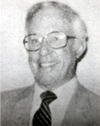
Dr. Bob Schaper, my homiletics professor, said two things I still remember, almost word-for-word: “If we had a Polaroid camera, we would not have seen God forming man of the dust of the ground and breathing into his nostrils the breath of life.” And “If we had a Polaroid camera, we would not have seen Jesus ascend to heaven. ‘Heaven isn’t up.’” And nobody questioned it! Yet Acts 1 plainly says Jesus “went up” before their eyes, while they watched. But Dr. Schaper never let the facts get in the way of his beliefs.
Oh, and one more thing. All the professors here, as far as they had said and I was told, were evolutionists. They thought creationism was a fairy tale, and that Genesis 1-11 was just poetry.
This is who trained thousands of present pastors and professors when they went to Fuller seminary, as I did. And they are only the tip of the iceberg.
Listening to my professors talk, was like dissecting dead things. These professors were perfectly happy to pick up the dead and rotting corpses of supposedly ancient Bible texts, cut out what they wanted, throw the rest away, and sort of “Frankenstein-together” a Bible out of the rotten remains of whatever they found.
But God’s words never died. They are living! The Bible’s words are “quick” —and they are powerful. They change lives.
“For the word of God is quick, and powerful, and sharper than any two-edged sword, piercing even to the dividing asunder of soul and spirit, and of the joints and marrow, and is a discerner of the thoughts and intents of the heart” (Hebrews 4:12).
“Quick” means “alive.” God’s words are quick and powerful, not dead and powerless.
“Is not my word like as a fire? saith the LORD; and like a hammer that breaketh the rock in pieces?” (Jeremiah 23:29). God’s word burns and breaks whatever God wants burnt and broken. That’s powerful.
In short, God’s words are an extension of God. They are powerful, like God. They do what God wants, when God wants, how God wants. God’s words are alive. When I approach HIS Book I can find out what my heavenly Father thinks, what He wants, and what will make Him happy.
The Bible is not like any other book. It is God’s Book! But my professors treated their own words as if they were more important than God’s words. And they taught the sons and daughters entrusted to them to doubt the Bible and trust them.
There is a solution. You can inoculate your sons and daughters against these kinds of faith-destroying professors. Teach them to trust the preserved words of the living God, in English, the King James Bible. As far as these seminaries, “let the dead bury their dead” (Luke 9:60).’https://www.chick.com/information/article?id=Seminary-Professors
‘Often people ask does the King James Bible say Jehovah. More and more lately, thanks to the rise and popularity of internet “ministries,” people ask questions about the name of God due to doubts and errant teachings being spread online. So, it is valid to ask is Jehovah mentioned in King James Bible? The answer is Yes! The King James Bible says “Jehovah” in four separate verses:
Exodus 6:3 And I appeared unto Abraham, unto Isaac, and unto Jacob, by the name of God Almighty, but by my name JEHOVAH was I not known to them.
Psalms 83:18 That men may know that thou, whose name alone is JEHOVAH, art the most high over all the earth.
Isaiah 12:2 Behold, God is my salvation; I will trust, and not be afraid: for the LORD JEHOVAH is my strength and my song; he also is become my salvation.
Isaiah 26:4 Trust ye in the LORD for ever: for in the LORD JEHOVAH is everlasting strength:
There are also four places where “Jehovah” is part of a name and therefore is transliterated:
Genesis 22:14 And Abraham called the name of that place Jehovah-jireh: as it is said to this day, In the mount of the LORD it shall be seen.
Exodus 17:15 And Moses built an altar, and called the name of it Jehovah-nissi:
Judges 6:24 Then Gideon built an altar there unto the LORD, and called it Jehovah-shalom: unto this day it is yet in Ophrah of the Abi-ezrites.
Interestingly, there is another verse where the name of God is presented differently:
Psalms 68:4 Sing unto God, sing praises to his name: extol him that rideth upon the heavens by his name JAH, and rejoice before him.
In the King James Bible, most of the appearances of the Tetragrammaton (the four letter abbreviated name of God) are translated instead as “the LORD” instead of transliterated as “Jehovah.” It is likely that this was done out of respect for the Personal Name of God, since it only appears a total of seven times (including the three place names). This article from Chick Publications gives a short explanation and also responds to the “Jehovah vs. Yahweh” issue.
Many times, those who ask about the the name Jehovah are asking for other reasons: they are challenging the deity of Jesus Christ who IS Jehovah. This is a fundamental doctrine, the deity of Christ. The most obvious example of those who deny this truth are the “Jehovah’s Witnesses,” who take their name from Isaiah, assuming that they are witnesses for Jehovah God and not Jesus Christ (Acts 1:8).
Yet the Bible truth is that the King James Bible tells us Who Jehovah is! While the Jehovah’s Witnesses’ translation (the New World Translation) obfuscates the identity of Jehovah, the King James Bible makes it clear who He is:
Zechariah 12:10 And I will pour upon the house of David, and upon the inhabitants of Jerusalem, the spirit of grace and of supplications: and they shall look upon me whom they have pierced, and they shall mourn for him, as one mourneth for his only son, and shall be in bitterness for him, as one that is in bitterness for his firstborn.
Revelation 1:7 Behold, he cometh with clouds; and every eye shall see him, and they also which pierced him: and all kindreds of the earth shall wail because of him. Even so, Amen.
The NWT intentionally hides this clear cross reference to Jehovah who is speaking in Zechariah 12 (a monologue starting with verse 1) and Jesus who is speaking in Revelation 12. The NWT says “and they will look to the one whom they pierced.” Jehovah Himself was pierced with a spear (John 19:34, 37) on the cross. It was on the cross that God’s own blood was shed to purchase His church (Acts 20:28). So, is Jehovah mentioned in King James Bible? Yes! Not only that, but the King James Bible clearly indicates who He is: Jesus Christ is Jehovah, revealed to us.
There are many other ways to identify Who Jehovah is. When He first revealed Himself to Moses in the desert, He told Moses that His name was “I AM THAT I AM” and to tell Israel that “I AM” had sent Moses (Exodus 3:14). The idea here is that God is defining reality and temporal existence by His own being. This goes along with “For in him we live, and move, and have our being” (Acts 17:28) and “he is before all things, and by him all things consist” (Colossians 1:17; see also Hebrews 1:1-4). So, when Jesus was speaking to the Jews, who knew the Old Testament very well, He enraged them by saying “Verily, verily, I say unto you, Before Abraham was, I am” (John 8:58). He was identifying Himself as the “I AM” of Exodus 3:14, and they knew it, which is why they tried to stone him (John 8:59; 10:31-33).
So, yes, the King James Bible says “Jehovah,” and it also tells us Who He is. Do you know Jehovah? Have you believed on Him to receive eternal life? ‘https://www.kjvchurches.com/does-the-king-james-bible-say-jehovah/
‘If one was to go by the teachings of the Church of Jesus Christ of Latter-Day Saints, they would be under the impression that they believed the Bible. This might lead one to ask why do Mormons use the KJV? After all, when the LDS Missionaries stop by your home in their attempts to convert you to the “church,” they always carry a King James Bible. They will gladly open it and go to a few select verses that seem to indicate that the books promoted as the “standard works” of the church, especially the Book of Mormon, are prophesied by the Bible. In fact, when you ask a Mormon if they believe the Bible, they will wholeheartedly confirm that they do, but sadly they only believe it, “…as far as it is translated correctly” as is stated in the eighth article of faith.
There are two main reasons that the Mormon church utilizes and endorses only the King James Version. The first is that at the time of the organization of the church in 1830, the King James or Authorized Version was accepted as the authoritative Bible among English speaking people. The Mormon use of the King James Version would certainly work towards credibility as they were trying to gain converts, whereas if they had utilized a less common and less available version, the opposite would no doubt had occurred. Franklin Gonzales, Institute Teacher at the University of Utah states, “Early church leaders were partial to the KJV not only because they have grown up with it, but also because the KJV was couched in language unparalleled for its literary beauty.”1 For the Mormons to use the King James all the way from the beginning was necessary, as they quickly gained a reputation for being “cult-like” in the surrounding areas of church influence.
The Mormon (LDS) movement started at Palmyra, New York, then moved to Kirtland, Ohio, Independence, Missouri, and lastly to Nauvoo, Illinois. If the Mormons had begun their proselytizing efforts with any version of the Bible than the King James, it would have been another warning flag to those they were seeking to convert. It is interesting to note is that Smith was supposedly divinely commissioned to make a new translation of the Bible called the Joseph Smith Translation, yet the church has never employed the Smith translation in their “evangelistic” work, as he died having only translated the Gospel of Matthew.
The second reason for why Mormons use the King James Version, even in these “latter days” (pun intended) with all the many modern versions available such as the NIV, NAS, ESV, etc. is that the King James Version was respected and chosen by Joseph Smith. The (false) prophet used an 1828 King James Bible to prepare the above-mentioned translation of Matthew. Gonzales states that Smith learned early on that “original Bible texts” had been corrupted.2 Of course the “originals” no longer exist, and though Smith and the leadership in the Mormon church held the King James Bible as being more accurate and reliable, Smith still fell into the same trap that modern revisionists have done since 1881, correcting the King James Bible using their wisdom, relying on that they think a specific word, phrase or verse should read. In fact, on March 7th, 1881, The “Prophet,” as he is known by church members, received a revelation that is an alternate revelation of the olivet discourse of Matt 24, this time God supposedly speaking directly to Smith. This adding to the word of God is found in another LDS standard work called Doctrine and Covenants 45:60-61.
While there is much more that can be added concerning the Joseph Smith Translation, in a desire to stay with the content of the article here about “Why do Mormons Use the KJV” it is very strange indeed that the KJV was not replaced by this translation, especially when BYU publications state that it provides clarity and understanding. Regarding the church’s continued use of the KJV, the Statement of the First Presidency states, “While other Bible versions may be easier to read than the KJV, in doctrinal matters latter-day revelation supports the KJV in preference to other translations. All of the Presidents of the Church, beginning with the Prophet Joseph Smith, have supported the KJV by encouraging its continued use in the Church. In light of all the above, it is the English language Bible used by the Church of Jesus Christ of Latter-day Saints.”
In Summary, the Mormons use the KJV because it was the most accepted version during the time of its origins and because the founder, Joseph Smith, endorsed it. It is interesting that a cult leader and his religion recognize the errors of modern versions, yet equally disheartening is that they add and take away from the KJV, just as the scholars of the past have done. So, in essence, it is the same double-speak that we get from those that have produced the NIV, NASB, ESV, Living Bible, etc. Thankfully we can trust that what we have in the KJV is God’s preserved word! As a side note I will also state as one that was a member of the Church of Jesus Christ of Latter-day Saints for about 3 years, that while they use and carry a KJV, it is hardly opened during their church meetings. Rather, it is primarily utilized when proselytizing, twisting scriptures to make it seem that those verses point to the Book Mormon.
By James Lyman
References:
1. Why does the Church still use the King James Version?
2. Ibid.’ https://www.kjvchurches.com/why-do-mormons-use-the-kjv/


 whatyareckon