
Listen to the following people and ask yourself if you would follow any or all of the advice given by these Marxist/Leftist/Loonies? I know what I would do!
Hate
All posts tagged Hate
‘What really caused Harvest Bible Chapel to fire James MacDonald? And what happened in all the backroom meetings, private conversations, and phone calls leading up to that fateful event?
In this episode of The Roys Report, former Harvest elder, Dan George, joins Julie to tell the real story of MacDonald’s firing.
This is a story that directly contradicts what MacDonald published in recent videos and statements on his webpage. But it’s a story that needs to be told—and remembered—given that MacDonald is trying to relaunch his ministry in Chicago.
Hear the dramatic and sovereignly orchestrated story of how MacDonald’s actions finally came to light at Harvest. And learn how MacDonald almost escaped being exposed—and how six scathing letters that revealed MacDonald’s true nature almost failed to reach the elder board.’
If a Biden/Harris administration is inaugurated in January, 2021 there will be Obama changes in all areas including Israel and its enemies. For example, ‘A Palestinian-American who has been characterized as a terrorist sympathizer has been appointed as Chief of Staff for the White House Office of Legislative Affairs.
In 2002, Reema Dodin described Palestinian suicide bombings as “the last resort of a desperate people,” during a public presentation in Lodi, CA, according to the Lodi News-Sentinel.
“The American public has a history of being a fair-minded people, but the information the public is getting is biased, awful and wrong. If you’re going to present this information to the public, you need to do it in a holistic manner,” said Dodin.
The presentation was conducted during the Second Intifada, which was the second Palestinian uprising against Israel.
The uprising lasted from 2000 to 2005 and resulted in 741 Israeli civilian deaths, according to The Israeli Information Center for Human Rights.
The year prior, Dodin participated in a demonstration at her alma mater UC Berkeley that compared Israel to an apartheid state and called for Berkeley to dispossess Israel, according to the Berkeley Daily Planet.
“She is the daughter of Palestine and her origins are Palestinian,” Dodin’s uncle, Ahmed Dodin told Anadolu Agency.
Ahmed expressed hopes that the appointment “will be good for her and her mother country.”
“Reema is the first to tell you she has grown from her youth in her approach to pushing for change, but her core values of fighting to expand opportunity to building a stronger middle class remain her driving force,” said the Biden-Harris transition team to The Jerusalem Post.’https://www.foreigndesknews.com/politics/biden-taps-terrorist-sympathizer-as-incoming-staffer/
What is it with politicians? Abortion, euthanasia, Marxism, climate change etc. In my own opinion there should be no debate that abortion is the murdering of another human being. Yet, our politicians here in Australia, when it comes to murder of the unborn all they can do is pass laws that those who are pro-life may not stand within 150 metres of the murder clinic. These political hypocrites are more concerned with Koalas than babies! If any Australian politician, especially a NSW state politician, happens to find this article please take the time to read and consider what it has to say.
Job 10:10-11 “Hast thou not poured me out as milk, and curdled me like cheese? Thou hast clothed me with skin and flesh, and hast fenced me with bones and sinews.”

‘January 22, 1973 marks the disastrous turn in American law that granted women the so‑called right to kill their unborn babies. The Bible makes it abundantly clear that the unborn child is a human being who is known and loved by God as He knits it together in the womb. Science knows that even when it is a single fertilized cell, the unborn child is uniquely human. Now science is learning the truth of what the Bible has told us all along about the individual human nature of the unborn child.
Research is confirming that even before birth children in the womb are learning about the world. The child in the womb does much more than simply hear sounds, including its mother’s voice. The child also becomes familiar with odors in the outside environment.
To test what newborns were thinking, scientists very cleverly hooked up a pacifier to a tape recorder. They then rewarded a particular sucking pattern with various sounds such as mother’s voice. They found that the infants would concentrate on a pattern that would produce their mother’s voice. In another test, women’s voices, and even their father’s voices, were not favored over mother’s heartbeat – a familiar sound in the womb.
Even science is beginning to agree that life in the womb is nothing less than a normal stage of human existence. Like every other stage of life, life in the womb includes learning new things and developing relationships. If only this knowledge was applied to the abortion debate.’https://creationmoments.com/sermons/learning-in-the-womb-learning-from-the-womb-2/?utm_source=rss&utm_medium=rss&utm_campaign=learning-in-the-womb-learning-from-the-womb-2&mc_cid=896148e4d8&mc_eid=00c1dcff3c
The following is adapted from an online lecture delivered at Hillsdale College on November 6, 2020.
‘Every generation of Americans, from the beginning, has had to answer for itself the question: how should we live? Our answers, generation after generation, in war and in peace, in good times and bad times, in small things and in great things through the whole range of human affairs, are the essential threads of the larger American story. There is an infinite variety of these smaller American stories that shed light on the moral and political reality of American life—and we keep creating them. These fundamental experiences, known to all human beings but known to us in an American way, create the mystic chords of memory that bind us together as a people and are the necessary beginnings of any human wisdom we might hope to find.
These mystic chords stretch not only from battlefields and patriot graves, but from back roads, schoolyards, bar stools, city halls, blues joints, summer afternoons, old neighborhoods, ballparks, and deserted beaches—from wherever you find Americans being and becoming American. A story may be tragic, complicated, or hilarious, but if it is a true American story, it will be impossible to read or listen to it attentively without awakening the better angels of our nature.
Here’s one, about the beautiful friendship of two remarkable Americans.
Fingertip Memories
Helen Keller was 14 years old when she first met the world-famous Mark Twain in 1894. They became fast friends. He helped arrange for her to go to college at Radcliffe where she graduated in 1904, the first deaf and blind person in the world to earn a Bachelor of Arts degree. She learned to read English, French, German, and Latin in braille and went on to become practically as world-famous as her dear friend, writing prolifically and lecturing across the country and around the world. Twain, with his usual understatement, called her “one of the two most remarkable people in the 19th century.” The other candidate was Napoleon.
Keller lived into the 1960s and shared some of her fond memories of Twain in an autobiographical book she published in 1929. In particular, she records recollections from her last visit to her friend in his “Stormfield” home in Redding, Connecticut, which she thought of as a “land of enchantment.” She preserves for us a vivid image not only of Mark Twain—Mr. Clemens, as she called him—but of her own vivacious mind. About Twain she writes,
There are writers who belong to the history of their nation’s literature. Mark Twain is one of them. When we think of great Americans we think of him. He incorporated the age he lived in. To me he symbolizes the pioneer qualities—the large, free, unconventional, humorous point of view of men who sail new seas and blaze new trails through the wilderness.
As they gathered around the hearth one night after dinner at Stormfield, she records,
Mr. Clemens stood with his back to the fire talking to us. There he stood—our Mark Twain, our American, our humorist, the embodiment of our country. He seemed to have absorbed all America into himself. The great Mississippi River seemed forever flowing, flowing through his speech.
When Twain took her to her room to say goodnight, he said “that I would find cigars and a thermos bottle with Scotch whiskey, or Bourbon if I preferred it, in the bathroom.”
One evening, Twain offered to read to her from his short story, “Eve’s Diary.” She was delighted, and he asked, “How shall we manage it?” She said, “Oh, you will read aloud, and my teacher will spell your words into my hand.” He murmured, “I had thought you would read my lips.” And so that is what she did. Upon request, and as promised, Twain put on his “Oxford robe,” the “gorgeous scarlet robe” he had worn when Oxford University “conferred upon him the degree of Doctor of Letters.”
Here is Keller’s recollection of the evening:
Mr. Clemens sat in his great armchair, dressed in his white serge suit, the flaming scarlet robe draping his shoulders, and his white hair gleaming and glistening in the light of the lamp which shone down on his head. In one hand he held “Eve’s Diary” in a glorious red cover. In the other hand he held his pipe. . . . I sat down near him in a low chair, my elbow on the arm of his chair, so that my fingers could rest lightly on his lips.
“Everything went smoothly for a time,” she wrote. But Twain’s gesticulations soon began to confuse things, so “a new setting was arranged. Mrs. Macy came and sat beside me and spelled the words into my right hand, while I looked at Mr. Clemens with my left, touching his face and hands and the book, following his gestures and every changing expression.”
Keller reflected that,
To one hampered and circumscribed as I am it was a wonderful experience to have a friend like Mr. Clemens. I recall many talks with him about human affairs. He never made me feel that my opinions were worthless. . . . He knew that we do not think with eyes and ears, and that our capacity for thought is not measured by five senses. He kept me always in mind while he talked, and he treated me like a competent human being. That is why I loved him. . . . There was about him the air of one who had suffered greatly.
Whenever I touched his face his expression was sad, even when he was telling a funny story. He smiled, not with the mouth but with his mind—a gesture of the soul rather than of the face. His voice was truly wonderful. To my touch, it was deep, resonant. He had the power of modulating it so as to suggest the most delicate shades of meaning and he spoke so deliberately that I could get almost every word with my fingers on his lips. Ah, how sweet and poignant the memory of his soft slow speech playing over my listening fingers. His words seemed to take strange lovely shapes on my hands. His own hands were wonderfully mobile and changeable under the influence of emotion. It has been said that life has treated me harshly; and sometimes I have complained in my heart because many pleasures of human experience have been withheld from me, but when I recollect the treasure of friendship that has been bestowed upon me I withdraw all charges against life. If much has been denied me, much, very much has been given me. So long as the memory of certain beloved friends lives in my heart I shall say that life is good.
When Helen Keller left the enchanted land of Stormfield on that visit, she wondered if she would ever see her friend again, and she didn’t. It was 1909, and Clemens would live just one more year. But, she writes for us, “In my fingertips was graven the image of his dear face with its halo of shining white hair, and in my memory his drawling, marvelous voice will always vibrate.”
Here’s another story about an American whose name the whole world knows.
John Wayne
Twenty-two-year-old Marion Morrison, known to his friends as Duke, was carrying a table on his head across the soundstage of a John Ford movie. He was working as a prop man at the Fox Studio in Los Angeles early in 1930. Director Raoul Walsh was looking for a leading man for an epic western film he was developing about a great wagon train journeying across vast deserts and mountains to California. Walsh didn’t want a known star to play the lead. He was looking for someone who would “be a true replica of the pioneer type.” He didn’t want the audience to see a part being acted; he wanted them to see the real thing—“someone to get out there and act natural . . . be himself.” Then he happened upon the young Duke Morrison lugging a table across a soundstage.
“He was in his early 20s,” Walsh recalled, “[and] laughing. . . . [T]he expression on his face was so warm and wholesome that I stopped and watched. I noticed the fine physique of the boy, his careless strength, the grace of his movement. . . . What I needed was a feeling of honesty, of sincerity, and [he] had it.” Within a few weeks, after a quick screen test, Duke would be signed up for the part of Breck Coleman, the fearless young scout in an ambitious film to be called The Big Trail; he would more than double his income, from $35 to $75 a week. He had to let his hair grow long and learn to throw a knife—and he would have a new name: John Wayne.
Already, as the young frontiersman in The Big Trail, the man the world would come to know as John Wayne is recognizable. He is more athletic and beautiful than we remember him from his later pictures, and he has a sweetness and shyness of youth that recedes over time, but he is “tough and in charge”; he has “a natural air of command.” The widescreen film is still visually stunning and interesting to watch, but it was an epic flop and left Wayne languishing in B-movie purgatory for almost a decade before John Ford decided to make him a star as the Ringo Kid in the great western Stagecoach.
Ford was inspired by something similar to what Raoul Walsh had seen in Duke Morrison. “It isn’t enough for an actor to look the part and say his lines well,” said Ford. “Something else has to come across to audiences—something which no director can instill or create—the quality of being a real man.” Ford added that Wayne “was the only person I could think of at the time who could personify great strength and determination without talking much. That sounds easy, perhaps. But it’s not. Either you have it or you don’t.” John Wayne had it. As James Baldwin wrote, “One does not go to see [Katharine Hepburn or Bette Davis, Humphrey Bogart or John Wayne] act: one goes to watch them be.”
And Duke Morrison decided that John Wayne would be the kind of man he—and the audience—wanted to believe in. Whatever his flaws, and Wayne’s characters had many, he would present on screen a character that had something admirable in it. This character took on added dimensions in his greatest films like Red River and The Searchers. But its essence was discernable from the earliest days. He had courage and self-reliance, obstinacy and even ruthlessness; but also generosity of soul and spirit. As his biographer Scott Eyman put it, he had the kind of “spirit that makes firemen rush into a burning building . . . because it’s the right thing to do.” He had “humor, gusto, irascibility”; he was “bold, defiant, ambitious, heedless of consequences, occasionally mistaken, primarily alone—larger than life.” As one of Wayne’s colleagues said, “John Wayne was what every young boy wants to be like, and what every old man wishes he had been.”
Wayne was 32 when he made Stagecoach and 69 when he made his last film, The Shootist, in which he plays the dying gunfighter, John Bernard Books. His oft-quoted line from that film would have been right at home in The Big Trail: “I won’t be wronged, I won’t be insulted, I won’t be laid a hand on. I don’t do these things to other people, and I require the same from them.” For 25 years, from 1949 to 1974, he was among the top ten box office stars every year but one. And he was more than a star for his time. Well into the 21st century, 35 years after his death, he was still listed as one of America’s five favorite movie stars; he became “indivisibly associated with America itself.”
On his 72nd birthday, May 26, 1979, as Wayne lay dying of cancer in UCLA Medical Center, the United States Congress, in a unanimous bipartisan vote, approved an order signed by President Jimmy Carter for striking a Congressional Gold Medal in his honor. Wayne would be the 85th recipient of the Medal. The first recipient was George Washington. Winston Churchill was awarded the Medal just a few years before John Wayne. As President Carter said, Wayne’s “ruggedness, the tough independence, the sense of personal conviction and courage—on and off the screen—reflected the best of our national character.” Wayne’s friend, actress Maureen O’Hara, testifying before Congress, said: “To the people of the world, John Wayne is not just an actor, and a very fine actor, John Wayne is the United States of America. He is what they believe it to be. He is what they hope it will be. And he is what they hope it will always be.”
And finally, here’s a story about an American whose name you may not know, but will want to.
“We Are All Americans”
Ely Parker was born in 1828 to Elizabeth and William Parker of the Tonawanda Seneca tribe of the Iroquois Confederacy in western New York. Parker became a leader in his tribe at a very young age. Trained as a civil engineer, he earned a reputation in that field. In 1857, when he was 29 years old, he moved to Galena, Illinois, as a civil engineer working for the Treasury Department, and there his life took a fateful turn.
He became friends with a fellow named Ulysses S. Grant. In these years, Grant was an ex-Army officer working as a clerk in his father’s store. Parker later liked to tell the story of coming to Grant’s aid in a barroom fight in Galena, the two of them back to back, fighting their way out against practically all the other patrons. At about five feet eight inches and 200 pounds, the robust Parker referred to himself as a “Savage Jack Falstaff.”
When the Civil War came on, Parker tried several times to join the Union Army as an engineer but was turned down because he was not a citizen. When he approached Secretary of State William Seward about a commission, he was told that the war was “an affair between white men,” that he should go home, and “we will settle our own troubles among ourselves without any Indian aid.”
Eventually, with Grant’s endorsement, Parker received a commission, with the rank of captain, as Assistant Adjutant General for Volunteers. By late 1863, he had been transferred to Grant’s staff as Military Secretary. He soon became familiarly known as “the Indian at headquarters” and was promoted to lieutenant colonel and later to brigadier general. He may have saved Grant’s life or at least prevented his capture one dark night during the Wilderness Campaign in 1864, when Grant and his staff, unbeknownst to themselves, were riding into enemy lines.
But Parker is rightly most remembered for something that happened in the parlor of a private residence in the village of Appomattox Court House on April 9, 1865.
In the days preceding, Union armies had captured the city of Petersburg and the Confederate capital of Richmond. Grant and the Federal Army of the Potomac had put Confederate General Robert E. Lee and the Army of Northern Virginia in such a position that in the late afternoon of April 7, Grant, sitting on the verandah of his hotel headquarters in Farmville, said to a couple of his generals, “I have a great mind to summon Lee, to surrender.” He immediately wrote a letter respectfully inviting Lee to surrender and had it sent to him under a flag of truce. It took Lee a couple of days of desperate failed maneuvers to come around to the idea. But by the morning of April 9, Lee had concluded that “there is nothing left me to do but to go and see General Grant, and I would rather die a thousand deaths.”
They agreed to meet in the village of Appomattox Court House to discuss terms.
Grant had been riding hard for days on rough roads in rough weather. When he met Lee in the parlor of the brick house where they had arranged to meet, he had on dirty boots, “an old suit, without [his] sword, and without any distinguishing mark of rank, except the shoulder straps of a lieutenant general on a woolen blouse.” Lee was decked out from head to toe in all the military finery he had at his disposal.
After introductions, and not much small talk, Lee asked Grant on what terms he would receive the surrender of Lee’s army. Grant told him that all officers and men would be “paroled and disqualified from taking up arms again until properly exchanged, and all arms, ammunition, and supplies were to be delivered up as captured property.” Lee said those were the terms he expected, and he asked Grant to commit them to writing, which Grant did, on the spot, and showed them to Lee.
With minor revisions, Lee accepted, and Grant handed the document to his senior adjutant general, Theodore Bowers, to “put into ink.” This was a document that would effectively put an end to four years of devastating civil war. Bowers’ hands were so unsteady from nerves that he had to start over three or four times, going through several sheets of paper, in a failed effort to prepare a fair copy for the signatures of the generals.
So Grant asked Ely Parker to do it, which he did, without trouble. This gave occasion for Lee and Parker to be introduced. When Lee recognized that Parker was an American Indian, he said, “I am glad to see one real American here.”
Parker shook his hand and replied, “We are all Americans.”’https://imprimis.hillsdale.edu/mystic-chords-memory-learning-american-story/?utm_campaign=imprimis&utm_medium=email&_hsmi=100840817&_hsenc=p2ANqtz-8esIfFOK9_OXkez0V-9rCk-MKyPyU_OhUWS34ez1Yq1-SFdaN2DaLd1nYNfoJPHJFjIAd-cm65e_kTdKiOTW8lzoTiGA&utm_content=100840817&utm_source=hs_email
Jeremiah 17:9 The heart is deceitful above all things, and desperately wicked: who can know it?
When a brother can rise up and kill his own brother and show NO remorse at all, then I guess, the following shouldn’t surprise us!
‘Babies in Ireland may be surviving late-term abortions and being abandoned to die under the nation’s new abortion law, according to a new study.
Published in the journal BJOG: An International Journal of Obstetrics and Gynaecology, the study provides a horrific glimpse at how unborn babies are being legally aborted in Ireland.
“In Ireland, several babies have already been born alive after abortion and left to die, admits a new study,” David Quinn, director of The Iona Institute, wrote Tuesday on Twitter. “This will cause absolutely no controversy, no heart-rending national debate, no questioning of what we have wrought.”
Ireland voted to repeal its Eighth Amendment, which granted unborn babies a right to life, in 2018. By the end of 2019, 6,666 unborn babies had been legally aborted in the country. The law allows abortions for any reason up to 12 weeks and without restriction in cases of fatal fetal anomalies.
The study included interviews with 10 Irish doctors who do late-term abortions on unborn babies diagnosed with fatal anomalies. Several described their work as “brutal” and “killing” with one admitting to “stabbing the baby in the heart.” They also expressed concerns about babies surviving abortions and uncertainty about who is supposed to care for the babies when they do.’https://www.lifenews.com/2020/11/19/in-ireland-babies-are-being-born-alive-after-abortion-and-left-to-die/
Nothing should surprise us today in the universities of lower learning. Now, ‘Bible-carrying students and staff at George Mason University, take heed: You might not want to leave your copies of the Good Book sitting in classrooms unattended — because their very presence just might get documented by your school’s Bias Incident Reporting Team.
So it’s like this: In November 2019, a professor found a Bible and an accompanying CD in her classroom, the College Fix reported.
Apparently unable or unwilling to put them aside for the owner to pick up later, the professor gathered the items and then reported them to the school’s Bias Incident Reporting Team, the outlet said.
And how did the Bias Incident Reporting Team respond? The Fix said the team classified the incident as “discrimination” and “harassment” against “religion.”
Seemingly to shore up her case, the professor included photographs of the Bible in her report, the outlet said, adding that the Bias Incident Reporting Team collected the items in question. The outcome of the report wasn’t made clear.’https://www.theblaze.com/news/professor-finds-bible-in-classroom-then-notifies-schools-bias-incident-reporting-team-about-it?utm_source=theblaze-dailyPM&utm_medium=email&utm_campaign=Daily-Newsletter__PM%202020-11-18&utm_term=ACTIVE%20LIST%20-%20TheBlaze%20Daily%20PM
This isn’t something a conservative or a person with an IQ above 1 did not already know but ‘American journalism has lost its bearings, and we are all paying the price. For the past four years, egged on by President Trump, mainstream news swiftly descended past the first circle of hell — subtle partisanship — and reached a far darker, hotter one: blatant favoritism, stories killed for purely partisan reasons and occasional propaganda masquerading as solid news.
Journalism’s decline mirrors that of other American institutions, but it has compounded the social damage. A thriving democracy depends on free and open debate and informed debate depends on trustworthy news. For most Americans, that trust has evaporated.
The Washington Post is exactly right when it says, ‘Democracy dies in darkness.’ It is ironic, then, that the Post is part of the problem, not the solution. It is the reliable mouthpiece for Washington’s entrenched establishment when the country is angrily debating how well that establishment has served them. The Washington Post, like the New York Times and other major news organizations, is not a neutral observer in that debate. It is a protagonist on a mission.
Before turning to the latest story killed by the mainstream media, consider their abysmal performance on the two biggest stories from 2016 to 2019. (In 2020, the biggest story was different. It was COVID-19 and the many facets of the pandemic.) During the first three years of the Trump presidency, however, the biggest stories were Donald Trump’s alleged collaboration with Russia to win the White House and the efforts of Barack Obama’s administration, led by the FBI and CIA, to spy on Trump’s campaign and then impede his transition to office and presidency.
America’s mainstream media didn’t just make a few mistakes on those stories. It didn’t just give them some partisan spin. It missed both stories completely. It got them utterly wrong, and it did so for years.
Failure #1: The media bought the Russia collusion story and retailed
Except for Fox News, all the major TV networks and national newspapers adopted the Russia collusion narrative and drove it forward. They relied almost entirely on leaked stories from anonymous sources, deeply opposed to Trump, mostly at the FBI and CIA, plus some Democrats on Capitol Hill. The main drivers were James Comey and Andrew McCabe at the FBI, John Brennan and James Clapper at the intelligence agencies and Rep. Adam Schiff, the top Democrat on the House Intelligence Committee. They not only got a Special Counsel appointed but got him free rein. Robert Mueller’s prolonged investigation, managed by his deputy, Andrew Weissmann, hamstrung the presidency and helped the Democrats win the House in 2018.
All this time, Schiff was a media darling, repeating his claim that he had proof positive that Trump actively worked with the Kremlin. In fact, Schiff was sitting on secret testimony, given by all Obama’s top officials in national security and law enforcement. Under oath, all of them said they had no evidence of Trump working with Russia. Schiff knew that, of course, but he repeatedly told the press the opposite. Not surprisingly, he refused to release the testimony since it betrayed his lies. Schiff’s secrecy allowed the Obama-era officials to go on CNN and MSNBC and tell viewers Trump was a Russian asset who had worked with Putin to win the White House. When the deception was finally revealed, the media yawned.
When Special Counsel Mueller began work, his team had all this information, plus the FBI investigations that failed to find collaboration between Russia and the Trump campaign. Knowing that, he could have double-checked the work, done some additional interviews, and reassured the public with an interim report after a few months. The public deserved that, but Mueller and Weissmann chose to stay silent, hoping to trap Trump or his aides into making a false statement. This partisan team was determined to take down Trump and they kept at it for over two years. It all ended with a report that found no collusion and failed to indict any American for working with Russia on the presidential campaign. Nada. Bupkes.
There may not have been collusion between Trump and the Kremlin, but there surely was between the mainstream media, elected Democrats and anti-Trump activists within the FBI, Department of Justice and CIA. They worked together to delegitimize the President, bring down him and his administration and, failing that, to impede them from making policy. The press shared that goal, eagerly swallowed the ‘inside stories’, and readily granted anonymity to anyone who leaked damaging information. It was all for a good cause, they knew, but it hasn’t held up well.
This week, we learned, once again, how badly journalists misused the cover of anonymity to advance their agenda. It came when we finally learned who wrote the anonymous 2018 New York Times opinion piece saying key members of the administration were working actively against President Trump, whom they considered dangerous. Publishing an anonymous op-ed is extremely rare, but the Times explained the secrecy by saying it was essential to protect a high level official working inside the administration to undermine it. It was all very high-level, hush-hush stuff. Only after the author finally ‘outed’ himself did we learn he was actually a low- to mid-level official at the Department of Homeland Security. He wasn’t senior, like the New York Times said. He wasn’t someone who worked closely with the president or his White House team. They didn’t know him. He was a worker bee, not the Queen Bee. The Times knew the truth when it originally published the piece and it deliberately deceived its readers. It was all for a noble purpose, of course, to damage the President and beguile the readers who hate him.
The larger point here is that anti-Trump animus was so strong it overrode basic standards of journalistic integrity and judgment. That animus, coupled with disgruntled officials eager to destroy Trump, led to three years of dreadful reporting, spinning up flimsy tales of foreign contacts into an ominous-but-false suggestion of treason.’https://www.spectator.com.au/2020/10/the-american-media-is-failing-you/?utm_medium=email&utm_campaign=WORL%20%2020201106%20%20AL&utm_content=WORL%20%2020201106%20%20AL+CID_9d4b076a5f4ee5f8dfeaee0fb26acb06&utm_source=CampaignMonitor_Australia&utm_term=The%20American%20media%20is%20failing%20you
Boy, the Race2Dinner thing is simply one of many anti-racism and anti-hate groups speaking out against supposed patriarchy, white superiority, and white supremacy. If society is as bad as many of these people see it we are in a BIG mess. Now, I know there are people who dislike and even hate others who are not LIKE them! These people come from every corner of society, white, black, brown, yellow, red, poor, rich or middle class.
I believe if we desire for our children to be taught courtesy for others, to be truthful and not a liar, and many other necessities for living in a civilized society it all begins at HOME. The Bible, YES, the BIBLE says in Ephesians 6:1 Children, obey your parents in the Lord: for this is right. 2 Honour thy father and mother; (which is the first commandment with promise;) 3 That it may be well with thee, and thou mayest live long on the earth. 4 And, ye fathers, provoke not your children to wrath: but bring them up in the nurture and admonition of the Lord.
Oh, I forgot you can’t have religion (especially Christianity) in the public school. However, that’s the very reason why we find ourselves in the situation we are in! God and His Word are out and lawlessness is in!
Searching the internet I came across this https://westseattleblog.com/2020/01/west-seattle-hs-families-discuss-racism-equity-at-workshop-before-no-place-for-hate-school-wide-launch/
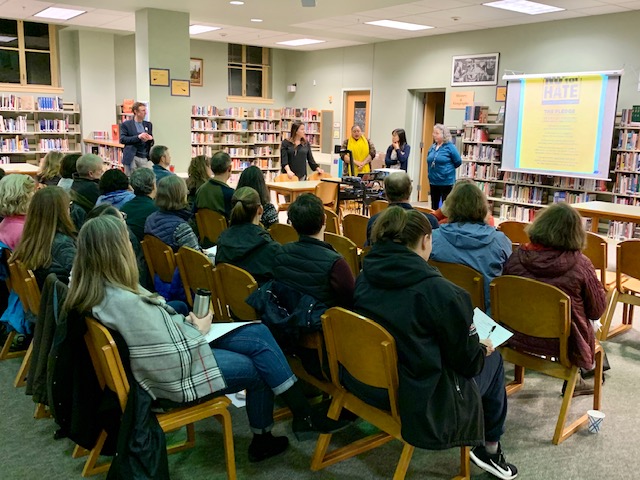
photo by Jason Grotelueschen
West Seattle HS families discuss racism, equity at workshop before ‘No Place For Hate’ school-wide launch
Before I get to the article allow me to say that the Bible tells us that the FIRST MURDER ever committed was by a brother against his own brother. The first murder was NOT a racial thing but a hatred of one brother against his own brother! In reality, Cain was really mad at God but he couldn’t do anything to God so he took out his hatred on his brother! That’s really what is at stake today in this racial issue. People are angry at God.
Now, we read that ‘Members of the West Seattle High School community gathered to participate in an “Undoing Racism and Teaching Equity to Teens” educational workshop led by Families of Color Seattle (FOCS).’ Now, to begin with here we have a group formed on the color of their skin! Hmm. I digress, ‘The workshop, held in the WSHS library last Wednesday night as part of the WSHS PTSA general meeting, was part of the school’s No Place for Hate program by the Anti-Defamation League, with a goal to “help establish and maintain a school environment where all students can thrive.” It’s being launched three months after a “school-wide positive response” was promised following incidents in which students were disciplined for “racist language and symbols.”
After a brief WSHS PTSA meeting to start the evening, the program was introduced by WSHS principal Brian Vance, along with WSHS Racial Equity Team members Angela Ferda, Amber Donaldson, Jennifer Hall, and Annie Zhou.
Vance noted that due to snow cancellations the prior week, WSHS had to postpone its original January 15 kickoff of the No Place for Hate program — they will now be introducing it to students and families on February 5 (during Black Lives Matter in School Week from February 3-7).’https://westseattleblog.com/2020/01/west-seattle-hs-families-discuss-racism-equity-at-workshop-before-no-place-for-hate-school-wide-launch/ Here we now have a BLACK LIVES MATTER school week!?
I am not saying there might not be something good in all this BUT the point is still it all begins at home and with the parents. Unfortunately, many homes do not have both parents living in the house along with other sins occurring within the house and so often these children simply mimic what they see and hear at home. One parent commenting on the situation at this school rightly said ‘But parents, this starts at home and it’s your responsibility to dig deep on this with your kids.’ This parent is so right!
Then at https://westseattleblog.com/2019/10/students-disciplined-for-racist-language-and-symbols-at-west-seattle-high-school/ the parent is introduced to BEYOND THE GOLDEN RULE. On pages four and five this pdf speaks to, ‘Parents As Teachers
I have a child of my own now, and my mother’s words come back to me. And I know
this: Teaching tolerance must begin with the Golden Rule, but it certainly does not end
there. Too often, simply advising a child to “do unto others as you would have them do
unto you” is insufficient.
There are times when we as parents must explain things that are painful and unfair
— racism, sexism, stereotypes, hate. Times when we must comfort our children, times
I have had to help my 10-year-old son learn that what some would do unto him isn’t
always kind or fair.
Like the day we stopped at a local carnival and I was forced to explain to him why
he could not have the small photo he had won while shooting darts — a caricature of a
bulldog against an image of the Confederate flag.
Or the Christmas he wanted an Easy Bake Oven and couldn’t understand why family members and friends balked at the notion.
Or why his elementary school’s “Indian” mascot — a feather-toting, stereotypical
warrior — was offensive and unacceptable.
Such moments have provided learning opportunities for my son and for me. Here’s
what I’ve learned:
Speak openly. When we are honest with children about our country’s history of bigotry, sexism and stereotypes, we help prepare them to challenge these issues when they
arise. A child who knows the racial history of the Confederate flag, for example, is less
likely to brandish that symbol out of ignorance.
Model equity. As parents, we are our kids’ first teachers. When it comes to teaching tolerance, actions speak louder than words. When you say that boys and girls are
equal but refuse to buy your son an Easy Bake Oven because it’s a “girls’ toy,” what message do you send?’ http://www.tolerance.org/sites/default/files/general/beyond_golden_rule.pdf
Did you discern the agenda in the above? No wonder home schooling is becoming more popular!
Psalm 25:4 Shew me thy ways, O LORD; teach me thy paths.
‘Racial literacies vs white supremacy – educating and researching together against racial silencing, racial violence and racial capitalism’ https://acrawsa.org.au/2019/10/27/racial-literacies-vs-white-supremacy-educating-and-researching-together-against-racial-silencing-racial-violence-and-racial-capitalism/
The following is an old but very relevant article from the Front Page Magazine August, 2016.
‘When a pair of black separatists recently murdered five police officers in Dallas and three others in Baton Rouge, they were aiming, by their own proclamation, to carry out righteous retribution against an American society which they deplored because of its deep-seated “white skin privilege,” a concept first popularized by Bill Ayers and his fellow Weatherman radicals who, in the early ‘70s, aimed to foment a violent race war against a supposedly Klan-like “Amerikkka.” Although their terrorist tactics and aspirations made the Weathermen a fringe group, their views on race proved, over time, to have legs. The notion of white skin privilege became an article of faith among progressives, accounting for everything that was racially wrong in America, beginning with its constitutional framework.
Even those liberals who initially resisted the concept of white skin privilege as a slander against a noble country that had just gone through an unprecedented civil-rights revolution, eventually embraced it to explain why racial disparities persisted even as overt racists vanished from public life and institutional barriers were toppled. Civil-rights professionals, meanwhile, were faced with yet another problem: how to remain relevant and prominent in an era when white racism was being dismantled and delegitimized in a manner never before seen in human history.
The common solution to these dilemmas was to depict the nebulous concept of “white skin privilege” as a thread woven so deeply into the fabric of American culture, that it could never be fully extracted; to claim that whites, no matter how earnest or well-intentioned, would never be able to truly shed the racism that infected their hearts. In other words, to claim that real racial healing could never occur, even in a thousand years, because whites, by definition and DNA, would remain racists, even if unwittingly, until the end of time.
Out of this mindset grew the academic field of Whiteness Studies—a.k.a. Critical Whiteness Studies—which first made its way onto college campuses in the early 1990s. And from its inception, this discipline bore no resemblance whatsoever to other group-identity-based curricula like Black Studies, Chicano Studies, and Women’s Studies. Whereas those fields steadfastly celebrated their respective groups and emphasized their status as innocent victims of societal oppression, Whiteness Studies depicted whites uniformly as malevolent oppressors of people with darker complexions. They weren’t Italians, or Brits, or Poles, or Germans—they were just depraved white miscreants, best known for their many crimes against humanity. As Jeff Hitchcock, the co-founder and executive director of the Center for the Study of White American Culture, said in 1998 at the Third National Conference on Whiteness: “There is plenty to blame whiteness for. There is no crime that whiteness has not committed against people of color. There is no crime that we have not committed even against ourselves…. We must blame whiteness for the continuing patterns today that deny the rights of those outside of whiteness and which damage and pervert the humanity of those of us within it.”
And absolutely nothing has changed in the field of Whiteness Studies in the years since then. Last fall, for instance, University of Colorado associate professor Amy Wilkins candidly explained that her Whiteness Studies class was in essence “an advanced course on racial inequality.”
The_ Oxford Research Encyclopedia of Education_ describes Whiteness Studies as “a growing body of scholarship whose aim is to reveal the invisible structures that produce and reproduce white supremacy and privilege.” Central to this definition is the notion that the average white person is largely unaware of his own racism, and that he must be helped to overcome the dreaded “ignorance of one’s ignorance” which prevents him from even recognizing “racism as a system of privilege” that benefits him at the expense of others.
The writings of feminist Peggy McIntosh are renowned in the field of Whiteness Studies, where professors and course readings often make reference to her famous metaphor of white skin privilege as an “invisible knapsack of unearned assets which I can count on cashing in each day, but about which I was ‘meant’ to remain oblivious.”
Whiteness Studies professor Lee Bebout of Arizona State University, for his part, says that “white supremacy makes it so that white people can’t see the world they have created.”
Not long ago, the University of Wisconsin–Superior sponsored an “Unfair Campaign” whose slogan—“It’s hard to see racism when you’re White”—was promoted aggressively via billboards, online videos, and posters. One poster showed a group of white students with the words “Is white skin really a fair skin?” written on their faces.
University of Wisconsin English professor Dr. Gregory Jay informs us that “Whiteness Studies is an attempt to think critically about how white skin preference has operated systematically, structurally, and sometimes unconsciously as a dominant force in American—and indeed in global—society and culture.” Moreover, he contends that telling white people that they’re racists whether or not they realize it, will ultimately foster interracial harmony: “I believe that Whiteness Studies must be part of the general effort to eradicate prejudice, bigotry, discrimination, and racism.”
With similar detachment from reality, Portland Community College claims that its annual “White History Month” initiative condemning the many evils of “whiteness” will help to “change our campus climate” for the better.
At Scripps College in Claremont, California, all incoming students receive a “survival guide” designed to alert the newcomers to the racism lurking quietly in the dark corners of white people’s hearts. One entry in this manual, titled “Dear White Students,” declares that “we as white students, must identify the ways that we are engaging in the perpetuation of white supremacy and work to unlearn our racism”; that racism is often manifested in “subtle ways through language” and “the perpetuation of white supremacist values like perfectionism [and] individualism”; that “reverse racism does not exist because there are no institutions that were founded with the intention of discriminating against white people on the basis of their skin”; that the “anger” of nonwhites “is a legitimate response to oppression, as is … a general distaste or hatred of white people”; that “we [whites] do not get to dictate how people of color respond to racism, nor do we get to delegitimize reactions that make us uncomfortable”; and that “our comfort is not more important than the safety of our peers of color.”
In other words, white students are advised to metaphorically lie down, belly-up, in contrite supplication, and to hold that pose for the remainder of their lives.
The common themes that run through all of the aforementioned programs and courses are Universal White Guilt on the one hand, and Universal Black Innocence on the other—flip sides of the same racialist coin. More than that, they are the twin centerpieces of the leftist mindset which aims to pit various groups of people against one another by dividing them neatly into oppressors and oppressed, victimizers and victims, evil and good. This tribal mentality, which sees human beings as members of mutually hostile groups rather than as individuals, is as contrary to the American ideal of individual rights and liberty as any mentality that has ever existed.
Moreover, it’s precisely this same tribalism which is promoted endlessly by the grievance mongers who constitute the Black Lives Matter (BLM) movement that inspired the gunmen who recently murdered those eight police officers in Dallas and Baton Rouge. And the college classroom—the very place where young people are routinely indoctrinated with the type of racist rhetoric that pervades the field of Whiteness Studies (as well as Black Studies, for that matter)—is where this tribalism is most likely to find minds that are receptive to it. As the _Washington Post_ puts it, BLM’s “strongest foothold may now be … the American university.” Given these sobering facts, a legitimate case can be made for the idea that much of the trillion-plus dollars in student-loan debt that young people have racked up, has been money that was entirely wasted.’ https://archives.frontpagemag.com/fpm/ugly-racism-whiteness-studies-programs-john-perazzo/


 whatyareckon