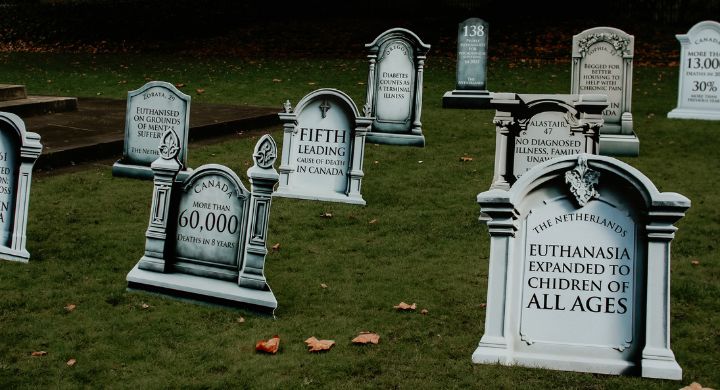
Each of the stories portrayed on gravestones during the demonstration were real-life testimonies of victims who had either lost their lives to euthanasia or were offered assisted suicide as a reasonable alternative to adequate support.
Alan Nichols (61) was euthanised in Canada. His only listed condition, and reason for seeking assisted suicide, was hearing loss. His family, left traumatised by his death, were convinced that he should have been supported to live rather than euthanised. Alan’s brother, Gary, stated that, “He was basically put to death … he needed some help from us, but he was not so disabled that he qualified for euthanasia.”
Godelieva de Troyer, a 64-year-old woman who had battled severe depression for years, was euthanised in Belgium without her family being properly notified or given a chance to ask her to reconsider.
In the Netherlands, after a long struggle with mental health and depression, 29-year-old Zoraya ter Beek was euthanised on the grounds of unbearable mental suffering that could not be remedied. Despite being physically healthy, she was not supported to live and overcome her depression but was rather encouraged that death was the only escape for her.
Revealing the justified distrust that legalising assisted suicide causes in patient-doctor relationships, after failed palliative care treatment in Belgium, Alexina Wattiez (36) died after her nurses smothered her with a pillow.
The following was received from the United Australia Party (UAP).
‘Covid jab warning’ – Paramedics told how to deal with side effects
It’s all starting to come out with regularity now. 2GB’s Ben Fordham reveals that the number of people presenting to hospital with chest pain has exploded post-COVID. Paramedics have even been given special instructions on how to deal with it.