Australia’s Prime Minister ‘Albo wants you to think the dangerous and divisive ‘Voice’ is just a feel-good virtue-signal that will make inner-city activists feel better about themselves … but the truth is hiding in plain sight.
And now the cat is out of the bag… the ‘Voice to Parliament’ is a TROJAN HORSE that threatens our democracy and would VANDALISE our Constitution.
Again, this is another admission that the Voice is not just an advisory body with symbolic power.
Instead, it is the first step in a total redesign of our democracy and constitution to disadvantage the average non-Indigenous voter because of their race.
…and, of course, the whole Labor party is on board.
This is an email received from the conservative ADVANCE.
‘Albo and the Labor party want you to think their referendum on the Voice to Parliament is just another woke virtue-signal.
They want you to think it’s merely a minor change to the Constitution … a “modest request”.
They want Australians believing that it’s nothing more than a small gesture to make our Indigenous brothers and sisters feel more included.
But it isn’t…
The Voice is a trojan horse the likes of which Australia has never seen…
The activists pushing for the Voice won’t tell you this, but Victoria has a version of it already legislated.
And right now, Melbourne’s mini-voice is demanding a “Black Parliament” – their words, not ours.
In 2019, Dan Andrews set up what became known as the First Peoples’ Assembly.
There to “represent Traditional Owners of Country and Aboriginal and Torres Strait Islander peoples in Victoria”, it has an “Elders’ Voice”, its own constitution, runs its own Indigenous-only elections and meets in the Victorian Parliament.
Its priority is to negotiate a “treaty” with the Victorian Government.
Using $65 million of Victorian taxpayers’ money, it’s pushing changes to Victoria’s democracy that will see power shift away from ordinary Victorian voters.
Victoria’s “voice” is open about the fact that “nothing is off the table, so we need to think big and push hard.”1
There is no exaggeration here.
These are some of the “First Peoples’ Assembly” specific goals for the treaty2:
Establishing a permanent representative body with meaningful decision-making powers – a “Black Parliament” of sorts.
Having a number of seats in the Victorian Parliament that members of the Aboriginal and Torres Strait Islander community vote for.
First Peoples oversight of the Victorian Government and public service for the benefit of First Peoples.
And the Andrews Government is backing them, saying in the announcement of the Treaty Framework3:
Treaty is a significant step towards transferring power and resources to First Peoples…
The Voice is not just about including our Indigenous brothers and sisters and giving them a say.
It’s about money and power, and changing our Constitution forever.
…and Albo is pretending it’s not a big deal.
The Voice to Parliament will divide us by race, it will threaten our democracy and – by looking at Melbourne’s mini-voice – we’re only just starting to see the real costs.’
‘Treasurer Jim Chalmers’ 6,000-word essay, recently published in left-wing publication The Monthly, shows conservatives were correct in predicting the Albanese Labor government would be a meddling, bigger-spending, anti-capitalist nightmare.
However, while there is an understandable temptation to label Chalmers’ love letter to big government as “socialism”, that’s not quite right.
It embodies something that could prove far worse.
Chalmers’ promise to “redesign markets for investment in social purposes, based on common metrics of performance” sounds innocuous.
As does his purported optimism that “2023 will be the year we build a better capitalism” that is “uniquely Australian”.
However, this supposedly better capitalism, or “values-based capitalism”, as he puts it, is not uniquely Australian.
It’s been virulently propagated internationally for decades by the likes of Klaus Schwab, founder of the World Economic Forum (WEF), under the banner of “stakeholder capitalism”, and is a core component of the WEF’s Great Reset initiative.
The Great Reset is a proposed alliance between big government and big business to “reset” the global economy post-pandemic, by pushing companies to adopt “Environmental, Social, and Governance” (ESG) policies as a condition of operation.
ESG policies are characterised by identity politics and radical climate action, and are determined in part by faceless, unelected corporate elites.
It’s not socialism; it’s neo-feudalism.
ESG policies are the “values” of Chalmers’ “values-based capitalism”.
We know this because his essay bears a striking resemblance to the type of stakeholder capitalism outlined in Klaus Schwab’s 2022 co-written book, The Great Narrative, a sort of sequel to his 2020 book The Great Reset.
This, for anyone who holds right-of-centre values, should be cause for alarm.
Chalmers describes a core component of values-based capitalism as enabling investors “to work out the climate-risk rating of a firm just as a lender can work out a credit-risk rating”.
“In 2023, we will create a new sustainable finance architecture, including a new taxonomy to label the climate impact of different investments. That will help investors align their choices with climate targets, help businesses who want to support the transition get finance more easily…This strategy begins with climate finance,” he continues.
Similarly, in The Great Narrative, Schwab says stakeholder capitalism “welcomes the idea of legislative action to define with precision the benchmarks for ESG reporting and performance”.
“In the same way that companies have an obligation to report their financial results…in the not-too-distant future they will have a similar obligation to report on ESG metrics… governments will make the last call for setting the legal obligations, targets and incentives around ESG standards.”
Ultimately, the purpose of both values-based and stakeholder capitalism is to justify politicians working with corporations to create big government policies, and insidiously exert the kind of control over markets and individuals that, in isolation, is unpalatable to your average voter.
This is the antithesis of democracy.
Jim Chalmers can claim all he wants that his values-based capitalism is the right thing for Australians, but he seems to forget that values are often subjective.
While he may believe that markets geared towards controlling citizen’s behaviour is a moral good, others (like me) believe this is – at best – overly stubborn.
Psalm 2:1 Why do the heathen rage, and the people imagine a vain thing? 2 The kings of the earth set themselves, and the rulers take counsel together, against the LORD, and against his anointed, saying, 3 Let us break their bands asunder, and cast away their cords from us. 4 He that sitteth in the heavens shall laugh: the Lord shall have them in derision.
‘Not even Kangaroo meat has been spared from the cost of living crisis currently gripping the nation.
The price of roo meat has soared from around $10 a kilo to almost $40 a kilo as a combination of wet weather, government regulation and a declining number of shooters puts pressure on supply.
A meat expert quoted in the Daily Mail said increased rainfall meant paddocks had become inaccessible to kangaroo shooters.
“This makes it extremely difficult to shoot and retrieve kangaroos without getting bogged,” he said.
He added that the difficulty in obtaining a government license to shoot kangaroos had put many shooters off the industry.
“To be a shooter you need to have a ute capable of carrying and processing carcasses,” he said.
“This means you need a tray and rack build made of stainless steel with wash-down facilities and all the other bits you’ll need to pass certifications.
“These can cost upwards of $25,000 to have built in some areas. Add in the cost of diesel at $2 per litre and you’ve significantly eaten into profit margins.”
Even the cost of bullets had increased exponentially, he said.
“It’s certainly not cheap to shoot. Throw in cost of licensing and the cost of kangaroo tags and it really becomes difficult to financially justify continuing as a kangaroo shooter.”
‘The Deep State is engineering a major energy crisis that may make life very difficult this winter across large parts of the Northern hemisphere, even in the United States, warns The New American magazine’s Alex Newman in this episode of Behind The Deep State. The emerging crisis was brought about through relentless Deep State sabotage of Western energy systems, including energy exploration and power plants, under the guise of “fighting climate change,” though even nuclear and hydropower are under attack by Deep State forces and their useful idiots. All over Europe, in large parts of America, and even in Japan, establishment media organs are warning that blackouts, brownouts and other problems are coming soon. The European Union is already working toward continent-wide, Soviet-style energy rationing. But the ultimate goal, as the Council on Foreign Relations put it in Foreign Affairs, is a new energy order in which governments will take total control of energy, thereby placing populations at the mercy of technocratic government while enforcing scarcity and outsourcing Western industry and manufacturing to Communist China.’
‘Major corporations including Telstra and Channel 10 have declared they will not celebrate January 26 as a national holiday.
Both organisations have advised staff they can choose to work on Australia Day and nominate another day of leave instead.
Network 10 created headlines earlier this week when they advised that Australia Day was “not a day to celebrate” for Indigenous Australians and staff were therefore free to celebrate the national day on a date of their own choosing.
An email sent to Network 10 editorial staff said: “We aim to create a safe place to work where cultural differences are appreciated, understood and respected. For our First Nations people, we as an organisation acknowledge that January 26 is not a day of celebration.
“We recognise that there has been a turbulent history, particularly around that date and the recognition of that date being Australia Day. We recognise that January 26 evokes different emotions for our employees across the business, and we are receptive to employees who do not feel comfortable taking this day as a public holiday.”
Meanwhile, a Telstra spokeswoman told the Daily Mail: “Our employees have the choice to work on Australia Day or take leave on another day.”
Other organisations to follow suit include Deloitte, KPMG and EY.
A KPMG spokeswoman said the company’s “cultural leave policy” meant that staff could celebrate Australia Day on a date that was “relevant to their culture” and “beliefs”.
Various local councils around Australia have boycotted Australia Day in recent years, arguing that it does not align with their values. But the move of corporations to boycott the national day is new.
January 26 is celebrated as Australia Day because it was on that day in 1788 that the First Fleet arrived at Sydney Cove and Governor Arthur Phillip raised a Union Jack flag on Australian soil.
Last week Prime Minister Anthony Albanese ditched a rule made by the Coalition government that forced councils to conduct citizenship ceremonies on Australia Day.
‘When Noah left the ark, God gave him the promise that he would never flood the entire world again. This promise is used as evidence that Noah’s Flood was indeed a global flood, for there have been many local floods since that time. If Noah’s Flood was just a large local flood, then what did God’s promise mean? God keeps his word; there will never be another global flood.
But, there is another promise which God gave to Noah that has been overlooked, forgotten. God promised Noah in Genesis 8:22 While the earth remaineth, seedtime and harvest, and cold and heat, and summer and winter, and day and night shall not cease.
In this time of paranoia over climate change, this is a promise that needs to be remembered. We can trust God to keep his word. God is the ultimate sustainer and provider. He has promised there will be cyclic seasons. Winter is his design, providing a cooling system for the earth that purifies the water and renews the soil.
God created winter by tilting the earth’s axis 23.5 degrees. Without a tilt, the entire earth would receive twelve hours of sunlight followed by twelve hours of darkness every twenty-four hours.
There would still be a temperature change depending on the distance from the equator. The polar regions would receive angled, not as intense, radiation from the sun and thereby stay cooler, while the equator would receive direct overhead radiation. It would be a gradient change without any extreme variations, so there would be no storms, strong wind, or snow. The equator would constantly be hot during the day and cool at night, while the poles would be cool but not freezing.
But, with the tilt, one pole is in total darkness while the other has total sunlight on a six-month rotating basis. Every year both poles experience winter followed by spring and summer, just as God promised. This polar summer sunlight is angled, not directly overhead, but it is constant without the cooling effect of night, so the heat gradually builds, and most of the ice and snow that accumulated over the winter melts by late summer.
Greenland, arctic sea ice, and Antarctica are the exceptions. Here the snow and ice accumulate over the years. Although there is some melting during the summer, as would be expected, most of it remains through the summer, only to be added to the following winter. Eight WWII planes that made an emergency landing in Greenland in July 1942 testify to just how quickly the ice can accumulate. Fifty years later, the planes were found buried under 260 feet of ice.
Interestingly, the 260 feet of ice consisted of thin layers, making it appear as if accumulation took place over thousands of years, not just 50.
In 1929, a world map was discovered in a Turkish palace. Drawn on gazelle skin and dated 1513, it shows the shoreline of Antarctica with detailed accuracy—a shoreline that today is hidden by ice. The map is the work of Piri Reis, a cartographer and admiral in the Turkish army. On the map, he documented the twenty earlier maps he had used when making this compilation. It would appear that since the flood, the ice on Antarctica has slowly accumulated until today the entire continent is buried under seven million cubic miles of ice.
But, there is no need to worry about melting ice causing the oceans to rise and earth’s coastline to flood. God has promised winter will follow summer. While ice melts at one pole, water freezes at the other. There is a balance in nature because God put it there.’https://thecreationclub.com/gods-promise-of-winter/
Net Zero and a rush into unreliable renewables is what got Australia into this mess. Next winter ought to be fun with these people running the show!!
‘Labor Cabinet ministers have slammed the gas companies for focusing on “maximising their profits” and halting major supply contracts following the government’s landmark response to soaring power prices.
The September Heads of Agreement deal which saw the gas companies commit to diverting all additional uncontracted LNG to the domestic market could be under threat.
In a shock response to the government’s $12/gigajoule cap on gas prices, Shell has paused its deal to sell 50 petajoules of LNG to energy providers as it “assesses the impact” of the proposed reforms.
The massive gas giant’s Queensland arm, QGC, was in the middle of an extensive tender process to contract the LNG for 2023/24.
“Pausing the EOI process was not an option we wanted to take, however, QGC needs to consider whether the design of the current EOI will meet the new regulatory requirements, including the 2023 price cap and the proposed mandatory Code,” a Shell spokesperson said.
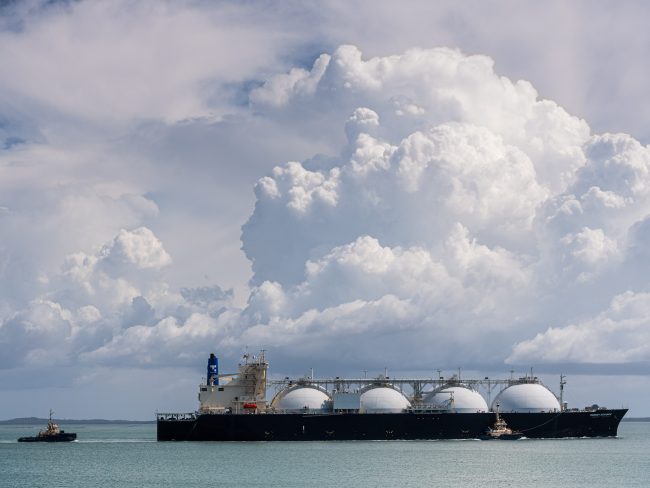
Shell has paused its tender process to sell 50 petajoules of LNG to Australian domestic market. Picture: NCA
But the government has unleashed on Shell and other gas companies threatening to withhold supply to the system.
Energy Minister Chris Bowen said while the company was focused on boosting profits, the government would “protect the Australian people”.
“Gas companies want high profits at the expense of industries at the expense of workers and industries,” Mr Bowen said on Tuesday.
“Shell is one of the most profitable companies in Australia and we don’t mind them making profits in their … gas exports, they can make as much profit as they want doing that, but Australians have a right to this gas at a fair price.
“The government will be acting in the national interest not in the interest of Shell, not in the interest of any gas company, in the interest of every Australian.”
The cost of gas has soared since the war in Ukraine, with the spot price hitting as high as $27/gigajoule compared to typical pre-pandemic prices hovering around $6/gigajoule.
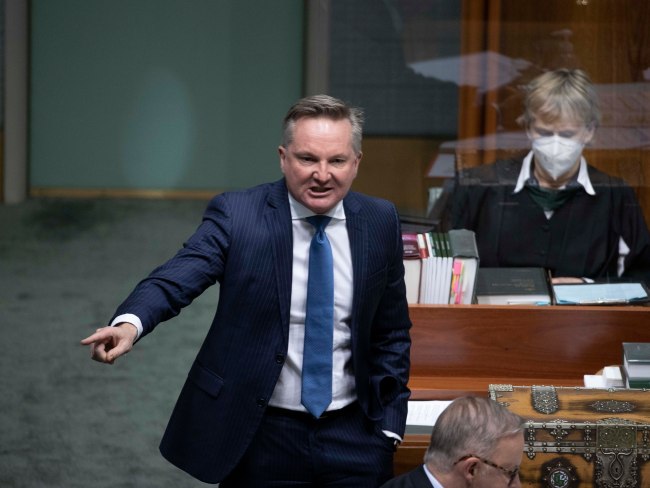
Energy Minister Chris Bowen accused the gas companies of receiving high profits at the “expense of workers and industries”. Picture: NCA NewsWire / Gary Ramage
As a result of the more than 140 per cent increase in the gas price year-on-year, industry giants Woodside has seen the share price jump by 57 per cent.
Fellow competitor Origin Energy has also seen its share price soar by more than 44 per cent this year and was another signatory to the September Heads of Agreement through its part ownership Queensland-based gas company APLNG.
Industry Minister Ed Husic warned the gas companies against pulling out of the landmark supply agreement as he questioned their claims over project sustainability.
“A lot of these players have made extraordinary profits, so, when these firms are making claims about the viability of projects, this is about them trying to maintain their profits in extraordinary times,” Mr Husic told ABC Radio National.
“For (energy companies) to claim this is a shock, or to threaten the nation, effectively, by saying they’ll walk away from a heads of agreement they walked into, I think they will need to consider their steps very carefully.”
Oil and gas company Woodside Energy joined Shell in warning the government its new caps on fossil fuels would create an “environment of uncertainty” which will see investment rapidly drop.
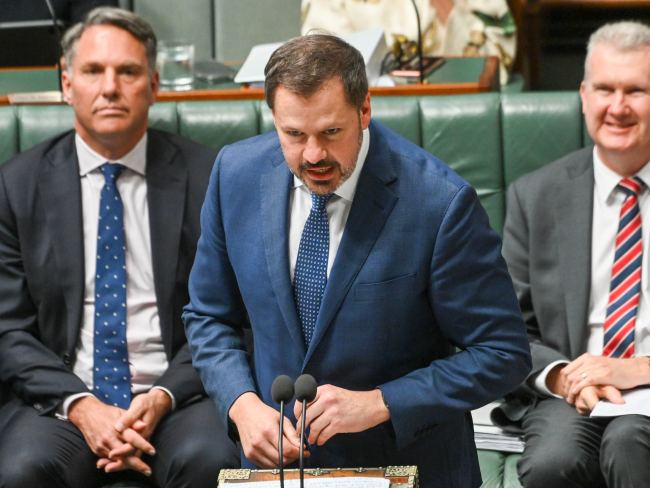
Industry Minister Ed Husic said the gas companies needed to “consider their steps very carefully” if the continued to threaten supply. Picture: NCA NewsWire / Martin Ollman
In a statement on Tuesday, Chief Executive Meg O’Neill said the industry’s ongoing investment was “crucial” to support the government’s renewable drive and added the government’s proposal failed to address falling supply.
“We need to unlock gas supply now. For example, Woodside has been looking at options to increase supply, including through new LNG import terminals, exploration spending and further development on the east coast,” Ms O’Neill said.
“Unfortunately, the proposed market intervention will make it very difficult for industry to economically invest to increase supply.
“No one wants to see energy shortages and gas rationing. We must develop a comprehensive, longer-term solution that addresses gas supply and reliability.”
The Albanese Government’s proposal to cap gas price, provide indirect energy bill relief and strengthen the consumer watchdog’s price monitoring capabilities will hit an emergency session of Parliament on Thursday.




 whatyareckon