Luke 2:1 ¶ And it came to pass in those days, that there went out a decree from Caesar Augustus, that all the world should be taxed. 2 (And this taxing was first made when Cyrenius was governor of Syria.) 3 And all went to be taxed, every one into his own city. 4 And Joseph also went up from Galilee, out of the city of Nazareth, into Judaea, unto the city of David, which is called Bethlehem; (because he was of the house and lineage of David:) 5 To be taxed with Mary his espoused wife, being great with child. 6 And so it was, that, while they were there, the days were accomplished that she should be delivered. 7 And she brought forth her firstborn son, and wrapped him in swaddling clothes, and laid him in a manger; because there was no room for them in the inn. 8 ¶ And there were in the same country shepherds abiding in the field, keeping watch over their flock by night. 9 And, lo, the angel of the Lord came upon them, and the glory of the Lord shone round about them: and they were sore afraid. 10 And the angel said unto them, Fear not: for, behold, I bring you good tidings of great joy, which shall be to all people. 11 For unto you is born this day in the city of David a Saviour, which is Christ the Lord. 12 And this shall be a sign unto you; Ye shall find the babe wrapped in swaddling clothes, lying in a manger. 13 And suddenly there was with the angel a multitude of the heavenly host praising God, and saying, 14 Glory to God in the highest, and on earth peace, good will toward men. 15 And it came to pass, as the angels were gone away from them into heaven, the shepherds said one to another, Let us now go even unto Bethlehem, and see this thing which is come to pass, which the Lord hath made known unto us. 16 And they came with haste, and found Mary, and Joseph, and the babe lying in a manger. 17 And when they had seen it, they made known abroad the saying which was told them concerning this child. 18 And all they that heard it wondered at those things which were told them by the shepherds. 19 But Mary kept all these things, and pondered them in her heart. 20 And the shepherds returned, glorifying and praising God for all the things that they had heard and seen, as it was told unto them.
John 3:16 For God so loved the world, that he gave his only begotten Son, that whosoever believeth in him should not perish, but have everlasting life.
As a born again Bible believing Christian I often wonder how unsaved people make it through life? Note the Christian’s help.
John 6:35 And Jesus said unto them, I am the bread of life: he that cometh to me shall never hunger; and he that believeth on me shall never thirst.
John 8:12 ¶ Then spake Jesus again unto them, saying, I am the light of the world: he that followeth me shall not walk in darkness, but shall have the light of life.
John 10:9 I am the door: by me if any man enter in, he shall be saved, and shall go in and out, and find pasture.
John 10:11 I am the good shepherd: the good shepherd giveth his life for the sheep.
John 11:25 Jesus said unto her, I am the resurrection, and the life: he that believeth in me, though he were dead, yet shall he live
John 14:6 Jesus saith unto him, I am the way, the truth, and the life: no man cometh unto the Father, but by me.
John 15:1 ¶ I am the true vine, and my Father is the husbandman.
“I will praise thee; for I am fearfully and wonderfully made: marvellous are thy works; and that my soul knoweth right well. My substance was not hid from thee, when I was made in secret, and curiously wrought in the lowest parts of the earth. Thine eyes did see my substance, yet being unperfect; and in thy book all my members were written, which in continuance were fashioned, when as yet there was none of them. How precious also are thy thoughts unto me, O God! How great is the sum of them! If I should count them, they are more in number than the sand: when I awake, I am still with thee.” (Psalm 139:14-18)
‘All of God’s creatures are fearfully and wonderfully made. Just look at the direct hand of God in the well-designed formation of a baby, as described in today’s passage.
Lamentably, Darwin’s Pandora’s box of death-based, anti-design, hit-and-miss ideology is alive and well in many origins teachings, conflicting with the theology that’s celebrated in this psalm. Regrettably, many believers are “evolutionized” in their thinking. They hold on to the vestiges of natural selection, which treats the chaos, mutations, and death that sin thrust into God’s originally “very good” creation as though they are the building blocks God used to create! Many have sold out to anti-design theory, evolution’s “center of gravity” for Darwinian ideology. In fact, natural selection’s broken randomness is counter to God’s “wonderfully made” design as depicted in Psalm 139.
We see the reverse of randomness as we view the marvelous Designer’s works. We must turn from past compromises and examine God’s ordered creation through the lens of Scripture, praising Yahweh’s wisdom, power, and genius, and proclaiming, “The heavens declare the glory of God; and the firmament sheweth his handywork” (Psalm 19:1).’https://www.icr.org/article/14121/
This is the first review of Dr. D. A. Waite’s 306 page book DEFENDING THE KING JAMES BIBLE. Doctor Waite is now in his 90’s and recently entered a nursing home. However, his love for and defense of the original texts underlying the King James Bible will never be forgotten by this preacher. May the Lord give us more D. A. Waites!
‘One of the fascinating things about maps is that they give us a bird’s eye view of God’s creation.
When we were filming at Cedarville University in 2021, Dr. John Whitmore pulled out a map of the Grand Canyon to provide some perspective on what he and Dr. Andrew Snelling accomplished on their research trip. (You can watch this in the video at the end of the post.)
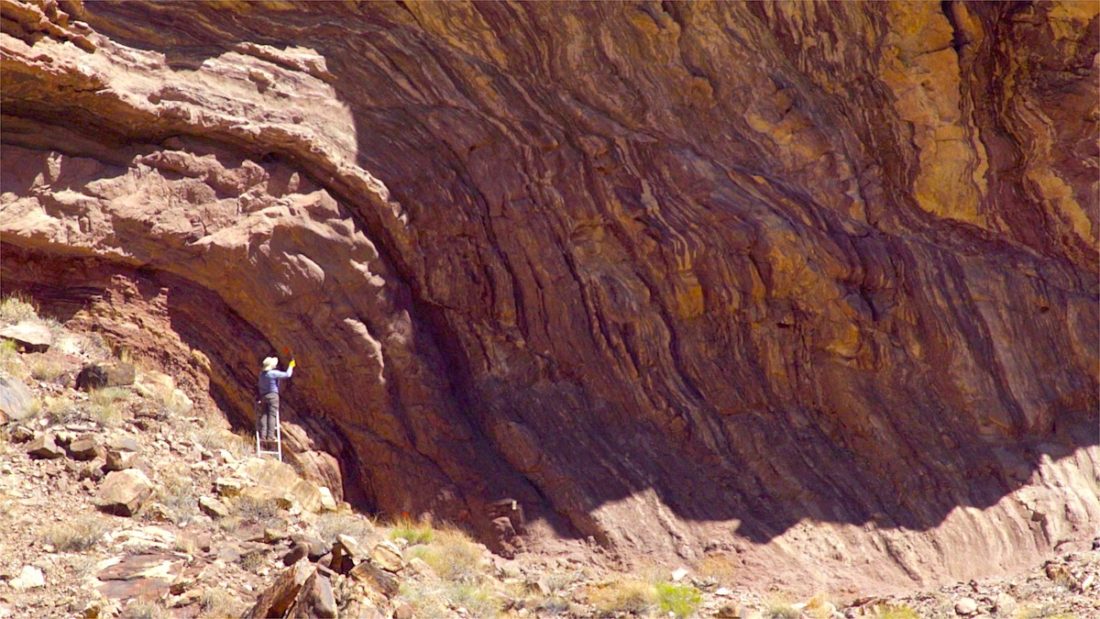
Dr. Snelling’s research provides the backbone for our upcoming film. In 2017, he and Dr. Whitmore traveled by boat down the Colorado River to collect a series of rock samples at different points in the Canyon. Their primary interest was understanding more about the enormous folded rock layers at the bottom of the Canyon.
DR. JOHN WHITMORE TAKES A SAMPLE AT MONUMENT FOLD.
‘The interaction of the angel with the shepherds was so engrained in the hearts and minds of the early church that Luke wrote that his record was “most surely believed,” that he had “perfect understanding,” from which Theophilus and subsequent readers might know “the certainty of those things.” If it was not God Himself who preserved the infallible, inspired word, how could the Church ever know with certainty that the events of Acts 2 ever historically transpired, and if the events did not transpire, then the written record of these non-events are spurious. So, let’s say for the moment, we discount the historic orthodox manner these verses have been rendered and consider what might be an empirical defeater to this paradigm for manuscript transmission?
There is no empirical evidence of this event except for the witness of the shepherds. Manuscripts at this point are meaningless. Luke, or someone calling herself “Luke” may have just recorded a happy story that became a wide-spread myth. This event cannot be supported scientifically. Indeed, this announcement can be easily erased simply by arguing that the author’s fabricated account was a local fable that found its way into the real Luke’s gospel. The whole Gospel is not spurious only the conflation that includes Luke 2:1-20. After all, what makes these verses any different that John 7:53-8:11? It’s all just words on parchment. Luke was not in the field with the shepherds, nor was anyone else to corroborate the event. Even if it did happen, how reliable are shepherds to accurately report something of this magnitude. The story sounds like something out of a bottle not of divine significance, kind of like “snake handling” in Mark 16, or maybe like an Aesop fable of wonder and amazement but not an actual inbreaking of heaven to earth.
Before you can argue transmission, you must agree or believe the event being recorded happened. Luke recorded an event of the angel’s announcement to the shepherds. Was there a moment in time when the Apostle John wrote 1 John 5:7? Was there a historic event when Christ interacted with the woman caught in adultery? Did Mark write the long ending? How many times did Mark’s heart beat before he completed the Gospel? Because special revelation is grammatical/historical, word and event, if there is no written record, there is no way of knowing whether the historic event happened; if the event is in the text, because it is God’s word, it did happen. The present critical reconstruction of the text reconstructs the past when the unchanging past has already limited the veracity of the record. The past did not manifest itself in two simultaneous, contradictory events. Text critics are not so much students of ancient literature as they are manipulators of time. Call the manipulation what you want, just not truth or the New Testament. Did redemptive history unfold in the Biblical record or did it not? Orwell was correct, “Who controls the past controls the future. Who controls the present controls the past.” By critically reshaping the past, the future has been the splintering of the Church with multiple modern bible versions, and it is the present information dominance of the evangelical text critic that continues to reshape the past.
The witness of the shepherds is confirmed by Anna and Simeon, and then by the Wise Men, and then by the Father, Holy Spirit, and John the Baptist at Christ’s baptism, then the ministry of Christ, his death, resurrection, ascension, Pentecost, the Apostolic message, and the founding of the Church based upon inspired writings. All of this either confirms the witness of the shepherds or we are witnessing a complete 1st century ruse. Indeed, much of the Church is about to reinforce this transgenerational ruse on Christmas Sunday if it is not believed that all the past events of Holy Scripture are forever, unchangeably settled. And the only means of exercising that kind of faith this Christmas is to believe that the Gospel record has been providentially preserved by God and based on the introduction to Luke’s Gospel to have “certainty” of those things through the Word and Spirit.
‘Often people ask does the King James Bible say Jehovah. More and more lately, thanks to the rise and popularity of internet “ministries,” people ask questions about the name of God due to doubts and errant teachings being spread online. So, it is valid to ask is Jehovah mentioned in King James Bible? The answer is Yes! The King James Bible says “Jehovah” in four separate verses:
Exodus 6:3 And I appeared unto Abraham, unto Isaac, and unto Jacob, by the name of God Almighty, but by my name JEHOVAH was I not known to them.
Psalms 83:18 That men may know that thou, whose name alone is JEHOVAH, art the most high over all the earth.
Isaiah 12:2 Behold, God is my salvation; I will trust, and not be afraid: for the LORD JEHOVAH is my strength and my song; he also is become my salvation.
Isaiah 26:4 Trust ye in the LORD for ever: for in the LORD JEHOVAH is everlasting strength:
There are also four places where “Jehovah” is part of a name and therefore is transliterated:
Genesis 22:14 And Abraham called the name of that place Jehovah-jireh: as it is said to this day, In the mount of the LORD it shall be seen.
Exodus 17:15 And Moses built an altar, and called the name of it Jehovah-nissi:
Judges 6:24 Then Gideon built an altar there unto the LORD, and called it Jehovah-shalom: unto this day it is yet in Ophrah of the Abi-ezrites.
Interestingly, there is another verse where the name of God is presented differently:
Psalms 68:4 Sing unto God, sing praises to his name: extol him that rideth upon the heavens by his name JAH, and rejoice before him.
In the King James Bible, most of the appearances of the Tetragrammaton (the four letter abbreviated name of God) are translated instead as “the LORD” instead of transliterated as “Jehovah.” It is likely that this was done out of respect for the Personal Name of God, since it only appears a total of seven times (including the three place names). This article from Chick Publications gives a short explanation and also responds to the “Jehovah vs. Yahweh” issue.
Many times, those who ask about the the name Jehovah are asking for other reasons: they are challenging the deity of Jesus Christ who IS Jehovah. This is a fundamental doctrine, the deity of Christ. The most obvious example of those who deny this truth are the “Jehovah’s Witnesses,” who take their name from Isaiah, assuming that they are witnesses for Jehovah God and not Jesus Christ (Acts 1:8).
Yet the Bible truth is that the King James Bible tells us Who Jehovah is! While the Jehovah’s Witnesses’ translation (the New World Translation) obfuscates the identity of Jehovah, the King James Bible makes it clear who He is:
Zechariah 12:10 And I will pour upon the house of David, and upon the inhabitants of Jerusalem, the spirit of grace and of supplications: and they shall look upon me whom they have pierced, and they shall mourn for him, as one mourneth for his only son, and shall be in bitterness for him, as one that is in bitterness for his firstborn.
Revelation 1:7 Behold, he cometh with clouds; and every eye shall see him, and they also which pierced him: and all kindreds of the earth shall wail because of him. Even so, Amen.
The NWT intentionally hides this clear cross reference to Jehovah who is speaking in Zechariah 12 (a monologue starting with verse 1) and Jesus who is speaking in Revelation 12. The NWT says “and they will look to the one whom they pierced.” Jehovah Himself was pierced with a spear (John 19:34, 37) on the cross. It was on the cross that God’s own blood was shed to purchase His church (Acts 20:28). So, is Jehovah mentioned in King James Bible? Yes! Not only that, but the King James Bible clearly indicates who He is: Jesus Christ is Jehovah, revealed to us.
There are many other ways to identify Who Jehovah is. When He first revealed Himself to Moses in the desert, He told Moses that His name was “I AM THAT I AM” and to tell Israel that “I AM” had sent Moses (Exodus 3:14). The idea here is that God is defining reality and temporal existence by His own being. This goes along with “For in him we live, and move, and have our being” (Acts 17:28) and “he is before all things, and by him all things consist” (Colossians 1:17; see also Hebrews 1:1-4). So, when Jesus was speaking to the Jews, who knew the Old Testament very well, He enraged them by saying “Verily, verily, I say unto you, Before Abraham was, I am” (John 8:58). He was identifying Himself as the “I AM” of Exodus 3:14, and they knew it, which is why they tried to stone him (John 8:59; 10:31-33).