
New testament
All posts tagged New testament
Baptist historian Thomas Armitage states “IN THE APOSTOLIC AGE, THE CHURCH WAS A LOCAL BODY; AND EACH CHURCH WAS ENTIRELY INDEPENDENT OF EVERY OTHER CHURCH. The simple term ‘Ecclesia’ designates one congregation, or organized assembly, and no more, this being its literal and primal meaning.” Page 28 of A History of the Baptists, VOLUME 1, Thomas Armitage
The New Testament knows nothing of the monsters man has organized such as the Southern Baptist Convention. When Paul wrote 1 and 2 Corinthians it was to a local New Testament church. In the first letter he wrote to that church he had something to say concerning a born again baptized church member going to law against another member of the same local New Testament church. Here is what he wrote. 1Corithians 6:1-8 Dare any of you, having a matter against another, go to law before the unjust, and not before the saints? 2 Do ye not know that the saints shall judge the world? and if the world shall be judged by you, are ye unworthy to judge the smallest matters? 3 Know ye not that we shall judge angels? how much more things that pertain to this life? 4 If then ye have judgments of things pertaining to this life, set them to judge who are least esteemed in the church. 5 I speak to your shame. Is it so, that there is not a wise man among you? no, not one that shall be able to judge between his brethren? 6 But brother goeth to law with brother, and that before the unbelievers. 7 Now therefore there is utterly a fault among you, because ye go to law one with another. Why do ye not rather take wrong? why do ye not rather suffer yourselves to be defrauded? 8 Nay, ye do wrong, and defraud, and that your brethren.
Nevertheless man too often has set up organizations such as the SBC which has its children such as the North American Mission Board. The following pdf is a result of man’s ways.
Trinitarian Bible Society Conference 11 Nov 2022. speaker Rev Christian McShaffrey
2Corithians 9:6 But this I say, He which soweth sparingly shall reap also sparingly; and he which soweth bountifully shall reap also bountifully. 7 Every man according as he purposeth in his heart, so let him give; not grudgingly, or of necessity: for God loveth a cheerful giver.
‘In two recent Sunday sermons Televangelist Creflo Dollar preached against tithing based on fear and guilt. On July 3rd, Dollar told his congregation, “I would argue that tithing isn’t required or even encouraged for believers in Jesus Christ…”
Instead, Dollar is now preaching that Christian giving should be based on gratitude.
Dollar made a surprising announcement in his June 26th, sermon titled “The Great Misunderstanding” about how his beliefs on tithing changed.
“I want to start off by saying to you that I’m still growing and that the teachings I’ve shared in times past on the subject of tithing were not correct. And today I stand in humility to correct some things I have taught for years and believed for years, but could never understand it clearly because I had not been confronted with the Gospel of grace, which has made the difference.
I won’t apologize ’cause if it wasn’t for me going down that route, I would have never ended up where I am right now. But I will say that I have no shame at all saying to you throw away every book, every tape and every video I did on the subject of tithing, unless it lines up with this.”
While Dollar’s rejection of fear-based giving is welcome, a lot of questions remain, and Trinity Foundation investigators wonder if Dollar is simply changing his message to appeal to a larger audience.
Yes, consider us skeptical. If a preacher is unwilling to apologize for leading people astray, does he really “stand in humility” as Dollar claimed?
If Dollar really wants to change course, he should abandon his extravagant lifestyle and also embrace financial transparency with accountability.
Dollar currently owns two jets registered to a shell company named World Heir (seriously?!): a Gulfstream G-IV and Learjet 60.
Creflo and Taffi Dollar own two expensive homes very close to each other. According to real estate website Redfin the properties are worth about $5.7 million.
Dollar should also explain to his congregation all of his business dealings in foreign countries. In March 2006, Dollar established YBC Limited and The Change Association Limited in the Bahamas. What is the purpose of these offshore entities? Have they been used in international money laundering?
Preachers must do more than just preach accurately about money. They should live a godly lifestyle that doesn’t contradict Scripture. Dollar, are you listening?’https://trinityfi.org/investigations/televangelist-creflo-dollar-preaches-against-tithing-were-doing-a-double-take-on-this-one/#more-2420
‘What chapter or verse of the Bible says there will be 27 books of the New Testament? Of course, none. Where does it say what the 27 books will be? Again, of course, none. How then do we know what are the 27 books of the New Testament?
When we read the New Testament, we open about two-thirds of the way through the Bible to that title page that says “New Testament” on it. The churches that received scripture were not sent such a copy. The New Testament did not come to churches with a cover page, stating, “New Testament,” and behind it 27 books.
Churches acknowledged and copied inspired books. They treated them as though they were inspired. They passed them from church to church and read then in churches. Before copies wore out, they were copied again to preserve them for the future.
The scriptural doctrine of which I speak concerning canonicity proceeds from the Bible itself. Through the inward testimony of the Spirit, regenerate, immersed church members distinguish between words which man’s wisdom teaches and those of and from the Holy Spirit (1 Corinthians 2:13-25). God gave His inspired Words to the apostles or the inspired human authors according to the plan of the Lord Jesus Christ through the Holy Spirit (John 14:26, 15:26, 17:8, 14; Gal 1:11-12). True believers led by the Spirit would know the things written were the words of God (1 Corinthians 14:37). The same Holy Spirit who had regenerated, indwelt, and filled them would testify to the words.
The testimony or witness of books of the New Testament arises from the promise of words. They knew Paul’s epistles were scripture like the Old Testament (2 Peter 3:16), but they were guided to inspired words. The epistles or books were an implication of received words. The Lord gave unto them “words” and they “received them” (John 17:8; cf. 12:48, Acts 2:41, 1 Thess 2:13).
Revelation 22:18-19 read:
18 For I testify unto every man that heareth the words of the prophecy of this book, If any man shall add unto these things, God shall add unto him the plagues that are written in this book: 19 And if any man shall take away from the words of the book of this prophecy, God shall take away his part out of the book of life, and out of the holy city, and from the things which are written in this book.
The Apostle John testifies to a completed book of Revelation. He speaks of “the words of the prophecy of this book.” He confirms a settled, completed, perfect text of words. One could only add or take away words from a book with a settled text. His instruction assumes the precision of the text and continued knowledge of it. No one could obey this command without standardized words.
God’s people will know what His Words are and receive them. That is how they knew and know the twenty-seven books. God intervenes through His Spirit in His churches to receive His Words and, therefore, His Books. History confirms this teaching. The nature of God’s Word is that when God says He will do something, He does it. His sheep hear His voice and follow Him. They believe what He says. They have.
Through the history of the Lord’s churches, they believed the biblical doctrine of canonicity or the preservation of the text and books of the New Testament. Errors were made in copies, what are most often called variants today. God did not promise to preserve copies. Believers do not receive copies. They receive “words.” They identify words. True churches assume a settled text. They have.
The Lord’s churches now call the text, the words and books, received and passed down from one generation to the next by the work of the Holy Spirit, the received, traditional, ecclesiastical, or standardized text. By “traditional,” they mean it like Paul used it in 2 Thessalonians 2:15, “Therefore, brethren, stand fast, and hold the traditions which ye have been taught, whether by word, or our epistle.” It is an ecclesiastical text, because churches received it. Some today call this a “confessional bibliology,” because it reflects the historical belief of churches and so written down in confessions.
Scripture is scientific. If God says it, it is true and it is knowledge. It is the pure mother’s milk without variableness or shadow of turning (1 Peter 2:2, James 1:17). Everything God says is true and is the standard for truth (John 17:17). God repudiates rejection of what He said for so-called science or for experience. We have a more sure word of prophecy (2 Peter 1:19-21).
The Lord’s churches received the text still received by His churches before the invention of the printing press. With the invention of the printing press in 1440, they printed that text in the 16th century. They continued to receive it for centuries. These people translated from it into other languages. They preached sermons from it in churches and wrote commentaries and other books from it or based upon it. We have all of this record.
No one should add to or take away from the settled text of the New Testament. This contradicts the teaching of the New Testament about itself. No one should assume and then believe God’s Words were lost and in need of restoration. This violates scripture. This hurts the faith.
Professing believers today do not know the New Testament by science. They do not know it by probability. God’s people do not know it by rules of textual criticism. They do not know it by intelligibility. The people of God know it by the testimony of the Holy Spirit through history or through the preceding centuries through the Lord’s churches. They should reject any other teaching or way. These are heretical ways that distort or veer from the already received and established scriptural bibliology.https://kentbrandenburg.com/2022/06/22/how-do-we-know-what-the-new-testament-is/
1Corinthians 16:2 Upon the first day of the week let every one of you lay by him in store, as God hath prospered him, that there be no gatherings when I come.
2Corinthians 9:7 Every man according as he purposeth in his heart, so let him give; not grudgingly, or of necessity: for God loveth a cheerful giver.
The following article concerns Willow Creek inviting Robert Morris from Gateway Church, Dallas, Texas to preach. The controversy is that some believe Morris preaches a prosperity Gospel. Willow Creek’s Tim Stevens however ‘…said Willow is spreading the word about God’s miraculous provision — not a prosperity gospel.’
Nevertheless, Robert Morris and his church are connected with Pentecostal preacher Jack Hayford https://www.tku.edu/about-tku/gateway-church/ and most prosperity preachers are within the Pentecostal movement.
Amos 3:3 asks ‘Can two walk together, except they be agreed?‘ Now Robert Morris and Pentecostal Jack Hayford seem to have a very close relationship as ‘Dr. Hayford serves as an apostolic elder of Gateway Church’. Hayford is associated with the Foursquare Pentecostal Church which encourages the speaking in tongues https://www.wayoflife.org/reports/beware_of_jack_hayford.html. Willow Creek must not have a problem with this either.
So, ‘Facing persistently lower giving, Willow Creek Community Church last Sunday invited Pastor Robert Morris, who some allege is a prosperity preacher, to deliver a guest sermon on tithing. The sermon contained a singular promise: Tithe for a year, and if you’re not satisfied, you’ll get your money back.
“Thousands and thousands” had seen their lives changed after starting to give 10% of their income regularly, Morris said. “I’ve done this with our church. I’ve told our church on multiple occasions, I’ve said to them, if you’ll try it for one year, if you are not fully satisfied at the end of that year, I’ll give you your money back. In 22 years of church no one’s ever asked for money (back).”
Morris is pastor of Gateway Church, once the largest congregation of the Association of Related Churches (ARC) in the United States. (It’s no longer listed in the ARC’s church finder.) He also is one of disgraced pastor Mark Driscoll’s staunchest supporters.
Morris was the first to replatform Driscoll after the Mars Hill debacle in 2014. And just last summer, Morris had Driscoll speak at an ARC preaching seminar at Gateway Church.
When asked about Morris’ money-back guarantee, Willow Creek Executive Pastor Tim Stevens said Willow is spreading the word about God’s miraculous provision — not a prosperity gospel.
Stevens confirmed that Willow Creek’s average weekly giving so far this year is 20% below the church’s already reduced budget. This year’s giving budget is about half the church’s revenue in 2019, when investigators said sexual misconduct allegations against Willow Creek’s founder Bill Hybels were credible. But he said giving so far this year is on par with last year’s weekly giving average.
Stevens told The Roys Report that the church budgets the same amount of revenue for every week—about $614,000 across seven campuses. However, he noted, “the reality is that a larger percentage of our giving happens at the end of the year.”
Critics, however, say that though Morris has a softer sell, he still preaches the same health and wealth gospel of prominent prosperity preachers like Kenneth Hagin. “Hagin had no problem telling you that God wanted him to be rich,” write Paul and Susan Dunk of KW Redeemer Church in Breslau, Ontario. “But Morris softens it and prefers blessed.”
They add that Morris’ teaching on tithing is more like “pagan votive offerings” than the voluntary giving encouraged in the New Testament. “If you needed health, wealth, crops, love, wisdom etc . . . you would go to the temple and give money to the corresponding gods of those blessings,” the Dunks write.
Theology professor and Pastor David Schrock likewise called Morris’s beliefs about material blessing a “misreading of Scripture” in a critical review of Morris’s book “The Blessed Life.”
“Instead of grounding God’s character and promises in the new covenant of Christ, Morris makes God a self-styled miracle-worker who promises supernatural power,” Schrock wrote.
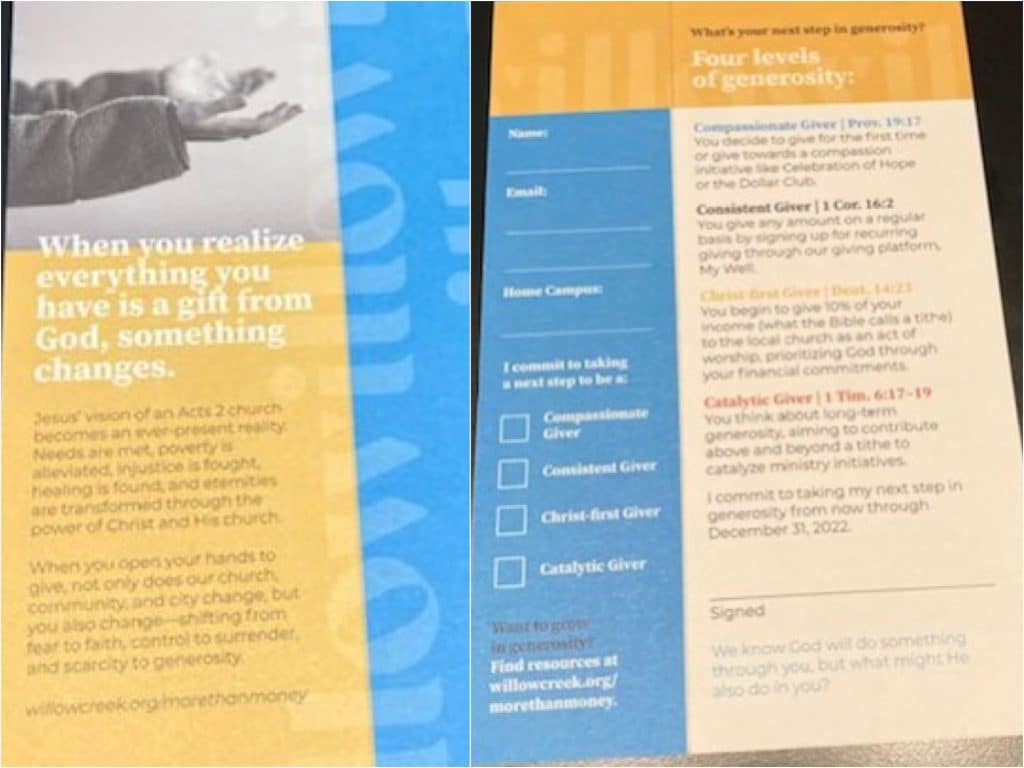
Morris preached Sunday on “The Principle of First” as part of Willow Creek’s five-part sermon series “More Than Money.” The series coincides with a major giving campaign underway now at Willow Creek.
“This series aims to help people understand that money is not a financial issue, it’s a discipleship issue and a matter of the heart,” the series summary reads in part.
Morris’s money-back promise was mentioned only in an unlisted video recording of the 9 a.m. service. It’s absent from the sermon video published on Willow Creek’s website, which was apparently drawn from the “full service” recording of the 11:15 a.m. service.
In the 9 a.m. service, Willow Creek Pastor Dave Dummitt made the same promise as he held up a commitment card for the church’s current giving initiative.
Dummitt encouraged congregants to consider pledging to be “Christ-first givers”— the third of four giving options the church is asking congregants to commit to. Then he told the audience he’d “go ahead and be bold and say, if you do this for the year, and you are not fully satisfied, we’ll give the money back.”
“I like that challenge. It’s good,” Dummitt added.
Stevens said Dummitt had offered something similar at his previous church, but his decision to challenge Willow Creek came spontaneously. Leadership decided the idea “needed some time to bake” so it wasn’t mentioned in the later service, Stevens said. However, the challenge is being developed now and could be formally announced as soon as this weekend.
Stevens denied that the money-back challenge constituted a “prosperity gospel” message.
“Any time that my wife and I have stretched in our giving, God has out-given us in return,” Stevens wrote in an email to The Roys Report. The old car lasted longer, he offered as an example, or the tax return was big enough to cover a surprise bill.
“God meets a need in some miraculous way that we didn’t see coming,” Stevens continued. “I think that was the intent of what our guest preacher was communicating, and what Dave was affirming. Willow does not, and never has, held a position that says God will make you rich if you commit your finances to the church.”
When asked about Morris’ longstanding support of Driscoll, Stevens wrote that Willow Creek tries “to shy away from ‘guilt by association’” when inviting guest speakers.
In addition to repeatedly platforming Driscoll, Morris was formerly an overseer at Driscoll’s new church, The Trinity Church. A spokesman for Morris previously told The Roys Report that Morris remains available if Driscoll’s church needs counsel.
Last August, Driscoll was featured alongside Morris as a speaker at a preaching seminar Gateway and Morris hosted.
Stevens pointed out Willow Creek has recently invited other speakers. Some of them could be considered controversial.
“In the last year we’ve had John Maxwell, Derwin Grey, Gene Appel, (Immanuel Acho), and others,” Stevens wrote. “Having them, and others, on our platform does not mean we endorse 100% of their theology, associations, or partnerships, but rather that we believe they can help us encourage our people to love God, love people, and change the world through teaching a specific topic on a given weekend.”’https://julieroys.com/giving-push-willow-creek-robert-morris-offer-tithe-refund/?mc_cid=80c8070c03&mc_eid=b13d34ad49
Jamess 2:23 And the scripture was fulfilled which saith, Abraham believed God, and it was imputed unto him for righteousness: and he was called the Friend of God.
I don’t think you would have caught Abraham at a BLM protest. However, ‘A group of Jewish Americans who showed up in solidarity of the Black Lives Matter movement in Philadelphia were taunted and assaulted by rioters, according to a video circulating on social media.
The protestors told the Jewish men to “get the f*** out of here” and one Jewish man was shoved by a protester as he tried to leave.
The man, who seems to be the one videoing the scene, calls the Jewish men “Amalek.”
“Amalek! Amalek! What y’all doing down here,” he says.
‘Amalekites’ are considered enemies to Jews within Jewish tradition.
One of the Jewish men responds that they were “just showing solidarity,” to which they received hostile responses to “get your white a** [on] home” and “Amalek ‘bout to get trashed, cuz.”’https://www.foreigndesknews.com/jewish-americans-supporting-blm-taunted-and-assaulted-by-protestors/

Nonconformist Matthew Henry wrote concerning the 45th Psalm and our Saviour that ‘There is more in Christ to engage our love, than there is or can be in any creature. This world and its charms are ready to draw away our hearts from Christ; therefore we are concerned to understand how much more worthy he is of our love.’
‘“All thy garments smell of myrrh, and aloes, and cassia, out of the ivory palaces, whereby they have made thee glad.” (Psalm 45:8)
Psalm 45 is one of the Messianic psalms, quoted as such in Hebrews 1:8-9. The section so quoted (vv. 6-7), which immediately precedes our text, begins with one Person of the Godhead addressing the Messiah also as “God,” whose throne is eternal. Then, He says, “Oh God, . . . thy God hath anointed thee with the oil of gladness above thy fellows.” The “oil of gladness” was the holy oil used for the anointing of priests and kings and was compounded of a mixture of spices that included myrrh and cassia (Exodus 30:22-25). Since the Messiah had been anointed to be “above his fellows” (first as High Priest, then as King of kings), “all his garments” would bear the sweet aroma of the holy ointment.
At the birth of Christ, His garments were “swaddling clothes,” and the gifts of the eastern wise men included a supply of myrrh and frankincense (Luke 2:7; Matthew 2:11). At His death, they gave Him to drink “wine mingled with myrrh [and] . . . parted his garments” (Mark 15:23-24). Then once again His body was wrapped in linen clothes and anointed with myrrh and aloes (John 19:39-40) for His burial.
The psalmist sees Christ (i.e., “Messiah,” both Greek and Hebrew titles meaning “the Anointed One”) emerging triumphantly from the “ivory palaces.” These mansions with their ivory walls and pearly gates are of shimmering white beauty in the distant heavenly city that will someday descend to Earth (Revelation 21:2, 10-21).
The Lord descended once from these ivory palaces to take on human flesh in Mary’s womb, thence to a burial in Joseph’s tomb. But someday He will again come forth, anointed as eternal King, and then “shall the people praise thee for ever and ever” (Psalm 45:17).’ https://www.icr.org/article/11515


 whatyareckon