Matthew 10:24 “The disciple is not above his master, nor the servant above his lord.”
‘As Christians, and especially as Christian parents, many of us have negative comments to make about what happens in school science lessons. In so many areas, it is often easier to criticize and break down than to build up something new. Many years ago, I came across a fascinating yet simple curriculum model idea that would be of considerable help in many Christian education situations.
In their book, Fighting the Secular Giants, Stephen Thomas and David Freeman outline their ideas for a so-called Trinity Curriculum Model. The three-part framework sees the Father as the source of all things, Jesus as the means of demonstrating God’s love to the world, and the Spirit as the fulfillment. Thomas and Freeman are wise enough to state that this is not an analogy of the Trinity because analogies of the Trinity always fall short of the full Trinitarian doctrine.
For example, suppose we are teaching children about the water cycle. The source concept is that God is the provider of all the water needed for creation. The water cycle therefore reveals God’s wise provision. The means would be the usual experiments about the water cycle, boiling water, condensing the steam, building charts, diagrams, and maps of the process. The fulfillment will be to see how much each student has learned about the process, especially that they have understood what this tells us about God.
Princeton was once a great “Christian” educational institution sending out preachers and missionaries with the Gospel of the Lord Jesus Christ. Today’s Princeton is WOKE.
‘ When selecting suppliers, competition is a best practice and provides opportunities for diverse firms to compete for, and win, University business. As part of the University’s Supplier Diversity commitment, a national database of diverse suppliers, called Supplier Explorer, is now available to all Princeton University faculty and staff. Supplier Explorer is the largest, most complete database of certified minority-owned, woman-owned, LGBT owned and veteran-owned businesses in the country. Explorer pulls diversity information from hundreds of certifying organizations like states, municipalities and third-party certifiers, into a single, searchable database of supplier information.’ https://finance.princeton.edu/sites/g/files/toruqf151/files/documents/Princeton%20General%20Ledger%20Newsletter%20November%202021_2.pdf
When school boards promote filth what may one then expect from the students? Garbage in; Garbage out!
‘Waukee Northwest High School has another book containing sexually explicit messaging. The district previously decided to pull “Gender Queer” from the school library due to its vulgar content, which Google calls adult sexual content and Facebook says violates its community standards for sexual activity.
The world of WOKE will not stop its insidious ruin of all professions including archaeology!
‘As soon as ancient human remains are excavated, archaeologists begin the work of determining a number of traits about the individual, including age, race and gender.
But a new school of thought within archaeology is pushing scientists to think twice about assigning gender to ancient human remains.
It is possible to determine whether a skeleton is from a biological male or female using objective observations based on the size and shape of the bones. Criminal forensic detectives, for example, do it frequently in their line of work.
But gender activists argue scientists cannot know how an ancient individual identified themselves.
“You might know the argument that the archaeologists who find your bones one day will assign you the same gender as you had at birth, so regardless of whether you transition, you can’t escape your assigned sex,” tweeted Canadian Master’s degree candidate Emma Palladino last week.
Palladino, who is seeking an advanced degree in archaeology, called assigning gender to an ancient human “bullshit.”
“Labelling remains ‘male’ or ‘female’ is rarely the end goal of any excavation, anyway,” wrote Palladino. “The ‘bioarchaeology of the individual’ is what we aim for, factoring in absolutely everything we discover about a person into a nuanced and open-ended biography of their life.”
She is not alone. Gender activists have formed a group called the Trans Doe Task Force to “explore ways in which current standards in forensic human identification do a disservice to people who do not clearly fit the gender binary.”
“We propose a gender-expansive approach to human identification by combing missing and unidentified databases looking for contextual clues such as decedents wearing clothing culturally coded to a gender other than their assigned sex,” the group’s mission statement reads.
“We maintain our own database of missing and unidentified people who we have determined may be Transgender or gender-variant, as most current database systems do not permit comparison of missing to unidentified across different binary sex categories,” the group writes.
This February, University of Kansas Associate Professor Jennifer Raff published “Origin: A Genetic History of the Americas,” in which she argued that there are “no neat divisions between physically or genetically ‘male’ or ‘female’ individuals.”
Raff (pictured) suggested scientists cannot know the gender of a 9,000 year-old biologically female Peruvian hunter because they don’t know whether the hunter identified as male or female – a “duality” concept she says was “imposed by Christian colonizers.”
Raff did not respond to a request from The College Fix to comment.
Some archaeologists push back at the effort to de-gender human remains.
San Jose State archaeology Professor Elizabeth Weiss told The Fix that eliminating gender classifications amounts to “ideologically-motivated fudging.” Weiss said there is a move among academics “toward getting all of the academy’s favored shibboleths to accord with one another.”
Weiss said the recent explosion in the number of people identifying as transgender suggests that trend is “social and not biological,” so “retroactively de-sexing obscures this obvious fact.”
She noted that applying biological sex to remains often helps dispel myths detrimental to women.
“Some early anthropologists sometimes mistook some robust female skeletons as male skeletons, particularly in the Aleut and Inuit collections; this reinforced false stereotypes that females were not as hard working as males,” she said. “Over time, biological anthropologists and archaeologists worked hard to determine which traits are determined by sex, regardless of time and culture. This new policy of erasing this progress is a step back for science and women.”
“Sexing skeletal remains is a critical skill in forensics and any diminishing of this skill will negatively impact criminal investigations, denying the victims and their families justice,” she said.
Weiss is currently suing her school for locking her out of its human remains collection, which she says is retribution for her position opposing the repatriation of human remains.
Weiss is joined by University of Cambridge scholar Jennifer Chisolm, who has argued analyses that posit transgender individuals played a large part in Indigenous populations are often ahistorical, and can even distract “from the contemporary discrimination [such individuals] face within their own communities.”
Gender politics are not the only ideology to work its way into anthropology and archaeology. Some activists have called for scientists to cease classifying remains by race, as well.
“Forensic anthropologists have not fully considered the racist context of the criminal justice system in the United States related to the treatment of Black, Indigenous, and People of Color; nor have we considered that ancestry estimation might actually hinder identification efforts because of entrenched racial biases,” Elizabeth DiGangi of Binghamton University and Jonathan Bethard of the University of South Florida wrote in a study released in January.
“Ancestry estimation contributes to white supremacy,” DiGangi and Bethard wrote, labeling the practice “dangerous.”
Others have called for changing primate names that were derived from white white men from the northern hemisphere. The activists argue that continuing to use the current names is “perpetuating colonialism and white supremacy.”
This article is quite lengthy but well worth the read so just click the link and enjoy the rest of this inspiring testimony.
‘He never desired to be an educator, this remarkable man whose distinguished academic career spanned 68 years and eight decades. And yet, as Dr. David R. Boylan turns 100 on Friday, July 22, 2022, he is still teaching to anyone who will lend a listening ear. And he is still brilliant.
“I never expected, intended, or even thought about being in education,” said Dr. Boylan in a recent interview with Faith Baptist Bible College. “I was an engineer. I had no idea I was going into teaching.”
Boylan excelled in his career, both in research and in teaching. An oil canvas photo of him as the sixth dean of the College of Engineering at Iowa State University hangs in the conference room of Marston Hall as evidence. Advancements in the fields of fertilizer and agriculture are results of his extensive research and patents. The changed lives of those who sat under his teaching in his college Sunday school class are living testimonies. And Faith Baptist Bible College and Theological Seminary in Ankeny, Iowa, has a 100-year legacy of its own whose longevity can be partially credited to the contributions of Dr. Boylan as a former president, faculty, and board member.
An oil canvas painting of Dr. Boylan (left) hangs in the conference room of Marston Hall, Iowa State University
Early Years
David Ray Boylan was born in Belleville, Kansas, a city of 2,000 people located 155 miles northwest of Topeka near the Nebraska border. His father, an accomplished man in his own right, was an Air Force major who flew combat missions in World War I. The Boylans moved from Belleville to Kansas City early in David’s life, and he spent the majority of his childhood there.
“My young career, I picked up the idea of building things, mechanical things,” said Boylan. “I remember as a young kid in Belleville, Kansas, (I was a little kid), they dug the ditches for the pipelines by hand. I noticed they were using tree limbs to clean their shovels out, so right then, I made little shovels out of orange crates. That was the only place I could get some wood as a kid. I guess I had a desire to do things and that grew. Even until now, I still like engineering.”
Boylan accepted Christ when he was in his early teens. Both his mother and father were Christians, and he was raised in a Christian home. They attended a Baptist church in Kansas City during most of his teenage years and later attended Central Bible Hall where he sat under the teaching of Walter L. Wilson, who co-founded and was the first president of Kansas City Bible Institute, which later became Kansas City Bible College, and finally merged with Midwest Bible College to form Calvary Bible College. The spiritual nourishment David received while attending Central Bible Hall wasn’t the only positive development that occurred. It was also where he met his eventual wife, Juanita.
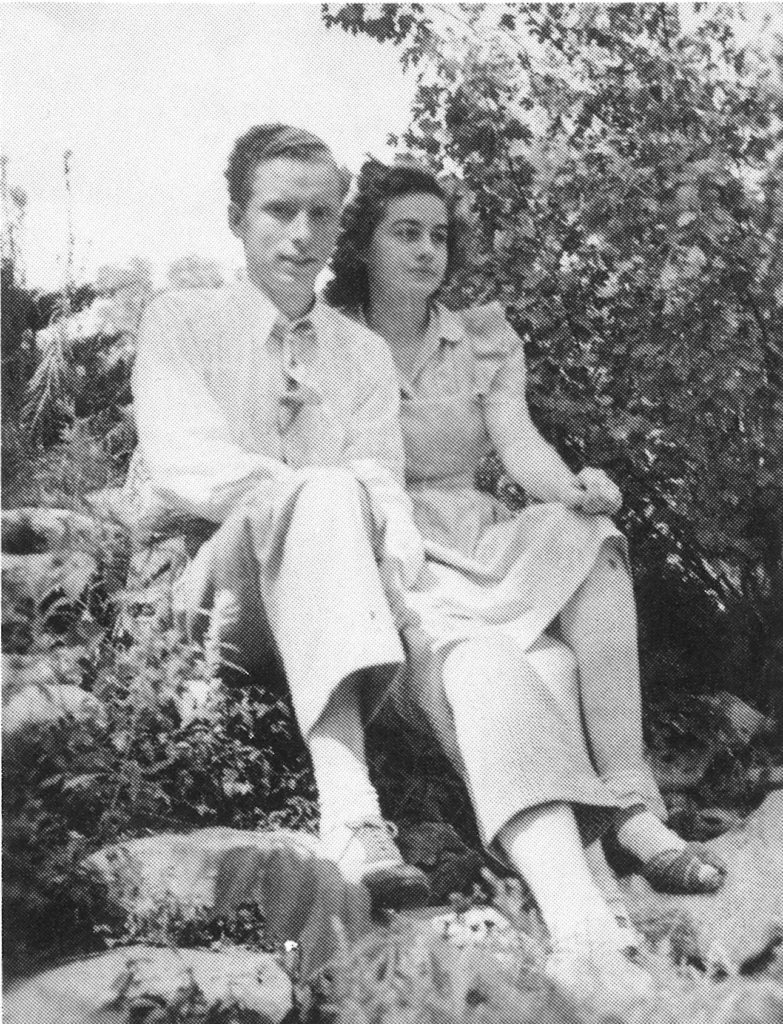
David and Juanita (Sheridan) Boylan during their dating years (1942).
Engineering Career
Following graduation from high school, David attended the University of Kansas where he earned a Bachelor of Science in Chemical Engineering in 1943. He and Juanita married on March 24, 1944, around the time she also graduated from the University of Kansas with a degree in Bacteriology. The newlyweds moved to the East Coast where David began his engineering career with the General Chemical Company in Camden, New Jersey. He advanced rapidly in his field, becoming a project engineer at General Chemical, then a Senior Chemical Engineer at American Cyanamid Company. David was successful and happy with his work. He had no intention of changing careers. God had other plans.
“All of a sudden, things began to happen,” said Dr. Boylan. “Some would call it coincidence. When coincidences begin to pile up, it’s no longer coincidence.”
The Boylans had settled into life on the East Coast. Mrs. Boylan was a homemaker with a two-year-old and a new baby. A young married couple with multiple children and a stable income did what most people do at that stage of life: they bought a new washing machine. By the 1940s more than half of American households had electric washing machines. Many of these featured new technology; not all of it was perfected, from an engineering standpoint.
“We bought a new washing machine with a powered wringer,” recalled David. “My wife caught her arm in the wringer. She had a new baby and couldn’t take care of the baby, and a two-year-old she couldn’t help.”
It was right at this same time that David had changed jobs to another company as a plant manager. As fate would have it, the company unexpectedly went out of business. The combination of unfortunate events all at once convinced David that these happenings were no longer just coincidences.
“I didn’t have a job,” said Boylan. “We had a baby. We had a family…but no income. I had no choice but to go home (to Kansas).”
Before they settled back into life in “The Wheat State,” David was approached by a friend who gave some advice that changed the course of the rest of his life.
Moving to Ames, Iowa; Early Years at Iowa State College
“Somebody said, ‘Why don’t you go up to Ames, Iowa, and see if you can get a job?’” recalled Boylan. “I had never been to Iowa. I went to Ames on a weekend and got a job as a graduate assistant at Iowa State College (as it was called in those days) and stayed there 60 years. I started off getting my PhD in engineering, and I taught in engineering. I enjoyed every moment.”
Boylan’s illustrious career at Iowa State began in 1948. The College of Engineering (one of the oldest and largest programs in the nation) was so impressed with his real-world experience that he was named Assistant Professor of Theoretical and Applied Mechanics and a graduate assistant in Chemical Engineering. Boylan completed his Doctor of Philosophy from Iowa State College in 1952 (it was renamed Iowa State University on July 4, 1959).
By the time he finished graduate school, Dr. Boylan was promoted to Assistant Professor of Chemical Engineering and eventually Professor of Chemical Engineering in 1956. The three years that followed were some of the most pivotal of his career as his reputation in the engineering field soared to new heights due to his research and development in fertilizer processes and technology.
On March 1, 1959, Dr. Boylan was named Associate Director of the Iowa Engineering Experiment Station at Iowa State University, where he oversaw 160 engineers, graduate assistants, and hourly staff. The purpose of the station was to do research and provide engineering solutions for projects that were relevant at that time, which included the digital computer, soil analysis of highway construction, the manufacturing of fertilizer, and the color television.
Spiritual Life; Impact as a College Sunday School Teacher
While Boylan was rising in the ranks of academia during the 1950s, he didn’t let his career take priority in his life. He kept his spiritual life in a condition that would have passed the strictest Rockwell hardness testing—an important trait for one who consistently taught creation in a public university, often facing resistance from colleagues. He never caved under pressure.
As the cards have poured in for Dr. Boylan’s 100th birthday, many have mentioned his commitment to creation science in a public school environment, according to his daughter, Elizabeth McKee.
These people are unsaved and totally NUTS! ‘A Virginia school district will suspend students from fourth grade on up for using the wrong pronouns to designate transgender peers, igniting a fierce backlash from parents during a Thursday school board meeting.
The Fairfax County School Board voted eight to four to approve guidelines that will discipline students who engage in “malicious misgendering,” “malicious deadnaming,” or use a slur based on a classmate’s “gender identity,” “gender expression,” or “sexual orientation.” The board approved the rules as part of next year’s school handbook. Four board members who objected did so for reasons unrelated to the suspension provision, preferring to debate a run-of-the-mill cell phone policy for an hour after fielding heated questions from parents.
The meeting showcased the power liberal school boards wield in America, as the members approved the rules over strenuous objections from parents on constitutional grounds and potentially under threat of lawsuits. While one board member acknowledged the concerns, another board member, Karl Frisch, evaded questions, saying the changes had already been implemented last year, though parents pointed out the school district quietly implemented them during the pandemic. A third, Abrar Omeish, floated the idea of nixing the public question period at the next meeting.
It equally showed parents’ frustration over their lack of influence, and their willingness to pull their children out of public schools due to their ideological drift. In a charged session that stretched late into the evening, many mothers questioned the legality of the new handbook rules as well as their necessity, citing learning loss for their children during the pandemic. One father told the Washington Free Beacon he would withdraw his kids from Fairfax County Public Schools if the “misgendering” rules passed. He mentioned two other parents he knew who had said the same.
Barbara Eckman is a mother of four boys, two of whom are gay. She told the school board she will homeschool her children now to avoid “activist policies” and redress learning gaps, saying she is having to do “the job that Fairfax County couldn’t.”
“I am both a loving mother and an ally to the Pride community,” Eckman said. “The fact that I do not support overwhelming, overreaching activist policies that violate First Amendment rights has nothing to do with how I feel about the gay and transgender community. … I have liberal and conservative friends, and when I discuss your proposed policies—the co-ed family life education and transgender unit in fourth grade, the potential suspensions for misgendering and deadnaming for kids as early as fourth grade—they’re all astonished. So this leads me to one question: Who are you really representing?”
A coalition of parents, conservative grassroots groups, political actors, and one erstwhile Trump administration official rallied before the vote. Many stayed to voice concerns during the open question period, though most left by the time of the vote, expecting unfavorable results. Of the 13 who addressed the school board, 8 rose in opposition to the new handbook.’https://freebeacon.com/campus/tiger-moms-maul-virginia-school-board-over-misgendering-rules/
‘Even nonscientists can face problems for suggesting that there might be a serious intellectual debate over Darwinism. At Baylor University, philosopher and legal scholar Francis Beckwith was initially denied tenure despite an outstanding record of academic research and publications.1 Although Professor Beckwith was well known for his prolife views, he was most controversial for his law review articles and an academic book defending the constitutionality of teaching about intelligent design as an alternative to Darwinism.2 It is important to note that Beckwith did not advocate that intelligent design should be taught in public schools — only that it was constitutional to teach it in an appropriate manner. But that nuanced position was too much for some of his colleagues, who were defenders of Darwin’s theory. Fortunately for Beckwith, after a public outcry, the president of Baylor later granted him tenure.3
A Dissertation in Limbo
College professors are not the only targets in academia who face discrimination because of their skepticism of Darwinism. Students can be even more vulnerable. Ohio State University doctoral candidate Bryan Leonard had his dissertation defense put in limbo after three pro-Darwin professors filed a spurious complaint attacking Leonard’s dissertation research as “unethical human subject experimentation.” Leonard’s dissertation project looked at how student beliefs changed after students were taught scientific evidence for and against modern evolutionary theory. The complaining professors admitted that they had not actually read Leonard’s dissertation. But they were sure it must be unethical. Why? According to them, there is no valid evidence against evolutionary theory. Thus — by definition — Leonard’s research must be tantamount to child abuse.4
Outside of academia, there have been similar cases of discrimination in government-funded science organizations. David Coppedge was a senior computer systems administrator for the Cassini Mission to Saturn at NASA’s Jet Propulsion Lab in California. He faced demotion and discharge after he offended his supervisor by occasionally offering to loan colleagues DVDs about intelligent design.5 No one had ever complained to Coppedge about his offers of DVDs, but when the supervisor found out, Coppedge faced a punitive investigation. His employment evaluations, which had been outstanding, suddenly became negative, and ultimately he lost his job. Coppedge’s dismissal was justified as a budgetary reduction unrelated to his views on intelligent design, but that explanation was questionable given the facts of the case.
The Sternberg Case
Evolutionary biologist Richard Sternberg faced similar retaliation by officials at the Smithsonian Institution’s National Museum of Natural History (NMNH) after accepting for publication a peer-reviewed article supportive of intelligent design in a biology journal he edited. A research associate at the museum, Sternberg said that after the article was published, he was told to vacate his office space and was shunned and vilified by colleagues. Efforts were also made by administrators to discover Sternberg’s personal religious and political beliefs.6 Investigators for the U.S. Office of Special Counsel concluded that “it is…clear that a hostile work environment was created with the ultimate goal of forcing [Dr. Sternberg]…out of the [Smithsonian].”7
Smithsonian officials denied any wrongdoing, but Sternberg was demoted from a research associate to a research collaborator without explanation.8 A 17-month investigation by subcommittee staff of the House Committee on Government Reform subsequently confirmed and elaborated on the previous findings of the US Office of Special Counsel. In a detailed report released to the public, subcommittee investigators concluded that they had uncovered “substantial, credible evidence of efforts to abuse and harass Dr. Sternberg, including punitively targeting him for investigation in order to supply a pretext for dismissing him, and applying to him regulations and restrictions not imposed on other researchers.”9
Congressional investigators further accused NMNH officials of conspiring “on government time and using government emails…with the pro-evolution National Center for Science Education (NCSE)…to publicly smear and discredit Dr. Sternberg with false and defamatory information.”10 The NCSE even provided a set of “‘talking points’ to…NMNH officials on how to discredit both Sternberg and the Meyer article.” In addition, the NCSE was asked by senior museum administrator Dr. Hans Sues “to monitor Sternberg’s outside activities…The clear purpose of having the NCSE monitor Dr. Sternberg’s outside activities was to find a way to dismiss him.”11 Congressional investigators concluded that “the extent to which NMNH officials colluded on government time and with government resources with the NCSE to publicly discredit Dr. Sternberg’s scientific and professional integrity and investigate opportunities to dismiss him is alarming.”12
When asked about Sternberg’s plight by the Washington Post, Eugenie Scott of the NCSE seemed to suggest that Sternberg was lucky more was not done to get rid of him: “If this was a corporation, and an employee did something that really embarrassed the administration, really blew it, how long do you think that person would be employed?”13
Teachers at Risk
Science teachers in K-12 schools also face challenges if they criticize Darwinian theory. In Minnesota, high school teacher Rodney LeVake was removed from teaching biology after expressing doubts about Darwin’s theory. LeVake, who holds a master’s degree in biology, agreed to teach evolution as required in the district’s curriculum, but said he wanted to “accompany that treatment of evolution with an honest look at the difficulties and inconsistencies of the theory.”14
In Washington State, longtime high school biology teacher Roger DeHart faced continuing harassment from pro-Darwin activists, who succeeded in getting his school district to prohibit him from discussing scientific criticisms of modern Darwinian theory with his students. DeHart was even banned from sharing mainstream science publications with students that corrected textbook errors about evolution. Although DeHart complied with his district’s gag order, ultimately, he was removed from teaching biology. When he took a job in an adjoining school district so that he could continue to teach biology, the harassment continued. He was eventually reassigned from teaching biology in that district as well, even though there were no allegations by his new district that he was not following the prescribed curriculum. DeHart finally was driven from public education altogether.15
See, for example, Francis J. Beckwith, Law, Darwinism, and Public Education: The Establishment Clause and the Challenge of Intelligent Design(Lanham, MD: Rowman & Littlefield, 2003); Francis J. Beckwith, “Science and Religion Twenty Years After McLean v. Arkansas: Evolution, Public Education, and the New Challenge of Intelligent Design,” Harvard Journal of Law & Public Policy 26 (Spring 2003), 455-499; Francis J. Beckwith, “Public Education, Religious Establishment, and the Challenge of Intelligent Design,” Notre Dame Journal of Law, Ethics, & Public Policy 17 (2003), 461-519; Francis J. Beckwith, “A Liberty Not Fully Evolved?: The Case of Rodney LeVake and the Right of Public School Teachers to Criticize Darwinism,” San Diego Law Review 39 (November/December 2002), 1311-1325.
For information about the Bryan Leonard case, see Catherine Candinsky, “Evolution debate re-emerges: Doctoral student’s work was possibly unethical, OSU professors argue,” The Columbus Dispatch (June 9, 2005); “Attack on OSU Graduate Student Endangers Academic Freedom,” Discovery Institute (April 18, 2005), https://www.discovery.org/a/2661/ (accessed November 24, 2020); “Professors Defend Ohio Grad Student Under Attack by Darwinists,” Discovery Institute (July 11, 2005), https://www.discovery.org/a/2715/ (accessed November 24, 2020).
For information and documentation about the Coppedge case, see Robert Crowther, “Trial to Begin in Intelligent Design Discrimination Lawsuit against NASA’s Jet Propulsion Lab,” Evolution News and Views (March 5, 2012), https://evolutionnews.org/2012/03/trial_to_begin_/ (accessed November 24, 2020); “Facts of the Coppedge Lawsuit Contradict the Spin from Jet Propulsion Lab and National Center for Science Education,” Evolution News and Views, March 12, 2012, https://evolutionnews.org/2012/03/facts_of_the_co/ (accessed November 24, 2020); Joshua Youngkin, “Why Did NASA’s JPL Discriminate Against David Coppedge and Why Does It Matter?” Evolution News and Views (November 22, 2011), https://evolutionnews.org/2011/11/what_happened_t/ (accessed November 24, 2020).
Intolerance and the Politicization of Science at the Smithsonian: Smithsonian’s Top Officials Permit the Demotion and Harassment of Scientist Skeptical of Darwinian Evolution, Staff Report Prepared for the Hon. Mark Souder, Chairman, Subcommittee on Criminal Justice, Drug Policy and Human Resources (Washington, DC: US House of Representatives, Committee on Government Reform, December 11, 2006), 3, 20-21, https://www.discovery.org/m/securepdfs/2020/11/IntoleranceandthePoliticizationofScienceattheSmithsonian.pdf (accessed November 26, 2020).
Intolerance and the Politicization of Science At the Smithsonian, 4.
Intolerance and the Politicization of Science At the Smithsonian, 5-6.
Intolerance and the Politicization of Science At the Smithsonian, 22, emphasis in original. The congressional report further explained, “Dr. Sues hoped that the NCSE could unearth evidence that Dr. Sternberg had misrepresented himself as a Smithsonian employee, which would have been grounds for his dismissal as a Research Associate: ‘As a Research Associate, Sternberg is not allowed to represent himself as an employee of the Smithsonian Institution, and, if he were to do so, he would forfeit his appointment.’”
Intolerance and the Politicization of Science at the Smithsonian, 23, emphasis in original.
Quoted in Michael Powell, “Editor Explains Reasons for ‘Intelligent Design’ Article,” TheWashington Post (August 19, 2005), A19.
Quoted in Rodney LeVake vs. Independent School District #656, State of Minnesota Court of Appeals, C8-00-1613 (May 8, 2001); https://web.archive.org/web/20130314100547/http://www.lawlibrary.state.mn.us/archive/ctappub/0105/c8001613.htm (accessed November 24, 2020). Additional information on the LeVake case can be found in James Kilpatrick, “Case of Scientific Heresy is Doomed,” Augusta Chronicle (December 23, 2001), A4. The Minnesota Court of Appeals found that the school district’s interest in maintaining its curriculum overrode LeVake’s First Amendment interest in teaching material critical of Darwinian evolution.
‘Last month, the New York Times published an article about Hillsdale College and its Barney Charter School Initiative. As we’ve grown accustomed to expecting from the past year of misinformation, the article was misleading and dishonest. The article serves, however, as an opportunity to remind everyone what exactly these charter schools are and illuminate their purpose.
Probably the occasion for this article was the state of the state address in Tennessee, where Governor Bill Lee mentioned that he was asking Hillsdale College to help with charter schools in the state. This set off a firestorm that touches the most powerful political and educational forces in the land. They are bureaucracies, ruling in the name of their “expertise.” Anyone not a member in good standing of this bureaucratic system is an invader. The articles critical of us and everybody else doing charter schools imply that this bureaucracy is the essence of public education. We hold to the old view that teachers, students, and parents make up the public schools.
Each of our charter schools is a civic project involving hundreds of people from their local community. Often, those involved have school-aged children or grandchildren. If not, they are citizens who care deeply for the families and children who live in their city or town. They educate these kids because they love them—they want to show them things that are beautiful, true, and good.
And so these people—most of them are volunteers, mind you—spend countless hours learning how to manage a school, how to start sports leagues and band programs, create budgets, establish a board, draft applications, or find a school building. Founding a school is difficult, but these people do it for the sake of others—that’s a noble thing.
Why do they work so hard to open these schools in particular? It is because these schools want to help their children become wise, but also become good. Hillsdale charter schools offer an education in the classical liberal arts, emphasizing science, mathematics, literature, and history, but also teaching the arts, Latin, civics, philosophy, and ethics. The purpose of such an education is to form the hearts and minds of its students—to strengthen their characters as well as their intellects.
By the time these schools open, they are big, effective, and excellent. They go on to hire headmasters who know how to build a school culture and make the trains run on time. They attract dynamic teachers who love their subjects because they too have been personally transformed by them. Within a few years, they rank among the best in their districts and states.
When he visited the United States in 1831 and 1832, Frenchman Alexis de Tocqueville wrote about the American spirit of community in his book, Democracy in America: “In no country in the world do the citizens make such exertions for the commonwealth; and I am acquainted with no people which has established schools as numerous and as efficacious … better suited to the wants of the inhabitants.” At our charter schools, these efforts continue for the sake of an education better suited to the needs of the community.
Our charter schools are the work of their communities and those who live in them. They are built with love, and they take on the character of the people and communities that built them. And so, the students flourish there.
In stark contrast to much of what is reported in the news today, the students and parents at these schools are happy. Parents love seeing their children grow into fine young men and women, and the students are proud to see it in themselves, as well.
We use the Latin words alma mater when we refer to our former place of education. The words mean “nurturing mother”—I cannot think of a more nurturing educational environment than these schools.’ An Email from Hillsdale College’s president, Dr. Larry Arnn






 whatyareckon