
Ephesians 5:1 ¶ Be ye therefore followers of God, as dear children; 2 And walk in love, as Christ also hath loved us, and hath given himself for us an offering and a sacrifice to God for a sweetsmelling savour. 3 ¶ But fornication, and all uncleanness, or covetousness, let it not be once named among you, as becometh saints; 4 Neither filthiness, nor foolish talking, nor jesting, which are not convenient: but rather giving of thanks. 5 For this ye know, that no whoremonger, nor unclean person, nor covetous man, who is an idolater, hath any inheritance in the kingdom of Christ and of God. 6 Let no man deceive you with vain words: for because of these things cometh the wrath of God upon the children of disobedience. 7 Be not ye therefore partakers with them.
8 For ye were sometimes darkness, but now are ye light in the Lord: walk as children of light: 9 (For the fruit of the Spirit is in all goodness and righteousness and truth;) 10 Proving what is acceptable unto the Lord. 11 And have no fellowship with the unfruitful works of darkness, but rather reprove them. 12 For it is a shame even to speak of those things which are done of them in secret.
13 But all things that are reproved are made manifest by the light: for whatsoever doth make manifest is light. 14 Wherefore he saith, Awake thou that sleepest, and arise from the dead, and Christ shall give thee light. 15 See then that ye walk circumspectly, not as fools, but as wise, 16 Redeeming the time, because the days are evil.
Life
This movie is for “people from all backgrounds and beliefs to watch this and be moved to stand for life.” https://nowayback.org.uk/#watch
‘The Justices wrote that the previous law was incorrect. It had forced “a theory of life” on the nation, defined by the passing of “an arbitrary point in a pregnancy”.
In the June 24, 2022 Supreme Court decision that overturned the 50-year-old mandate for nationwide legalized abortion, there were many excellent points of truth. But the incorrect theory of life is critical and brings up another one of the great evils of evolution theory – underlying as it does so much of what is called “a culture of death”.
The Roe v. Wade Court of 1973 had coined the term “trimesters”. It was a word invented to allow for the dehumanizing of an unborn person during the early stages of pregnancy, and thus the purposeful taking of the life. Justice Harry Blackmun admitted it was their invented “framework”1 so that they could arbitrarily divide the abortion code into three different time-frames. By doing this, they attempted to deal with the inconsistency of allowing abortion when the killing of a human being is murder. There were to be no exceptions for abortion in the first trimester of pregnancy – considered essentially a “non-human” phase of pregnancy.
The theory that human life is not present from the beginning of pregnancy owes its modern basis to the Theory of Evolution. True biological science actually affirms that each individual of any species must start their life-cycle as an exact copy of the progenitor cell. This is understood from the routinely proven biological principles of “Fixity of Species” and the “Law of Biogenesis”. Furthermore, the Bible tells us repeatedly in Genesis 1 that all created life will reproduce in no other way except “after its kind”.
You might give people in the early 1970s – especially under the pressure of the sexual revolution and women’s liberation – an excuse to have abortions. Both ultrasound scans and genetic science were not as developed as they are today. People learned they could use “science” – taught through the Haeckel embryo drawings – to argue that a fetus was not truly a human life. It is an excuse you will hear to this very day – another great evil, given “scientific support” by the pseudo-science of evolution.
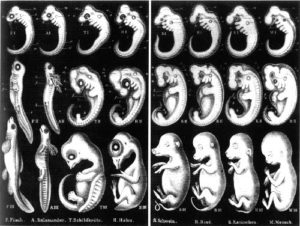
Zoologist Ernst Haeckel drew his infamous embryo drawings in the year 1874. He was a zealous proponent of Darwin’s theory of evolution, and he proposed that human embryos retraced their evolutionary history as they grew in the womb. He coined the technical terminology for this supposed retracing of evolutionary history as life develops: “ontogeny recapitulates phylogeny”. Indeed, Charles Darwin himself was convinced of Haeckel’s argument. In fact, he declared that the similarity of vertebrate embryos in their earliest stages – which he thought demonstrated their descent from a common ancestor – was “the strongest single set of facts” supporting his theory!
You can see in Haeckel’s presentation of embryos three rows of eight different species – fish, salamander, tortoise, chick, hog, calf, rabbit and human. By separating them into three rows – showing early, middle and late stages of development – Haeckel conveniently created three divisions for the Roe v. Wade Court to split its ruling into three “trimesters”. In this way, evolution once again promoted a culture of death – as it has in undergirding Nazism, Communism, eugenics, and other false and godless philosophies.
For over 150 years, the drawings have been used in textbooks to proclaim evolution. Yet, they are known frauds with Haeckel’s “embellishments”. For instance, he drew the mammalian embryos with gill slits in place of wrinkles. There are no perforations like gills in the mammalian embryos! And yet, Haeckel said the embryos were going through a “fish” stage of development.
Even the late renowned evolutionist Stephen Jay Gould wrote in 2000: “We do, I think, have the right to be both astonished and ashamed by the century of mindless recycling that has led to the persistence of these drawings in a large number, if not a majority, of modern textbooks.”
But let’s continue to think critically about the argument. What kind of proof is mere similarity? Is similarity of appearance sufficient evidence in a court of law? Or do we need better evidence to draw a conclusion – like fingerprints and DNA? I suppose if you go back all the way to fertilized egg cells, all life would look pretty similar on a macro scale – though hugely different genetically. And, if a developing baby is not “viable” until a more “independent” stage, is a baby not human until his arm and leg lengths are of adult proportions? Or maybe until she can speak? Or when he can feed himself?
We rapidly descend into infant sacrifice, for which the pagan nations around ancient Israel were judged, the Bible says. And we actually have many advocating for essentially that in our society today! On May 16, 2022, for example, after news of the pending decision had been illegally leaked, all 49 Senators of one political party voted for the most radical abortion bill proposed in the history of the United States Congress – including abortion right up to birth.
Like so much agenda-driven “research”, Haeckel did his work with an end-point in mind. In that sense, he was like anthropologist Margaret Mead and entomologist-turned-sexologist Alfred Kinsey. They both laid “scientific” groundwork for increased sexual promiscuity and deviancy through the last century. Both did “research” with an agenda driven by their own deviancy, desired outcomes and evolution-supported worldviews. Both are now thoroughly debunked.2,3 And both have been used for years to justify conclusions desired by those who push a godless and/or subversive agenda of sexual license – as has Roe v. Wade.
1 Desanctis, A., “Little Known Facts about Roe v. Wade”, National Review, Jan 23, 2017.
2 Freeman, D., Margaret Mead and Samoa: The Making and Unmaking of an Anthropological Myth, Harvard University Press, 1983.
3 Reisman, J.A. and Eichel, E.W., Kinsey, Sex, and Fraud: The Indoctrination of a People, Huntington House, 1990.
Image: Ernst Haeckel’s infamous and inaccurate embryo drawings (PD)’ https://creationmoments.com/newsletter/eventually-the-truth-prevails-one-way-or-another/?mc_cid=4265557c07&mc_eid=00c1dcff3c
Life brings with it many problems. Some are easy and some hard to answer. I have found this little book helpful for myself and others. Perhaps it may be a help to you as well.
Psalm 119:89-90
“For ever, O Lord, thy word is settled in heaven. Thy faithfulness is unto all generations: thou hast established the earth, and it abideth.”

‘There are those that claim that Evolution is a scientific theory. Scientific theories can be subject to the scientific method. If the same test or experiment is carried out under the same conditions, on different days or locations, the results should still be the same.
The existence of scientific methodology suggests that ideas, referred to as science, actually divide under two headings. The first of these would be the testable, repeatable scientific ideas, which refer to situations here and now. These can be referred to as Observable or Operational Science. This is, in fact, the real science. Not only is there nothing unbiblical about Operational Science, we can insist that such science would not be possible without a rational, biblical worldview.
The other scientific heading would be Historical Science. This is the type of science that refers to one-time, single events that allegedly happened in the past. Because these events are one-time events, they are not repeatable, nor are they falsifiable, because we do not have a time machine to go back and test things. Evolution must fall into this second category. Therefore, the alleged event, when non-living molecules got together to form a living cell, cannot be repeated. Evolution is not testable, and is therefore not Operational Science.
Some might point out that biblical creation is similarly untestable, and must be Historical Science. Although this is true, it merely serves to remind us that science is not the ultimate test of truth. The revelation of God’s word in the Bible is that ultimate truth.’https://creationmoments.com/sermons/can-we-test-evolution-2/?mc_cid=3f99a6adb5&mc_eid=00c1dcff3c
Genesis 2:7 And the LORD God formed man of the dust of the ground, and breathed into his nostrils the breath of life; and man became a living soul.
‘The existence of humans suggests that, at some point, there must have been a first human. Neither evolutionists nor creationists deny this. However, creationists believe that Adam (Genesis 1–2) was the first human. But whether the first human was Adam or some unnamed, recently-evolved person, where did that person learn to speak?
Evidence suggests that humans do not learn to speak unless they are taught by someone who already knows how to speak. Additionally, the archaeological record indicates that fully-developed languages have been in existence as long as humans have been (Elgin 1973, 44). For these reasons, Curtis, in a 1990 article, argues that a personal creator was responsible for the existence of the first human.
Linguistic Evidence
Linguistic research suggests that languages have not evolved from a prehistoric development period (Eglin 1973, 44). Rather, languages have always existed with the same communication potential as they currently possess. In fact, it is possible that they even held greater communication potential in the past.
Archaeological Evidence
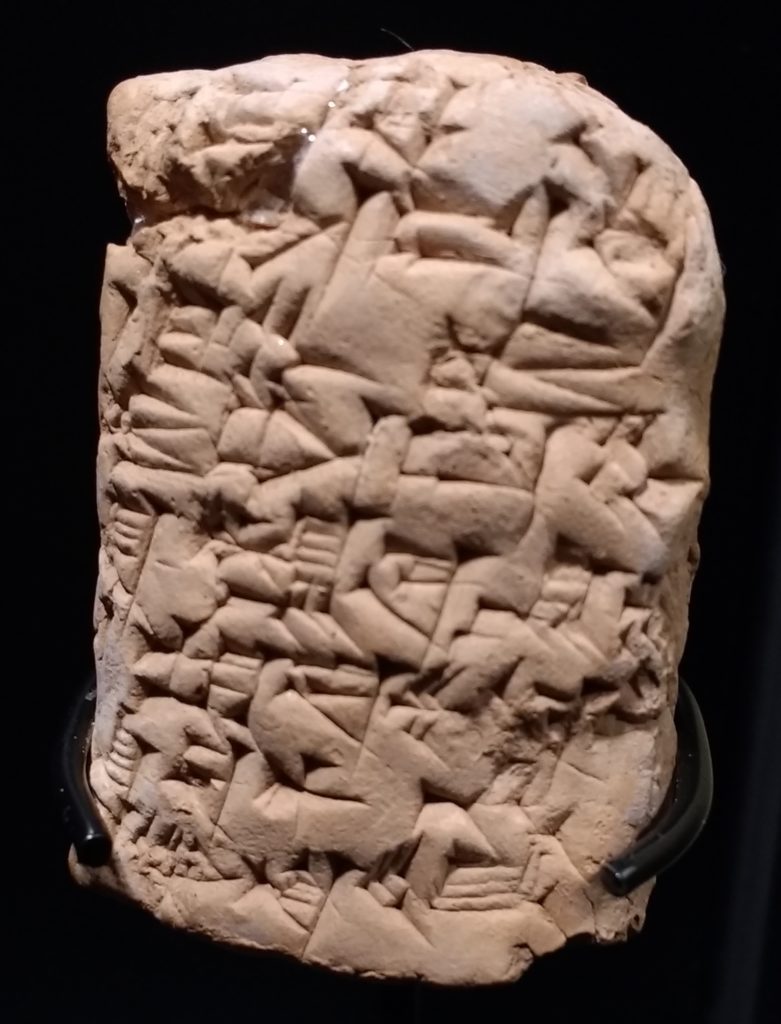
The archaeological finds from the past 100 years of excavations have demonstrated that written language appears well developed in the earliest records of civilization. For example, the Ebla tablets date to about 2000 BC. These tablets contain writing in a fully-developed, phonetic language.
How Do People Learn How to Speak?
Some Darwinian anthropologists have suggested that if, in the process of evolution, there was a transition from animal to man, this transition would have included the acquisition of language. However, one of these anthropologists, Humbolt, realized that man cannot speak without already being human. For him, this created an unsolvable problem regarding the origin of speech (Lyell 1873).

Another problem with determining the origin of speech from an evolutionary perspective is that in so-called primitive cultures, the languages tend to be more complex than in more advanced cultures. Furthermore, animals with the physical capability to use logical speech do not do so. Studies have shown that animals that respond to commands do so based on vocal tones rather than the spoken words. Thus, all attempts to solve the evolutionary origin of language have failed.

Every child that learns how to speak learns from someone who already knows how to speak. There do not seem to be any exceptions to this rule. Feral children who grow up without contact with spoken language did not learn to speak until they came into contact with speaking individuals. Once they had heard speech, they were able to learn how to speak (Tomb 1925).
What Does this All Mean?

Since multiple languages appear to have existed in fully developed forms in the earliest known civilizations, it appears that the languages do not have one common root. Rather, each language appeared independently of the others.
This evidence aligns well with the biblical account. From the creation of Adam until the Tower of Babel, there was only one language on earth (Genesis 11:1). Curtis suggests that God taught the first man, Adam, to speak. It is clear that Adam spoke a well-developed language because he was able to name the animals (Genesis 2:19). From that point on, each generation learned to speak from the previous one.
Later, when God confused the languages at the Tower of Babel (Genesis 11:7), He miraculously created a number of additional unrelated, fully-formed languages. The pattern of language learning continued. Each person learned to speak from the previous generation.
Conclusion
The scientific evidence obtained through linguistic and archaeological studies suggest that the first human who learned how to speak must have learned from someone who already possessed the capability of speech. This first person must have learned from someone of a higher order than humans. This correlates well with the biblical account of God’s creation of Adam. Adam must have received the ability and knowledge to speak from God himself. The study of language demonstrates that there must be a creator God. No human can speak a language unless that person has been taught. Furthermore, languages have not arisen from some lesser forms of communication. They appeared early in history, fully developed. The languages present today do not share a common root, suggesting that they appeared as separate, well-developed languages. This accords well with the account of the Tower of Babel.
References
Curtis, William M. 1990. “Human Language Demands a Creator.” The Proceedings of the International Conference on Creationism 2:1, 69–72.
Elgin, Suzette H. 1973. What is Linguistics? Englewood Cliffs: Prentice-Hall Inc.
Lyell, C. 1873. Antiquity of Man, 4th Ed., 518.
Tomb, J. W. 1925. “On the Intuitive Capacity of Children to Understand Spoken Language.” British Journal of Psychiatry 1, 553–555.’https://newcreation.blog/how-did-humans-learn-to-speak/?mc_cid=c226022714&mc_eid=2abe4a38b0
“I call heaven and earth to record this day against you, that I have set before you life and death, blessing and cursing: therefore choose life, that both thou and thy seed may live.” (Deuteronomy 30:19)
‘Shortly before his death, Moses restated the law and the covenant between God and His people summed up in the greatest commandment: “Thou shalt love the LORD thy God with all thine heart, and with all thy soul, and with all thy might” (Deuteronomy 6:5).
Furthermore, Moses claimed that “this commandment which I command thee this day, it is not hidden from thee, neither is it far off. It is not in heaven…Neither is it beyond the sea” (Deuteronomy 30:11-13). Nothing about it was hard to understand. “But the word is very nigh unto thee, in thy mouth, and in thy heart, that thou mayest do it” (Deuteronomy 30:14).
Indeed, the evidence that God is Creator, Judge, Provider, and Redeemer is all around us. Our text informs us that “heaven and earth” are witnesses of God’s nature. We have more than enough information than we need in order to respond. In fact, these things “from the creation of the world are clearly seen” so that those who reject are “without excuse” (Romans 1:20). Indeed, to ignore the evidence of creation and the Flood, one must be “willingly…ignorant” (2 Peter 3:5). Rejection is foolishness.
“See, I have set before thee this day life and good, and death and evil” (Deuteronomy 30:15). The choice is between blessing (v. 16) and cursing (v. 19). All lines of reasoning point toward the God of the Bible as the one true God. “Therefore choose life,” as our text encourages us, “That thou mayest love the LORD thy God, and that thou mayest obey his voice, and that thou mayest cleave unto him: for he is thy life” (v. 20). ‘https://www.icr.org/article/12949/?utm_source=phplist9549&utm_medium=email&utm_content=HTML&utm_campaign=September+10+-+Choose+Life


 whatyareckon