
Water
All posts tagged Water
‘One of the fascinating things about maps is that they give us a bird’s eye view of God’s creation.
When we were filming at Cedarville University in 2021, Dr. John Whitmore pulled out a map of the Grand Canyon to provide some perspective on what he and Dr. Andrew Snelling accomplished on their research trip. (You can watch this in the video at the end of the post.)
Dr. Snelling’s research provides the backbone for our upcoming film. In 2017, he and Dr. Whitmore traveled by boat down the Colorado River to collect a series of rock samples at different points in the Canyon. Their primary interest was understanding more about the enormous folded rock layers at the bottom of the Canyon.
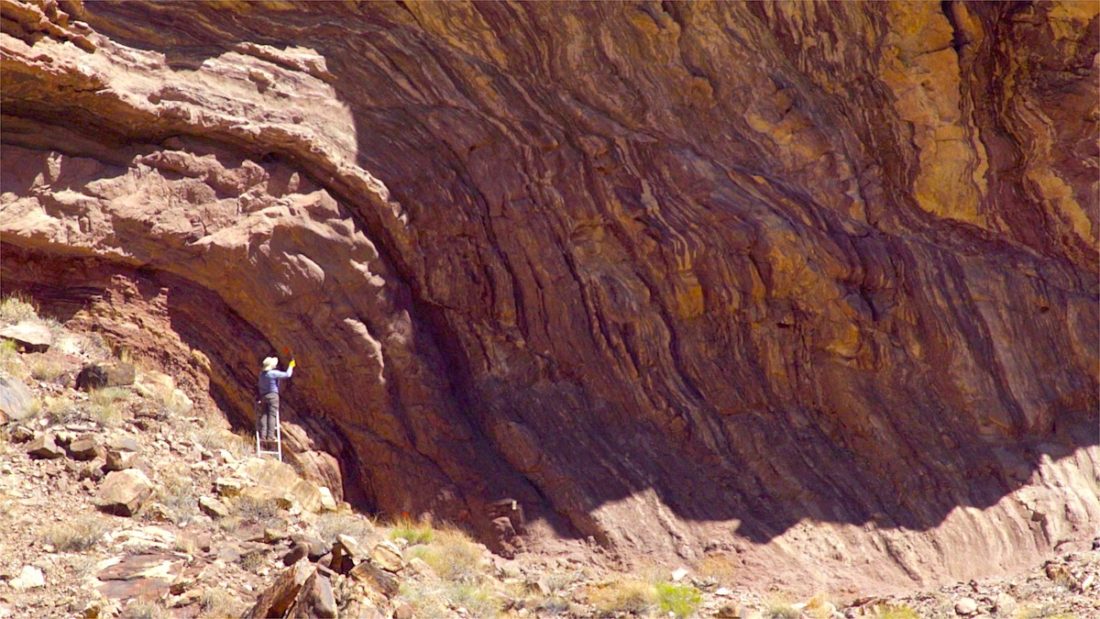
Were those layers soft and pliable when they formed, or were they hard and brittle? If it could be demonstrated they were soft when they folded, they couldn’t be hundreds of millions of years old. This new research could therefore provide important new evidence of a global flood and a young earth.
Although the folds appear to be smooth at normal observational levels, Andrew knew he needed to look at the rocks under the microscope. What did they reveal at a crystalline level? Did they show evidence of slow movement while brittle over a long period, or rapid movement while soft over a short period?
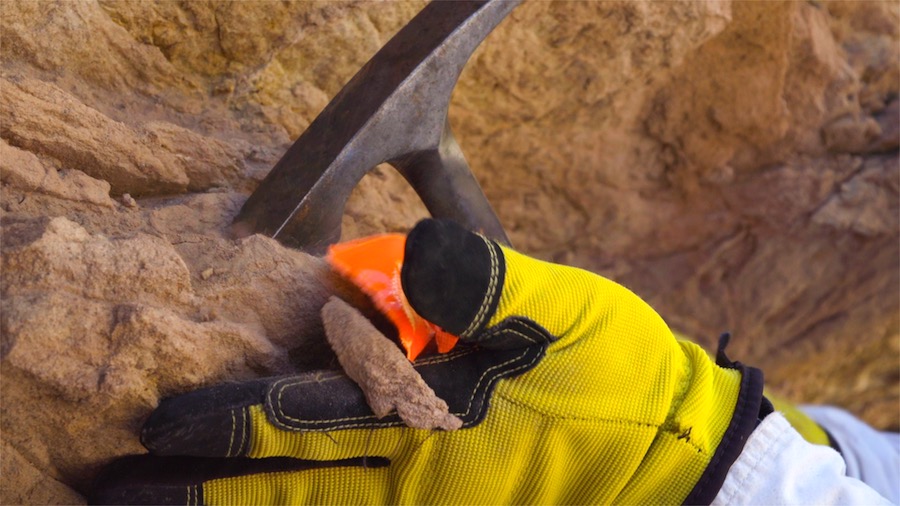
To test his theory, Andrew needed to collect two different series of samples from the same layer of rock. One series would be taken from where the rock layer was sharply folded; the other series would be taken many miles aways where the same rock layer was lying flat. By comparing these samples, he would have a good indication of the condition of the rock when it folded.
For the entire article go to https://isgenesishistory.com/mapping-the-research-for-mountains-after-the-flood/?mc_cid=f340ffcce4&mc_eid=2abe4a38b0

‘If there was a worldwide flood, where is all the water?
The Flood mentioned in Genesis was a worldwide flood; it began with a special rain of “40 days and nights” and all of the “fountains of the great deep” opened up. The Flood continued for one year. During the first five months, the waters rose and covered all land surfaces. “Every hill under the whole heaven was covered.” God’s judgment upon sin was to totally destroy all life on land that had the “breath of life.” The floodwaters cleansed the earth.
Towards the end of the Flood, all current mountains of the earth rose up and the valleys sank low, resulting in the water rushing off the continents into the oceans. This explains why fossils of ocean creatures that once lived on the ocean floor can be found on the highest mountain peaks. Today this flood water fills the oceans of the world which cover about 70% of the globe. Many parts of the ocean are extremely deep. The deepest is the Marianas Trench, located in the Pacific Ocean. It is almost seven miles deep; compare this with Mt. Everest at about 5 ½ miles high. If the earth’s surface were completely leveled, as smooth as a ping pong ball, the oceans would cover the entire globe to a depth of about a mile and a half. Here is a satellite picture of the Pacific Ocean. Water everywhere! Where is the Flood water? The water from the Flood is still here; it is found in the earth’s oceans.’ An email from http://www.searchforthetruth.net/
‘Deserts cover one-fifth of the earth’s land surfaces, but only the Americas have cacti. The southwestern U.S. has more than 2,000 varieties of cactus. What design would you put into a desert plant for it to hold onto its water? Cacti open their tiny pores (stomata) to take in carbon dioxide during the night! This is the opposite of most plants; they open their pores (stomata) during the daylight hours because this is when photosynthesis takes place and the carbon dioxide is needed at that time. If the cacti were to open their pores during the day, precious water would evaporate. Losing water is not good in the desert! Cacti are designed so that during the night, stomata open up and carbon dioxide is collected and stored. During the day, the stomata close, and the previously stored carbon dioxide is used for photosynthesis. Cacti are an extremely unique plant that open their pores only at night.
The cacti have many other ingenious designs to help them survive in the desert:
- The main body of the cacti acts as a reservoir, storing water. The cacti can actually expand their diameter. Question: Can trees swell their trunks as they gather water, and then shrink their girth as they use the water? A mature saguaro can absorb 200 gallons from one rainstorm. Cacti are like sponges, so when it does rain, they collect as much water as possible!
- The outer part of the cactus is waxy. This helps retain the moisture.
- Pointy spines or “cactus needles” stop thirsty animals from getting a free drink.
Evolution teaches that cacti evolved these features over eons of time. Yet thousands of specific programming changes would be needed to allow some sort of “pre-cactus” to survive in the desert. What if stomata were open during the day, like other plants? The cacti would most likely wither away and die. What if it did not have the unusual feature of its stem expanding to hold water? An extended dry spell would kill all the cacti. What if there were no spines? Animals would eat the cacti for their water. These are just a few of the design issues that God had to think about so that cacti could survive and thrive in a harsh desert environment. Cacti show the handiwork of the Great Creator!’ An email from http://www.searchforthetruth.net/
Isaiah 45:18 “For thus saith the LORD that created the heavens; God himself that formed the earth and made it; he hath established it, he created it not in vain, he formed it to be inhabited: I am the LORD; and there is none else.”
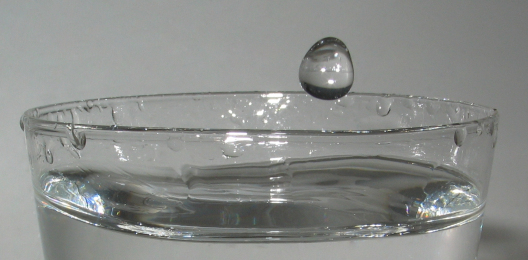
‘Have you ever thought what a strange material water actually is? A water molecule comprises of three atoms – two hydrogens and one oxygen. Oxygen is an element in Group VI of the Periodic Table; Group VI also contains the elements sulfur, selenium, and tellurium, in increasing order of size (oxygen is the smallest. Hydrogen can also form compounds with these elements: H2S, H2Se, H2Te. These have the boiling points -60.7, -41.5, and -2.2deg Celcius. Therefore, all these compounds are gases at room temperature. If we were following the size of the Group VI atom only, then water should have a boiling point considerably lower than that of H2S. But it doesn’t. In fact, the boiling point of water is higher than all those other compounds, at 100 deg C (or 212 deg F).
This, of course, is not the only anomalous property of water. The solid form of water – ice – floats on liquid water. So what, you might say. Well, the solid form of every other liquid there is always sinks in its liquid. If you have ever allowed molten candle wax to cool down, for example, you will notice it freezes from the bottom up. Nearly all liquids behave that way – except water! In short, the most common liquid in the world – the one that we require most for life – behaves like no other liquid. It is almost as if it were specially designed! God designed the Earth – including water – for us to inhabit.’https://creationmoments.com/sermons/strange-water/?mc_cid=20fe537290&mc_eid=00c1dcff3c
Genesis 7:11
“In the six hundredth year of Noah’s life, in the second month, the seventeenth day of the month, the same day were all the fountains of the great deep broken up, and the windows of heaven were opened..”
‘One of the biggest headlines in planetary exploration in recent years was the confirmation that at one time Mars had water. Further exploration and study reveals evidence that there was once quite a lot of moving water on the surface of Mars.
With two rovers having sent back pictures and information from the surface, plus an orbiter exploring the surface, evidence of water action began to mount. At first, small features that looked like they were formed by moving water were discovered. Soon, it looked like that there was widespread water action in the southern hemisphere. Besides erosion, there is widespread evidence of the type of rocks that form underwater. Now, similar evidence suggests widespread water action in the northern lowlands as well. One of the most dramatic features could be the Mars version of the Grand Canyon. Called Valles Marineris, it is 2,000 miles long, 400 miles wide and five miles deep. It is so big, it can be seen from Earth with a good telescope. It would take catastrophic amounts of water to form such a canyon.
While the Bible doesn’t say anything about the flood that would suggest Mars was involved, some creation geologists say that it may have been. One thing is certain. This water action did not take place billions of years ago as those who believe in evolution say.’https://creationmoments.com/sermons/did-noahs-flood-affect-mars-too-2/


 whatyareckon