‘What chapter or verse of the Bible says there will be 27 books of the New Testament? Of course, none. Where does it say what the 27 books will be? Again, of course, none. How then do we know what are the 27 books of the New Testament?
When we read the New Testament, we open about two-thirds of the way through the Bible to that title page that says “New Testament” on it. The churches that received scripture were not sent such a copy. The New Testament did not come to churches with a cover page, stating, “New Testament,” and behind it 27 books.
Churches acknowledged and copied inspired books. They treated them as though they were inspired. They passed them from church to church and read then in churches. Before copies wore out, they were copied again to preserve them for the future.
The scriptural doctrine of which I speak concerning canonicity proceeds from the Bible itself. Through the inward testimony of the Spirit, regenerate, immersed church members distinguish between words which man’s wisdom teaches and those of and from the Holy Spirit (1 Corinthians 2:13-25). God gave His inspired Words to the apostles or the inspired human authors according to the plan of the Lord Jesus Christ through the Holy Spirit (John 14:26, 15:26, 17:8, 14; Gal 1:11-12). True believers led by the Spirit would know the things written were the words of God (1 Corinthians 14:37). The same Holy Spirit who had regenerated, indwelt, and filled them would testify to the words.
The testimony or witness of books of the New Testament arises from the promise of words. They knew Paul’s epistles were scripture like the Old Testament (2 Peter 3:16), but they were guided to inspired words. The epistles or books were an implication of received words. The Lord gave unto them “words” and they “received them” (John 17:8; cf. 12:48, Acts 2:41, 1 Thess 2:13).
Revelation 22:18-19 read:
18 For I testify unto every man that heareth the words of the prophecy of this book, If any man shall add unto these things, God shall add unto him the plagues that are written in this book: 19 And if any man shall take away from the words of the book of this prophecy, God shall take away his part out of the book of life, and out of the holy city, and from the things which are written in this book.
The Apostle John testifies to a completed book of Revelation. He speaks of “the words of the prophecy of this book.” He confirms a settled, completed, perfect text of words. One could only add or take away words from a book with a settled text. His instruction assumes the precision of the text and continued knowledge of it. No one could obey this command without standardized words.
God’s people will know what His Words are and receive them. That is how they knew and know the twenty-seven books. God intervenes through His Spirit in His churches to receive His Words and, therefore, His Books. History confirms this teaching. The nature of God’s Word is that when God says He will do something, He does it. His sheep hear His voice and follow Him. They believe what He says. They have.
Through the history of the Lord’s churches, they believed the biblical doctrine of canonicity or the preservation of the text and books of the New Testament. Errors were made in copies, what are most often called variants today. God did not promise to preserve copies. Believers do not receive copies. They receive “words.” They identify words. True churches assume a settled text. They have.
The Lord’s churches now call the text, the words and books, received and passed down from one generation to the next by the work of the Holy Spirit, the received, traditional, ecclesiastical, or standardized text. By “traditional,” they mean it like Paul used it in 2 Thessalonians 2:15, “Therefore, brethren, stand fast, and hold the traditions which ye have been taught, whether by word, or our epistle.” It is an ecclesiastical text, because churches received it. Some today call this a “confessional bibliology,” because it reflects the historical belief of churches and so written down in confessions.
Scripture is scientific. If God says it, it is true and it is knowledge. It is the pure mother’s milk without variableness or shadow of turning (1 Peter 2:2, James 1:17). Everything God says is true and is the standard for truth (John 17:17). God repudiates rejection of what He said for so-called science or for experience. We have a more sure word of prophecy (2 Peter 1:19-21).
The Lord’s churches received the text still received by His churches before the invention of the printing press. With the invention of the printing press in 1440, they printed that text in the 16th century. They continued to receive it for centuries. These people translated from it into other languages. They preached sermons from it in churches and wrote commentaries and other books from it or based upon it. We have all of this record.
No one should add to or take away from the settled text of the New Testament. This contradicts the teaching of the New Testament about itself. No one should assume and then believe God’s Words were lost and in need of restoration. This violates scripture. This hurts the faith.
Professing believers today do not know the New Testament by science. They do not know it by probability. God’s people do not know it by rules of textual criticism. They do not know it by intelligibility. The people of God know it by the testimony of the Holy Spirit through history or through the preceding centuries through the Lord’s churches. They should reject any other teaching or way. These are heretical ways that distort or veer from the already received and established scriptural bibliology.https://kentbrandenburg.com/2022/06/22/how-do-we-know-what-the-new-testament-is/
‘The Suez Inscription of the Medo-Persian King Darius the Great (Darius I Hystaspes, 521-486 B. C.) of the Achaemenid Empire is found in the Cairo Museum in Cairo, Egypt. The inscription is commented on by leading Egyptologist, Biblical and Old Testament scholar, and evangelical Christian Dr. James Hoffmeier. The canal was built through the Wadi Tumilat, connecting the easternmost or Bubastite branch of the Nile with Lake Timsah, which was connected to the Red Sea by natural waterways. Darius the Great is frequently mentioned in the Bible (Ezra 4:5, 24; 5:5–7; 6:1, 12–15; Haggai 1:1, 15; 2:10; Zechariah 1:1, 7; 7:1). He is the Persian ruler who, in the time of Ezra the priest, confirmed the decree of the Persian king Cyrus for the rebuilding of the Temple in Jerusalem: Then Darius the king made a decree, and search was made in the house of the rolls … in Babylon. And there was found at Achmetha, in the palace that is in the province of the Medes, a roll … thus written: In the first year of Cyrus the king the same Cyrus the king made a decree concerning the house of God at Jerusalem, Let the house be builded, the place where they offered sacrifices … And also let the golden and silver vessels of the house of God, which Nebuchadnezzar took forth out of the temple which is at Jerusalem, and brought unto Babylon, be restored, and brought again unto the temple which is at Jerusalem[.] . … [L]et the … Jews build this house of God in his place. Moreover I make a decree what ye shall do to the elders of these Jews for the building of this house of God: that of the king’s goods, even of the tribute beyond the river, forthwith expenses be given unto these men, that they be not hindered. And that which they have need of, both young bullocks, and rams, and lambs, for the burnt offerings of the God of heaven, wheat, salt, wine, and oil, according to the appointment of the priests which are at Jerusalem, let it be given them day by day without fail: That they may offer sacrifices of sweet savours unto the God of heaven, and pray for the life of the king, and of his sons. Also I have made a decree, that whosoever shall alter this word, let timber be pulled down from his house, and being set up, let him be hanged thereon; and let his house be made a dunghill for this. And the God that hath caused his name to dwell there destroy all kings and people, that shall put to their hand to alter and to destroy this house of God which is at Jerusalem. I Darius have made a decree; let it be done with speed. (Ezra 6:1-12) The Suez inscription of Darius reads: “I am a Persian; with Persia I seized Egypt. I commanded to dig this canal from the river named the Nile [Pirāva], which flows through Egypt, to this sea which comes from Persia. Then this canal was dug, according as I commanded. And I said, ‛Come ye from the Nile through this canal to Persia.’” (“Persians,” ed. James Orr et al., The International Standard Bible Encyclopaedia [Chicago: Howard-Severance, 1915], 2336.) The Greek historian Herodotus states that Pharaoh Necho / Neco started to build the 115 mile long canal to join the Mediterranean to the Gulf of Suez, while Darius I of Persia completed it. Herodotus writes (Histories 2:158-159): Psammetichus had a son Necos, who became king of Egypt. It was he who began the making of the canal into the Red Sea, which was finished by Darius the Persian. This is four days’ voyage in length, and it was dug wide enough for two triremes to move in it rowed abreast. It is fed by the Nile, and is carried from a little above Bubastis by the Arabian town of Patumus; it issues into the Red Sea. The beginning of the digging was in the part of the Egyptian plain which is nearest to Arabia; the mountains that extend to Memphis (in which mountains are the stone quarries) come close to this plain; the canal is led along the lower slope of these mountains in a long reach from west to east; passing then into a ravine it bears southward out of the hill country towards the Arabian Gulf. Now the shortest and most direct passage from the northern to the southern or Red Sea is from the Casian promontory, which is the boundary between Egypt and Syria, to the Arabian Gulf, and this is a distance of one thousand furlongs, neither more nor less; this is the most direct way, but the canal is by much longer, inasmuch as it is more crooked. In Necos’ reign a hundred and twenty thousand Egyptians perished in the digging of it. During the course of excavations, Necos ceased from the work, being stayed by a prophetic utterance that he was toiling beforehand for the barbarian. The Egyptians call all men of other languages barbarians. Necos then ceased from making the canal and engaged rather in warlike preparation[.] The king Darius mentioned in the Bible was a real historical person. The Darius inscription is one of thousands of archaeological evidences validating the Bible is God’s Word.’
1Corinthians 16:2 Upon the first day of the week let every one of you lay by him in store, as God hath prospered him, that there be no gatherings when I come.
2Corinthians 9:7 Every man according as he purposeth in his heart, so let him give; not grudgingly, or of necessity: for God loveth a cheerful giver.
The following article concerns Willow Creek inviting Robert Morris from Gateway Church, Dallas, Texas to preach. The controversy is that some believe Morris preaches a prosperity Gospel. Willow Creek’s Tim Stevens however ‘…said Willow is spreading the word about God’s miraculous provision — not a prosperity gospel.’
Nevertheless, Robert Morris and his church are connected with Pentecostal preacher Jack Hayford https://www.tku.edu/about-tku/gateway-church/ and most prosperity preachers are within the Pentecostal movement.
Amos 3:3 asks ‘Can two walk together, except they be agreed?‘ Now Robert Morris and Pentecostal Jack Hayford seem to have a very close relationship as ‘Dr. Hayford serves as an apostolic elder of Gateway Church’. Hayford is associated with the Foursquare Pentecostal Church which encourages the speaking in tongues https://www.wayoflife.org/reports/beware_of_jack_hayford.html. Willow Creek must not have a problem with this either.
So, ‘Facing persistently lower giving, Willow Creek Community Church last Sunday invited Pastor Robert Morris, who some allege is a prosperity preacher, to deliver a guest sermon on tithing. The sermon contained a singular promise: Tithe for a year, and if you’re not satisfied, you’ll get your money back.
“Thousands and thousands” had seen their lives changed after starting to give 10% of their income regularly, Morris said. “I’ve done this with our church. I’ve told our church on multiple occasions, I’ve said to them, if you’ll try it for one year, if you are not fully satisfied at the end of that year, I’ll give you your money back. In 22 years of church no one’s ever asked for money (back).”
Morris is pastor of Gateway Church, once the largest congregation of the Association of Related Churches (ARC) in the United States. (It’s no longer listed in the ARC’s church finder.) He also is one of disgraced pastor Mark Driscoll’s staunchest supporters.
Morris was the first to replatform Driscoll after the Mars Hill debacle in 2014. And just last summer, Morris had Driscoll speak at an ARC preaching seminar at Gateway Church.
When asked about Morris’ money-back guarantee, Willow Creek Executive Pastor Tim Stevens said Willow is spreading the word about God’s miraculous provision — not a prosperity gospel.
Stevens confirmed that Willow Creek’s average weekly giving so far this year is 20% below the church’s already reduced budget. This year’s giving budget is about half the church’s revenue in 2019, when investigators said sexual misconduct allegations against Willow Creek’s founder Bill Hybels were credible. But he said giving so far this year is on par with last year’s weekly giving average.
Stevens told The Roys Report that the church budgets the same amount of revenue for every week—about $614,000 across seven campuses. However, he noted, “the reality is that a larger percentage of our giving happens at the end of the year.”
Critics, however, say that though Morris has a softer sell, he still preaches the same health and wealth gospel of prominent prosperity preachers like Kenneth Hagin. “Hagin had no problem telling you that God wanted him to be rich,” write Paul and Susan Dunk of KW Redeemer Church in Breslau, Ontario. “But Morris softens it and prefers blessed.”
They add that Morris’ teaching on tithing is more like “pagan votive offerings” than the voluntary giving encouraged in the New Testament. “If you needed health, wealth, crops, love, wisdom etc . . . you would go to the temple and give money to the corresponding gods of those blessings,” the Dunks write.
Theology professor and Pastor David Schrock likewise called Morris’s beliefs about material blessing a “misreading of Scripture” in a critical review of Morris’s book “The Blessed Life.”
“Instead of grounding God’s character and promises in the new covenant of Christ, Morris makes God a self-styled miracle-worker who promises supernatural power,” Schrock wrote.
Morris preached Sunday on “The Principle of First” as part of Willow Creek’s five-part sermon series “More Than Money.” The series coincides with a major giving campaign underway now at Willow Creek.
“This series aims to help people understand that money is not a financial issue, it’s a discipleship issue and a matter of the heart,” the series summary reads in part.
Morris’s money-back promise was mentioned only in an unlisted video recording of the 9 a.m. service. It’s absent from the sermon video published on Willow Creek’s website, which was apparently drawn from the “full service” recording of the 11:15 a.m. service.
In the 9 a.m. service, Willow Creek Pastor Dave Dummitt made the same promise as he held up a commitment card for the church’s current giving initiative.
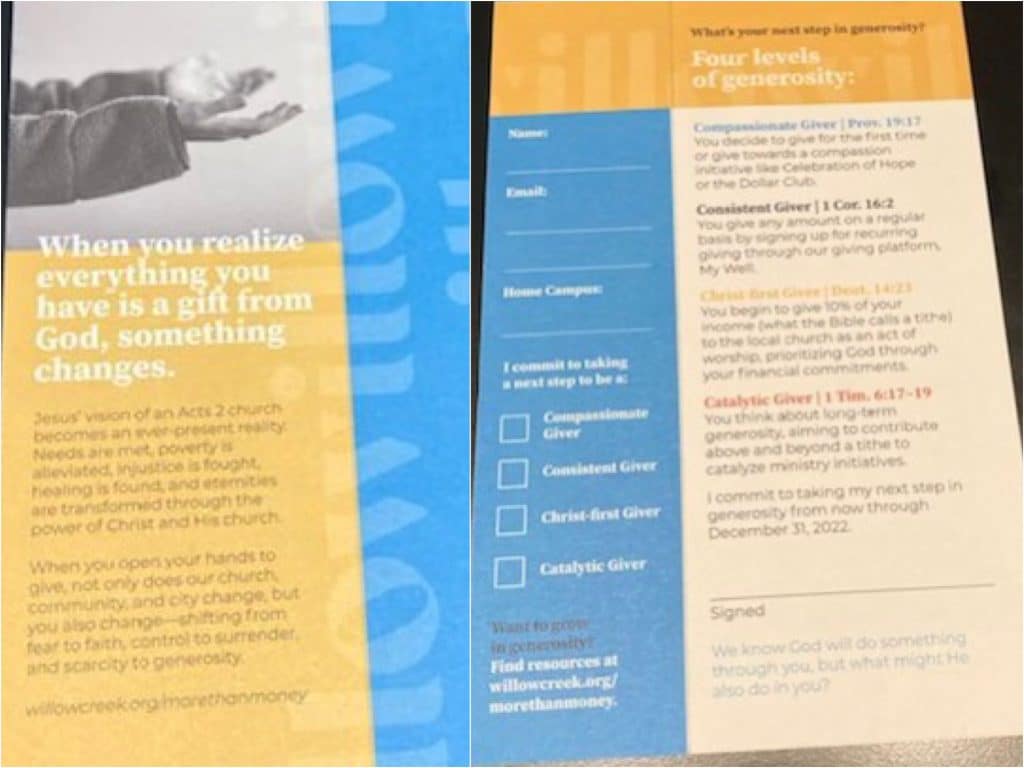
Dummitt encouraged congregants to consider pledging to be “Christ-first givers”— the third of four giving options the church is asking congregants to commit to. Then he told the audience he’d “go ahead and be bold and say, if you do this for the year, and you are not fully satisfied, we’ll give the money back.”
“I like that challenge. It’s good,” Dummitt added.
Stevens said Dummitt had offered something similar at his previous church, but his decision to challenge Willow Creek came spontaneously. Leadership decided the idea “needed some time to bake” so it wasn’t mentioned in the later service, Stevens said. However, the challenge is being developed now and could be formally announced as soon as this weekend.
Stevens denied that the money-back challenge constituted a “prosperity gospel” message.
“Any time that my wife and I have stretched in our giving, God has out-given us in return,” Stevens wrote in an email to The Roys Report. The old car lasted longer, he offered as an example, or the tax return was big enough to cover a surprise bill.
A giving commitment card distributed on Feb. 20, 2022 at Willow Creek Community Church (Courtesy Photo)
“God meets a need in some miraculous way that we didn’t see coming,” Stevens continued. “I think that was the intent of what our guest preacher was communicating, and what Dave was affirming. Willow does not, and never has, held a position that says God will make you rich if you commit your finances to the church.”
When asked about Morris’ longstanding support of Driscoll, Stevens wrote that Willow Creek tries “to shy away from ‘guilt by association’” when inviting guest speakers.
In addition to repeatedly platforming Driscoll, Morris was formerly an overseer at Driscoll’s new church, The Trinity Church. A spokesman for Morris previously told The Roys Report that Morris remains available if Driscoll’s church needs counsel.
Last August, Driscoll was featured alongside Morris as a speaker at a preaching seminar Gateway and Morris hosted.
Stevens pointed out Willow Creek has recently invited other speakers. Some of them could be considered controversial.
“And he believed in the LORD; and he counted it to him for righteousness.” (Genesis 15:6)
‘The key New Testament doctrine of imputed righteousness, received through saving faith in the Word of God, is foreshadowed beautifully in the life of Abraham. Because of his strong faith, demonstrated again and again in difficult acts of obedience, Abraham has been called “the father of all them that believe” (Romans 4:11). Our text verse is quoted four times in the New Testament (Romans 4:3, 22; Galatians 3:6; James 2:23) and is made the basis of the great gospel theme of salvation and righteousness. This is obtained not by one’s good works but by imputation, and is received through faith in the gracious promises of God through Jesus Christ. “For he hath made him to be sin for us, who knew no sin; that we might be made the righteousness of God in him” (2 Corinthians 5:21).
“Therefore it is of faith, that it might be by grace; to the end the promise might be sure…to that also which is of the faith of Abraham; who is the father of us all” (Romans 4:16). Just as “Jerusalem which is above…is the mother of us all” (Galatians 4:26), so faithful Abraham is “the father of us all.” Spiritual Jerusalem speaks of salvation by grace rather than by law, and Abraham testifies of righteousness through faith rather than by works. And yet, 12 of the 40 verses of Hebrews 11, the great “faith chapter,” deal with the outward evidences of Abraham’s inner faith.
Matthew Henry, the non-conformist, wrote ‘This psalm has something of David in it, but much more of Christ. It begins with such expressions of devotion as may be applied to Christ; but concludes with such confidence of a resurrection (and so timely a one as to prevent corruption) as must be applied to Christ, to him only, and cannot be understood of David, as both St. Peter and St. Paul have observed, Ac 2:24; 13:36. For David died, and was buried, and saw corruption.’
Jamess 2:23 And the scripture was fulfilled which saith, Abraham believed God, and it was imputed unto him for righteousness: and he was called the Friend of God.
I don’t think you would have caught Abraham at a BLM protest. However, ‘A group of Jewish Americans who showed up in solidarity of the Black Lives Matter movement in Philadelphia were taunted and assaulted by rioters, according to a video circulating on social media.
The protestors told the Jewish men to “get the f*** out of here” and one Jewish man was shoved by a protester as he tried to leave.
The man, who seems to be the one videoing the scene, calls the Jewish men “Amalek.”
“Amalek! Amalek! What y’all doing down here,” he says.
‘Amalekites’ are considered enemies to Jews within Jewish tradition.
‘Millions of people are now clamoring for paper masks to cover their mouths and noses while thousands of healthcare and public service workers are wearing full Hazmat suits. The new Coronavirus – now officially known as SARS-CoV-2 – has had a devastating effect in China this winter of 2020.
What can we learn from this plague in regard to biblical and creation truth? Apart from being another example of a creation fallen from innocence and perfection because of sin, the Bible has much to say about it that is relevant. In Leviticus chapter 11, the Bible presented the Jewish people with dietary laws for animals. These laws were ceremonially important for honoring God and remembering the people’s place before Him. But we know today that these principles from the Bible were filled with keen insight and prophetic foreknowledge in their understanding of health science and disease prevention.
And while the ceremonial aspects of these dietary rules were replaced by New Testament freedoms (see Acts 10:9-28), the fact is that important medical and health wisdom predating modern science is reflected in these laws! For example, warnings appear throughout Leviticus 11 about handling dead carcasses, including water and any objects which contacted the carcasses – something medicine lost sight of until modern germ theory in the 19th century.
Though many people now think that SARS-CoV-2 coronavirus originated as a biological weapon, the official explanation is that it started in a “live wildlife” market in Wuhan, China. We are told that the virus got its start from people who were eating bats. Interestingly, in Leviticus 11:13-19, “bats” are listed along with 19 unclean birds which “shall not be eaten” as “they shall be an abomination unto you”. The last phrase is also translated “a detestable thing and abhorrent to you”.
Bats are known to host up to 137 different kinds of viruses – the most well-known one being rabies. These include over 60 “zoonotic” viruses (viruses which can be transferred to other species). Bats and rodents (prohibited in Leviticus 11:29) carry the most such viruses of any animals. The viruses can make the leap to humans through an intermediate species such as dogs and cats (also prohibited because they are animals that walk on their “paws”. They eat the meat of other unclean animals and thereby ingest more pathogens which can be transferred through their own meat. In addition, of course, the unclean animals of Leviticus 11 are eaten directly by humans, especially in parts of the world which do not have a biblical tradition.
Viruses are difficult for the immune system to contend with because they disguise themselves by hiding within the body’s own cells – a cell “uniform” which the immune system’s “soldiers” have learned to overlook. The thing that keeps us alive against the ravages of infections and other “uncleanness” is the blood’s immune system. And with viruses, the immune system must “train” and deploy the special B- and T-lymphocyte immune system cells to become like specially trained commandos to recognize and neutralize the virus-infected cells.
As the Bible puts it, “the life of the flesh is in the blood” (Leviticus 17:11). This biblical statement is true on many levels. It is true on the surface as well as on a deeply spiritual level. We can make the connection between our own blood carrying life-giving oxygen and nutrition to our whole body with our incredible immune system manufactured with and carried by the blood throughout our bodies, knocking out the pathogens which would otherwise quickly bring death. And then there is the wonderful renewing love, joy, and peace of spiritual life brought with the blood of Christ cleansing us from spiritual infection (sin)!
Viruses mutate. And this makes them able to re-infect people. But the truth is, contrary to the assumptions of evolution, such mutations – as with any mutation – will be far less likely to survive. This fact – that mutations are at best equally viable but most frequently weaker members of a species – is a key reason why evolution is impossible. Mutations do not advance a species and make it more genetically complex. Mutations result in the loss of genetic information in the same way that a random disturbance of the letters in the words of a book will detract from what is being said rather than adding information to the sentences.
The overwhelming probabilities of increasing entropy (disorder) applied to genetics prevents any fluke positive mutation from ever accumulating and surviving into a more “advanced” species or even so-called “transitional” species. This is why there are no transition species in the fossil record, and the rarities that are claimed as such are fraudulent or otherwise dubious.
The viral epidemic in China has made things difficult, not only for victims of the virus, but for Xi Jinping, President for Life and communist dictator of China since 2013. He has been leading a renewed effort of totalitarian oppression of freedoms, including bulldozing churches and rolling back Christian freedoms in China – which has seen many converts since relaxation in the 1980s of Mao Tse Tung’s oppressive tactics. But communism, supported by evolutionism, has taken its toll. And according to mission groups, China has over 60% of the world’s “Religiously Unaffiliated” people (i.e., atheists, agnostics). The “good thing” about this new virus is that it has further exposed the deficits of communism to China’s population, in spite of tight control over the internet and censorship of expression.
Nonconformist Matthew Henry wrote concerning the 45th Psalm and our Saviour that ‘There is more in Christ to engage our love, than there is or can be in any creature. This world and its charms are ready to draw away our hearts from Christ; therefore we are concerned to understand how much more worthy he is of our love.’
‘“All thy garments smell of myrrh, and aloes, and cassia, out of the ivory palaces, whereby they have made thee glad.” (Psalm 45:8)
Psalm 45 is one of the Messianic psalms, quoted as such in Hebrews 1:8-9. The section so quoted (vv. 6-7), which immediately precedes our text, begins with one Person of the Godhead addressing the Messiah also as “God,” whose throne is eternal. Then, He says, “Oh God, . . . thy God hath anointed thee with the oil of gladness above thy fellows.” The “oil of gladness” was the holy oil used for the anointing of priests and kings and was compounded of a mixture of spices that included myrrh and cassia (Exodus 30:22-25). Since the Messiah had been anointed to be “above his fellows” (first as High Priest, then as King of kings), “all his garments” would bear the sweet aroma of the holy ointment.
At the birth of Christ, His garments were “swaddling clothes,” and the gifts of the eastern wise men included a supply of myrrh and frankincense (Luke 2:7; Matthew 2:11). At His death, they gave Him to drink “wine mingled with myrrh [and] . . . parted his garments” (Mark 15:23-24). Then once again His body was wrapped in linen clothes and anointed with myrrh and aloes (John 19:39-40) for His burial.
The psalmist sees Christ (i.e., “Messiah,” both Greek and Hebrew titles meaning “the Anointed One”) emerging triumphantly from the “ivory palaces.” These mansions with their ivory walls and pearly gates are of shimmering white beauty in the distant heavenly city that will someday descend to Earth (Revelation 21:2, 10-21).
The Lord descended once from these ivory palaces to take on human flesh in Mary’s womb, thence to a burial in Joseph’s tomb. But someday He will again come forth, anointed as eternal King, and then “shall the people praise thee for ever and ever” (Psalm 45:17).’ https://www.icr.org/article/11515

 “shall not be eaten” as “they shall be an abomination unto you”. The last phrase is also translated “a detestable thing and abhorrent to you”.