The present American government is not a friend of the American people!
‘The top Republican on the Senate energy committee launched an inquiry on Wednesday into a Biden administration grant to a China-based battery company under scrutiny from U.S. financial regulators. The announcement came in the wake of a Washington Free Beacon report about the Biden administration’s attempt to spin the grant as a boon for American-made clean energy.
Sen. John Barrasso (R., Wyo.), the ranking member of the Senate Energy and Natural Resources Committee, said the Department of Energy’s grant to Microvast Holding “endangers our national security” and “undermine[s] the United States’ position in its race against China for technological supremacy,” in a letter to DOE secretary Jennifer Granholm on Wednesday.
‘For the second time in a week, top scientists have reported that “Omicron specific” Covid mRNA boosters are a $5 billion taxpayer-financed marketing gimmick.
The new shots work no better than the original mRNA shots to produce antibodies specifically targeting the Omicron variant.
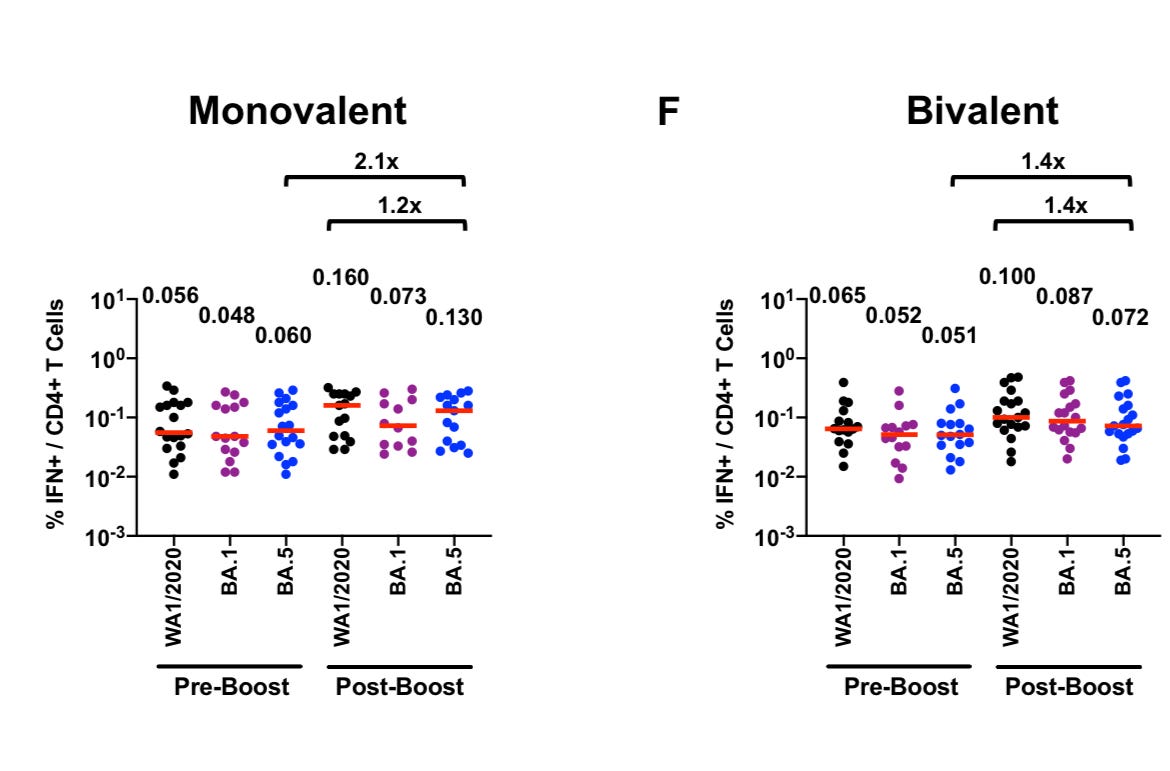
And the Omicron shots are even WORSE than the original boosters in producing T-cells that target Omicron, according to the researchers, part of a group led by Dr. Dan Barouch, a highly respected virologist. This finding is of particular concern because T-cells, the second line of the immune system, keep infections from becoming too severe.
—
Boosters using the original mRNA formulation have been largely phased out, because – as public health bureaucrats now admit – they stop working against Omicron infection within weeks. In fact, real-world data from many countries suggest they increase the risk of infection within months.
The “Omicron-specific” boosters were supposed to solve that problem. Regulators approved them in August, despite a lack of any clinical trial evidence they reduced coronavirus infections or serious cases of Covid in people. The Federal government agreed to pay Pfizer and Moderna $5 billion for 171 million doses of them.
But both Dr. Barouch’s study and another last week from Dr. David Ho, another top virologist, found that Omicron-specific boosters work no better than the original boosters against Omicron. Both studies showed the antibodies our immune systems produce after the Omicron shot are more effective against the original and now essentially extinct version of Sars-Cov-2 than against Omicron variants.
This phenomenon is called “original antigenic sin” or “immune imprinting,” and can occur after any vaccination – or infection. But the mRNA shots appear particularly likely to cause it, probably because they stimulate such high levels of anti-spike antibodies when they are first given.
The findings help explain why so many people, including Centers for Disease Control director Dr. Rochelle Walensky, have recently tested positive shortly after being boosted.
But Dr. Barouch’s group went further than Dr. Ho’s, examining T-cells as well. It found the same problem; following both the Omicron and the old booster, T-cells focused much more on the original Sars-Cov-2 than Omicron variants.
T-cells are a crucial second line of immune defense, helping the body keep infections from becoming too severe. Because Omicron is not very dangerous to most people, so a weak T-cell response does not matter much against it. But if a future Sars-Cov-2 variant is more dangerous, the relative lack of a T-cell response could put vaccinated people may be at serious risk.
(Bivalent is a fancy word for “Omicron-specific.” Except the Omicron-specific booster isn’t Omicron-specific at all, which is why T-cells targeting Omicron hardly rise at all following the bivalent booster, while they more than double after the original booster.)
As the researchers concluded:
Our findings suggest that immune imprinting by prior antigenic exposure may pose a greater challenge than currently appreciated for inducing robust immunity to SARS-CoV-2 variants.
Such a polite way to say, we gave a billion-plus people mRNA shots that probably opened them to future Sars-Cov-2 infections forever.
Former President Trump was robbed of the 2020 election because he was a hinderance to those seeking to enslave us. ‘President Trump outlined the geopolitical context of the world, without ambiguity:
“We’re at war, in a true sense we’re at war, and we are fighting an invisible enemy,”1
Before we explore the nature of this present war against a “horrible invisible enemy”, we must first understand that in war, ‘to the victor go the spoils’. For millennia, conquered lands not only gave up their territory, but also many of their men, women and children as slaves. They would be duly commoditized as an asset that went to the victor. But what exactly is ‘slavery’?
This definition offers some key components of slavery which are worth considering:
What is legal?
What is obedience?
What is the labor required of a slave?
If we look way back in time, we can see that the Spartans did not mess around. They conquered a region, killed off the strong men, and enslaved everyone else. These assets provided Sparta with everything they required to wage war. The legality of this scheme was dictated by the swords, spears and shields of Spartan warriors. A slave remained obedient if they wanted to remain alive. The slave’s work was whatever Sparta required. All in all, it was a very simple system.
It was the Athenians, Carthaginians, Romans and Khazarians who developed more sophisticated methods of enslavement. Rather than directly enslaving peoples, their empires revolved around trade. Trade brought such immense wealth and prosperity that their empires did not need to impose the brutal militancy of Sparta in order to acquire slaves. They simply bought and traded slaves as they saw fit.
Trade, and the ownership of trade routes, therefore, became the path to power and prosperity. Slaves were a luxury afforded by the strongest and wealthiest civilizations. Slave trade represented a terrible threat to the weak and poor that were within the grasp of these empires.
The Khazarians, in particular, implemented the most sophisticated strategy by placing themselves right in the middle of the most valuable trade routes of Western civilization. Anything travelling east, west, north or south was taxed by the Khazarians, who would crush anyone that did not pay the 10% tax on their goods. Khazaria become extremely wealthy and powerful by ensuring 10% always went to the “big guy”; in this case this was the Kagan of Khazaria.
A few centuries later, the Holy Roman Emperor began granting privileges to various ‘Hanses’, which were medieval guilds of merchants or traders in certain German city states. This initiative would morph into the monopolization of trade on the North and Baltic Seas, eventually giving birth to the mighty Hanseatic League.
If any kingdom was not ‘obedient’ to the terms-of-trade doled out by the League, it was seen as an act of war. The Hanse towns would cut off the supply chain to any ‘rogue’ kingdom, and duly plunge it into famine and economic depression. Once sufficiently weakened, the Hanseatic League would then wage direct warfare, subduing their enemy back into obedience.
In terms of the components of slavery, there is much we can learn:
It was legal because an agreement (in the form of a Treaty, contract or mandate) was signed by the Sovereign;
It was forced-labor because the terms of trade would create an unfair advantage to the Hanseatic League, which in turn reinforced their power over that kingdom; and
It was forced-obedience because the Monarchs didn’t want their subjects placed into famine and poverty, which could potentially give cause for the overthrow of their monarchy.’ For the entire article go to https://prussiagate.substack.com/p/evolution-of-slavery-part-iv



 whatyareckon