
Life
All posts tagged Life
‘The existence of humans suggests that, at some point, there must have been a first human. Neither evolutionists nor creationists deny this. However, creationists believe that Adam (Genesis 1–2) was the first human. But whether the first human was Adam or some unnamed, recently-evolved person, where did that person learn to speak?
Evidence suggests that humans do not learn to speak unless they are taught by someone who already knows how to speak. Additionally, the archaeological record indicates that fully-developed languages have been in existence as long as humans have been (Elgin 1973, 44). For these reasons, Curtis, in a 1990 article, argues that a personal creator was responsible for the existence of the first human.
Linguistic Evidence
Linguistic research suggests that languages have not evolved from a prehistoric development period (Eglin 1973, 44). Rather, languages have always existed with the same communication potential as they currently possess. In fact, it is possible that they even held greater communication potential in the past.

Archaeological Evidence
The archaeological finds from the past 100 years of excavations have demonstrated that written language appears well developed in the earliest records of civilization. For example, the Ebla tablets date to about 2000 BC. These tablets contain writing in a fully-developed, phonetic language.
How Do People Learn How to Speak?
Some Darwinian anthropologists have suggested that if, in the process of evolution, there was a transition from animal to man, this transition would have included the acquisition of language. However, one of these anthropologists, Humbolt, realized that man cannot speak without already being human. For him, this created an unsolvable problem regarding the origin of speech (Lyell 1873).

Another problem with determining the origin of speech from an evolutionary perspective is that in so-called primitive cultures, the languages tend to be more complex than in more advanced cultures. Furthermore, animals with the physical capability to use logical speech do not do so. Studies have shown that animals that respond to commands do so based on vocal tones rather than the spoken words. Thus, all attempts to solve the evolutionary origin of language have failed.

Every child that learns how to speak learns from someone who already knows how to speak. There do not seem to be any exceptions to this rule. Feral children who grow up without contact with spoken language did not learn to speak until they came into contact with speaking individuals. Once they had heard speech, they were able to learn how to speak (Tomb 1925).
What Does this All Mean?

Since multiple languages appear to have existed in fully developed forms in the earliest known civilizations, it appears that the languages do not have one common root. Rather, each language appeared independently of the others.
This evidence aligns well with the biblical account. From the creation of Adam until the Tower of Babel, there was only one language on earth (Genesis 11:1). Curtis suggests that God taught the first man, Adam, to speak. It is clear that Adam spoke a well-developed language because he was able to name the animals (Genesis 2:19). From that point on, each generation learned to speak from the previous one.
Later, when God confused the languages at the Tower of Babel (Genesis 11:7), He miraculously created a number of additional unrelated, fully-formed languages. The pattern of language learning continued. Each person learned to speak from the previous generation.
Conclusion
The scientific evidence obtained through linguistic and archaeological studies suggest that the first human who learned how to speak must have learned from someone who already possessed the capability of speech. This first person must have learned from someone of a higher order than humans. This correlates well with the biblical account of God’s creation of Adam. Adam must have received the ability and knowledge to speak from God himself. The study of language demonstrates that there must be a creator God. No human can speak a language unless that person has been taught. Furthermore, languages have not arisen from some lesser forms of communication. They appeared early in history, fully developed. The languages present today do not share a common root, suggesting that they appeared as separate, well-developed languages. This accords well with the account of the Tower of Babel.
References
Curtis, William M. 1990. “Human Language Demands a Creator.” The Proceedings of the International Conference on Creationism 2:1, 69–72.
Elgin, Suzette H. 1973. What is Linguistics? Englewood Cliffs: Prentice-Hall Inc.
Lyell, C. 1873. Antiquity of Man, 4th Ed., 518.
Tomb, J. W. 1925. “On the Intuitive Capacity of Children to Understand Spoken Language.” British Journal of Psychiatry 1, 553–555.’https://newcreation.blog/how-did-humans-learn-to-speak/?mc_cid=c226022714&mc_eid=2abe4a38b0
‘One way to get a Nobel prize in something, you’ve got to break some new ground or discover something no one has ever seen. In the world, the making of a printing press or light bulb changes everything. People still try to invent a better mousetrap. It happens. The phone replaced the telegraph and now our mobile devices, the phone.
Everyone can learn something new from scripture. You might even change or tweak a doctrine you’ve always believed. On the whole, you don’t want to teach from the Bible what no one has ever heard before. The goal is the original intent and understanding of the Author.
From the left comes progressivism. The U. S. Constitution, just over two hundred years old, means something different than when it was written. Loosely constructed, it has a flexible interpretation into which new meanings arise. Hegelian dialectics say a new thesis comes from synthesis of antithesis and a former thesis. Everything can be improved.
Early after the inspiration and then propagation of the Bible, men found new things no one ever saw in scripture. Many of these “finds” started a new movement. People have their fathers, the father of this or that teaching, contradictory to the other, causing division and new factions and denominations. Some of these changes become quite significant, a majority supplanting the constituents of the original teaching.
At the time of the Reformation, it was as if the world first found sole fide and sole scriptura. Men often call justification the Reformation doctrine of justification. This opened a large, proverbial can of worms. Many could read their own Bible in their own language. Others now dug into their own copy of the original languages of scripture. Skepticism grew. “If we didn’t know this before, what else did they not tell us.” It became a time ripe for religious shysters and this practice hasn’t stopped since then.
Socinus
The Italian, Laelius Socinus, was born in 1525 into a distinguished family of lawyers. Early his attention turned from law to scripture research. He doubted the teachings of Roman Catholicism. Socinus moved in 1548 to Zurich to study Greek and Hebrew. He still questioned established doctrine and challenged the Reformers. Laelius wrote his own confession of faith, which introduced different, conflicting beliefs. They took hold of his nephew, Faustus Socinus, born in 1539.
Faustus rejected orthodox Roman Catholic doctrines. The Inquisition denounced him in 1559, so he fled to Zurich in 1562. There he acquired his uncle’s writings. His doubt of Catholicism turned anti-Trinitarian. The Reformation did not go far enough for Socinus. His first published work in 1562 on the prologue of John rejected the essential deity of Jesus Christ.
Socinus’s journeys ended in Poland, where he became leader of the Minor Reformed Church, the Polish Brethren. His writings in the form of the Racovian Catechism survived through the press of the Racovian Academy of Rakow, Poland. His beliefs took the name, Socinianism, now also a catch-all for any type of dissenting doctrine.
Socinianism held that Jesus did not exist until his physical conception. God adopted Him as Son at His conception and became Son of God when the Holy Spirit conceived Him in Mary, a Gnostic view called “adoptionism.” It rejected the doctrine of original sin.
Socianism denied the omniscience of God. It introduced the first well developed concept of “open theism,” which said that man couldn’t have free will under a traditional (and scriptural) understanding of omniscience.
Socinianism also taught the moral example theory of atonement, teaching that Jesus sacrificed himself to motivate people to repent and believe. His death gave men the ability to be saved by their own works, who weren’t sinners by nature anyway.
Unitarians
The work of Socinus lived on in the belief of early English Unitarians, Henry Hedworth and John Biddle. Socinian belief was helped along also by its position of conscientious objection, a practice of refusing to perform military service. This principle was very popular with many and made Socinianism much more attractive to potential adherents. The First Unitarian Church, which followed Socianism as passed down through its leaders in England, was started in 1774 on Essex Street in London, where British Unitarian headquarters are still today.
As the Puritans of colonial America apostatized through various means, Unitarianism, a modern iteration of Socinianism took hold in the Congregational Church in America. After 1820, Congregationalists took Unitarianism as their established doctrine. The doctrine of Christ diminished to Jesus a good man and perhaps a prophet of God and in a sense the Son of God, but not God Himself.
Spirit of Skepticism
I write as an example of the diversity in the history of Christian doctrine and why it takes place. When you read the beliefs of Socinians, you easily see them in modern liberal Christianity. They influence on religious cults that deny the deity of Jesus Christ.
A limited amount of skepticism wards away the acceptance of false doctrine. Better is a Berean attitude (Acts 17:11), searching the scripture to see if these things are so, and what Paul wrote in 1 Thessalonians 5:21, proving all things, holding fast to that which is good.
As I grew up among fundamentalists and independent Baptists, I witnessed regular desire to find something new in the Bible. Many sermons espoused interpretations I had never heard and didn’t see in the text. A preacher often said, “God gave it to me.” You should know God used the man because no one had seen such insights into scripture.
The same spirit of doctrinal novelty continues today in many evangelical churches. The same practice led Joseph Smith in his founding of Mormonism. Many cults arose in 19th century America under the same spirit of skepticism of established historical doctrines.
The Temptation of Novel Teaching
The temptation of novel teaching preys on anyone. Faustus Socinus accepted many orthodox doctrines of his day. He rejected Christ as fully God and fully human because it was contrary to sound reason (ratio sana). This steered Socinians toward Enlightenment thinking, where human reason took the highest role as arbiter of truth.
Warren Wiersbe wrote that H.A. Ironside, longtime pastor of Chicago’s Moody Church, said, “If it’s new, it’s not true, and if it’s true, it’s not new.” Elsewhere I read that Spurgeon first said that. I don’t know. Clever new interpretations, teachings, and takes on and from scripture corrupt and overturn scriptural, saving doctrines in the hearts of men. They condemn them through all eternity.’https://kentbrandenburg.com/2021/11/22/the-regular-history-of-clever-new-interpretations-teachings-or-takes-on-and-from-scripture-socinianism/
This Australian Senator is an apartheid promoter for that’s exactly what CCP vaccine mandates are all about. Having a Senator like her says a lot about the people who put her in the Senate!
‘I wanted to tell you what I am doing about ongoing and proposed medical segregation and workplace jab mandates by state governments and private corporations. You might have heard that Liberal Senators Gerard Rennick and Alex Antic and One Nation Senators Pauline Hanson and Malcolm Roberts have announced they are withholding their votes from the government in the Senate until Australians are given protection from vaccine discrimination.
An attempt was made by One Nation in the Senate this morning (Monday) to bring in a bill which would have ended vaccine discrimination. Senators Rennick and Antic as well as Matthew Canavan, Sam McMahon and Concetta Fierravanti-Wells voted for that bill. The bill was sadly defeated. As I am not a Senator, I did not get a vote. However, the One Nation bill is very similar to the one I have co-sponsored with Craig Kelly in the House of Representatives, titled the No Domestic COVID Vaccine Passports Bill 2021. I have already voted for this bill in the House of Representatives (unsuccessfully sadly) and will vote for it again and again and again, if and when the bill is given a chance to go forward.
But here’s what I’m doing now.
Earlier today, I informed Nationals leader Barnaby Joyce (and the Nationals Party Room of which I am a member) that, unless we act to stop state governments and private corporations from discriminating against non-vaccinated Australians when it comes to either employment or clientele, then I intend to not be beholden to party room discipline when voting in the House of Representatives.
To be clear, until federal action is taken against vaccine discrimination, I will be voting according to my conscience (or abstaining from votes) on bills and substantive motions rather than just voting with the government as MPs usually do.
As I was elected as a member of the Liberal National Party, I will continue to support the government with confidence motions and supply as well as procedural motions (except if they relate to ending vaccine discrimination). My support is not guaranteed on bills or substantive motions. When action is taken to stop vaccine discrimination, I will go back to the normal process of voting with the government on most, if not all, bills and substantive motions.
I have no doubt this stance will result in personal attacks on me. But far more important than my political and personal reputation is the prospect of ending the tyranny, the discrimination, the segregation, the job losses and the negative business impacts that are all being wrought (or are about to be wrought) on my fellow Australians.
You can support my stance at www.georgechristensen.com.au/vax
Here’s hoping we see some action soon.
God bless you and your family.
Take care,
George Christensen MP‘https://nationfirst.substack.com/p/-alert-what-im-doing-to-stop-vaccine
‘A small, violent group of counter-protesters lash out at independent media as hundreds of thousands rally against pandemic powers’ and the Victorian Police move Avi on (for his protection)!
‘I have heard from multiple people now that Comcast is sending Unreported Truths emails to spam no matter how many times users mark them otherwise.
And this just came in.
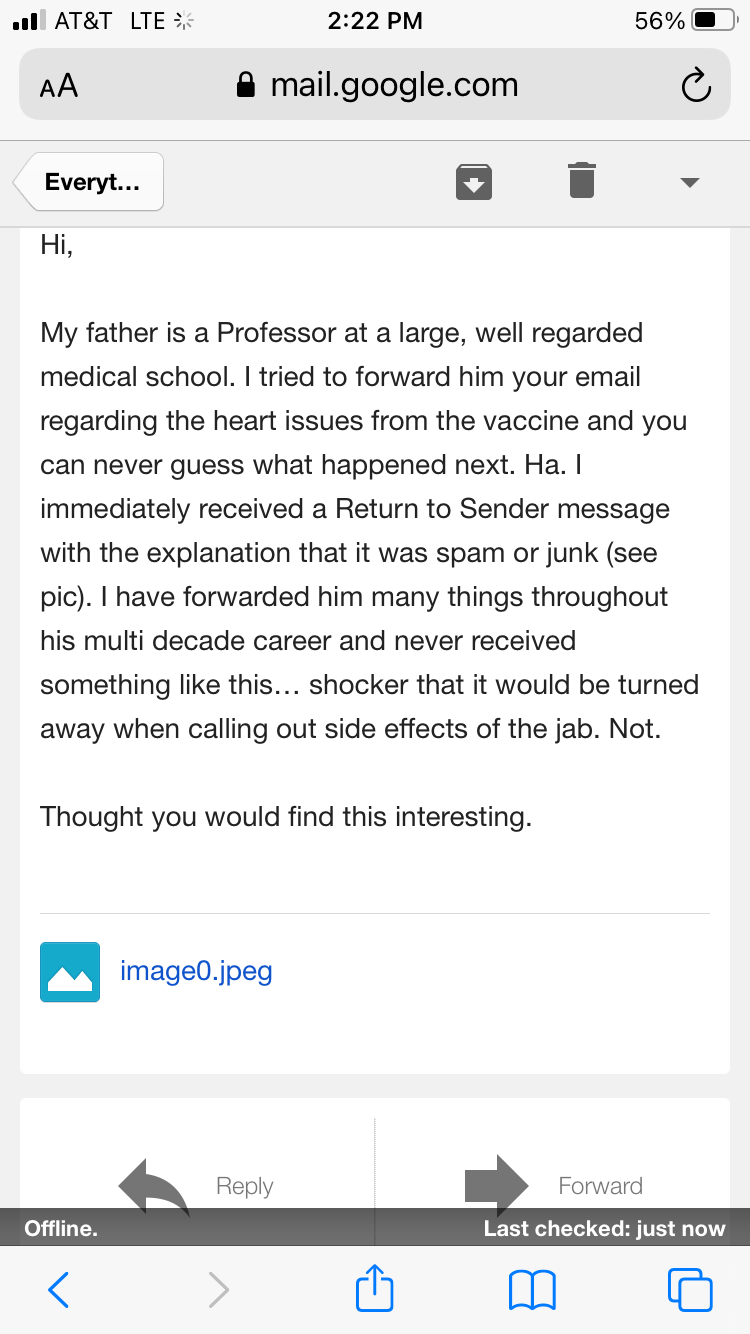

I have also heard that some hospitals are blocking all access to Unreported Truths on their networks. Because science! Sciency-sciency-science! is all about making sure people can’t have access to data that might make them question dogma for themselves.
I email fairly frequently (for better or worse), so if you don’t see something from me for a couple of days, make sure to check your spam box.’https://alexberenson.substack.com/p/the-censorship-from-email-providers/comments?token=eyJ1c2VyX2lkIjo0MjUyOTI1MiwicG9zdF9pZCI6NDQ0MjIxMjEsIl8iOiJEbU9udiIsImlhdCI6MTYzNzYxMzY4OSwiZXhwIjoxNjM3NjE3Mjg5LCJpc3MiOiJwdWItMzYzMDgwIiwic3ViIjoicG9zdC1yZWFjdGlvbiJ9.wqu89QCSpNl_fQDOL_dxWgpt_VnDfZB-J3WBjMdb2Eg


