
John 10:27 My sheep hear my voice, and I know them, and they follow me
King James Bible
All posts tagged King James Bible
Dr. D. A. Waite is a defender of the Masoretic Hebrew and Received Greek texts of the Word of God. In a recent issue of the Dean Burgon Society News he wrote that;
‘It perplexes me to observe many saved believers who can not see the truth about the textual issue. The Bible states clearly that “all Scripture is given by inspiration of God” (2  Timothy 3:16), which points to inerrancy and infallibility. The Bible also very directly states over and over again that Scripture is preserved. For example, Psalm 12:7 states, “Thou shalt keep them, O LORD, thou shalt preserve them from this generation for ever”, referring to Scripture. And again in John 10:35b, “..the scripture cannot be broken.” Also in 1 Peter 1:23, 25, Matthew 24:35, Isaiah 40:8, Psalm 119:89, and others. Not just Scripture in general, but the very Words of God. The Bible is very clear about this even in with some of the passages in many of the corrupt English versions. For example, the NIV cites Matthew 24:35 as, “ Heaven and earth will pass away, but my words will never pass away.“ This is very , very close to the KJB and is basically a good interpretation of the passage despite the many other flaws that the NIV embraces.
Timothy 3:16), which points to inerrancy and infallibility. The Bible also very directly states over and over again that Scripture is preserved. For example, Psalm 12:7 states, “Thou shalt keep them, O LORD, thou shalt preserve them from this generation for ever”, referring to Scripture. And again in John 10:35b, “..the scripture cannot be broken.” Also in 1 Peter 1:23, 25, Matthew 24:35, Isaiah 40:8, Psalm 119:89, and others. Not just Scripture in general, but the very Words of God. The Bible is very clear about this even in with some of the passages in many of the corrupt English versions. For example, the NIV cites Matthew 24:35 as, “ Heaven and earth will pass away, but my words will never pass away.“ This is very , very close to the KJB and is basically a good interpretation of the passage despite the many other flaws that the NIV embraces.So why are the Critics blind about this issue? I think there are several reasons involved. One of them is that they are not led by the Holy Spirit on this issue and another is that some of them may not be saved at all. A big reason is that they were taught a certain way in seminary, as was I at Dallas Theological Seminary, many years ago. Many men, unfortunately, accept whatever they are taught without question. They never examine the issue with care. They never compare what they were taught with Scripture itself.
One crystal clear observation that they should make is that their favorite manuscripts, Codex Vaticanus, Codex Sinaiticus, P75, and many others do not agree with one another. I am not just talking about spelling issues. They do not agree with one another with regard to good grammar, words missing or added, complete changes, complete passages removed, and in many other ways.
It is certainly possible, even likely, that God allowed for some occasional anomalies in His Word such as leaving out the Hebrew nun (נ) in Psalm 145, but there are also very good reasons for those anomalies. Sometimes, we know what they are and sometimes not, but what we do know is that God’s Word is inspired, inerrant, authoritative, sufficient, and preserved. It is because of this, that we may also know that His Word is NOT inconsistent. We can know false Scripture from true Scripture by its consistency and by whether it affects theology and doctrine in any way. The Critics “precious” manuscripts do not stand up in the face of scrutiny. They fail in many ways. Let’s keep to the traditional texts, which are preserved in the Masoretic and Received texts, which are the texts behind the King James Bible.’DBS Issue 121

MORNING & EVENING:
DAILY READINGS
by C. H. SPURGEON
JANUARY 23 — AM
“I have exalted one chosen out of the people.” — Psalm 89:19
Why was Christ chosen out of the people? Speak, my heart, for heart-thoughts are best. Was it not that He might be able to be our brother, in the blest tie of kindred blood? Oh, what relationship there is between Christ and the believer! The believer can say, “I have a Brother in heaven; I may be poor, but I have a Brother who is rich, and is a King, and will He suffer me to want while He is on His throne? Oh, no! He loves me; He is my Brother.” Believer, wear this blessed thought, like a necklace of diamonds, around the neck of thy memory; put it, as a golden ring, on the finger of recollection, and use it as the King’s own seal, stamping the petitions of thy faith with confidence of success. He is a brother born for adversity, treat Him as such.
Christ was also chosen out of the people that He might know our wants and sympathize with us. “He was tempted in all points like as we are, yet without sin.” In all our sorrows we have His sympathy. Temptation, pain, disappointment, weakness, weariness, poverty — He knows them all, for He has felt all. Remember this, Christian, and let it comfort thee. However difficult and painful thy road, it is marked by the footsteps of thy Saviour; and even when thou reachest the dark valley of the shadow of death, and the deep waters of the swelling Jordan, thou wilt find His footprints there. In all places whithersoever we go, He has been our forerunner; each burden we have to carry, has once been laid on the shoulders of Immanuel.
“His way was much rougher and darker than mine Did Christ, my Lord, suffer, and shall I repine?”
Take courage! Royal feet have left a blood-red track upon the road, and consecrated the thorny path for ever.
JANUARY 23 — PM
“We will remember Thy love more than wine.” — Song of Solomon 1:4
Jesus will not let His people forget His love. If all the love they have enjoyed should be forgotten, He will visit them with fresh love. “Do you forget my cross?” says He, “I will cause you to remember it; for at My table I will manifest Myself anew to you. Do you forget at I did for you in the council-chamber of eternity? I will remind you of it, for you shall need a counsellor, and shall find Me ready at your call.” Mothers do not let their children forget them. If the boy has gone to Australia, and does not write home, his mother writes — ”Has John forgotten his mother?” Then there comes back a sweet epistle, which proves that the gentle reminder was not in vain. So is it with Jesus, He says to us, “Remember Me,” and our response is, “We will remember Thy love.” We will remember Thy love and its matchless history. It is ancient as the glory which Thou hadst with the Father before the world was. We remember, O Jesus, Thine eternal love when Thou didst become our Surety, and espouse us as Thy betrothed. We remember the love which suggested the sacrifice of Thyself, the love which, until the fulness of time, mused over that sacrifice, and long for the hour whereof in the volume of the book it was written of Thee, “Lo, I come.” We remember Thy love, O Jesus as it was manifest to us in Thy holy life, from the manger of Bethlehem to the garden of Gethsemane. We track Thee from the cradle to the grave — for every word and deed of Thine was love — and we rejoice in Thy love, which death did not exhaust; Thy love which shone resplendent in Thy resurrection. We remember that burning fire of love which will never let Thee hold Thy peace until Thy chosen ones be all safely housed, until Zion be glorified, and Jerusalem settled on her everlasting foundations of light and love in heaven.
Are all Bibles the same? Does it really make any difference what English Bible you use? The answer to question one is; if they are different they are not the same. The answer to question two is; do you want a Bible with all that God spoke or only what man thinks God spoke?
Dr. Boys wrote ‘Recently, a highly trained and very successful New Jersey pastor announced that he would be preaching the following week in his Gospel of John series but would not deal with John 7:53-8:11–the woman taken in adultery who was forgiven by Christ. The pastor, very close to me, wrote, “we conclude without doubt that John 7:53-8:11 was not 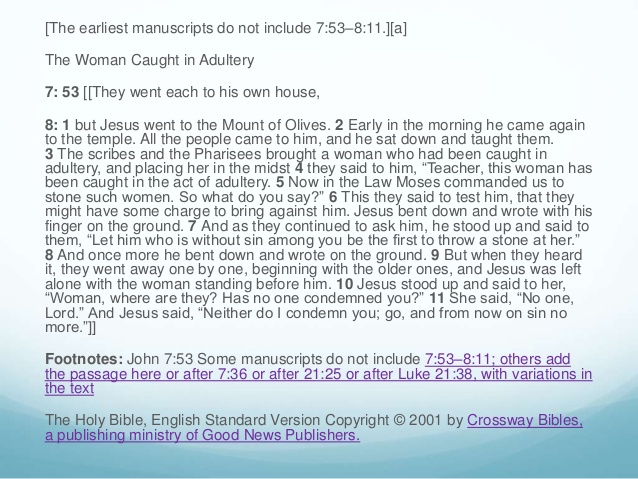 part of the gospel of John as the Apostle wrote it.” I disagree. There is plenty of doubt.
I believe that pastor, far more qualified than I, was wrong. In a discussion with him or other scholars about biblical manuscripts, I would feel like a mule at the Kentucky Derby. But he is still wrong. In fact, he has to be wrong because God promised to preserve His Word. If He did not, then the Bible is untrue, unreliable, and unnecessary.
Even though that pastor is my very special first grandchild (and the father of four precious great grandchildren), he is still wrong! Of course, he knows my position on this issue.
He also suggested that pastors need to know the biblical languages in order to provide correct instructions to church members; however, if pastors know those languages, they must use the correct manuscripts and reject the corrupt ones. But his suggestion smacks of Roman Catholics who made it illegal for members to keep a copy of the Bible in their vernacular. The Catholics were to come to the priest for a “correct” interpretation. One reason God gave us the Bible in our language was so we could all become Bereans who “searched the scriptures daily, whether those things were so.” While it is good to know the original languages, it is not a requirement to be an effective pastor.
Some pertinent questions about the Bible’s reliability will be helpful: Could a sovereign, all-powerful God lead and direct men to write a perfect book? Of course, the question demands a positive answer. Question two: Could a sovereign, all-powerful God, after directing men to write a perfect Bible, then keep scribes and translators from error? Again, the answer must be positive. Third question: Why would a sovereign, all-powerful God direct men to produce a perfect Bible to give mankind directions for life and death, and not preserve its perfection?
Pastors who take the modern approach tell us that the Bible is perfect in the “originals” but they seldom tell their audience that no one has seen the “originals” in 2000 years! Why would God give man the “originals” for a few years and leave following generations with an imperfect book? Why give the human race a perfect book then take it from us?
The disputed passage belongs in the Bible; if the Bible is not reliable in John 7 and 8, it is not reliable in John 3 on which personal salvation rests. The Bible is the Words of the  Living God which will stand forever. If our critics are correct and we do not have an available, accurate, and authoritative Word then where on the face of the earth can we find His will?
Admittedly, the issue is one that good, great, and godly scholars have debated for centuries. One of the earliest objections to the John passage is that Christ seems to be abrogating the Old Testament law requiring death for adultery. Ancient Jews were fearful that Christ’s leniency might give succor to their wives about adultery! Ambrose (died 420) mentioned this in a sermon on David and Bathsheba condemning those who were critical of Christ and those who excised the passage. So the passage was in the Bibles of the early 400s.
Many other Latin Fathers including John Chrysostom and Augustine of Hippo all speak of the passage as being canonical! Augustine (died 430) said some scribes removed the passage because it might seem that Christ was nonchalant about adultery, but Augustine did not advocate removing it from Scripture.
Jerome (died 420), who translated the Latin Vulgate, agreed the passage was legitimate and left it in his translation. Furthermore, he says that the disputed passage was found in “many Greek and Latin manuscripts” in Rome and the Latin West, late in the 4th century.
However, an overzealous scribe decided it would be best to remove the passage rather than cause concern and possibly encourage loose living with scriptural justification! Such scribes were guilty of taking away from the Word of God which is dangerous.
The disputed passage is included in the 1611 KJV, in the 1587 Geneva Bible, 1568 Bishop’s Bible, 1539 Great Bible, 1537 Matthew’s Bible, 1535 Coverdale Bible, 1526 Tyndale Bible, and 1382 Wycliffe Bible. Modern Bibles omit it, footnote it, or bracket it so that readers get the message: it is not reliable. It is fake news, a false story by fallible writers.
All liberals and many Evangelicals teach that the John passage should not be in the Bible, yet the new translations keep putting it in the Bible! The RSV even took it out causing a furor, then replaced it in a later edition to make people happy and to continue selling Bibles! (Is it cynical to suggest that modern translations are all about money?) Modern translators know that removing that famous story would precipitate rebellion, revolution, and ruin in their Bible market. So they knowingly use a passage that practically all their liberal experts agree should not be in the Bible! If a passage does not belong in the Bible (according to their research and convictions), they should do the principled thing, but modern translators have taken a stand like a crippled chicken. They place the disputed passage in their translations because of cash, cowardice, and convenience.
There are some reputable scholars who agree with my grandson about whether or not the passage belongs in John’s Gospel. Among them are: Bruce Metzger, Leon Morris, Merrill Tenney, D. A. Carson, Ed Blum, Colin Kruse, John Piper, R. C. Lenski, Alfred Edersheim, G. Campbell Morgan, and A. T. Robertson.
Some in the above camp consider the defense of the passage and defense of the KJV a “cancerous sore,” “cultic,” “near cultic,” and “deplorable.” Such “scholars” are, in my opinion, “deplorable.”
Other scholars accept the passage as scriptural: Dean John William Burgon, Zane Hodges, D. A. Waite, David Otis Fuller, Edward F. Hills, A. W. Pink, R. C. Sproul, John MacArthur, James Boice, J. C. Ryle, and John Calvin. So, there are good, highly qualified men on both sides of this issue.
Evidently, there is some doubt. It is not as clear as the critics say.
According to the number of manuscripts that have and don’t the passage, 1,495 Greek manuscripts include the John passage or part of it, and 267 do not include it. Moreover,  the 267 manuscripts are very early. Most people are impressed with the “earliest” manuscripts but valid, original manuscripts were in the hands of early church fathers who quoted from them from A.D. 150 forward! They quoted, for example, from the last twelve verses of Mark so how could they quote from manuscripts they didn’t hold in their hands? Manuscript date is part of the equation, but it is non-determinative. Manuscripts should be accepted unless proved defective.
Even Aristotle’s dictum supports that approach. He said, “the benefit of the doubt is to be given to the document itself, not arrogated by the critic to himself.” However, modern translators think they are more trustworthy than the document in question, but I wouldn’t trust them to walk my dog!
The fathers of modern Bible translations, Brooke Foss Westcott (1825-1903) and Fenton John Anthony Hort (1828-1892) declared, “The earliest and most reliable manuscripts and other ancient witnesses do not have John 7:53-8:11.” These so-called earliest and most reliable manuscripts were polluted at an early age by the Gnostics whose headquarters were in Alexandria, Egypt–the same city where the Vatican manuscript arose. When the Gnostics didn’t agree with some doctrine or passage, they either subtracted it, or changed it in some way to fit their heretical theology. Hence the production of the Vatican and Sinai manuscripts.
Westcott and Hort, like many liberals, gush over the “earliest” and “most reliable” manuscripts but the earliest are not always the most reliable. Both men were unbelieving Anglican priests.
It should also be remembered that the main reason there are so many older manuscripts extant is because they were avoided by the early church leaders because the documents were corrupt. They didn’t get worn out and thus survived to be found and used to confuse Christians today.
Moreover, the “earliest” and “most reliable” manuscripts are identified as Vaticanus and Sinaiticus from the fourth century. Westcott and Hort assumed that both manuscripts were far superior and since those manuscripts did not have the John passage, that was enough for them. However, traditional Greek manuscripts preceded the 4th century manuscripts of Vaticanus and Sinaiticus and were quoted by many church fathers such as Irenaeus who wrote from 150 A.D.! Since very early church fathers quoted from Mark 16:9-20 for example, then it is false to claim that the Vaticanus and Sinaiticus were the oldest known manuscripts.
But it gets even worse for proponents of modern translations. Dean John Burgon was a famous scholar and Bible defender (died 1888) and he declared that Vaticanus and Sinaiticus are among “the most corrupt copies in existence.” Older does not equal reliable.
According to Frederick Henry Ambrose Scrivener, the African Church corrupted the New Testament as far back as A.D. 150! He also declared of the Codex Sinaiticus (Aleph) from the 4th Century: “From the number of errors, one cannot affirm that it is very carefully written.”
Of the Codex Vaticanus (B) from the 4th Century, he declares that a marked feature is the great number of omissions and calculates that whole words or clauses are left out!
Not a good recommendation for the much vaunted Sinaiticus and Vaticanus–from a scholar recognized as an expert by both sides of the controversy.
Most readers do not know of this Bible disagreement in Fundamentalist and Evangelical ranks. Most religious leaders do not believe the KJV is totally reliable while many do. However, I have noticed for many years the tendency of both sides to demonize the other. Those critical of the KJV are often very arrogant and vicious in their opposition, even calling us “cultists.” They quickly slide by the fact that many of our persuasion hold degrees just as reputable as theirs.
And on the other side, some in our group give good ammunition to the other side by making irresponsible and ridiculous claims. Some claim the KJV is “better than the Greek”; others declare than the KJV must be used in preaching or a person cannot be born again! There are devoted dummies on both sides of the issue.
If a man tells me he sincerely wants to know about eternal things, I will send him to the King James Bible for the truth. I tell him that it is God’s instruction manual for mankind  which was accurately translated into English from the reliable and preserved Hebrew and Greek texts and preserved by God therefore, is totally reliable.
All the modern versions are based on corrupt Vaticanus and Sinaiticus and the work of evolutionists Westcott and Hort, radical unbelievers. They were Anglican scholars who never missed a chance to denounce, deny, and denigrate the Bible; but they did not disprove it. According to Dr. Jack Moorman’s book on Bible manuscripts, Westcott and Hort’s Vatican and Sinai manuscripts of the New Testament contain more than 8,000 differences with the traditional text underlying the King James Bible!
I can’t think of anything more shattering than for congregations to be told that the Bible on their laps is full of mistakes, misquotes, and misinformation. It is not if it is the KJV.
All right, for sake of argument, I could be wrong. If I have placed too much confidence in the Word of God, I will discover that at the Judgment Seat of Christ. I suppose Christ will say, “Don, you were wrong about the KJV being totally reliable. You were too committed to my Word!” I believe He will correct my error but with a smile and nod.
After all, I have only convinced people to place too much reliance on the Word of God–not the worse sin to commit; however, those who burn incense to the corrupt modern translations are guilty of taking away from the Word of the living God who promised to preserve it forever!
If I am to be wrong, it will be in favor of the Word that He promised in Psalm 12:6-7, “The words of the LORD are pure words: …Thou shalt keep them, O LORD, thou shalt preserve them from this generation for ever.” Either He did or He didn’t!
So, honest people will look at the issue and come down on the side that is most convincing; however, it takes character to change when one has gone on record for most of his or her life. It’s difficult to admit a mistake. Tolstoy expressed this when he wrote, “I know that most men…can seldom accept even the simplest and most obvious truth if it be such as would oblige them to admit the falsity of conclusions which they have delighted in explaining to colleagues, which they have proudly taught to others, and which they have woven, thread by thread, into the fabrics of their lives.”
However, having a reliable Bible is not a simple issue but it is sublime. I’ve made my decision and if I’m wrong, Christ will correct me. Same with you!’ http://donboys.cstnews.com/does-the-bible-contain-fake-news-and-false-stories-by-fallible-writers
Question: “HOMOSEXUALITY? There is no reference to homosexuality in any Bible prior to the 1946 RSV so why do you oppose it?”
Answer: “This question is, beyond a shadow of a doubt, taken from the words of the publishers of the new “Queen James Bible” for gays, which is now available and is a re-version of the King James Bible with editorial changes to make it pro-homosexual. The publishers state their reason for doing this as: “Homosexuality was first mentioned in the Bible in 1946 in the Revised Standard Version. There is no mention of or reference to homosexuality in any Bible prior to this – only interpretations have been made. Anti-LGBT Bible interpretations commonly cite only eight verses in the Bible that they interpret to mean homosexuality is a sin; Eight verses in a book of thousands! The Queen James Bible seeks to resolve interpretive ambiguity in the Bible as it pertains to homosexuality: We edited those eight verses in a way that makes homophobic interpretations impossible.” (LGBT stands for Lesbian, Gay, Bisexual, Transexual.)
It is true the words “homosexuality” and “homosexual” do not appear in the King James Bible, which was printed in the year 1611, but the simple reason is that those words hadn’t even been invented, even though the sexual act between males is clearly described in the King James Version (KJV) Biblical record. e.g. from the Old Testament: “Thou shalt not lie with mankind, as with womankind: it [is] abomination” (Leviticus 18 22 KJV) and: “If a man also lie with mankind, as he lieth with a woman, both of them have committed an abomination: (Leviticus 20:13 KJV). If you like to check the Apostle Paul’s use of the Greek word “arseno – koites” in 1 Corinthians 6: 9 (Strong’s number 733), which shouldn’t need any translation as a description of anal sex. Of course the similarity of the Greek to the vulgar Anglo Saxon ‘arse’ which has been doing the rounds for the past 1,000 years or so does not prove the case. You can either plug the English word homosexual into a modern online English Greek dictionary and find the translation is still arsenokoites, or you can trace the meaning from its parts arsenand koites which refers to men in bed. And when men are sleeping together – we think you’ve got the point.
In 1 Corinthians 6: 9 chapter Paul wrote on the sinfulness of homosexuality. The King James Translators rendered the Greek as “abusers of themselves with mankind.” The word “homosexual” wouldn’t be available in English for at least another two and half centuries. The Oxford Dictionary informs us the word “homosexual” has its origin in the late 19th century, and is a blend of the words “homo” (from the Greek: homos, meaning ‘same’) and “sexual” (no explanation necessary).
Many words have been added to the English language since 1611, and some of these are used in more modern translations of the Bible. As long as they are accurate translations of the original Hebrew and Greek this is quite appropriate, and it is no excuse for perverting the clear meaning of a passage, as the “Gay Bible” crowd have done. Acts of homosexuality (and Lesbianism) are clearly described in the Bible and exclusively mentioned in the context of condemnation and judgement, even in the New Testament, e.g. “For the wrath of God is revealed from heaven against all ungodliness and unrighteousness of men, who hold the truth in unrighteousness; … For this cause God gave them up unto vile affections: for even their women did change the natural use into that which is against nature: And likewise also the men, leaving the natural use of the woman, burned in their lust one toward another; men with men working that which is unseemly, and receiving in themselves that recompence of their error which was meet.” (Romans 1:18, 26-27 KJV)
The argument that “only eight verses” interpret homosexuality as sin is no excuse for changing the meaning of any Scripture. Truth is never determined by the number of times something is mentioned in the Bible. God needs only tell us once to pronounce something right – or wrong!
At the end of their introduction the Queen James publishers quote the famous verse: “For God so loved the world, that he gave his only begotten Son, that whosoever believeth in him should not perish, but have everlasting life.” (John 3:16) We would remind us all that the gift of everlasting life is given to those who repent of their sins, rather than pretend their sins don’t exist. The Apostle John reminds us: “If we say that we have no sin, we deceive ourselves, and the truth is not in us. If we confess our sins, he is faithful and just to forgive us our sins, and to cleanse us from all unrighteousness. (I John 1:8-9)
The Apostle Paul reminded the Christians at Corinth that they once participated in many sins that would exclude them from the kingdom of God, including being “effeminate”, and “abusers of themselves with mankind” as translated in the KJV. Modern translations use the word “homosexual” here, which falls just a little short, as the King James Bible has translated two Greek words referring to both passive (effeminate) and active participants in homosexual acts (abusers). So much for “I am gay but not practising,” claim of some clergy! Paul then reminds the Corinthian Christians of the glorious truth: “And such were some of you: but ye are washed, but ye are sanctified, but ye are justified in the name of the Lord Jesus, and by the Spirit of our God.” (I Corinthians 6:11 KJV)
By deceiving people into denying that homosexuality is sin, the Queen James publishers are hindering their followers from receiving the wonderful free gift of forgiveness and new life in Christ, and in so doing are locking people out of Jesus’ Kingdom here and for eternity. They need to repent now, and do so publically!” http://askjohnmackay.com/no-reference-homosexuality-in-bible-prior-to-1946-rsv-why-oppose/


