I am so glad there were WISHY WASHY “Christian book authors published by Zondervan” who opposed the God Bless the USA Bible https://religionunplugged.com/news/2021/5/25/why-were-glad-our-publisher-isnt-backing-this-bible which was going to use the Westcott and Hort Critical Text New Testament based New International version! That opposition led to the project using the ENGLISH BIBLE translated from the Masoretic Hebrew and Recieved Greek Text known as the KING JAMES BIBLE or the AUTHORIZED BIBLE! Their website says “This bible has been designed so that it delivers an easy reading experience in the trusted King James Version translation. This large print Bible will be perfect to take to church, a bible study, to work, travel, etc.”https://godblesstheusabible.com/
Well, anyway ‘The controversial God Bless the USA Bible is still on track, with a little help from a long-dead British king.
A Nashville-based marketing firm had planned to publish a New International Version Bible that paired the Christian Scriptures with the U.S. Constitution, Declaration of Independence, Bill of Rights and Pledge of Allegiance, along with lyrics to “God Bless the U.S.A.,” the 1984 patriotic anthem from country singer Lee Greenwood.
Hugh Kirkpatrick of Nashville-based Elite Source Pro said he had reached an agreement with HarperCollins, whose subsidiary Zondervan is licensed to publish the NIV, to produce 1,000 copies of the Bible and already had more than 500 orders.
After news about the Bible was reported by ReligionUnplugged, an online magazine, several Christian book authors published by Zondervan objected. More than 800 people also signed an online petition as well.
Kirkpatrick said HarperCollins then contacted him and backed out of the project, which he said was disappointing. But that’s the way things go, he said.
“It’s not the end of the world,” Kirkpatrick told Religion News Service. “I believe that from a business perspective, they have the freedom to make their own decisions.”
Kirkpatrick said his contacts at HarperCollins had already done some design work on the God Bless the USA Bible. He’s now taken those files, along with the text of the King James Version of the Bible — which is in the public domain — and sent them to several printers. He hopes to finalize plans for printing the Bibles, which will have an imitation leather cover, this week.
Kirkpatrick, who is 58, described himself as a nondenominational Christian who loves America. He said the audience for the Bible is people like him — who care about their country and spirituality. He worries our current political divides have made it difficult for people to appreciate the country’s heritage.
The flag on the Bible’s cover represents America — not former President Donald Trump, he said.
For him, the God Bless the USA Bible is a patriotic book, not a sign of Christian nationalism. Kirkpatrick also believes the nation’s Founding Fathers were inspired by the words in the Bible and that it will be helpful to have both the Scripture and the Constitution in the same book.
Kirkpatrick believes America was once a Christian country but it has been “sliding away from that.” And he does worry about the future.
Many years ago after attending schools that leaned toward the NIV and other versions based on the Critical text of Westcott and Hort I came to the personal conviction that the Authorized Bible based on the Received Greek Text and the Masoretic Hebrew Text was God’s Word in the English language. Here is the testimony of Alex Bowler https://www.alexbowlerevangelism.com/why-i-use-the-king-james-bible.html as to why he uses only the Authorized Bible, the King James Bible.
The words of the Lord are pure words: as silver tried in a furnace of earth, purified seven times. Thou shalt keep them, O Lord, thou shalt preserve them from this generation for ever. Psalm 12:6 & 7
‘A Personal Testimony
Ask, and it shall be given you; seek, and ye shall find; knock, and it shall be opened unto you: Matthew 7:7
As a new Christian I decided to read three Bibles: the New International Version, the Good News Bible and the King James Bible. I thought that the NIV and GNB, written in modern English, would help me to understand the King James Bible better. During my Bible studies however, I began to notice great differences between the King James Bible and the other two versions. I saw that passages about the deity of Christ, the blood of Jesus, the Trinity and other important doctrines had been changed, watered down or even deleted in the NIV and GNB and I grew increasingly uneasy about this. I knew in my heart that God must have preserved His true word for us to read so one day I prayed: “Lord, please show me which Bible you want me to use, which Bible is your true word.” Later that same day I decided to go for a walk in a nearby park, and saw in the distance a Christian friend, who attended a local Anglican Church, walking towards me. As she approached me I could see that she was carrying a Bible under her arm. We greeted each other and then she said, “Hi! Guess what? The Lord spoke to me today and told me to bring this King James Bible to your parents’ house and to give it to you!”
From that day I have only read and preached from the King James Bible – God’s pure preserved words in English.
Rotten Roots
For there are certain men crept in unawares, who were before of old ordained to this condemnation, ungodly men, turning the grace of our God into lasciviousness, and denying the only Lord God, and our Lord Jesus Christ. Jude:4
Brooke Foss Westcott (1825 – 1901) Fenton John Anthony Hort (1828 – 1892)
‘ …. ye have perverted the words of the living God, …’ Jeremiah 23:36
The 4th Century Roman emperor Constantine wanted to bring unity between Christians and pagans. He therefore commissioned the creation of fifty Alexandrian ‘bibles’. It is speculated that the Vaticanus and Sinaiticus manuscripts, which underlie modern versions, are part of this fifty but if so, why are there so many differences between them?
In 1844 Lobegott Friedrich Constantin (von) Tischendorf claimed to have found 86 sheets of vellum, in a wastepaper bin which were to be burned, in the Roman Catholic St Catherine’s Monastery at the foot of Mt. Sinai in Egypt. He later claimed that by 1859 he obtained what they came from: a huge codex he called Sinaiticus. This included parts of the Old Testament, all of the New Testament, as well as the Epistle of Barnabas and the Shepherd of Hermas. A Greek palaeographer, Constantine Simonides, really threw the cat amongst the pidgeons and infuriated Von Tischendorf, who was glorying in his ‘discovery’ and his publication of Sinaiticus in 1862, when he claimed that same year to have produced Sinaiticus himself twenty years earlier!
Two 19th Century liberal Anglican churchmen, Westcott and Hort, studied Vaticanus and Sinaiticus and liked what they saw! They set out to create a NEW bible and saw their inclusion on the committee formed to undertake a modest revision of the King James Bible as a golden opportunity to introduce their radical and heretical changes, even insisting on the inclusion in that committee of the Unitarian scholar Dr. Vance Smith! (This revision of the King James Bible was sanctioned by the Southern Convocation of the Church of England.) Using Vaticanus and Sinaiticus they changed the historical Greek New Testament text to conform to those corrupt Alexandrian manuscripts! The result was the notorious English Revised Version of 1881, which horrified evangelical Christians on its publication and caused an outcry! This was the start of the counter-Reformation in earnest! The rot truly set in in 1881. (NB The New Testament was published in 1881, the Old Testament in 1885)
A wicked plan was put in place to flood Bible colleges, churches and bookshops with fake ‘bibles’ produced from these corrupt manuscripts and to attack by all means the pure preserved words of the Lord in English – the King James Bible. This plan continues to this day with a vengeance!
18 A good tree cannot bring forth evil fruit, neither can a corrupt tree bring forth good fruit.. 19 Every tree that bringeth not forth good fruit is hewn down, and cast into the fire. 20 Wherefore by their fruits ye shall know them. Matthew 7:18-20
Statements of Westcott and Hort
The following quotes are taken from the diaries and letters of Westcott and Hort.
1846 Oct. 25th – Westcott: “Is there not that in the principles of the “Evangelical” school which must lead to the exaltation of the individual minister, and does not that help to prove their unsoundness? If preaching is the chief means of grace, it must emanate not from the church, but from the preacher, and besides placing him in a false position, it places him in a fearfully dangerous one.” (Life, Vol.I, pp.44,45).
Oct., 22nd after Trinity Sunday – Westcott: “Do you not understand the meaning of Theological ‘Development’? It is briefly this, that in an early time some doctrine is proposed in a simple or obscure form, or even but darkly hinted at, which in succeeding ages,as the wants of men’s minds grow, grows with them – in fact, that Christianity is always progressive in its principles and doctrines” (Life, Vol.I, p.78).
Dec. 23rd – Westcott: “My faith is still wavering. I cannot determine how much we must believe; how much, in fact, is necessarily required of a member of the Church.” (Life, Vol.I, p.46).
1847 Jan., 2nd Sunday after Epiphany – Westcott: “After leaving the monastery we shaped our course to a little oratory…It is very small, with one kneeling-place; and behind a screen was a ‘Pieta’ the size of life (i.e. a Virgin and dead Christ)…I could not help thinking on the grandeur of the Romish Church, on her zeal even in error, on her earnestness and self-devotion, which we might, with nobler views and a purer end, strive to imitate. Had I been alone I could have knelt there for hours.” (Life, Vol.I, p.81).
1848 July 6th – Hort: “One of the things, I think, which shows the falsity of the Evangelical notion of this subject (baptism), is that it is so trim and precise…no deep spiritual truths of the Reason are thus logically harmonious and systematic…the pure Romish view seems to me nearer, and more likely to lead to, the truth than the Evangelical…the fanaticism of the bibliolaters, among whom reading so many ‘chapters’ seems exactly to correspond to the Romish superstition of telling so many dozen beads on a rosary…still we dare not forsake the Sacraments, or God will forsake us…I am inclined to think that no such state as ‘Eden’ (I mean the popular notion) ever existed, and that Adam’s fall in no degree differed from the fall of each of his descendants” (Life, Vol.I, pp.76-78).
Aug. 11th – Westcott: “I never read an account of a miracle (in Scripture?) but I seem instinctively to feel its improbability, and discover some want of evidence in the account of it.” (Life, Vol.I, p.52).
Nov., Advent Sunday – Westcott: “All stigmatise him (a Dr. Hampden) as a ‘heretic,’…I thought myself that he was grievously in error, but yesterday I read over the selections from his writings which his adversaries make, and in them I found systematically expressed the very strains of thought which I have been endeavouring to trace out for the last two or three years. If he be condemned, what will become of me?” (Life, Vol.I,p.94).
1850 May 12th – Hort: “You ask me about the liberty to be allowed to clergymen in their views of Baptism. For my own part, I would gladly admit to the ministry such as hold Gorham’s view, much more such as hold the ordinary confused Evangelical notions” (Life, Vol.I, p.148).
July 31st – Hort: “I spoke of the gloomy prospect, should the Evangelicals carry on their present victory so as to alter the Services.” (Life, Vol.I, p.160).
1851 Feb. 7th – Hort: “Westcott is just coming out with his Norrisian on ‘The Elements of the Gospel Harmony.’ I have seen the first sheet on Inspiration, which is a wonderful step in advance of common orthodox heresy.” (Life, Vol.I, p.181).
1851 Dec. 29,30th – Hort: “I had no idea till the last few weeks of the importance of texts, having read so little Greek Testament, and dragged on with the villainous Textus Receptus. Think of that vile Textus Receptus leaning entirely on late MSS.; it is a blessing there are such early ones” (Life, Vol.I, p.211).
1858 Oct. 21st – Further I agree with them in condemning many leading specific doctrines of the popular theology as, to say the least, containing much superstition and immorality of a very pernmicious kind…The positive doctrines even of the Evangelicals seem to me perverted rather than untrue…There are, I fear, still more serious differences between us on the subject of authority, and especially the authority of the Bible” (Life, Vol.I, p.400).
1860 Apr. 3rd – Hort: “But the book which has most engaged me is Darwin. Whatever may be thought of it, it is a book that one is proud to be contemporary with. I must work out and examine the argument in more detail, but at present my feeling is strong that the theory is unanswerable.” (Life, Vol.I, p.416).
Oct. 15th – Hort: “I entirely agree – correcting one word – with what you there say on the Atonement, having for many years believed that “the absolute union of the Christian (or rather, of man) with Christ Himself” is the spiritual truth of which the popular doctrine of substitution is an immoral and material counterfeit…Certainly nothing can be more unscriptural than the modern limiting of Christ’s bearing our sins and sufferings to His death; but indeed that is only one aspect of an almost universal heresy.” (Life, Vol.I, p.430).
1864 Sept. 23rd – Hort: “I believe Coleridge was quite right in saying that Christianity without a substantial Church is vanity and dissolution; and I remember shocking you and Lightfoot not so very long ago by expressing a belief that ‘Protestantism’ is only parenthetical and temporary. In short, the Irvingite creed (minus the belief in the superior claims of the Irvingite communion) seems to me unassailable in things ecclesiastical.” (Life, Vol.II, p.30,31).
1865 Sept. 27th – Westcott: “I have been trying to recall my impressions of La Salette (a marian shrine). I wish I could see to what forgotten truth Mariolatry bears witness; and how we can practically set forth the teaching of the miracles”.
Nov. 17th – Westcott: “As far as I could judge, the ‘idea’ of La Salette was that of God revealing Himself now, and not in one form but in many.” (Life, Vol.I. pp.251,252).
Oct. 17th – Hort: “I have been persuaded for many years that Mary-worship and ‘Jesus’-worship have very much in common in their causes and their results.” (Life, Vol.II, p.50).
1867 Oct. 17th – Hort: “I wish we were more agreed on the doctrinal part; but you know I am a staunch sacerdotalist, and there is not much profit in arguing about first principles.” (Life, Vol.II, p.86).
1890 Mar. 4th – Westcott: “No one now, I suppose, holds that the first three chapters of Genesis, for example, give a literal history – I could never understand how any one reading them with open eyes could think they did – yet they disclose to us a Gospel. So it is probably elsewhere.”
The True Manuscripts
All scripture is given by inspiration of God, and is profitable for doctrine, for reproof, for correction, for instruction in righteousness: II Timothy 3:16
The King James Bible is translated from the traditional Greek text (Textus Receptus). It has been proven through recent collation of the very earliest papyri that the King James readings are early and not late as some supposed. There are 5500 Greek New Testament manuscripts in existence today. From these existing manuscripts over 99% agree with each other – the text which underlies the King James Bible.
Dr Kenyon, curator of the British Museum said, ” This is the text found in the great majority of manuscripts.” “Until 1881 it held the field as the text in practically universal use.”
In 1881 Westcott and Hort changed this traditional Greek text in 8413 places!
Dr Hort said the following words about the changes they made: ” I do not think the significance is generally understood. It is quite impossible to judge the value of what appears to be trifling alterations merely by reading them one after another. Taken together, they have often important bearings which few would think of at first …… The difference between a picture say of a Raffaelle and a feeble copy of it is made up of a number of trivial differences …. It is, one can hardly doubt, the beginning of a new period in Church history. So far the angry objectors have reason for their astonishment.”
Hort also said: ” At present many orthodox (but rational) men are being unawares acted upon by influences which will assuredly bear good fruit in due time if the process is allowed to go on quietly.”
The testimony of Dr. Franklin Logsdon
Dr Frank Logsdon was the co-founder of the New American Standard Bible (NASB). He has since renounced any connection to it as well as to the Amplified Version.
“I must under God renounce every attachment to the New American Standard Version. I’m afraid I’m in trouble with the Lord … We laid the groundwork; I wrote the format; I helped interview some of the translators; I sat with the translator; I wrote the preface … I’m in trouble; I can’t refute these arguments; it’s wrong, terribly wrong … The deletions are absolutely frightening … there are so many … Are we so naive that we do not suspect Satanic deception in all of this? Upon investigation, I wrote my dear friend, Mr Lockman, (The benefactor through which the NASB was published) explaining that I was forced to renounce all attachment to the NASV (NASB). You can say that the Authorized Version (KJV) is absolutely correct. How correct? 100% correct …
Dr Franklin Logsdon also said, “As a member of the editorial committee in production of the Amplified New Testament, we honestly and conscientiously felt it was a mark of intelligence to follow Westcott and Hort. Now, what you have in these books (Which Bible? and True or False? , by Dr. D.O. Fuller) strikes terror to my heart. It proves, alarmingly, that being conscientiously wrong is a most dangerous state of believing. God help us to be more cautious, lest we fall into the snares of the arch deceiver.”
Dr. D. A. Waite is a defender of the Masoretic Hebrew and Received Greek texts of the Word of God. In a recent issue of the Dean Burgon Society News he wrote that;
‘It perplexes me to observe many saved believers who can not see the truth about the textual issue. The Bible states clearly that “all Scripture is given by inspiration of God” (2 Timothy 3:16), which points to inerrancy and infallibility. The Bible also very directly states over and over again that Scripture is preserved. For example, Psalm 12:7 states, “Thou shalt keep them, O LORD, thou shalt preserve them from this generation for ever”, referring to Scripture. And again in John 10:35b, “..the scripture cannot be broken.” Also in 1 Peter 1:23, 25, Matthew 24:35, Isaiah 40:8, Psalm 119:89, and others. Not just Scripture in general, but the very Words of God. The Bible is very clear about this even in with some of the passages in many of the corrupt English versions. For example, the NIV cites Matthew 24:35 as, “ Heaven and earth will pass away, but my words will never pass away.“ This is very , very close to the KJB and is basically a good interpretation of the passage despite the many other flaws that the NIV embraces.
So why are the Critics blind about this issue? I think there are several reasons involved. One of them is that they are not led by the Holy Spirit on this issue and another is that some of them may not be saved at all. A big reason is that they were taught a certain way in seminary, as was I at Dallas Theological Seminary, many years ago. Many men, unfortunately, accept whatever they are taught without question. They never examine the issue with care. They never compare what they were taught with Scripture itself.
One crystal clear observation that they should make is that their favorite manuscripts, Codex Vaticanus, Codex Sinaiticus, P75, and many others do not agree with one another. I am not just talking about spelling issues. They do not agree with one another with regard to good grammar, words missing or added, complete changes, complete passages removed, and in many other ways.
It is certainly possible, even likely, that God allowed for some occasional anomalies in His Word such as leaving out the Hebrew nun (נ) in Psalm 145, but there are also very good reasons for those anomalies. Sometimes, we know what they are and sometimes not, but what we do know is that God’s Word is inspired, inerrant, authoritative, sufficient, and preserved. It is because of this, that we may also know that His Word is NOT inconsistent. We can know false Scripture from true Scripture by its consistency and by whether it affects theology and doctrine in any way. The Critics “precious” manuscripts do not stand up in the face of scrutiny. They fail in many ways. Let’s keep to the traditional texts, which are preserved in the Masoretic and Received texts, which are the texts behind the King James Bible.’DBS Issue 121
MORNING & EVENING: DAILY READINGS by C. H. SPURGEON
JANUARY 23 — AM
“I have exalted one chosen out of the people.” — Psalm 89:19
Why was Christ chosen out of the people? Speak, my heart, for heart-thoughts are best. Was it not that He might be able to be our brother, in the blest tie of kindred blood? Oh, what relationship there is between Christ and the believer! The believer can say, “I have a Brother in heaven; I may be poor, but I have a Brother who is rich, and is a King, and will He suffer me to want while He is on His throne? Oh, no! He loves me; He is my Brother.” Believer, wear this blessed thought, like a necklace of diamonds, around the neck of thy memory; put it, as a golden ring, on the finger of recollection, and use it as the King’s own seal, stamping the petitions of thy faith with confidence of success. He is a brother born for adversity, treat Him as such.
Christ was also chosen out of the people that He might know our wants and sympathize with us. “He was tempted in all points like as we are, yet without sin.” In all our sorrows we have His sympathy. Temptation, pain, disappointment, weakness, weariness, poverty — He knows them all, for He has felt all. Remember this, Christian, and let it comfort thee. However difficult and painful thy road, it is marked by the footsteps of thy Saviour; and even when thou reachest the dark valley of the shadow of death, and the deep waters of the swelling Jordan, thou wilt find His footprints there. In all places whithersoever we go, He has been our forerunner; each burden we have to carry, has once been laid on the shoulders of Immanuel.
“His way was much rougher and darker than mine Did Christ, my Lord, suffer, and shall I repine?”
Take courage! Royal feet have left a blood-red track upon the road, and consecrated the thorny path for ever.
JANUARY 23 — PM
“We will remember Thy love more than wine.” — Song of Solomon 1:4
Jesus will not let His people forget His love. If all the love they have enjoyed should be forgotten, He will visit them with fresh love. “Do you forget my cross?” says He, “I will cause you to remember it; for at My table I will manifest Myself anew to you. Do you forget at I did for you in the council-chamber of eternity? I will remind you of it, for you shall need a counsellor, and shall find Me ready at your call.” Mothers do not let their children forget them. If the boy has gone to Australia, and does not write home, his mother writes — ”Has John forgotten his mother?” Then there comes back a sweet epistle, which proves that the gentle reminder was not in vain. So is it with Jesus, He says to us, “Remember Me,” and our response is, “We will remember Thy love.” We will remember Thy love and its matchless history. It is ancient as the glory which Thou hadst with the Father before the world was. We remember, O Jesus, Thine eternal love when Thou didst become our Surety, and espouse us as Thy betrothed. We remember the love which suggested the sacrifice of Thyself, the love which, until the fulness of time, mused over that sacrifice, and long for the hour whereof in the volume of the book it was written of Thee, “Lo, I come.” We remember Thy love, O Jesus as it was manifest to us in Thy holy life, from the manger of Bethlehem to the garden of Gethsemane. We track Thee from the cradle to the grave — for every word and deed of Thine was love — and we rejoice in Thy love, which death did not exhaust; Thy love which shone resplendent in Thy resurrection. We remember that burning fire of love which will never let Thee hold Thy peace until Thy chosen ones be all safely housed, until Zion be glorified, and Jerusalem settled on her everlasting foundations of light and love in heaven.
Are all Bibles the same? Does it really make any difference what English Bible you use? The answer to question one is; if they are different they are not the same. The answer to question two is; do you want a Bible with all that God spoke or only what man thinks God spoke?
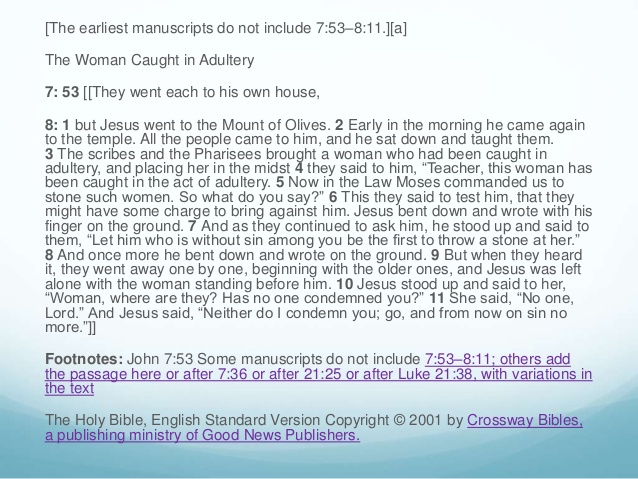
Dr. Boys wrote ‘Recently, a highly trained and very successful New Jersey pastor announced that he would be preaching the following week in his Gospel of John series but would not deal with John 7:53-8:11–the woman taken in adultery who was forgiven by Christ. The pastor, very close to me, wrote, “we conclude without doubt that John 7:53-8:11 was not part of the gospel of John as the Apostle wrote it.” I disagree. There is plenty of doubt.
I believe that pastor, far more qualified than I, was wrong. In a discussion with him or other scholars about biblical manuscripts, I would feel like a mule at the Kentucky Derby. But he is still wrong. In fact, he has to be wrong because God promised to preserve His Word. If He did not, then the Bible is untrue, unreliable, and unnecessary.
Even though that pastor is my very special first grandchild (and the father of four precious great grandchildren), he is still wrong! Of course, he knows my position on this issue.
He also suggested that pastors need to know the biblical languages in order to provide correct instructions to church members; however, if pastors know those languages, they must use the correct manuscripts and reject the corrupt ones. But his suggestion smacks of Roman Catholics who made it illegal for members to keep a copy of the Bible in their vernacular. The Catholics were to come to the priest for a “correct” interpretation. One reason God gave us the Bible in our language was so we could all become Bereans who “searched the scriptures daily, whether those things were so.” While it is good to know the original languages, it is not a requirement to be an effective pastor.
Some pertinent questions about the Bible’s reliability will be helpful: Could a sovereign, all-powerful God lead and direct men to write a perfect book? Of course, the question demands a positive answer. Question two: Could a sovereign, all-powerful God, after directing men to write a perfect Bible, then keep scribes and translators from error? Again, the answer must be positive. Third question: Why would a sovereign, all-powerful God direct men to produce a perfect Bible to give mankind directions for life and death, and not preserve its perfection?
Pastors who take the modern approach tell us that the Bible is perfect in the “originals” but they seldom tell their audience that no one has seen the “originals” in 2000 years! Why would God give man the “originals” for a few years and leave following generations with an imperfect book? Why give the human race a perfect book then take it from us?
The disputed passage belongs in the Bible; if the Bible is not reliable in John 7 and 8, it is not reliable in John 3 on which personal salvation rests. The Bible is the Words of the Living God which will stand forever. If our critics are correct and we do not have an available, accurate, and authoritative Word then where on the face of the earth can we find His will?
Admittedly, the issue is one that good, great, and godly scholars have debated for centuries. One of the earliest objections to the John passage is that Christ seems to be abrogating the Old Testament law requiring death for adultery. Ancient Jews were fearful that Christ’s leniency might give succor to their wives about adultery! Ambrose (died 420) mentioned this in a sermon on David and Bathsheba condemning those who were critical of Christ and those who excised the passage. So the passage was in the Bibles of the early 400s.
Many other Latin Fathers including John Chrysostom and Augustine of Hippo all speak of the passage as being canonical! Augustine (died 430) said some scribes removed the passage because it might seem that Christ was nonchalant about adultery, but Augustine did not advocate removing it from Scripture.
Jerome (died 420), who translated the Latin Vulgate, agreed the passage was legitimate and left it in his translation. Furthermore, he says that the disputed passage was found in “many Greek and Latin manuscripts” in Rome and the Latin West, late in the 4th century.
However, an overzealous scribe decided it would be best to remove the passage rather than cause concern and possibly encourage loose living with scriptural justification! Such scribes were guilty of taking away from the Word of God which is dangerous.
The disputed passage is included in the 1611 KJV, in the 1587 Geneva Bible, 1568 Bishop’s Bible, 1539 Great Bible, 1537 Matthew’s Bible, 1535 Coverdale Bible, 1526 Tyndale Bible, and 1382 Wycliffe Bible. Modern Bibles omit it, footnote it, or bracket it so that readers get the message: it is not reliable. It is fake news, a false story by fallible writers.
All liberals and many Evangelicals teach that the John passage should not be in the Bible, yet the new translations keep putting it in the Bible! The RSV even took it out causing a furor, then replaced it in a later edition to make people happy and to continue selling Bibles! (Is it cynical to suggest that modern translations are all about money?) Modern translators know that removing that famous story would precipitate rebellion, revolution, and ruin in their Bible market. So they knowingly use a passage that practically all their liberal experts agree should not be in the Bible! If a passage does not belong in the Bible (according to their research and convictions), they should do the principled thing, but modern translators have taken a stand like a crippled chicken. They place the disputed passage in their translations because of cash, cowardice, and convenience.
There are some reputable scholars who agree with my grandson about whether or not the passage belongs in John’s Gospel. Among them are: Bruce Metzger, Leon Morris, Merrill Tenney, D. A. Carson, Ed Blum, Colin Kruse, John Piper, R. C. Lenski, Alfred Edersheim, G. Campbell Morgan, and A. T. Robertson.
Some in the above camp consider the defense of the passage and defense of the KJV a “cancerous sore,” “cultic,” “near cultic,” and “deplorable.” Such “scholars” are, in my opinion, “deplorable.”
Other scholars accept the passage as scriptural: Dean John William Burgon, Zane Hodges, D. A. Waite, David Otis Fuller, Edward F. Hills, A. W. Pink, R. C. Sproul, John MacArthur, James Boice, J. C. Ryle, and John Calvin. So, there are good, highly qualified men on both sides of this issue.
Evidently, there is some doubt. It is not as clear as the critics say.
According to the number of manuscripts that have and don’t the passage, 1,495 Greek manuscripts include the John passage or part of it, and 267 do not include it. Moreover, the 267 manuscripts are very early. Most people are impressed with the “earliest” manuscripts but valid, original manuscripts were in the hands of early church fathers who quoted from them from A.D. 150 forward! They quoted, for example, from the last twelve verses of Mark so how could they quote from manuscripts they didn’t hold in their hands? Manuscript date is part of the equation, but it is non-determinative. Manuscripts should be accepted unless proved defective.
Even Aristotle’s dictum supports that approach. He said, “the benefit of the doubt is to be given to the document itself, not arrogated by the critic to himself.” However, modern translators think they are more trustworthy than the document in question, but I wouldn’t trust them to walk my dog!
The fathers of modern Bible translations, Brooke Foss Westcott (1825-1903) and Fenton John Anthony Hort (1828-1892) declared, “The earliest and most reliable manuscripts and other ancient witnesses do not have John 7:53-8:11.” These so-called earliest and most reliable manuscripts were polluted at an early age by the Gnostics whose headquarters were in Alexandria, Egypt–the same city where the Vatican manuscript arose. When the Gnostics didn’t agree with some doctrine or passage, they either subtracted it, or changed it in some way to fit their heretical theology. Hence the production of the Vatican and Sinai manuscripts.
Westcott and Hort, like many liberals, gush over the “earliest” and “most reliable” manuscripts but the earliest are not always the most reliable. Both men were unbelieving Anglican priests.
It should also be remembered that the main reason there are so many older manuscripts extant is because they were avoided by the early church leaders because the documents were corrupt. They didn’t get worn out and thus survived to be found and used to confuse Christians today.
Moreover, the “earliest” and “most reliable” manuscripts are identified as Vaticanus and Sinaiticus from the fourth century. Westcott and Hort assumed that both manuscripts were far superior and since those manuscripts did not have the John passage, that was enough for them. However, traditional Greek manuscripts preceded the 4th century manuscripts of Vaticanus and Sinaiticus and were quoted by many church fathers such as Irenaeus who wrote from 150 A.D.! Since very early church fathers quoted from Mark 16:9-20 for example, then it is false to claim that the Vaticanus and Sinaiticus were the oldest known manuscripts.
But it gets even worse for proponents of modern translations. Dean John Burgon was a famous scholar and Bible defender (died 1888) and he declared that Vaticanus and Sinaiticus are among “the most corrupt copies in existence.” Older does not equal reliable.
According to Frederick Henry Ambrose Scrivener, the African Church corrupted the New Testament as far back as A.D. 150! He also declared of the Codex Sinaiticus (Aleph) from the 4th Century: “From the number of errors, one cannot affirm that it is very carefully written.”
Of the Codex Vaticanus (B) from the 4th Century, he declares that a marked feature is the great number of omissions and calculates that whole words or clauses are left out!
Not a good recommendation for the much vaunted Sinaiticus and Vaticanus–from a scholar recognized as an expert by both sides of the controversy.
Most readers do not know of this Bible disagreement in Fundamentalist and Evangelical ranks. Most religious leaders do not believe the KJV is totally reliable while many do. However, I have noticed for many years the tendency of both sides to demonize the other. Those critical of the KJV are often very arrogant and vicious in their opposition, even calling us “cultists.” They quickly slide by the fact that many of our persuasion hold degrees just as reputable as theirs.
And on the other side, some in our group give good ammunition to the other side by making irresponsible and ridiculous claims. Some claim the KJV is “better than the Greek”; others declare than the KJV must be used in preaching or a person cannot be born again! There are devoted dummies on both sides of the issue.
If a man tells me he sincerely wants to know about eternal things, I will send him to the King James Bible for the truth. I tell him that it is God’s instruction manual for mankind which was accurately translated into English from the reliable and preserved Hebrew and Greek texts and preserved by God therefore, is totally reliable.
All the modern versions are based on corrupt Vaticanus and Sinaiticus and the work of evolutionists Westcott and Hort, radical unbelievers. They were Anglican scholars who never missed a chance to denounce, deny, and denigrate the Bible; but they did not disprove it. According to Dr. Jack Moorman’s book on Bible manuscripts, Westcott and Hort’s Vatican and Sinai manuscripts of the New Testament contain more than 8,000 differences with the traditional text underlying the King James Bible!
I can’t think of anything more shattering than for congregations to be told that the Bible on their laps is full of mistakes, misquotes, and misinformation. It is not if it is the KJV.
All right, for sake of argument, I could be wrong. If I have placed too much confidence in the Word of God, I will discover that at the Judgment Seat of Christ. I suppose Christ will say, “Don, you were wrong about the KJV being totally reliable. You were too committed to my Word!” I believe He will correct my error but with a smile and nod.
After all, I have only convinced people to place too much reliance on the Word of God–not the worse sin to commit; however, those who burn incense to the corrupt modern translations are guilty of taking away from the Word of the living God who promised to preserve it forever!
If I am to be wrong, it will be in favor of the Word that He promised in Psalm 12:6-7, “The words of the LORD are pure words: …Thou shalt keep them, O LORD, thou shalt preserve them from this generation for ever.” Either He did or He didn’t!
So, honest people will look at the issue and come down on the side that is most convincing; however, it takes character to change when one has gone on record for most of his or her life. It’s difficult to admit a mistake. Tolstoy expressed this when he wrote, “I know that most men…can seldom accept even the simplest and most obvious truth if it be such as would oblige them to admit the falsity of conclusions which they have delighted in explaining to colleagues, which they have proudly taught to others, and which they have woven, thread by thread, into the fabrics of their lives.”
Question: “HOMOSEXUALITY? There is no reference to homosexuality in any Bible prior to the 1946 RSV so why do you oppose it?”
Answer: “This question is, beyond a shadow of a doubt, taken from the words of the publishers of the new “Queen James Bible” for gays, which is now available and is a re-version of the King James Bible with editorial changes to make it pro-homosexual. The publishers state their reason for doing this as: “Homosexuality was first mentioned in the Bible in 1946 in the Revised Standard Version. There is no mention of or reference to homosexuality in any Bible prior to this – only interpretations have been made. Anti-LGBT Bible interpretations commonly cite only eight verses in the Bible that they interpret to mean homosexuality is a sin; Eight verses in a book of thousands! The Queen James Bible seeks to resolve interpretive ambiguity in the Bible as it pertains to homosexuality: We edited those eight verses in a way that makes homophobic interpretations impossible.” (LGBT stands for Lesbian, Gay, Bisexual, Transexual.)
It is true the words “homosexuality” and “homosexual” do not appear in the King James Bible, which was printed in the year 1611, but the simple reason is that those words hadn’t even been invented, even though the sexual act between males is clearly described in the King James Version (KJV) Biblical record. e.g. from the Old Testament: “Thou shalt not lie with mankind, as with womankind: it [is] abomination” (Leviticus 18 22 KJV) and: “If a man also lie with mankind, as he lieth with a woman, both of them have committed an abomination: (Leviticus 20:13 KJV). If you like to check the Apostle Paul’s use of the Greek word “arseno – koites” in 1 Corinthians 6: 9 (Strong’s number 733), which shouldn’t need any translation as a description of anal sex. Of course the similarity of the Greek to the vulgar Anglo Saxon ‘arse’ which has been doing the rounds for the past 1,000 years or so does not prove the case. You can either plug the English word homosexual into a modern online English Greek dictionary and find the translation is still arsenokoites, or you can trace the meaning from its parts arsenand koites which refers to men in bed. And when men are sleeping together – we think you’ve got the point.
In 1 Corinthians 6: 9 chapter Paul wrote on the sinfulness of homosexuality. The King James Translators rendered the Greek as “abusers of themselves with mankind.” The word “homosexual” wouldn’t be available in English for at least another two and half centuries. The Oxford Dictionary informs us the word “homosexual” has its origin in the late 19th century, and is a blend of the words “homo” (from the Greek: homos, meaning ‘same’) and “sexual” (no explanation necessary).
Many words have been added to the English language since 1611, and some of these are used in more modern translations of the Bible. As long as they are accurate translations of the original Hebrew and Greek this is quite appropriate, and it is no excuse for perverting the clear meaning of a passage, as the “Gay Bible” crowd have done. Acts of homosexuality (and Lesbianism) are clearly described in the Bible and exclusively mentioned in the context of condemnation and judgement, even in the New Testament, e.g. “For the wrath of God is revealed from heaven against all ungodliness and unrighteousness of men, who hold the truth in unrighteousness; … For this cause God gave them up unto vile affections: for even their women did change the natural use into that which is against nature: And likewise also the men, leaving the natural use of the woman, burned in their lust one toward another; men with men working that which is unseemly, and receiving in themselves that recompence of their error which was meet.” (Romans 1:18, 26-27 KJV)
The argument that “only eight verses” interpret homosexuality as sin is no excuse for changing the meaning of any Scripture. Truth is never determined by the number of times something is mentioned in the Bible. God needs only tell us once to pronounce something right – or wrong!
At the end of their introduction the Queen James publishers quote the famous verse: “For God so loved the world, that he gave his only begotten Son, that whosoever believeth in him should not perish, but have everlasting life.” (John 3:16) We would remind us all that the gift of everlasting life is given to those who repent of their sins, rather than pretend their sins don’t exist. The Apostle John reminds us: “If we say that we have no sin, we deceive ourselves, and the truth is not in us. If we confess our sins, he is faithful and just to forgive us our sins, and to cleanse us from all unrighteousness. (I John 1:8-9)
The Apostle Paul reminded the Christians at Corinth that they once participated in many sins that would exclude them from the kingdom of God, including being “effeminate”, and “abusers of themselves with mankind” as translated in the KJV. Modern translations use the word “homosexual” here, which falls just a little short, as the King James Bible has translated two Greek words referring to both passive (effeminate) and active participants in homosexual acts (abusers). So much for “I am gay but not practising,” claim of some clergy! Paul then reminds the Corinthian Christians of the glorious truth: “And such were some of you: but ye are washed, but ye are sanctified, but ye are justified in the name of the Lord Jesus, and by the Spirit of our God.” (I Corinthians 6:11 KJV)
By deceiving people into denying that homosexuality is sin, the Queen James publishers are hindering their followers from receiving the wonderful free gift of forgiveness and new life in Christ, and in so doing are locking people out of Jesus’ Kingdom here and for eternity. They need to repent now, and do so publically!” http://askjohnmackay.com/no-reference-homosexuality-in-bible-prior-to-1946-rsv-why-oppose/


 Timothy 3:16), which points to inerrancy and infallibility. The Bible also very directly states over and over again that Scripture is preserved. For example, Psalm 12:7 states, “Thou shalt keep them, O LORD, thou shalt preserve them from this generation for ever”, referring to Scripture. And again in John 10:35b, “..the scripture cannot be broken.” Also in 1 Peter 1:23, 25, Matthew 24:35, Isaiah 40:8, Psalm 119:89, and others. Not just Scripture in general, but the very Words of God. The Bible is very clear about this even in with some of the passages in many of the corrupt English versions. For example, the NIV cites Matthew 24:35 as, “ Heaven and earth will pass away, but my words will never pass away.“ This is very , very close to the KJB and is basically a good interpretation of the passage despite the many other flaws that the NIV embraces.
 part of the gospel of John as the Apostle wrote it.” I disagree. There is plenty of doubt.
 Living God which will stand forever. If our critics are correct and we do not have an available, accurate, and authoritative Word then where on the face of the earth can we find His will?
 the 267 manuscripts are very early. Most people are impressed with the “earliest” manuscripts but valid, original manuscripts were in the hands of early church fathers who quoted from them from A.D. 150 forward! They quoted, for example, from the last twelve verses of Mark so how could they quote from manuscripts they didn’t hold in their hands? Manuscript date is part of the equation, but it is non-determinative. Manuscripts should be accepted unless proved defective.
 which was accurately translated into English from the reliable and preserved Hebrew and Greek texts and preserved by God therefore, is totally reliable.


 whatyareckon