‘Paris, April 4, 2017. Sarah Halimi, a 66-year-old Jewish woman, is thrown from her third-floor balcony or window. Her body lands in the building’s courtyard. Her murderer first had tortured her. Neighbors had heard screams and called the police. Nine officers came, but when they heard through the door a man shouting “Allahu Akbar”, they ran downstairs to wait for reinforcements. When Kobili Traoré finally surrendered, he said, “I killed the sheitan” (Arabic for “Satan”). While torturing his victim, he said, he had recited verses from the Qur’an, and the Qur’an had “ordered him to kill a Jew”. He said he had spent the previous day in a nearby mosque. He was placed in a mental institution, where he told the psychiatrist who examined him that he smoked marijuana.
The murder was not mentioned in the newspapers. A French Jewish organizations spoke of a “distressing anti-Semitic crime” and organized a silent demonstration in front of Halimi’s building. It was only then that a few articles were written. The French presidential election was about to take place, and journalists from the mainstream media apparently did not want to speak about an anti-Semitic murder committed by a Muslim.
The judge assigned to the case, Anne Ihuellou, at first refused to acknowledge that the murder had been a hate crime. It took the Halimi family’s lawyers more than six months to get her finally to concede, on February 27, 2018, that the motive for the murder had in fact been anti-Semitic.
The judge also refused to organize a review of the events of the case, and agreed to question Traoré only briefly. She called in a psychiatric expert, Daniel Zagury, who said that at the time of the act, the murderer had been in a state of “acute delirium” due to the consumption of cannabis, but fully “accessible to a penal sanction.” Seemingly dissatisfied with Dr. Zagury’s conclusions, Judge Ihuellou asked for two more opinions by experts — both of whom, contradicting Dr. Zagury’s conclusions, said that the Traoré was unfit to stand trial.
On July 12, 2019, the judge dismissed Dr. Zagury’s report, declared that there are “plausible reasons for concluding that the murderer is not criminally responsible” and stated that the attack had not been anti-Semitic.
Realizing that Traoré could soon be released without trial, the Halimi family’s lawyers requested that the case immediately be transferred to a court of appeals.
That court, issuing its decision on December 19, declared that Kobili Traoré had “voluntarily killed” Sarah Halimi and had thereby committed a murder. The court also acknowledged the “aggravating circumstance of anti-Semitism,” but added that due to a “temporary abolition of discernment,” the murderer was “criminally irresponsible,” could not be tried, and therefore had to be released.’ https://www.gatestoneinstitute.org/15448/france-jews-murder
‘Organisers of a protest against Australia Day have asked attendees to bring cash and bank cards to “pay the rent” to Australia’s Aboriginal and Torres Strait Islander communities.
Thousands of people are expected to gather in the Melbourne CBD for the Invasion Day rally which aims to abolish Australia’s national day — a day organisers say is “built on the stealing of our lands and the massacres of our people”.
More than 4000 people have agreed to attend the event between 11am-2pm at Parliament House.
Organisers from WAR: Warriors of Aboriginal Resistance say they want Australians to know they do not accept “racist and discriminatory policing practices and courts which incarcerate our people at the highest levels in the world” and “our people being killed at the hands of police, prisons, hospitals and healthcare providers”.
Part of a remedy, they say, is payment. But it’s not an idea that went over well with everybody.
Melbourne radio host Neil Mitchell took exception to the idea on his breakfast show on Monday after WAR published a guide for “how to act in solidarity” that included instructions to “bring cash and cards on the day to pay the rent”.
“How do we know where they’ll use the money?” Mitchell asked. “You don’t freely go out and collect money without being accountable … I hand over $20, what happens to it?”
Speaking with Lidia Thorpe, the former Greens MP and first Aboriginal woman in Victoria’s Parliament, Mitchell asked, “Is it really about money?”
When one listens to a Leftist politician it makes one either laugh or weep. These folk are nuts for it seems murdering babies is one of their main themes. Laugh at the following video while you still have the liberty to do so.
Is the draught broken? Perhaps but this we do know ‘While the earth remaineth, seedtime and harvest, and cold and heat, and summer and winter, and day and night shall not cease’ Genesis 8:22 .
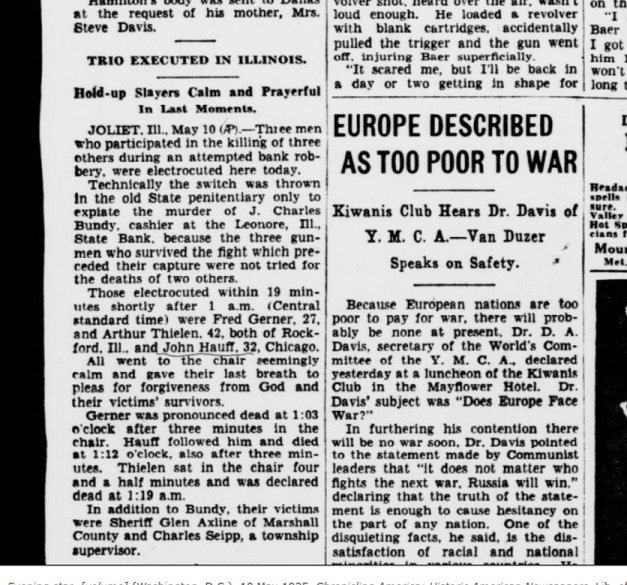
‘Clayton Co. Treasurer’s Office Robbery The unsuccessful attempt to rob the county treasurer’s safe here a week ago last Friday has been cleared up by the confession of three men captured in an attempted bank robbery at Ottawa, Ill., last week Wednesday. A fourth member, included in the confession of the three men, is dead as the result of a running gun battle after the yeggs (a slang term used in reference to safecrackers/robbers in the early 1900s) were discovered in the Leonore, Ill., bank.
The dead member of the gang is Melvin Liest, 40, of Rockford, Ill., for four years a member of the Dubuque fire department. In a hospital in LaSalle, Ill., Arthur Thielen, 41, a former Dubuque taxicab driver, lies dangerously wounded, a bullet in his abdomen. In the LaSalle county jail are Fred Gerner of Rockford, Ill., formerly a resident of Clayton; and a brother-in-law of Thielen. With him also is John Hauff, who claims to be from Chicago. The latter is the one who first confessed implicating the others in the attempted robbery here. After his confession had been gotten the others admitted their guilt.
Hauff’s confession gave a clear account of the time spent here in Elkader and vicinity from the time they arrived until they left after their unsuccessful attempt to loot the treasurer’s safe. According to his story in the LaSalle county jail last Sunday, the gang arrived here Wednesday afternoon, January 9th. They came to Elkader via Prairie du Chien and the Marquette bridge avoiding Dubuque because Liest was known there.
They spent Wednesday afternoon here in town and since the attempted robbery a number of people reported to authorities that an out-of-state car was observed on the streets. While the car was parked on lower Front street near the Niemeyer Bros. store, Liest spent about an hour in the court house, getting the lay of the land, according to Hauff. While Norbert Niemeyer took no particular pains to observe the number of the license plates he felt certain the number was Wisconsin “77-070.” A check on the plates last Sunday revealed that he had not been far off for the number was “77-080.” Both the car and the plates were stolen, county officials have found.
The group ate their supper Wednesday night in the Riverside Café and that evening attended the show in the Rivola theatre where they signed fictitious names on the bank night record in the presence of Donna and Kathleen Dinan. They claim to have spent the night in their car but evidence points to the fact that they spent, at least part of the time, in the Pony Hollow school house just south of town. There is evidence that a fire had been started in the stove and the rope from the flag pole and bell were taken by the gang to use in getting out their car which had been stuck. Their story admits that they broke into the school house.
Thursday morning they claimed to have eaten breakfast in Garnavillo. Thursday night they admit breaking into the court house about nine o’clock, and it was not until after they had broken into the vault that they went to get the torch and gas tanks from the county garage. Hauff stated that he kept guard at the west entrance of the court house while Thielen guarded the east entrance. Gerner and Liest continued the job in the vault.
Just about the time the gas pressure in the tanks began to give out, Liest suffered an attack from the gas. He walked from the vault into the main hall and there fell over in a faint. His pals carried him into the air and after he recovered he wanted to return to finish the job. His pals, however, resisted and they left immediately along the same route they had taken when they came to Elkader. From here they finally landed in central Illinois where they attempted the bank robbery at Leonore, which resulted in the death of four men and the serious injury of two others; with one gangster in a hospital and two others in jail.
Besides Liest the dead are: Charles Bundy, 42, cashier of the Leonore State Bank; Glenn Axline, 32, newly elected sheriff of Marshall county, Ill., and Charles Seipp, 50, a director of the bank and a member of the township supervisors. Seipp died last Sunday. Renof Brown, a member of the posse, and Robert Ness, a 16-year-old farm boy were injured in the running gun fight.
Gerner, who is supposed to have suggested the robbery here is a former Clayton county boy. He lived near Clayton and at one time attended the Guttenberg school. February 25, 1925, he was indicted on a charge of larceny by a grand jury in this county. The following month he was sentenced to a term of six months in the county jail. During the time he was serving his sentence he was used as a trusty to drive a truck on road work and also did odd jobs around the court house. His familiarity about the court house and the county garage is what led officials to believe, for a short time, that the gang had had a local contact.
After the reports of the Leonore attempt Sheriff Palas and State Agent Joe Burke felt that there might be a connection between that job and the one attempted here. They followed those clews and Sunday went to Ottawa and LaSalle where they obtained the confessions as already outlined.
Sheriff Palas left here Saturday afternoon with the Misses Donna and Kathleen Dinan for the purpose of identifying any or all members of the gang. The Misses Dinan did identify Gerner and Hauff but were uncertain about Thielen. Since the three are charged with a graver offense in Illinois than they would be here no effort will be made to bring any of the remaining trio to this county for trial.
Several local people have reported that there were five in the car when the gang was in Elkader but the confession of Hauff and the other two implicates only four men. Local officials appreciate the assistance of Sheriff Ralph Desper of Ottawa and the co-operation of Chief of Police Gillis and Sheriff Ryder, both of Dubuque.
Harry and Meghan are the ‘wokest’ of the Royals so far! Even though they are sort of leaving Royal duties they will never be average as far as their bank accounts are concerned.
‘Prince Harry’s net worth is on people’s minds now that he and his wife, the former Meghan Markle, have announced they are stepping back from their duties as senior Royals to become “financially independent.”
Despite that statement, Prince Harry already has significant wealth. His money derives largely from the inheritance he received from the estate of his mother, Princess Diana. The former Princess of Wales left both of her sons wealthy men in their own right. In addition, Harry also has many of his expenses paid by his father’s properties, the Duchy of Cornwall, income which he appears to want to still receive, according to the announcement that he and Meghan put on their new website, Sussex Royal.
What is Prince Harry’s net worth? How rich is the prince?
A lot of the Royal Family’s wealth is caught up in property that its members could never sell (it’s not like you could ever put Buckingham Palace or Windsor Castle on the market, for example.) However, the Queen has other assets and draws money from some of the properties, making her worth about $425 million) Harry is still sitting on a fortune of his own, and his marriage to Meghan Markle added more wealth to his already impressive net worth due to her career as an actress. He and Meghan were also receiving money from the sovereign grant, which they now say they’re relinquishing.’ If interested the whole article is at https://heavy.com/news/2020/01/prince-harry-net-worth-2020/
Matthew 19:24 And again I say unto you, It is easier for a camel to go through the eye of a needle, than for a rich man to enter into the kingdom of God.
Yes, even the poor Hummus is not safe from the loony Leftist desire to inflict damage to Israel and its supporters. Now, ‘In a refreshing change of pace, Dickinson College in Pennsylvania actually stood up to radical leftist students who came up with a silly proposal to make the campus more woke. In a startling shift from the nonsense we’ve seen at the University of Missouri, Yale, Evergreen State College, and many, many other academic institutions, the administration of Dickinson College did not immediately fold like a cheap table when social justice warriors tried to ban hummus from the campus.
Wait, they tried to…ban hummus?
Yes, as the social justice movement grows in power, it also grows in silliness. In this instance, students came up with a resolution to ban Sabra Hummus from the campus as part of the wider Boycott, Divestment, and Sanctions movement – an anti-Semitic effort to punish the state of Israel for daring to exist.
“Sabra Hummus is a brand partially owned by the Strauss Group, which is a company that financially and morally supports the Golani and Givati bridge of the Israeli Defense Force (IDF),” the students wrote in the resolution. “These brigades of the IDF commit human rights abuses against Palestinians in the West Bank and Gaza and the support of Sabra products helps the Strauss Group support the Israeli Defence Force brigade which maintains a cycle of oppression for Palestinian people in violation of international law.”
Under ordinary circumstances, the college would 100% support this trash proposal for fear that the students would turn on them, lock themselves in the cafeteria, and begin screaming that they were made to feel “unsafe” from the Zionist Nazis in the administration. So it was with a breath of relief that we read Dickinson College’s statement distancing themselves from the proposal and condemning the ideas behind it.
“As an institution that deeply values global diversity and civil discussion and debate, Dickinson opposes this boycott. In 2014, we rejected the call from the American Studies Association to boycott Israeli universities and instead maintained our ongoing relationships with three Israeli institutions,” the university said in a statement.
“We reject the current call for boycott on the same grounds,” they continued. “Students have committed to continue with the open dialogue and active listening that they demonstrated during the discussion. We are confident that as they grapple with this and other complex issues they will continue to seek out and consider multiple perspectives and draw on the critical thinking and analysis skills they are developing here at Dickinson.”
We suppose that the students could still arrive at a point where they ban Sabra Hummus from the campus, but at least they won’t have the eager support of the administration while doing so. For once, we’re left with the impression that there are actually a few adults in the room at an academic institution. How novel.’ http://unfilteredpatriot.com/college-stands-strong-against-student-proposed-anti-semitic-hummus-ban/
The following is from an Australian Senator bringing her constituents up to date concerning the Religious Freedom Bill. This will not turn out good for those who have religious beliefs based on the Christian Scriptures. As Paul wrote in Romans 1:18, 24, 26, 27 For the wrath of God is revealed from heaven against all ungodliness and unrighteousness of men, who hold the truth in unrighteousness; 24 Wherefore God also gave them up to uncleanness through the lusts of their own hearts, to dishonour their own bodies between themselves: 26 For this cause God gave them up unto vile affections: for even their women did change the natural use into that which is against nature: 27 And likewise also the men, leaving the natural use of the woman, burned in their lust one toward another; men with men working that which is unseemly, and receiving in themselves that recompence of their error which was meet.
Here is what the Senator wrote; ‘Australians of family and faith want to be able to live their lives in accordance with their faith and their convictions. The growing body of cases in Australia of people facing harassment, intimidation and persecution because of their religious beliefs and actions highlights the need for positive religious freedom laws. Some are even losing their livelihoods.
Indeed, since the 2017 same-sex marriage campaign and postal survey, people who hold and practice traditional values of marriage and family have been intimidated and harassed.
When freedom of speech, thought, conscience and belief is framed only as an “exemption” to other rights, they are “read down” against positive rights, rendering them subordinate to those other rights. A regime of positive rights in the form of religious freedom legislation would give greater effect to the right to manifest one’s freedom of thought, conscience and belief as outlined in Article 18 of the International Covenant on Civil and Political Rights.
Consequently, in June 2019, I launched a petition in the Australian Senate calling for the enactment of a Religious Freedoms Act to protect the right to freedom of speech, thought, conscience and religion.
To date more than 30,000 original hardcopy signatures have been tabled in the Senate and I thank you to those of you who have signed my petition. My petition is ongoing and more signatures will be tabled this year.
I have continued to regularly speak in the Senate and in other forums on the need for protection of religious freedom as well as working with faith leaders and their communities toward this end.
On 29 August 2019, the Federal Government released its first exposure draft of the Religious Discrimination Bills. Following almost 6,000 submissions and strong pressure from religious leaders, experts and stakeholders from across the faith spectrum, on 10 December 2019, the Federal Government released its second exposure draft of the Religious Discrimination Bills.
Whilst the Second Draft did address some changes, there are still major issues of concern including:
The current draft bills DO NOT include or define religious bodies as being involved in “commercial activities”. Therefore, no full legal protection is provided to aged care facilities, retirement villages, residential colleges, school boarding houses, camps, conference facilities or marriage counselling organisations being operated by religious organisations. Protections should extend to all bodies which are conducted in accordance with, or in furtherance of, the doctrines, tenets and beliefs of a religion. That a religious body pursuing a religious purpose could cease to be a religious body because of “commercial activities” is deeply problematic. The solution is to ensure the commercial activities test MUST be removed.
The current draft bills DO NOT provide legal protections from discrimination to religious corporate bodies and unincorporated associations. The definition of “persons” should not just include corporate bodies, but there needs to be a mechanism by which a religious belief can be attributed to a corporate body in light of judicial rulings that a corporate body cannot have a belief. The solution is to ensure religious corporate bodies and religious unincorporated associations MUST be protected.
The current draft bills DO NOT provide full legal protections to religious bodies to preference the employment of staff that support the religious ethos of the organisation as well as to religious bodies to preference people of faith in the use of their facilities. This should include any consequential amendments to the Fair Work Act and the Sex Discrimination Act. The proposal that faith-based aged care, retirement villages and hospitals only be permitted to discriminate in respect of employment, but not services, will seriously compromise their ability to act consistently with their religious ethos. The solution is to ensure religious bodies MUST be afforded full legal protections to preference the employment of staff that support their religious ethos as well as preference people of faith in the use of their facilities
The current draft bills DO NOT extend to State vilification laws. “Vilify” needs to be defined to remove the implication that “causing harm” amounts to vilification. The interaction between the protection of statements of belief and the protections to employees against indirect religious discrimination needs greater clarity. The “reasonableness test” (clause 8) leaves open the prospect that an employer may dismiss an employee, or a professional may have their accreditation removed, even though their statement of belief is protected under clause 42. The solution is for the protection for statements of belief MUST NOT be removed or watered down but extended to include State vilification laws.
The current draft bills DO NOT provide protections for employees to make statements of faith at their workplace or private time without fear of retribution from their employer (no freedom of speech or religion). It will not protect you from being the next Israel Folau! Concerns remain with the $50M threshold, the principle of “unjustifiable financial hardship”, and the fact that the current drafting may in fact incentivise secondary boycotts and third-party activism. They should also apply to persons irrespective of the turnover of their employer and whether they are engaged by government. Also, reasonable statements of belief should be protected from adverse discriminatory action by qualifying bodies and others (not just employers). In order to provide adequate protection, the protections to employees and professionals should extend to reasonable statements of belief made inside and outside the workplace or in the course of their profession. The solution is to ensure genuine statements of belief MUST be protected across the board inside and outside work.
The current draft bills DO NOT override State laws, which gives too much power to State Governments that may be hostile to religion to pass laws prohibiting certain activities. The definition of “religious activity” should exclude “criminal” rather than “unlawful” activity. “Criminal activity” means activity that constitutes a criminal offence under the laws of the Commonwealth or any State or Territory. Whilst the Second Draft excludes council by-laws from lawful religious activity, it otherwise allows State or Territory laws to override the Bill. For example, the Victorian and Queensland Governments have recently proposed to ban conversion therapy (which is so broadly defined that it includes traditional religious teaching on sexuality and prayer and pastoral care based on that teaching). Such core traditional religious practices may be made unlawful by State laws and the Bill would provide no protection to religious bodies or individuals from discrimination. Further, courts have taken restrictive views of what comprises ‘religious activity’, confining that notion to prayer, worship or the observance of religious rituals or customs. This interpretation has the potential to exclude religious statements on matters such as marriage, gender or the family from the Bill’s protections, or to exclude religiously motivated acts, or to exclude refusals to perform ‘secular’ acts that are contrary to religious teaching. In light of this jurisprudence, such activities should be clearly included within the protected notion of ‘religious activity’. The solution is to ensure draft bills MUST exclude only activities that are considered criminal offences.
The current draft bill contains a “reasonableness test” that TOO BROADLY permits “reasonable” policies and conditions that discriminate against religious people and organisations. This leaves too much discretion to tribunals and courts to decide what is “reasonable”. The “reasonableness test” for indirect discrimination and the “comparator test” for direct discrimination is too broad and leaves too much discretion to tribunals and courts to decide what is “reasonable” and is therefore inconsistent with the strict grounds for limiting religious manifestation in Article 18(3) of the International Covenant on Civil and Political Rights. Both tests will weaken the protections to religious believers. The solution is to ensure draft bills MUST be strictly interpreted to international standards Australia has ratified as under Article 18(3) of the International Covenant on Civil & Political Rights.
The current draft bills DO NOT provide legal and financial protections to Charitable organisations. The Human Rights Legislation Amendment (Freedom of Religion) Bill 2019 proposes an amendment to the Charities Act 2013 (Cth) that will clarify that a charity may advocate for a traditional view of marriage and not fail the requirement that it conform to public policy. This needs to be extended to ensure that a charity will not breach the public interest test and will not lose its tax-exempt status due to its traditional view of marriage. The solution is for Charitable organisations espousing traditional views of family and faith MUST retain their charitable status without any qualifications, exemptions or exceptions.
The current draft bills DO NOT provide protections to individuals who may hold genuine beliefs (minority) that are not the view of a religious denomination (majority). For example, an alternative point of view from a person in that particular denomination could be used to declare that individual’s belief as wrong. The protections in the Bill to religious bodies and persons should not turn on whether ‘a person of the same religion … could reasonably consider [the conduct] to be in accordance’ with the beliefs. The focus should remain on the sincerity of the belief, consistent with the approach taken amongst leading Anglophone Courts across the world, including the High Court in the Scientology Case. The requirement that religious bodies and persons must act in ‘good faith’ may also allow the imposition of secular notions of reasonableness. The solution is to ensure an individual’s genuinely held beliefs MUST be protected (a major hallmark of a mature and plural society).
The current draft bills DO NOT provide maximum protection to health practitioners who seek to exercise conscientious objections and they DO NOT provide protections to faith-based health institutions. Conscientious protection offered to a limited number of health practitioners is insufficient. The solution is to ensure health practitioners and faith-based health institutions MUST be protected to exercise conscientious objections’ https://mailchi.mp/1f1752e00177/religious-discrimination-2nd-draft-exposure-bill-more-work-needed?e=63ff15b667

 ‘Paris, April 4, 2017. Sarah Halimi, a 66-year-old Jewish woman, is thrown from her third-floor balcony or window. Her body lands in the building’s courtyard. Her murderer first had tortured her. Neighbors had heard screams and called the police. Nine officers came, but when they heard through the door a man shouting “Allahu Akbar”, they ran downstairs to wait for reinforcements. When Kobili Traoré finally surrendered, he said, “I killed the sheitan” (Arabic for “Satan”). While torturing his victim, he said, he had recited verses from the Qur’an, and the Qur’an had “ordered him to kill a Jew”. He said he had spent the previous day in a nearby mosque. He was placed in a mental institution, where he told the psychiatrist who examined him that he smoked marijuana.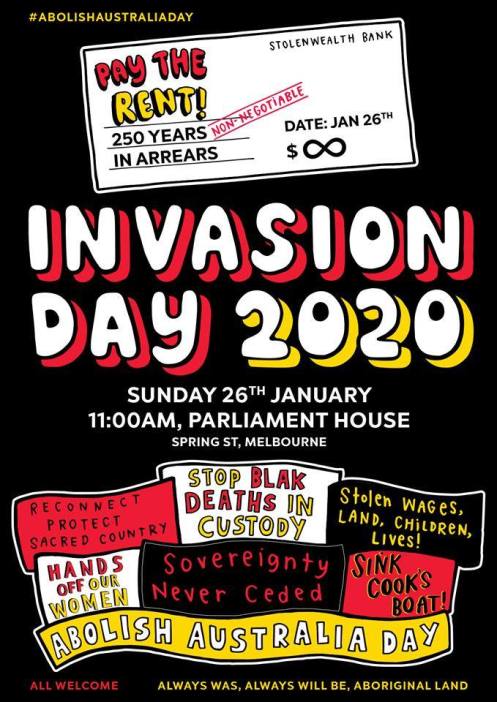



 whatyareckon