“Moreover he must have a good report of them which are without; lest he fall into reproach and the snare of the devil.” (1 Timothy 3:7)
‘A snare is a trap normally used to catch an unwary wild animal, but each of the five times the word (Greek pagis) is used in the New Testament, it refers to devices used by the great deceiver, Satan, to trap unwary human beings.
There is, first of all, the snare of worldly involvement. “And take heed to yourselves, lest at any time your hearts be overcharged with surfeiting, and drunkenness, and cares of this life, and so that day come upon you unawares. For as a snare shall it come on all them that dwell on the face of the whole earth” (Luke 21:34-35).
There is the snare of rejecting God’s Word, both the written Word and the living Word. When Israel repudiated Christ, God said: “Let their table be made a snare, and a trap, and a stumblingblock, and a recompence unto them” (Romans 11:9, quoting Psalm 69:22). The desire for riches can be a snare. “They that will be rich fall into temptation and a snare, and into many foolish and hurtful lusts, which drown men in destruction and perdition” (1 Timothy 6:9).
Satan has many other “devices” (2 Corinthians 2:11) by which he seeks “an advantage of us.” Not even “bishops” or other full-time Christian ministers are immune, for our text is a warning to prospective bishops against “the snare of the devil.” It is the responsibility of every true “servant of the Lord” to be “gentle unto all men, apt to teach, patient, in meekness instructing those that oppose themselves…that they may recover themselves out of the snare of the devil, who are taken captive by him at his will” (2 Timothy 2:24-26). We must both avoid Satan’s snares ourselves and seek to deliver those who have been thus ensnared. HMM’https://www.icr.org/article/13983/
‘In December 2019, the journal Expert Review of Proteomics published a paper I authored with Stephen Taylor titled “Proteomes of the past: the pursuit of proteins in paleontology.”1The article features a table that lists 85 technical reports of still-existing biomaterial—mostly proteins—discovered inside fossils.
Can proteins last millions of years? Not according to decay rate measurements. Five incriminating trends emerged from these 85 secular reports. Our review sharpens the tension between how short a time biochemicals last and the supposed age of the fossils that contain them. We wrote:
Collagen decay rate experimental results build a temporal expectation that restricts bone collagen to archeological time frames, yet many reports of collagen and other proteins in older-than-archeological samples have sprinkled the paleontological literature for decades. Tension between the expectation of lability [susceptibility to chemical breakdown] and observations of longevity has fueled steady debate over the veracity of original biochemistry remnants in fossils.1 Image credit: Thomas, B. and S. Taylor. 2019. Proteomes of the past: the pursuit of proteins in paleontology. Expert Review of Proteomics. 16 (11-12): 881-895.
The 85 reports included descriptions of original skin, connective tissues, flexible and branching blood vessels, bone cells, and probable blood cells. Original biochemistry includes tattered but still-detectable osteocalcin, hemoglobin, elastin, laminin, ovalbumin, PHEX, histone, keratin, chitin, possible DNA, collagen, and collagen sequence—all inside fossil bones.
The first trend we found noted biomaterials from all kinds of different fossilized animals, not just dinosaurs.2 Thus, researchers need not restrict their searches for fossil biomaterials to any specific plant or animal type.
The second trend from all of these reports, which span over a half century of exploration, found no better preservation in one ancient environment over another. Whether living in air, oceans, lakes, swamps, or forests before they were fossilized, fossils could still contain biomaterials.3
Third, a bar graph of the number of relevant publications per year showed an increased interest in this field within the last two decades. Additionally, Figure 5 from our paper plots discoveries onto a world map to show that biomaterials in fossils occur virtually worldwide. We predict that future investigations could discover original biomaterials wherever fossils are found.
The fifth and final trend presents the biggest obstacle for those who insist that rock layers represent vast eons. We found reports of original biomaterials from seven of the 10 standard geologic systems plus one report each from the Precambrian and Ediacaran layers—the bottommost sediments on Earth. As one of our anonymous peer reviewers protested in response to these findings, having biomaterials last over 70 million years—let alone 500 million—is simply fantasy.
Proteins decay relentlessly and relatively fast. Yet protein discoveries keep piling up. Thus, “it is likely that contention will persist.”1 Our secular colleagues now have a sharper look at the vast depth and wide spread of young-looking biomaterials from fossils.
References
Thomas, B. and S. Taylor. 2019. Proteomes of the past: the pursuit of proteins in paleontology. Expert Review of Proteomics. 16 (11-12): 881-895.
Tissues or biochemistry were reported in dinosaur, eggshell, turtle, bird, marine worm casings, sponge, clam, mosasaur, tree, insect, arachnid, frog, salamander, and crinoid fossils.
‘Evolutionary scientists recently claimed to have discovered bacteria that are 101.5 million years old. In 2010 researchers collected deep-sea sediment cores in the South Pacific as part of the Integrated Ocean Drilling Program, with the goal of examining seafloor life and habitability in one of the lowest-productive ocean areas. Sediment samples used in the analysis were taken from depths of up to 75 meters below the seafloor at several sites in water between 3,700 and 5,700 meters (12,100 to 18,700 feet) deep.1
Publishing in Nature Communications, Yuki Morono of the Kochi Institute for Core Sample Research, Japan Agency for Marine-Earth Science and Technology, and his colleagues added a special blend of nutrients to nearly 7,000 individual bacteria collected from the sediments. This food source contained a unique mix of carbon and nitrogen isotopes that allowed scientists to see if the bacteria were actively feeding.1 Co-author Steven D’Hondt, a University of Rhode Island oceanographer, said of the bacteria, “We didn’t know whether we had fully functioning cells or zombies capable of doing very few things.”2
Within 68 days, the distinctive tracer isotopes began showing up in the bacteria cultures, indicating the bacteria were feeding on the nutrients. The bacteria also reproduced, “increasing total numbers by four orders of magnitude” during the study.1
The scientists found this truly amazing since the bacteria had been taken from mud trapped between layers of impermeable porcellanite, a microcrystalline variety of quartz that no microbe could penetrate.1,2 This led the study’s authors to suggest the microbes could be as old as the sediments they were found in, essentially having been trapped in a time capsule. Colin Barras of NewScientist observed:
Many biologists are unsettled by the idea that individual bacterial cells could survive for 100 million years. There have been a handful of claims for even older microbes on Earth. One team claimed in 2000 to have resurrected microbes trapped inside 250-million-year-old salt crystals, but some researchers suspect that the microbes were seen as a result of sample contamination, which is unlikely to be the case in the new study.2
Claiming that bacteria can survive trapped in sediment for over 100 million years seems like science fiction. And yet, scientists have found cells, proteins, and flexible blood vessels in dinosaurs and other animals dated by secular scientists at 66 to over 500 million years.3 These discoveries question the great ages assigned to these creatures and instead suggest these fossils are just thousands of years old.
In light of these other fossil discoveries, there appear to be two possible solutions for these deep-sea bacteria: 1) the bacteria were not trapped for 101.5 million years, suggesting that there were fractures or conduits in the porcellanite that allowed bacteria to migrate in at a more recent date; or 2) these sediments and the bacteria found in them are not really millions of years old.
Either one of these scenarios better explains the presence of living bacteria in deep-ocean sediments compared to the tale spun by secular scientists. However, the earlier discoveries of so many original proteins and cells found in so-called ancient rocks makes solution number two the most likely one.
These bacteria, if indeed trapped in sediment at the time of deposition, are only thousands of years old. The ocean sediments, and possibly the bacteria too, were deposited during the global Flood described in Genesis. Claiming these bacteria are over 100 million years old is not based on empirical science but on a secular, deep-time worldview.
“And for the chief things of the ancient mountains, and for the precious things of the lasting hills,”
‘There is a lot of misunderstanding surrounding what carbon dating actually is and does. For example, we mentioned in a previous Creation Moment that, contrary to popular opinion, carbon dating is not used to find a date for fossils because such fossils do not usually contain the original material of the organism.
Carbon dating relies on an isotope of carbon with a mass of 14, whereas normal carbon atoms have a mass of 12. About one in every trillion carbon atoms is carbon-14. It is just as well that the amount of carbon-14 is so small because it is radioactive, having a half-life of 5,730 years. Carbon-14 is produced in the atmosphere by bombardment by cosmic rays. These rays produce thermal neutrons which crash into atoms of nitrogen (mass 14), dislodging a proton in a microscopic game of pool, thus producing a carbon-14 atom. As carbon-14 acts chemically the same as carbon-12, it gets into carbon compounds and enters the food chain. Both plants and animals are constantly both taking in and emitting carbon-14, so its quantity is assumed to remain constant. On death, however, the existing carbon-14 will simply decay, so the amount of carbon-14 left can be used to calculate how long ago it died.
Used correctly, carbon dating is actually a useful technique, but it relies on the assumption that atmospheric bombardment has been constant. This is an unsupported conjecture, and the devastating effects and aftermath of the biblical Flood would have greatly affected calculated carbon-dates.’ https://creationmoments.com/sermons/what-is-carbon-dating/?mc_cid=5ef30aa0f2&mc_eid=00c1dcff3c
Genesis 1:14 And God said, Let there be lights in the firmament of the heaven to divide the day from the night; and let them be for signs, and for seasons, and for days, and years:
15 And let them be for lights in the firmament of the heaven to give light upon the earth: and it was so. 16 And God made two great lights; the greater light to rule the day, and the lesser light to rule the night: he made the stars also.
‘According to secular scientists, the Moon is roughly 4.5 billion years old. It supposedly formed right after the Solar System did. But there’s a growing body of evidence that this old-age assessment is incorrect.
The Moon’s supposed age of billions of years was never correct, of course. But it was easier for secular scientists to make that claim a few decades ago—back when we didn’t know as much about the Moon as we do now.
The challenges arise from simple, well-understood physics:
Hot things cool off.
Small hot things cool off more quickly than large hot things. (Small objects have a high surface-area-to-volume ratio. Thus, they lose heat more quickly.)
The Moon is a small object. According to secular theories, it should have cooled from its formation long ago. A small, cold body would have no source of energy for geological activity. (Although there are tidal interactions between the Moon and Earth, these don’t supply significant amounts of energy.)
Therefore, the Moon’s geological activity also should have ceased long ago.
But apparently it didn’t. Here are three indicators of recent tectonic activity within the Moon:
Volcanic eruptions
TLP (Transient Lunar Phenomena)
Seismic activity (moonquakes)
Here’s why these discoveries are interesting.
If the Moon is (or recently was) geologically active, this activity indicates that it’s still hot inside. And if it’s still hot inside, it hasn’t cooled off yet.

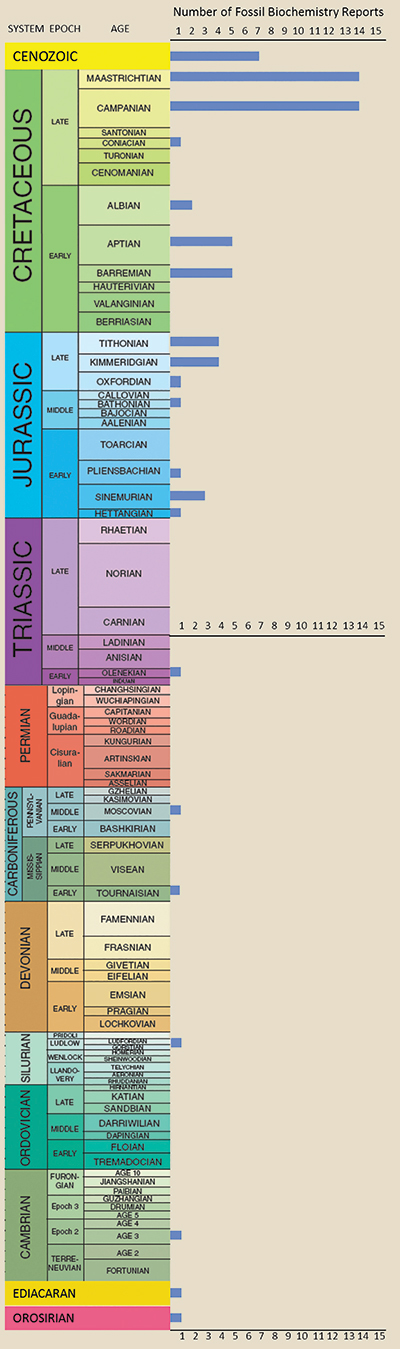 Image credit: Thomas, B. and S. Taylor. 2019. Proteomes of the past: the pursuit of proteins in paleontology. Expert Review of Proteomics. 16 (11-12): 881-895.
 ‘There is a lot of misunderstanding surrounding what carbon dating actually is and does. For example, we mentioned in a previous Creation Moment that, contrary to popular opinion, carbon dating is not used to find a date for fossils because such fossils do not usually contain the original material of the organism.


 whatyareckon