What happened to law and democracy in Hong Kong was a tragedy. So why are several former Australian High Court judges still sitting on the HK Court of Final Appeal, overseeing communism's destruction of #liberty?https://t.co/5yv8Aj52U5
— The Spectator Australia (@SpectatorOz) July 5, 2022
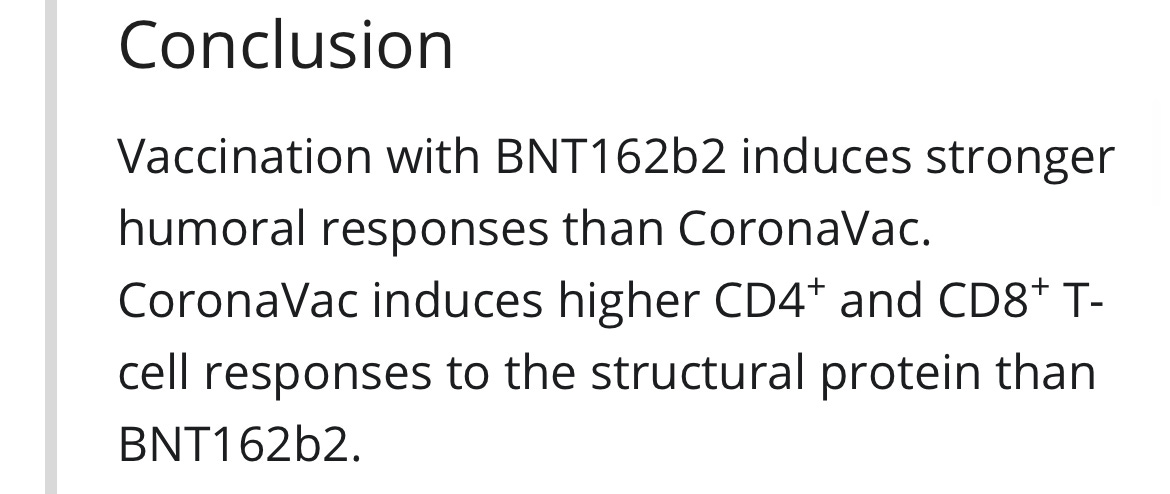
‘A jaw-dropping, peer-reviewed paper shows China’s old-school vaccine produces a far stronger T-cell response to the coronavirus than the Pfizer/BioNTech mRNA jab.
China’s CoronaVac shot caused people to make far more T-cells targeting the coronavirus than those who received Pfizer’s mRNA shot, scientists in Hong Kong have found.
Though it is only one datapoint, the study hints the Chinese shot – which is based on older, well understood principles of vaccinology – may ultimately provide longer-lasting protection than the hastily developed mRNA jabs from Pfizer and Moderna.
The study was published in a peer-reviewed journal called Respirology in November, but has (unsurprisingly) received no attention. It offers a rare head-to-head look at the immune-system effects of the Chinese and Pfizer Covid vaccines, which work in very different ways.
“Humoral responses” are antibodies, the body’s first-line defense against infection; the mRNA vaccines are known to produce supra-natural levels of antibodies, giving rise to short-term protection that fades within months.
T-cells are a part of the immune system crucial for producing long-term immunity and reducing severe disease in people who are infected. The mRNA jabs have been shown to produce relatively limited T-cell protection, but this study appears to have been the first time anyone directly compared them to the Chinese vaccine.
The scientists compared the immune responses in more than 700 people who had received either CoronaVac or mRNA shots, matching them by age and demographic data.
As expected, they found very high levels of anti-spike protein antibodies in people who received the mRNA shot. The mRNA jabs force our cells to make large amounts of the spike protein that sticks out of the shell of the coronavirus. Those proteins then cause the immune system to produce antibodies against it.
The CoronaVac recipients had lower levels of anti-spike protein antibodies. But they also had antibodies to other parts of the coronavirus. Even more importantly, when the scientists ran further tests on a smaller group of about 100 people, they found the CoronaVac shot had sharply increased the level of their coronavirus-targeting T-cells, which last far longer than antibodies.
The new T-cells targeted both the spike protein and another important part of the virus. They included both CD4+ T-cells – which stimulate the overall immune response to infection – and CD8+ T-cells – which directly attack infected cells. Meanwhile, the mRNA jab produced an equally good response in only one of those four types of T-cell.
“The average magnitude of post-vaccination responses was higher in CoronaVac subjects for structural and S-specific T-cell responses,” the researchers explain.
The research was possible because Hong Kong offers its citizens both the CoronaVac shot and the BNT162b2 mRNA jab – the Pfizer/BioNTech shot. (In Hong Kong, BNT162b2 is distributed by a Chinese drugmaker called Fosun, but it is still made by BioNTech and is identical to the shot Pfizer sells elsewhere. A Beijing-based company called Sinovac Biotech makes CoronaVac, which is not approved in the United States.)
CoronaVac’s advantage in producing a T-cell response probably occurs because it presents the body with an invader that is far more like the actual coronavirus than the mRNA shots do.
The CoronaVac shot is a traditional “inactivated virus” vaccine. It contains whole Sars-Cov-2 particles grown in kidney cells and chemically treated so they cannot reproduce. They are then injected alongside an “adujvant” meant to boost the immune response.
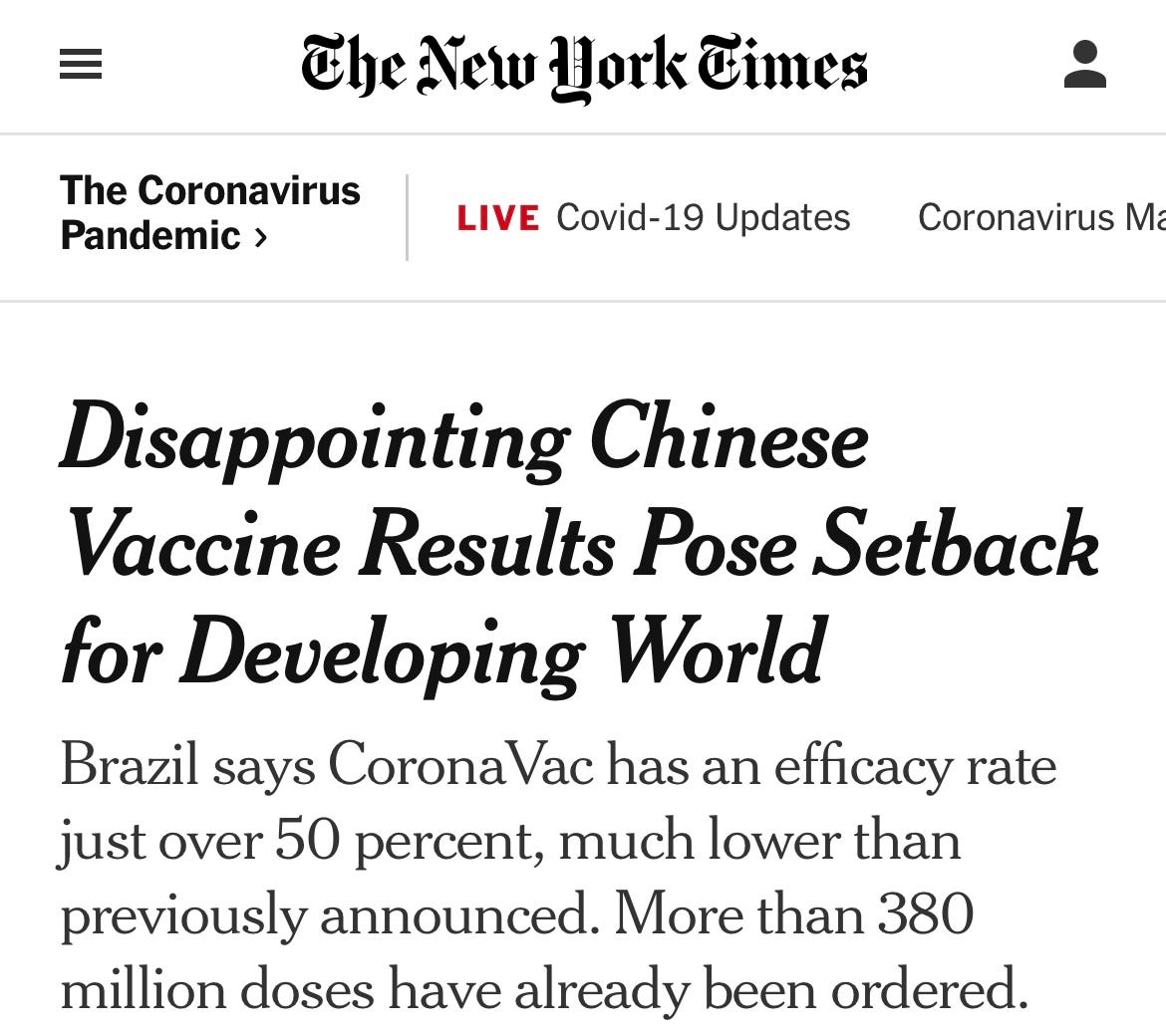
In short-term trials, the mRNA vaccines reduced infections far more than the CoronaVac and a second Chinese vaccine called Sinopharm BIBP, which is also an inactivated virus vaccine.
The early results led to considerable chest-pounding about the superiority of Western vaccines and biotechnology in general.
But the real-world data from the last year has made clear that the mRNA shots lose their protective effect quickly. Because they focus the body’s immune response on a small part of the coronavirus, they are also very vulnerable to new variants such as Omicron, even after a third “booster” dose.
In fact, Western countries have faced a much harsher Omicron wave since December than countries such as Indonesia, which used more Chinese vaccines than any country except China (although in the last two weeks Omicron cases have risen sharply in Indonesia).
The Hong Kong study may also help explain China’s apparent reluctance to move forward with mRNA vaccines – either its own or those from Moderna and Pfizer/BioNTech. Fourteen months after Fosun announced a deal to make the BNT162b2 mRNA shot available in mainland China, Chinese regulators have refused to approve it.
‘Another pro-democracy outlet based in Hong Kong has been shut down following a raid by the police and the arrests of seven former and current employees and board members. Stand News was one of few remaining pro-democracy media outlets, following the shut down of Apple Daily in April.
“Because of the situation, Stand News is ceasing operations immediately,” the organization said in a Facebook post.
The publication’s office was raided by more than 200 police. The police said that they were authorized to “search and seize relevant journalistic materials.”
On Facebook, Stand News added that it would no longer add stories to its website, and that it would be removing all of its social media posts.
“This morning, the police arrested a number of senior and former senior staff of the company, [and] took many people away to assist in the investigation,” the statement reads.
The police seized documents and computers, the statement added. The outlet said that it would be assisting in the investigation. The seven people arrested were detained on the basis of “conspiracy to publish seditious publications.”
In a statement, Hong Kong’s Chief Secretary for Administration John Lee said: “Anybody who attempts to make use of media work as a tool to pursue their political purpose or other interests [and] contravenes the law, particularly offenses that endanger national security, they are the evil elements that damage press freedom.”
The raid came a day after Stand News’ deputy assignment director Ronson Chan said Hong Kong “will always need journalists” during the annual Hong Kong Journalists Association (HKJA) dinner.
In his speech, Chan referenced the shut down of Apple Daily, saying it had “shaken Hong Kong.
He concluded that Hong Kong would “always need the truth and always need journalists… no matter how difficult the road ahead is, the [HKJA] will not fall down”.
‘A court handed down sentences ranging from four to 14 months in prison to eight people involved with the annual Tiananmen Square vigil in Hong Kong. The government has canceled the event for the past two years citing pandemic concerns. Organizers were sentenced for encouraging people to light candles and sing in Victoria Park. Most of the activists accused of inciting disobedience against the police pleaded guilty or fled the city.
Who was convicted? One of those sentenced was Jimmy Lai, activist and founder of the now-defunct pro-democracy newspaper Apple Daily. He received 13 months in prison. Lai submitted a mitigation letter stating he did not attend the illegal vigil but instead lit a candle in front of reporters to commemorate when the Chinese military massacred peaceful protesters in Beijing on June 4, 1989. The judge declared it was still “an act of defiance and protest against the police.” Lai, 74, is serving a separate 14-month sentence for convictions related to 2019 rallies. He also awaits trial for charges under the national security law, some of which carry a maximum sentence of life imprisonment.’https://wng.org/sift/hong-kong-court-sentences-pro-democracy-activists-1639431414
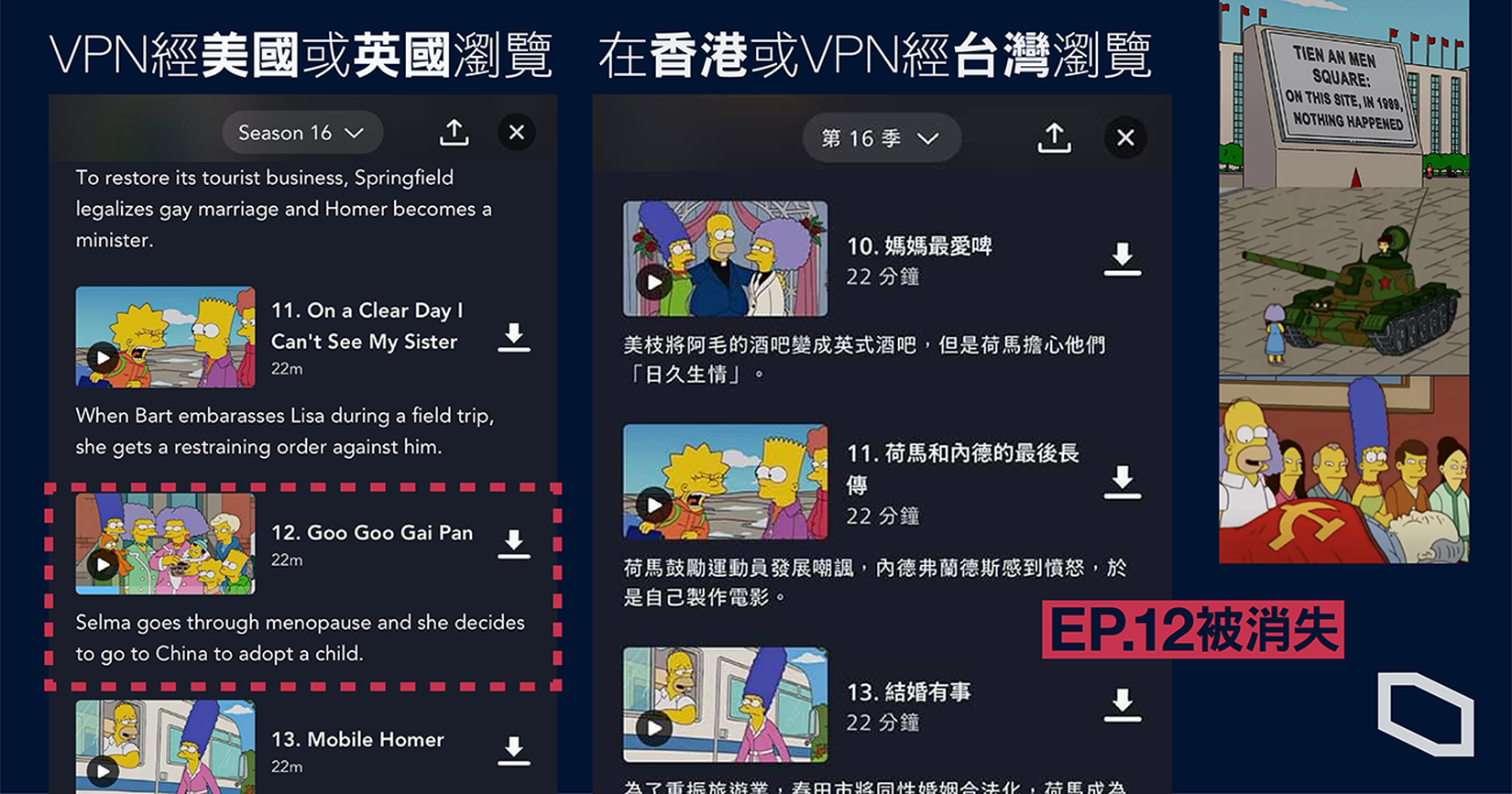
It really comes as no surprise that ‘Disney+ has censored an episode of The Simpsons in Hong Kong, where the streaming service recently launched. The episode was censored over references to the Tiananmen Square massacre.
Until June last year, Hong Kong operated separately from China. Hong Kongers enjoyed more freedoms than the mainland.
However, since Beijing enforced the national security law in Hong Kong, the censorship laws enforced in China started applying on the island.
On social media, Disney+ subscribers began reporting that an episode in Season 16 had been removed in Hong Kong.
We’ve managed to confirm that the Season 16 episode “Goo Goo Gai Pan” has been removed in Hong Kong.
The episode had two references to the Tiananmen Square massacre. It featured the famous Tank Man Photo and a plaque with the statement “Tien An Men Square: On this site, in 1989, nothing happened.” People often use the statement to mock the government’s attempts to erase the event from history.
In China references to the Tiananmen Square massacre are heavily censored and is called the “Tiananmen Square Incident.”
On June 4, 1989, in an effort to stop a protest by students about corruption in the government and democratic reforms, the Chinese government sent the army to Tiananmen Square with tanks. The exact death toll from the clash between protesters and the army has never been released, although it is speculated to be in the thousands.
With the USA so woke and broke will China invade Taiwan before the end of 2021 and after that who?
‘(Hong Kong—September 09, 2021) Today, Hong Kong police raid a closed June 4th Museum dedicated to the victims of Tiananmen Square in 1989. Officials also arrest Hong Kong Alliance leaders Lee Cheuk-yan, Albert Ho, and Chow Hang-tung and charge them with “incitement to subversion”. The Chinese Communist Party has targeted Hong Kong Alliance for many months. In August, police sent a letter requesting detailed information about the organization. Five other committee members were arrested yesterday for “failing to comply with notice to provide information”. Police have accused the Alliance of being “agent[s] of foreign forces.” This prompted authorities to apprehend alliance leaders and to raid the June 4th Museum. Concerning the arrests, ChinaAid President Bob Fu states: “This is a full manifestation of fascism in Hong Kong by the CCP, the international community should hold those brutal leaders in Beijing fully accountable with strong specific measures of sanctions.“‘https://www.chinaaid.org/2021/09/officials-raid-june-4th-museum-and.html
‘Publishing tycoon Jimmy Lai Chee-ying was jailed for 14 months on Friday in back-to-back sentencing for his role in two illegal protests during Hong Kong’s anti-government unrest in 2019, while four former opposition lawmakers who joined one or both demonstrations were also sent to prison.
Democratic Party founding chairman Martin Lee Chu-ming was given an 11-month suspended sentence for joining one of the protests, an unauthorised march on August 18, 2019, while veteran democrat and barrister Margaret Ng Ngoi-yee was also spared jail in a 12-month suspended sentence.
The way the leaders in the West have succumbed to the China virus by ruining their economies and not stopping China’s expansionism freedom loving patriots in the West may soon be joining Jimmy Lai.
‘TAIPEI, TAIWAN – Hong Kong’s legislature will undergo major changes to its format and structure as a result of Beijing’s approval of a political shakeup that will expand its control over the semiautonomous city.
China’s National People’s Congress, the Communist Party’s rubber-stamp legislative body, passed a resolution earlier this month proposing the overhaul, which would make it harder for candidates from Hong Kong’s pro-democracy opposition to be elected.
The revamp, signed into law Tuesday by President Xi Jinping, reduces the number of directly elected seats on Hong Kong’s Legislative Council and increases the number of pro-Beijing voices.
Those seeking office will face strict vetting by a special committee, which critics expect to shut out pro-democracy forces and ensure that “patriots” govern the Chinese city.
Lee Cheuk Yan, a veteran pro-democracy activist and former lawmaker, told VOA that it’s a “disastrous act” for Hong Kong.
“I think it’s closer to the National People’s Congress, which also have the candidates before any election takes place. There will not be any more credibility for this Legislative Council in the future,” he said.
Fewer selections by public
In its current form, the Legislative Council has 70 members, of which 35 are selected every four years by popular vote from various municipal constituencies and district councils.
Under the reforms, Legislative Council seats will increase to 90, of which the public will vote for only 20, down from 35. The lawmaking body’s Election Committee, which is heavily pro-Beijing and tasked with appointing Hong Kong’s chief executive, will be expanded to 1,500 members from 1,200.
Lee said during his time as a Legislative Council lawmaker from 1995 to 2016, the aim was to gradually increase the number of seats to be filled by public elections.
“Don’t go too quick, too fast — we have to make a gradual step,” he said. “The debate was always about the speed, never about the direction. But now this time, the direction is backwards and it’s really a shock to us.”
The former lawmaker believes those seeking greater democracy will have to wait for more opportunities in the future.
“I think we have to prepare ourselves to be outside the system for some time to come, for years to come, wait it out,” Lee told VOA. “Wait for Hong Kong people to continue [voicing protest], if possible on the street, to work it out in civil society.”



 whatyareckon