Food
All posts tagged Food
‘Mankind’s constant, consuming, and ceaseless primary need from the first day in Eden, has been to have enough food and water to keep his family alive. Additionally, man must have lodging, a source of income, and health care. Still, man’s biggest, most pressing, and constant need is food, including water.
And the food supply is being devastated by the ever-increasing population.
In 1906, Alfred Henry Lewis stated, “There are only nine meals between mankind and anarchy.” Three days without food will often turn friend against friend, neighbor against neighbor, and in some cases, relative against relative. It will also turn decent people into criminals and, in some cases, turn well-bred people into cannibals.
No stable person will go berserk after not eating for three days, but when the fear of starvation is added, panic will soon follow.
In 1798, Thomas Malthus wrote that the population expands in times of plenty until there is not enough food (and other resources) to feed the people. A relentless struggle for food causes tremendous pressure and distress in a region. Even in difficult times, the drive for “a virtuous attachment” (marriage) is so strong that the problem will worsen with additional children making any permanent improvement of the poor impossible. His basic premise was when times are good, the population increases, and the increase tends to consume resources, making it difficult for the less fortunate.
Malthusianism is in our world today, often with missionary zeal, to cut the population by prohibiting marriage, limiting family size, and even using the radical schemes of forced abortion, infanticide, and euthanasia. Even aborting handicapped babies after their birth and killing off those born without the possibility of a “quality life.”
Malthus posited that since population growth will always outrun the food supply, any improvement of humankind is impossible unless harsh limits on reproduction are imposed. He suggested late marriages and “moral restraint” (abstinence), wars, and disease would help keep a balance between the population and the food supply. Others added birth control; however, Malthus was an English preacher and did not recommend birth control.
When favorable weather produces abundant crops, the population is generally healthy and happy. They tend to keep having children in abundance. We are told the tendency toward marriage is a constant struggle and hinders any improvement in the condition of the poor. Therefore, the population increases, causing distress and pressure for additional food and other resources. Malthus considered society doomed to famine, disease, poverty, misery, and death; however, later marriages, sexual abstinence, and celibacy would help mitigate the suffering of the poor.
He lived in the mid-1700s and did not see the Industrial Revolution galloping his way from 1760 to about 1840. He did not anticipate machines run by steam, water, air, or electricity doing the work of scores of men. He also failed to see the rise of contraceptives that permitted families to have two or three children instead of five or six—or more.
Hunger, disease, and war decrease the population requiring less food; and birth control, postponement of marriage, and celibacy further help to keep the world in balance.
He thought natural causes such as accidents, old age, famine, and “vice,” including infanticide, murder, contraception, and homosexuality, could stop excessive population growth. But he didn’t have any hope of escaping massive famine.
When good times continue and the population increases, it threatens everyone; consequently, since more people live longer, the elderly, handicapped, and unproductive are “useless eaters.”
The famines in India (which happened about every ten years for decades) were necessary to keep the “excess” population in check. Officials even prohibited private charities from taking food into famine-stricken areas! The Malthusian theory also “influenced British policies in Ireland during the 1840s, in which relief measures during the Irish Potato Famine (1845-1849) were neglected, and mass starvation was seen as a natural and inevitable consequence of the island’s supposed over-population.”
Enter the Germans. In 1920, a world-shaking book was published by Germans Karl Binding and Dr. Alfred Hoche with the English title, Permission to Destroy Life Devoid of Value or Permitting the Destruction of Life Unworthy of Life. It addressed the legal relationship between suicide and euthanasia and then extended it to killing the mentally ill. The book suggested that killing a patient was justifiable when it led to other lives being saved, mainly when the patient in question was of no value to themselves or society. The book advocates killing the mentally ill or the intellectually dead, especially since such people were a drain on society.
The expression “life unworthy of life,” which appeared first in this book, was essential to Nazi ideology. The two authors, a lawyer, and a physician, were not political and were not National Socialists. They were academics dealing with a very delicate subject. Does the state have the right to kill some people for the good of many? Does the state have a right to decide when a life is not productive?
That question has not been answered, in my opinion.
Food or the lack of it is a significant issue in our time because if not enough food is available, then everything comes down. I have never seen such an emphasis on food and its potential unavailability. It is no longer only an issue for the preppies, but for everyone since everyone eats.
People are becoming more aware of their total dependence on others for that which is indispensable—food. Past generations would have been horrified of such reliance.
With the absence of food, anarchy prevails, followed by famine. Shortage of food is one thing, but the lack of food is a disaster. Paul Lee Tan gave a peasant’s description of the Russian Famine from 1932 to 1933. “We’ve eaten everything we could lay our hands on—cats, dogs, field-mice, birds. When it’s light tomorrow you will see the trees stripped of bark…And the horse manure has been eaten. Sometimes there are whole grains in it.”
Americans have little experience with food shortage on a national scale and no examples of massive starvation in our country.
No longer is a food shortage, food interruption, and food unavailability discussed only by the fringe groups, but highly placed officials and politicians are concerned. President Biden said of the food shortage, “Yes, it’s gonna be real.” Food prices are at their highest since records began 60 years ago.
That’s one time Biden got it right.
The concern is already here, and it will worsen as grocery stores run out of major items early in the day, then they will no longer have those items at all. Then, many people will go from anxious to apprehension to anarchy—the nine meals have been missed. It is one thing to be fearful of food shortages but another to have a fear of starvation, then the fact starvation.
It will get super serious as some borderline people become irresponsible. Some parents will take what they want to feed their children. The cities would become unlivable as food riots occur as otherwise decent people use force to take what they feel they need—if not deserve. Understand this is not speculation. It has always happened in all societies. As seen before, truckers would refuse to enter the rioting cities, further exacerbating the problem.
Henry Kissinger declared in The Final Days, “Control oil and you control nations; control food and you control the people.” In a 1974 National Security Memo, he also declared, “Depopulation should be the highest priority of foreign policy towards the third world, because the US economy will require large and increasing amounts of minerals from abroad, especially from less developed countries.”
If you don’t think many public officials will promote plans to diminish, deplete, and destroy elements of a population to keep order (and their jobs), you live in an alternate universe. And you don’t know history.
Our Great Food Disaster has already started.
The Great Famine was one of the great disasters of human history. The world-class disaster started when a physical chill settled on Europeans of the 14th century. The Baltic Sea froze twice, followed by unseasonably cold years of gradually shorter growing seasons that meant disaster. Rain started in 1315 and continued for 7 years, especially in the summers. Crop failures lasted through 1316 until the summer harvest in 1317.
In 1315, it rained so much, people talked of Noah’s flood. Crops failed, and people all over Europe died of starvation. People began to harvest wild edible roots, grasses, nuts, and bark in the forests. They ate their own children, and people in Poland took down hanged men from the scaffold and ate them. Food scarcity prompted prison inmates to kill new inmates and “devoured them half alive.” The time was conspicuous for severe crime levels, rampage, disease, mass death, cannibalism , and infanticide.
Almost everyone was hungry since 95% of the population consisted of peasants who had no reserve food supplies and no money to purchase if any were available for sale. During this time, people did not think or act rationally. They butchered their draft animals and ate their seed grain, guaranteeing continued famine. Many abandoned their children, yet some elderly people chose not to eat to ensure food for the young.
During this period, life expectancy was shockingly low. During the Great Famine and the Plague, it was a little under 30 years, and between 1348 and 1375, life expectancy was only 17 years! Lack of food and a deadly plague will do that to a population.
All that was area-wide, including a few nations; however, some experts tell us we are facing a world famine, first in Africa, Bangladesh, South American nations, Middle East nations, and China, then Europe and the United States.
And those populations are all headed in your direction!
Governments and do-good organizations will do something even if it is wrong. The World Economic Forum (WEF) just finished its annual conference in Davos, Switzerland, expressing concern about the world’s future because of the reliance on meat in our diets. They recommend everyone swear an oath to veganism and eat seaweed, algae, cacti, and avocado seeds. Gamblers can safely bet the farm that the billionaires in Davos did not eat algae.
God warns us in I Timothy 4:3 in the last days men would forbid the eating of meat and abstaining from marriage!
Suppose you’re stranded on a leaking lifeboat in the middle of the ocean with 5 other people. The problem is the boat will only hold 4, so two passengers must jump overboard or be thrown overboard. One passenger is CEO of a major corporation; another is a surgeon skilled in saving helpless children; another is Stacey Abrams, pretender to the Georgia Governor’s office; another is a glib college student, and an unemployed person recently fired and now waiting for the results of a recent job application. The boat is leaking badly. Two of you have to go. Whom do you throw overboard? I don’t think the unemployed man has to worry about his job application, nor will the college student have to worry about his student loans. Both are expendable.
The obvious point is people have different values in today’s world, but no person or board or any political entity has the authority to decide on a person’s worth.
But then, if Stacey would choose to do the manly thing and jump overboard, that would solve the theoretical problem. However, the food problem is not theoretical. And Stacey’s decision, like all her decisions, is totally irrelevant.
Today, leaders who allegedly are levelheaded, honest, informed, and concerned say starvation is ahead, first in third world nations then here.
Have you planted your garden yet?’https://donboys.cstnews.com/whoever-controls-the-food-controls-the-world
‘Some 13 years after the end of a civil war that saw 100,000 deaths, Sri Lanka is once again on the cusp of serious violence. Earlier today, the police opened fire on protesters in the town of Rambukkana. One person has died and at least ten people are said to be in critical condition. It’s the first use of deadly force against demonstrators who seem to have filled the entire island in recent weeks. Grainy footage shows half-conscious bodies being carried into hospital, bullet casings littering the quiet palm-lined streets.
This was meant to be a time of celebration. Buddhists are marking the new year while the country’s Muslim minority observe Ramadan. Instead, the country has been brought to a standstill by nationwide protests demanding that President Gotabaya Rajapaksa resign amid a crippling economic crisis.
Sri Lanka’s capital, Colombo, is now a ghost town. The savings of the country’s burgeoning middle classes have become worthless: the Sri Lankan Rupee is now the world’s worst-performing currency. India’s southern neighbour owes international lenders more than £21 billion, with just £1.7 billion in reserves. Shops and restaurants are closed and armed police patrol the streets. The price of vegetables has increased fivefold since 2021, while the cost of rice has doubled. Many residents say they are unable to eat more than one meal a day.
Rajapaksa, a Sinhalese Buddhist, was elected President in 2019 following the Easter Sunday terror attacks. To many Sri Lankans – particularly the country’s Sinhalese Buddhist majority, around 70 per cent of the population – he seemed the obvious choice to restore law and order, having served as defence secretary during the civil war. He is credited with bringing an end to the 26-year conflict, but not without allegedly committing an array of gross human rights abuses against Sri Lanka’s Tamil minority. It’s difficult to find a more polarising figure in South Asian politics.
Since his election, Rajapaksa has faced accusations of economic mismanagement, embezzlement and corruption. His brother, Mahinda, is the country’s Prime Minister and another brother, Basil, was finance minister until he resigned last week along with the rest of the cabinet. Basil implemented a series of ill-advised tax cuts back in 2019; Sri Lanka was subsequently locked out of international debt markets and has had to burn through its foreign exchange reserves to service sovereign bond payments.
The Rajapaksas were also behind a sudden decision to suddenly ban chemical fertilisers last May, without consulting farmers, which led to a disastrous drop in rice yields this year. They claimed that it would protect farmers from harmful chemicals which were causing kidney issues. Unable to afford food imports, Sri Lanka saw yields of domestically-grown rice fall by around 50 per cent.
In order to deal with the surging levels of debt, Sri Lanka announced a blanket ban on non-essential imports last year. Now, everything from milk powder to spare car parts are unavailable. Even school exams have been cancelled because the government can’t afford the paper on which to print the tests.
Fuel, gas and diesel shortages have become common. Sunrise in Colombo is met by crowds of residents heading to petrol stations and waiting, usually in vain, to fill up their vehicles. In an attempt to preserve supplies, the government is enforcing ten-hour daily power cuts across the country.
Unsurprisingly, Sri Lankans are angry. Last Saturday, in the largest protest to date, tens of thousands of Colombo residents took to the streets demanding regime change. Many also called for the Rajapaksa brothers to have their day in court. ‘It was never this bad during the civil war,’ one 43-year-old IT worker in Colombo explains. ‘At least then we had food to eat, power in our homes and fuel in our cars.’
It seems growing numbers of Sri Lankans agree. The weekend before last, Muslim leaders marched side-by-side with saffron-robed Buddhist monks before members of the country’s LGBTQ community joined them to break the Ramadan fast. You find groups of wealthy professionals chanting anti-Rajapaksa slogans alongside poor rickshaw drivers who can no longer afford fuel. Doctors and nurses are becoming a vocal part of the protests.
Meanwhile, Sri Lanka’s largest public medical body, the Government Medical Officers Association, has declared a health emergency. Hospitals have run out of five life-saving drugs and the GMOA says there are shortages of another 180 medicines, as well as a lack of vital surgical and testing equipment. There are reports of several deaths due to a shortage of Tenecteplase, a drug administered to patients after heart attacks. Pharmacies surrounding Colombo’s leading cancer hospital are turning away patients. The GMOA is pleading with Sri Lankan expats to send essential drugs.
Yet the Rajapaksas remain resolute: Gotabaya has refused to resign. The country’s new finance minister, who attempted to quit less than 24 hours in the job, has said that reviving the economy will be a ‘Herculean’ task. He estimates Sri Lanka requires £2.3 billion in aid over the next six months to purchase essentials like food and fuel, in addition to meeting £5.3 billion of debt repayments for the rest of the year.
Many Sri Lankans blame high-interest Chinese loans for the crisis. Already, Sri Lanka has been forced to lease a new mega port to China in lieu of repayments. Spotting an opportunity, India has signed over £760 million of credit to Sri Lanka and talks are underway for a further £1.1 billion of financial support.
Back in Colombo, some are saying this is Sri Lanka’s ‘Arab Spring’ moment, as peaceful protesters seek to overthrow an autocratic government mired in corruption allegations and complicit in gross economic mismanagement. But for now, Sri Lanka’s notorious military continues to support the Rajapaksas. Whether that continues is an open question.
‘We haven’t seen anything like this for decades, there is no gas, no fuel, no food. The whole country is coming out onto the streets,’ one 22-year-old protester says. ‘The Rajapaksas have to go right now or it is going to be the end of us all.’’https://www.spectator.com.au/2022/04/sri-lankas-descent-into-chaos/
‘If you were born after 1930 then you are about to experience your first world class recession.
The difference between the one that is coming and all the ones that preceded it is that this one isn’t happening by accident.
The recession you are about to endure is no mistake; it was conceived, planned and orchestrated by the billionaire conspirators, it will last for years and it will usher in the Great Reset and the New World Order.
Once the recession is properly under way the game will be over, the war will be lost and the conspirators will have won.
(They’ve been calling me a ‘conspiracy theorist’ for years so it gives me a little light amusement to call them the conspirators. When a bunch of billionaires and assorted evil bastards conspire to take over the world, it seems fair enough to describe them as conspirators.)
The recession was guaranteed and triggered when company bosses were pressured by tiny groups of lobbyists to plan their businesses around ESG nonsenses.
ESG, in case you’ve been asleep for a while, stands for ‘environmental, social and governance’ regulations. Today companies are pretty well forced to put these issues way above finding employment for staff, satisfying customers and making a profit for shareholders.
Then the covid fraud really moved things along nicely for the billionaire conspirators.
In 2020 alone, the world’s workers lost $3.7 trillion in earnings with the self-employed and small business owners suffering most and public employees suffering very little if at all.
The elderly were also particularly badly damaged, in every respect, by the covid fraud – the biggest fraud in history. And, let us not forget, there are still people around who are so terrified by the thought of what they regard as the ‘plague’ that they have not left their homes for two years.
Then they manipulated a war scenario: a real ‘Wag the Dog’ war.
And the recession began in earnest.
The economic crash was carefully designed to wreck the economy while sustaining an ever enlarging State bureaucracy.
House prices have for decades been allowed to soar for this moment. There will now be mass bankruptcies – entirely according to plan. Inflation is heading into double figures around the Western world. We are all Argentina and Venezuela now.
Half-witted, retarded greens and climate change nutters, who have ventured further into the world of pseudoscience than I would have thought possible, believe that the coming recession will save us all. The idiots whose hobby is gluing themselves to motorways think that our use of fossil fuels and fertilisers means that seven billion people are going to have to crowd together on the top of Mount Everest to survive. They are now welcoming the recession because it will mean less travel, less heating and less hot food – especially for the world’s poor.
And so they’re taking opportunity of a war to lead us into net zero and global genocide.
The mad climate change nutters probably think they are caring people but they are cruel and ruthless and they don’t give a damn about anything other than their distorted, selfish ambitions. They are happy to let the end justify the means as long as the end means victory and power they will put up with a few hundred million Africans starving to death.
The startling fact is that left wing commentators excitedly supported and promoted the covid fraud and were delighted that millions of people in Africa descended into starvation territory.
The lefty liberals are thrilled by the genocide in Africa because they have been tricked into supporting the billionaire conspirators.
The mad lefties thought the covid world would take them straight towards a global government run by communists. They were wrong, of course. They’d been tricked. The world was heading straight for the New World Order planned by the Rothschilds, the Bilderbergers, the World Economic Forum and a bunch of miscellaneous psychopaths.
(The only countries in the world which didn’t descend into chaos were Tanzania and Sweden. Tanzania did not impose any covid-19 restrictions in 2020 and had no more deaths than usual. Sweden introduced very few restrictions, had lower mortality rates than anywhere else and was the first to recover from the consequences of the fraud. The mainstream media skilfully avoided mentioning these simple but inconvenient truths.)
Before the Russian invasion of Ukraine took place it was already possible to see the Great Reset beginning to develop – with money and power being concentrated in fewer and fewer hands, with State authority increasing and with cronyism and State inefficiency and theft of public money by politicians and civil servants rising dramatically.
Now things are getting worse by the second. Prices will soar. Jobs will disappear. The long-awaited housing crash will come.
And we are heading for the biggest recession anyone under 100 years of age can possibly remember.
Most people have no idea how awful the future is going to be.
You can help stop what is happening if you want to – simply by sharing the truth about the covid fraud, the climate change fraud and the war fraud with everyone you know. The conspirators can still be stopped.
But if you think I’m a mad conspiracy theorist you won’t do a damned thing to stop what’s coming.
When you’re homeless, cold and starving, and begging for a crust of bread you’ll look back and think: ‘Pity I didn’t listen to that Coleman. We could have avoided all this.’’https://dailyexpose.uk/2022/03/24/what-does-the-global-elite-have-in-store-for-us-next/
‘The information that I am about to share with you is extremely alarming, but I have always endeavored to never sugarcoat things for my readers. Right now, there are shortages of certain items in grocery stores across the United States, and food supplies have gotten very tight all over the globe. I have repeatedly warned that this is just the beginning, but I didn’t realize how dire things have already gotten until I received an email from a farming insider that I have corresponded with over the years. I asked him if I could publicly share some of the information that he was sharing with me, and he said that would be okay as long as I kept his name out of it.
According to this farming insider, dramatically increased costs for fertilizer will make it impossible for many farmers to profitably plant corn this year. The following is an excerpt from an email that he recently sent me…
“Things for 2022 are interesting (and scary). Input costs for things like fertilizer, liquid nitrogen and seeds are like triple and quadruple the old prices. It will not be profitable to plant this year. Let me repeat, the economics will NOT work. Our plan, is to drop about 700 acres of corn off and convert to soybeans (they use less fertilizer, and we also have chicken manure from that operation). Guess what? We are not the only ones with those plans. Already there is a shortage of soybean seeds, so we will see how that will work out. The way I see it, there will be a major grain shortage later in the year, especially with corn. I mean, we are small with that. What about these people in the midwest who have like 10,000 acres of corn? This will not be good.”
Once I received that message, I wrote him back with some questions that I had.
In response, he expanded on his comments in a subsequent email…As for the farming, I see it getting bad. Things like fertilizer and liquid nitrogen have tripled and quadrupled in price. Yes commodity prices are up, but that certainly wont cover the new increased input costs. We are in NC, so while certainly not like the midwest, we still grow grain. The midwest of course will have these same higher input costs as well.Corn for example, typically takes about 600 pounds of fertilizer per acre, plus 50 gallons of liquid nitrogen. Times that by many acres and thats a lot of money. Soybeans take much less. The plan for us, and most others around here, is to drastically cut corn acres and switch to soybeans. Problem is, there is apparently a soybean seed shortage because others have this plan as well. We were lucky enough to pre buy enough to do it. However, most people, especially younger farmers, or farmers where that is all they do, probably don’t have the money to front like that.The way I see it, a corn shortage will come. I guess there could possibly be a glut of soybeans, but remember that could depend on the seed being available. I guess there are other alternatives, maybe milo, oats, or barley. Of course the corn market is much larger. Think animal feed and ethanol. I mean for animals, soybeans are used too, but its a mix. What happens to the animal producers who depend on reasonably priced corn? I just don’t see how it can end well. I mean, even if we end up with plenty of soybeans, even a glut, then you have a busted market for that. I don’t know. There just isnt much history to base any of this on. I just see it hurting both grain farmers, and animal farmers, and also translating to more shortages and price increases for consumers who buy the end products.
I was stunned when I first read that.
Corn is one of the foundational pillars of our food supply.
If you go to the grocery store and start reading through the ingredients of various products, you will quickly discover that corn is in just about everything in one form or another.
So what is our country going to look like if a severe corn shortage actually happens?
I don’t even want to think about that.
Of course fertilizer prices are not just going through the roof here in the United States.
In South America, high fertilizer prices are going to dramatically affect coffee production…
Christina Ribeiro do Valle, who comes from a long line of coffee growers in Brazil, is this year paying three times what she paid last year for the fertilizer she needs. Coupled with a recent drought that hit her crop hard, it means Ms. do Valle, 75, will produce a fraction of her Ribeiro do Valle brand of coffee, some of which is exported.
There is also a shortage of fertilizer. “This year, you pay, then put your name on a waiting list, and the supplier delivers it when he has it,” she said.
If you love to drink coffee in the morning, you will soon be paying much more for that privilege.
Over in Africa, fertilizer prices could result in “30 million metric tons less food produced”…
Fertilizer demand in sub-Saharan Africa could fall 30% in 2022, according to the International Fertilizer Development Center, a global nonprofit organization. That would translate to 30 million metric tons less food produced, which the center says is equivalent to the food needs of 100 million people.
“Lower fertilizer use will inevitably weigh on food production and quality, affecting food availability, rural incomes and the livelihoods of the poor,” said Josef Schmidhuber, deputy director of the United Nations Food and Agriculture Organization’s trade and markets division.
Where in the world are we going to get enough food to replace “the food needs of 100 million people”?
This is beyond serious.
Basically, the stage is being set for the sort of historic global crisis that I have been relentlessly warning about.
Many Americans had assumed that even if the rest of the world was suffering that we would be immune.
But now there are widespread shortages all over the nation, and the Wall Street Journal just published a major article entitled “U.S. Food Supply Is Under Pressure, From Plants To Store Shelves”.
This is really happening.
In Washington D.C., residents are being instructed to “just buy what you need and leave some for others”…
“If you’re hitting the grocery store to prepare for winter weather, please just buy what you need and leave some for others! You may have noticed empty shelves in some stores due to national supply chain issues, but there is no need to buy more than you normally would.”
What would have been unimaginable just a few years ago is now making headlines on a daily basis.
Of course it isn’t just our food supply that is under threat. As Victor Davis Hansen has aptly noted, our country is now in the process of undergoing a “systems collapse”…
In modern times, as in ancient Rome, several nations have suffered a “systems collapse.” The term describes the sudden inability of once-prosperous populations to continue with what had ensured the good life as they knew it.
Abruptly, the population cannot buy, or even find, once plentiful necessities. They feel their streets are unsafe. Laws go unenforced or are enforced inequitably. Every day things stop working. The government turns from reliable to capricious if not hostile.
A lot of people are going to be caught off guard by the pace of change.
Things are shifting so rapidly that it really is hard to keep up with it all unless you are paying very close attention.
Now that you have been exposed to the information in this article, please don’t go back to sleep.
This is not a drill.
We really are heading into a nightmare scenario, and I strongly urge you to act accordingly.’http://themostimportantnews.com/archives/a-farming-insider-has-warned-me-that-the-coming-food-shortages-are-going-to-be-far-worse-than-we-are-being-told
Psalm 103:1-5 “ Bless the Lord, O my soul: and all that is within me, bless his holy name. Bless the Lord, O my soul, and forget not all his benefits: Who forgiveth all thine iniquities; who healeth all thy diseases; Who redeemeth thy life from destruction; who crowneth thee with lovingkindness and tender mercies; Who satisfieth thy mouth with good things; so that thy youth is renewed like the eagle’s.”
‘Many ethnic cooking traditions have their origin in health considerations. Some of those traditions are so old their origin is unknown, which strongly suggests that the ancients had a very sophisticated knowledge of food and health, some of which is only being rediscovered today.
Throughout most of history, humans have not had the luxury of refrigeration or freezing to preserve food. And even these do not provide permanent storage for food. Meats, whether cooked or raw, deteriorate even when frozen. The cold simply slows down the process. Fat spoilage in meat is a universal problem.
Chemically, fat spoilage is referred to as lipid oxidation. Lipids in meat include fat and cholesterol. Lipid oxidation does more than give meat a rancid, warmed-over flavor. Researchers believe that oxidized lipids also contribute to heart disease. Japanese research suggested that ginger, common in oriental cooking, might retard lipid oxidation in meat. Armed with this knowledge, researchers investigated whether there was any connection between the common use of ginger and Japan’s very low rate of heart disease. They found that pork patties seasoned with ginger showed only one‑third as much lipid oxidation as unseasoned meat.
It appears that even before so‑called recorded history, people knew that ginger helped preserve meat and keep it more wholesome. This is yet another refutation of the idea that ancient man was primitive and ignorant.’https://creationmoments.com/sermons/wonders-from-ancient-cooks-2/?utm_source=rss&utm_medium=rss&utm_campaign=wonders-from-ancient-cooks-2&mc_cid=0f285a9ff8&mc_eid=00c1dcff3c
The woke Left is not afraid to lie if they think it will help their agenda. Well, all I can say is that in spite of their climate change lies God’s Word tells us in the very first Book that While the earth remaineth, seedtime and harvest, and cold and heat, and summer and winter, and day and night shall not cease Genesis 8:22. Now consider ‘Why is Greenland called Greenland?
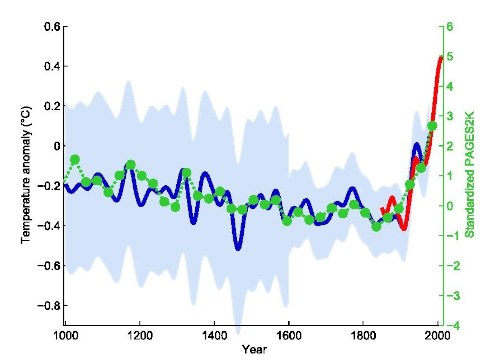
Most people are familiar with the reasons for the name. During the Medieval period, there is a lot of historical evidence to show that global temperatures were higher than they are today. Therefore, Greenland had quite a lot of green during the time when Vikings were colonizing it. As the Medieval period ended, however, the planet became a lot colder, sinking into the famous “little ice age”, which was at its depth during Victorian times, when it was common for the Thames River in London, England, to freeze over, and for annual ice fairs to be accommodated by London Bridge. From Victorian times onward, average world temperatures have been on the rise again.
But this dome-and dip-shaped graph did not fit with the upcoming paradigm of the 1990s onward which suggested that the Earth’s average temperature must be getting warmer due to industrial emission of so-called greenhouse gases, especially carbon dioxide.
So researchers produced the infamous hockey stick graph. The right hand side of this
temperature-time graph showed a sharp rise in temperature from about 1910 onward. The “handle” of this hockey stick shape was flat, not showing a Medieval warm period; the warmth of northern climes, like Greenland, or even England being attributed to a misleading local effect.’ https://creationmoments.com/sermons/hockey-sticks-and-tricks/?utm_source=rss&utm_medium=rss&utm_campaign=hockey-sticks-and-tricks&mc_cid=f8043c3e75&mc_eid=00c1dcff3c
Pastor Kent Brandenburg writes the following concerning this Covid-19 crisis which I think is worth a read.
‘Many pastors and theologians have provided their counsel, take, admonition, or encouragement on this virus that is sickening and killing people all over the world. I’ve listened to at least four sermons on it, while going about working at home while sheltered-in-place, a terminology I never remember hearing until now. It’s come up in about every one of my sermons since we knew a pandemic had begun. In addition to the offerings of Thomas Ross in the way of a gospel tract, David Warner from our church wrote one (click on the link here). Those are very good and should be utilized, if people will touch them, considering the virus might survive on the surface of the tract for twenty-four hours.
Here are ten typical subjects right now, no offense to anyone. I’ve brought them up too. They are worth meditating upon.
- God is sovereign.
- Everyone’s going to die.
- God is gracious that this isn’t worse.
- God cares for us more than many sparrows.
- All things work together for good for them who love God.
- Sin is the cause of the virus at least as a byproduct.
- We all deserve worse than this outcome.
- We know not what shall be on the morrow.
- Except we repent, we shall all likewise perish.
- It is only by God’s faithfulness that we are not consumed.
Even the Left leaning New Daily here in Australia has a sense of humor.
‘As most of the country enters stage three lockdowns, many people have been living the home-life for for what is now coming up to a month. That’s prompting some pretty interesting outfits for when we do have to go out in public.’ https://thenewdaily.com.au/entertainment/people-entertainment/2020/04/01/coronavirus-outfits-funny-shopping/?utm_source=Adestra&utm_medium=email&utm_campaign=COVID-19%20-%2020200403