
- The Biden administration just cleared a Chinese company to own 370 acres of land within 12 miles of Grand Forks Air Force Base in Grand Forks, North Dakota.
- As a result, China will be able to use a proposed $700 million corn milling plant on the site to spy on military communications and even disrupt them. In Beijing, they must be shaking their heads in disbelief….
- [T]he failure to include all military installations in the implementing regulations was a clear case of regulatory malpractice.
- As a result of these enormous mistakes, Fufeng USA, a subsidiary of a Shandong province-based agribusiness giant, is, at least for the moment, free to build its wet corn milling and biofermentation plant in Grand Forks.
- “The worst-case scenario involves active sabotage of operations at the Grand Forks facility. Should the U.S. and China end up in a shooting war over, say, Taiwan, Fufeng’s property near the Air Force base could be used to send malicious signals to jam passing satellites or disrupt the operation of drones. We have made ourselves vulnerable on our own territory.” — Brandon Weichert, author of Winning Space: How America Remains a Superpower, to Gatestone; December 2022.
- President Joe Biden can use his authority under the International Emergency Economic Powers Act of 1977 to block the sale of the Grand Forks land and the building of the milling facility.
- “[T]he most serious problem: The [CIFIUS] Committee is chaired by Treasury, which never saw a foreign investment it did not approve. “This means, as a practical matter, that an agency that basically doesn’t give a damn about national security is entrusted with running a process that supposedly evaluates and protects national security.” — Frank Gaffney, Vice Chair of the Committee on the Present Danger; to Gatestone, December 2022,
- The CFIUS mandate must be broadened “to include any foreign investment that threatens our national security interests or, for that matter, other vital interests, in the face of unrestricted and especially economic warfare.” — Frank Gaffney to Gatestone; December 2022
- China’s regime, which has declared a “people’s war” on the U.S., uses investments to undermine America. In wartime — the Communist Party believes it is currently in such a struggle with America — Washington needs to prohibit all investments from China, especially ones near critical Air Force installations in North Dakota.https://www.gatestoneinstitute.org/19260/china-sabotage-north-dakota
Biden
All posts tagged Biden
The present American government is not a friend of the American people!
‘The top Republican on the Senate energy committee launched an inquiry on Wednesday into a Biden administration grant to a China-based battery company under scrutiny from U.S. financial regulators. The announcement came in the wake of a Washington Free Beacon report about the Biden administration’s attempt to spin the grant as a boon for American-made clean energy.
Sen. John Barrasso (R., Wyo.), the ranking member of the Senate Energy and Natural Resources Committee, said the Department of Energy’s grant to Microvast Holding “endangers our national security” and “undermine[s] the United States’ position in its race against China for technological supremacy,” in a letter to DOE secretary Jennifer Granholm on Wednesday.
The inquiry comes after the DOE gave the $200 million award to Microvast, a holding company that operates primarily in China, to build a lithium-ion battery separator facility in Tennessee, the Free Beacon reported on Tuesday. Granholm said the funding, which came from the Bipartisan Infrastructure Law, would help “supercharge the private sector to ensure our clean energy future is American-made.”‘https://freebeacon.com/biden-administration/endangering-our-national-security-senator-launches-inquiry-into-bidens-200m-grant-to-china-based-battery-company/
Are or were you an election denier? If you were continue to be one! If they were able to cheat in 2020 what was going to stop them from CHEATING in this election?
‘Welcome to the Banana Republic of Biden — where the voting machines break down and the tabulators fail and the paper runs out on Election Day!
The rigging was so bad, so obvious, so corrupt that even the corporate media was forced to admit that electronic voting machines didn’t work across America. That was a “conspiracy theory” — you might recall — just the day before.
But — lo and behold ! — the machines were all “down” in Mercer County, New Jersey. They were full of “mishaps” in Harris County, Texas and in Chesterfield County, Virginia and in Bell County, Texas and in Suffolk County, New York. At least 20% of all the machines were “not working” throughout Maricopa County, Arizona. They “ran out of paper” in Luzerne County, Pennsylvania. In fact, “officials say that roughly 44 polling locations in Luzerne County ran out of paper to print ballots.”
Of course, it’s completely normal on Election Day for 44 polling places to run out of paper simultaneously. Don’t start fueling conspiracy theories by noticing that such a shortage must be deliberate!
It was always the case that the Washington uniparty was going to rig the elections against Trump-aligned candidates. The Swamp was not interested in victories for candidates like Blake Masters and Kari Lake in Arizona, Herschel Walker in Georgia, Dr. Oz and Doug Mastriano in Pennsylvania — and it was not interested in the continued careers of “troublemakers” like Lauren Boebert and Ron Johnson. Notice that almost all of those races are currently “too close to call” this morning — or called for the Democrat long before the votes could be counted.
Democrats needed to disrupt the Republican vote in Arizona to stop Masters and Lake — and what a coincidence! — the machines go down in the red precincts of Maricopa County and keep working elsewhere!
Democrats needed to disrupt the Republican vote to stop Lee Zeldin in New York — and what a coincidence! — the machines go down in Suffolk County!
That’s Lee Zeldin’s hometown.
A day after the election, the corporate media is telling you that “late arriving mail-in ballots” are still to be counted in order to decide elections in Arizona, Nevada, and elsewhere.
If you can believe these obvious lies, you can believe anything.
What does this vote-rigging look like?
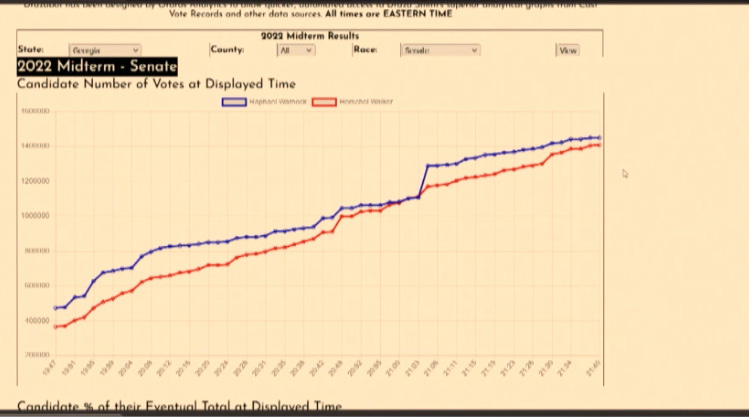
All the corporate media outlets in America get their “real time” vote counts from Edison Research — and obvious vote-rigging patterns emerge when you chart the vote-dumping in real time.
Here’s the Georgia Senate race between Herschel Walker and Raphael Warnock.
Any blue spikes for Warnock that you notice?
Here’s the real-time vote dumping in the race for Minnesota governor between Tim Walz (D) and Scott Jensen (R) for governor.

Do you notice any strange curves? Any sudden surges?
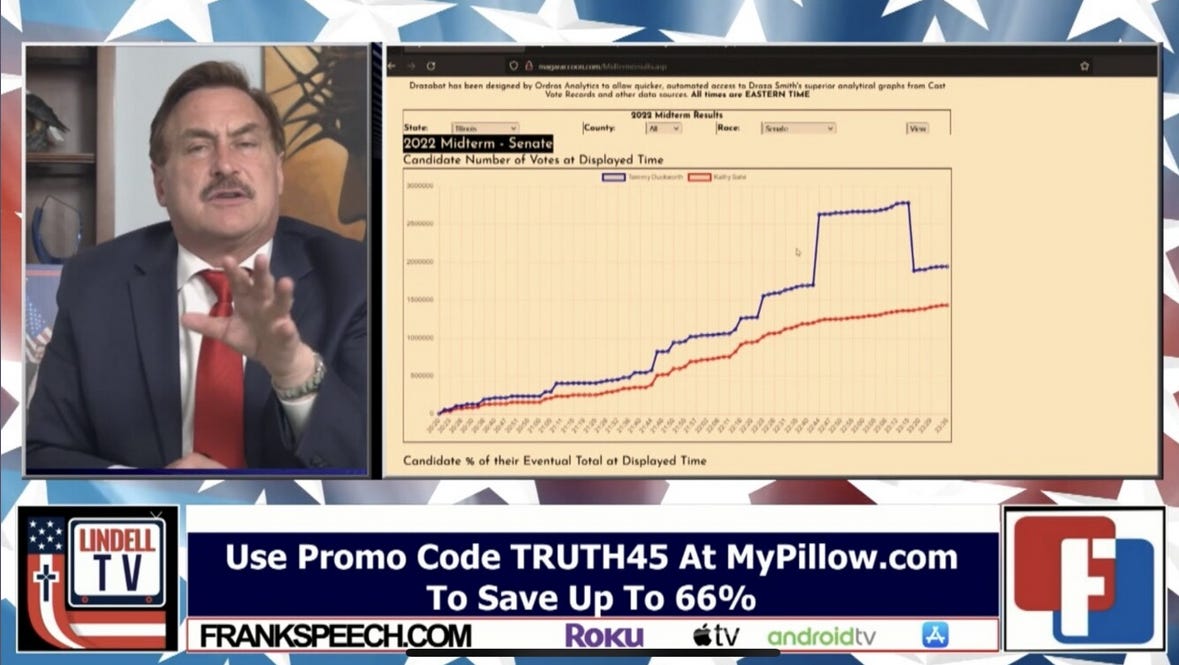
Here’s the real-time vote dumping in the Illinois Senate race between Tammy Duckworth (D) and Kathy Salvi (R).
The race was called for Duckworth two minutes after the polls closed.
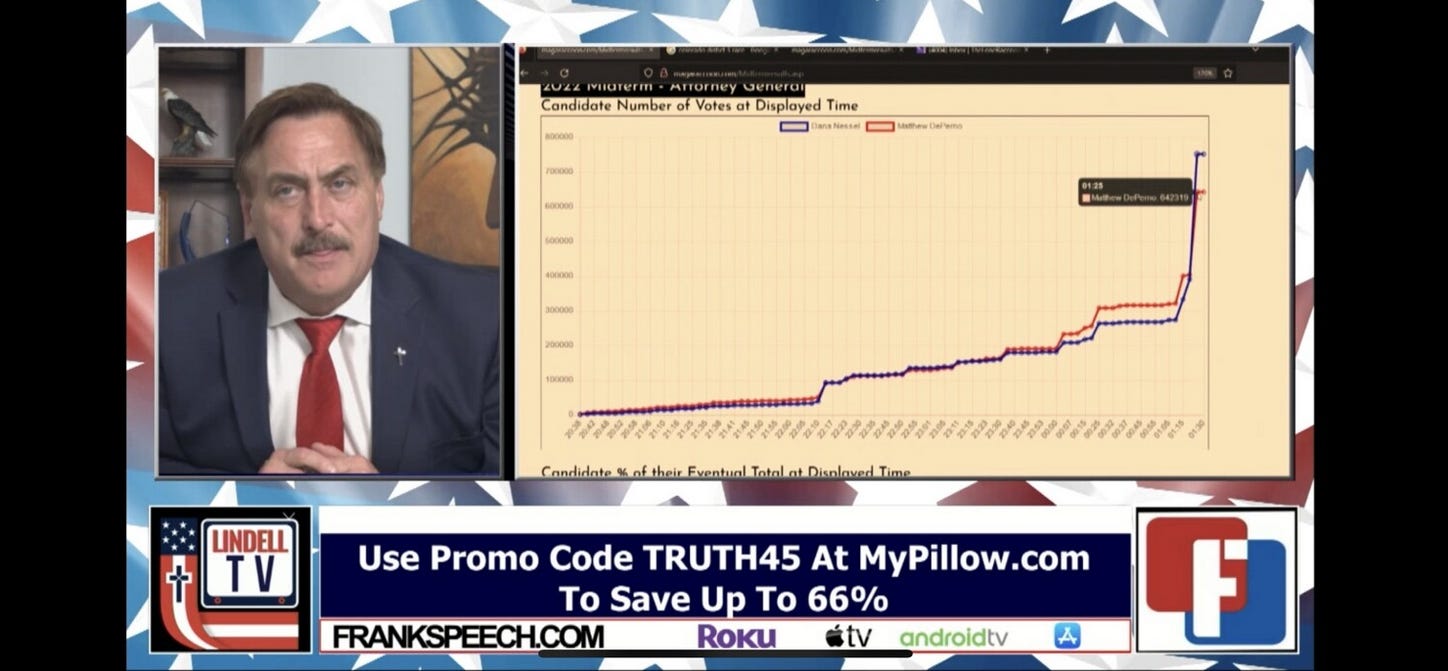
Here’s the real-time vote dumping in the Michigan Attorney General race between Dana Nessel (D) and Matthew DePerno (R).
What happens next? Just watch all the corporate media stories about malfunctioning machines get wiped from the Internet in the coming days.
How do I know this will happen?
This is not my first rodeo — and it’s not yours either.’https://emeralddb3.substack.com/p/its-obvious-now-americas-voting-system?publication_id=263063&post_id=83420367&triggerShare=true&isFreemail=true
This is from a much longer article.
‘Stating the obvious: Here in the United States, the commander in chief is far past his intellectual prime, and prone to petulant retaliation against those who disagree with him and his policies. Biden is no Kennedy. His administration has jumped Constitutional guardrails in many areas, and increasingly acts as a Globalist lapdog, just as we have seen happen in current WEF-influenced Canadian, UK, Australian, and New Zealand political leadership structures.
US Nuclear saber rattling in Europe will further damage the cohesion of the European Union, NATO, and is adding to the profound geopolitical insecurity and instability of the entire region as it heads into what looks like a truly “Dark Winter”.
One has to wonder, what are the US National interests in Ukraine which merit this level of risk?
If there is not a clear and compelling US National interest in the region, has the US Military and NATO merely become tools for enforcing a Globalist agenda seeking to punish Putin for incursion into what has become a US/WEF puppet territory?
The Belgian people and most Europeans still remember Flanders Fields. I only wish that Joe Biden could.’https://rwmalonemd.substack.com/p/an-inconvenient-opinion-from-europe?publication_id=583200&post_id=81904344&isFreemail=true

The following is adapted from a talk delivered at Hillsdale College on October 4, 2022, during a Center for Constructive Alternatives conference on the topic of Russia.
‘According to what we hear from the White House and from the television networks, the issues at stake in the Ukraine War are simple. They concern the evil of Vladimir Putin, who woke up one morning and chose, whether out of sadism or insanity, to wreak unspeakable violence on his neighbors. Putin’s actions are described as an “unprovoked invasion” of a noble democracy by a corrupt autocracy. How we ought to respond is assumed to be a no-brainer. The United States has pledged vast quantities of its deadliest weaponry, along with aid that is likely to run into the hundreds of billions of dollars, and has brought large parts of the world economy—particularly in Europe—to a standstill.
Now, whenever people in power tell you something is a no-brainer, there’s a good chance that it’s a brainer. And the Ukraine War is more complicated than we’ve been led to assume.
There are reasons why the U.S. might want to project power into the Black Sea region. But we must not ignore that the politics of the region are extraordinarily complex, that the Ukraine conflict is full of paradoxes and optical illusions, and that the theater we are entering has been, over the past 150 years, the single most violent corner of the planet. And unless we learn to respect the complexity of the situation, we risk turning it into something more dangerous, both for Europeans and for ourselves.
Historic Roots of the Conflict
Putin invaded Ukraine after the U.S. rejected his demand for a guarantee that Ukraine not join NATO. We don’t have to excuse Putin, but we should note that, until quite recently, having Ukraine in NATO was a prospect that struck even many American foreign policy thinkers as a bad idea. These included George Kennan, who was one of the architects of the NATO alliance when the Cold War began in the late 1940s. Kennan was still alert and active, at about 90 years of age, when NATO won the Cold War at the turn of the 1990s. And in 1997, during the Clinton administration, he warned that American plans to push NATO borders “smack up to those of Russia” was the “greatest mistake of the entire post–Cold War era.”
John Mearsheimer, a professor at the University of Chicago, is a forceful representative of Kennan’s viewpoint. Mearsheimer is skeptical of “idealist” crusades, like the one in Iraq that George W. Bush drew the country into in 2003. He thinks President Bush dramatically overestimated the degree to which the U.S. could spread its values and its institutions. In light of present events, he especially faults Bush’s push to bring the former Soviet Republics of Georgia and Ukraine into NATO in 2008.
A lot of Americans in government at the time felt the same. One was William Burns, then President Bush’s ambassador in Moscow, now President Biden’s Director of Central Intelligence. In a memo to Secretary of State Condoleezza Rice, Burns wrote the following:
Ukrainian entry into NATO is the brightest of all red lines for the Russian elite (not just Putin). In more than two-and-a-half years of conversations with key Russian players, from knuckle-draggers in the dark recesses of the Kremlin to Putin’s sharpest liberal critics, I have yet to find anyone who views Ukraine in NATO as anything other than a direct challenge to Russian interests. [It would be seen] as throwing down the strategic gauntlet. Today’s Russia will respond. Russian-Ukrainian relations will go into a deep freeze. . . . It will create fertile soil for Russian meddling in Crimea and eastern Ukraine.
In thinking about why this would be the “brightest of all red lines,” consider why it was that the Ukraine problem didn’t get resolved at the end of the Cold War.
Russia is a vast country—the largest in the world. It’s not so much a country as an empire. Even today it has dozens of ethnic republics in it. Maybe you’ve heard of Chechnya or Tatarstan. But have you heard of Tuva? Or Mari-El? Or the Republic of Sakha? Sakha is four times the size of Texas, but it disappears inside of Russia. Back in the day, of course, this vast Russian empire was part of another empire, famously referred to by Ronald Reagan as the Evil Empire—that is, the Union of Soviet Socialist Republics. There were 15 Soviet Republics, including Russia, Ukraine, the Baltic states, Armenia, and Turkestan. And that bigger empire was part of an even bigger empire, which included the Eastern European “captive nations” of Poland and Hungary.
When Communism collapsed in the early 1990s, all these countries found their way to independence, most of them peacefully, some of them bloodily. But Ukraine, while nominally independent, remained bound to Russia in a number of informal ways—sometimes willingly, sometimes reluctantly. Russia kept its Black Sea fleet in Crimea, unmolested by Ukraine. Ukraine got cheap gas and desperately needed financial assistance.
Why wasn’t Ukraine able to make a clean break? Not because it forgot to. Not for lack of can-do spirit. It was just a really hard problem. With the possible exception of Latvia, Ukraine was the most Russian of the non-Russian Soviet Republics. Russian has for a long time been the language of its big cities, of its high culture, and of certain important regions.
If you had to give a one-word answer to what this Ukraine War is about, you would probably say Crimea. Crimea is a peninsula jutting out into the middle of the Black Sea. It’s where the great powers of Europe fought the bloodiest war of the century between Napoleon and World War I. It is a defensive superweapon. The country that controls it dominates the Black Sea and can project its military force into Europe, the Middle East, and even the steppes of Eurasia. And since the 1700s, that country has been Russia. Crimea has been the home of Russia’s warm water fleet for 250 years. It is the key to Russia’s southern defenses.
Crimea found itself within the borders of Ukraine because in 1954, the year after Stalin died, his successor Nikita Khrushchev signed it over to Ukraine. Historians now hotly debate why he did that. But while Crimea was administratively Ukrainian, it was culturally Russian. It showed on several occasions that it was as eager to break with Ukrainian rule as Ukraine was to break with Russian rule. In a referendum in January 1991, 93 percent of the citizens of Crimea voted for autonomy from Ukraine. In 1994, 83 percent voted for the establishment of a dual Crimean/Russian citizenship. We’ll leave aside the referendum held after the Russians arrived in 2014, which resulted in a similar percentage but remains controversial.
Enter the United States
With the end of Communism, Ukraine was beset by two big problems. First, it was corrupt. It was run by post-Communist oligarchs in a way that very much resembled Russia. In many ways Ukraine was worse off. In Russia, Putin—whatever else you may think of him—was at least able to rebuff those oligarchs who sought direct political control.
The second problem for Ukraine was that it was divided between a generally Russophile east and a generally Russophobe west. It was so divided, in fact, that Samuel Huntington devoted a long section in his book The Clash of Civilizations to the border between the two sections. But Huntington did not think that the line dividing them was civilizational. He wrote: “If civilization is what counts . . . the likelihood of violence between Ukrainians and Russians should be low. They are two Slavic, primarily Orthodox peoples who have had close relationships with each other for centuries.”
The U.S. didn’t see things that way. It backed the Russophobe western Ukrainian side against the Russophile eastern Ukrainian side. This orientation took hold in the Bush administration, during the democracy promotion blitz that accompanied the Iraq War. And in 2004, the U.S. intervened in a crooked election, helping to sponsor and coordinate the so-called Orange Revolution. But the pivotal moment—the moment when the region began to tip into violence—came in early 2014 under more dubious circumstances.
The previous year, Ukrainian diplomats had negotiated a free trade deal with the European Union that would have cut out Russia. Russia then outbid the EU with its own deal—which included $15 billion in incentives for Ukraine and continued naval basing rights for Russia—and Ukrainian President Viktor Yanukovich signed it. U.S.-backed protests broke out in Kiev’s main square, the Maidan, and in cities across the country. According to a speech made at the time by a State Department official, the U.S. had by that time spent $5 billion to influence Ukraine’s politics. And, considering that Ukraine then had a lower per capita income than Cuba, Jamaica, or Namibia, $5 billion could buy a lot of influence. An armory was raided, shootings near the Maidan left dozens of protesters dead, Yanukovich fled the country, and the U.S. played the central role in setting up a successor government.
That the U.S. would meddle with Russia’s vital interests this way created problems almost immediately. Like every Ukrainian government since the end of the Cold War, Yanukovich’s government was corrupt. Unlike many of them, it was legitimately elected, and the U.S. helped to overthrow it.
That was the point when Russia invaded Crimea. “Took over” might be a better description, because there was no loss of life due to the military operation. You can call this a brutal and unprovoked invasion or a reaction to American crowding. We cannot read Putin’s mind. But it would not be evidence of insincerity or insanity if Putin considered the Ukrainian coup—or uprising—a threat. That is what any military historian of the region would have said.
At the turn of the twentieth century, the strategist H.J. Mackinder called the expanse north of the Black Sea the “Geographical Pivot of History.” Zbigniew Brzezinski, who served as Secretary of State in the Carter administration, used the same “pivot” metaphor to describe Ukraine in his post–Cold War book The Grand Chessboard. “Without Ukraine,” Brzezinski wrote, “Russia ceases to be a Eurasian empire.”
The danger to Russia in 2014 was not just the loss of Russia’s largest naval base. It was that that naval base would be acquired by the world’s most sophisticated military power—a power that had shown itself to be Russia’s enemy and that would now sit, with all its weaponry, at Russia’s gateway to the world. When Russians describe Ukrainian membership in NATO as a mortal threat to their country’s survival, they are being sincere.
American and European leaders, although they deplored the Russian occupation of Crimea, seemed to understand that a Russia-controlled Crimea created a more stable equilibrium—and was more to the natives’ liking—than a Ukraine-controlled Crimea. President Obama mostly let sleeping dogs lie. So did President Trump. But they also made large transfers of advanced weaponry and military know-how to Ukraine. As a result, over time, a failed state defended by a ramshackle collection of oligarch-sponsored militias turned into the third-largest army in Europe—right behind Turkey and Russia—with a quarter million men under arms.
Then, on November 10 last year, Secretary of State Antony Blinken signed a “strategic partnership” with Ukraine. It not only committed the U.S. to Ukraine’s full integration into NATO but also stressed Ukraine’s claim to Crimea. This was hubris. Now the Black Sea region’s problems, in all their complexity, risk being thrown into our lap.
Our Problems in Ukraine
When Russia invaded, the U.S. stood by its potential future ally, but without much sense of proportion and seemingly without much attention to the stakes. Let us conclude by discussing the complex military, economic, and political problems we face in dealing with the Ukraine War.
Military Problems
I’m not competent to predict who is going to win this war. But given that Russia is much more powerful than Ukraine—both economically and militarily—the need for U.S. assistance will be immense and indefinite, no matter the war’s outcome. Keeping Ukraine in this war has already come at a high cost in weapons for the U.S. and a high cost in lives for Ukraine.
The U.S. is not just supporting Ukraine. It is fighting a war in Ukraine’s name. From early in the war, we have provided targeting information for drone strikes on Russian generals and missile attacks on Russian ships. Since this summer, the U.S. has been providing Ukraine with M142 HIMARS computer-targeted rocket artillery systems. Ukrainians may still be doing most of the dying, but the U.S. is responsible for most of the damage wrought on Russia’s troops.
This is a war with no natural stopping point. One can easily imagine scenarios in which winning might be more costly than losing. Should the U.S. pursue the war to ultimate victory, taking Crimea and admitting an ambivalent Ukraine into NATO, it will require a Korea-level military buildup to hold the ground taken. It will also change the West. The U.S.—for the first time—will have expanded NATO by conquest, occupying territories (Crimea and parts of eastern Ukraine) that don’t want it there.
Economic Problems
American policymakers have launched an unprecedented type of economic warfare against Russia. They expect it to be just as effective as battlefield warfare, but to generate none of the hard feelings. At American urging, Russia has been cut off from the private-but-universal Brussels-based SWIFT system, which is used for international financial transfers. And the U.S. has frozen the hard currency reserves of the Russian central bank—roughly $284 billion.
Long-term, these actions carry risks for the U.S. Our economic power—particularly the dollar’s status as a reserve currency, which permits us to sustain deficits that would bankrupt others—depends on our carrying out our fiduciary responsibilities to international institutions, remembering that the money we are managing is not ours. If you are a banker who pockets his depositors’ money, those depositors will look for another bank. The danger to the United States is that not only Russia, but also China and India, will set up alternative systems through which to move their money.
Political Problems
Finally, we should have learned from the latter stages of George W. Bush’s administration that it is hard to build a forceful foreign policy on top of a wobbly domestic mandate. This is especially true of the Biden administration, which seems unable to distinguish between domestic policy and foreign policy. At the one-month mark after the Russian invasion, for instance, the White House sent a message in which President Biden proclaimed his commitment to those affected by the Russian invasion—“especially vulnerable populations such as women, children, lesbian, gay, bisexual, transgender, and intersex (LGBTQI+) persons, and persons with disabilities.”
President Biden seems to view Russia’s conflict with Ukraine as one of autocracy versus democracy—the same framework he used to describe “MAGA Republicans” in his militaristically choreographed Philadelphia speech in early September.
We should not overestimate how much Americans know or care about Russia and Ukraine. In August, the Pew Center published a study listing the top 15 issues motivating voters in the 2022 elections. Here are those issues in order: the economy, guns, crime, health care, voting rules, education, the Supreme Court, abortion, energy policy, immigration, foreign policy, big government, climate change, race and ethnicity, and the coronavirus. Ukraine doesn’t appear on the list, and generic foreign policy didn’t make the top ten. That doesn’t look like a level of voter buy-in sufficient for running such big economic and military risks.
A dispassionate and honest discussion of Vladimir Putin’s conduct through the years would find much to criticize. Unfortunately, Putin’s name has been dragged into American politics primarily for the purpose of discrediting the presidency of Donald Trump. And the main thing Americans were told about Putin—that he and Trump colluded to steal the 2016 U.S. election—turned out to have no basis in fact. Since then, Congress has become as much an investigative body as a legislative chamber. Should Republicans end up with a majority in one or both houses of Congress next January, it would not be surprising if they investigated the allegation that President Biden’s family enriched itself by trading on his name with corrupt foreign elites—most prominently those in Ukraine.
The largest problem America faces is distrust, both at home and abroad. Thus far the war’s most important world-historical surprise has been the failure of the U.S. to rally a critical mass of what it used to call “the world community” to punish Russia’s contestation of the American-led world order. In the past few decades the U.S. has developed a method of intervention against those it considers ideological adversaries. The U.S. first expresses moral misgivings about a country and then tries to rally other countries to pressure it economically and to isolate it until it relents. This time, India and China did not join us in isolating Russia. It seems they fear that this same machinery can easily be cranked up against them if they’re not careful. And in fact it is being cranked up against China.
Another factor is surely that, after the Iraq War, other countries have less trust in the judgment of the U.S. as to which territories are likely to be suitable candidates for “spreading democracy.”
Finally, the big transformation that has been predicted for a generation now—that power would shift from the U.S. and Europe to Asia and other places—is now measurably underway. In the 1990s, between the Gulf War and the Iraq War, the U.S. and its Western European allies controlled 70 percent of world GDP; that number is now 43 percent. The West still does relatively well, but not so well that it can count on the rest of the world to rally behind it automatically. Whether in victory or defeat, Americans may be about to discover that you cannot run a twentieth century foreign policy with a twenty-first century society. ‘

This is something I as an older person never had to face when a teen in high school. Today is different. To read this article go to https://theiowastandard.com/mom-asks-about-her-daughters-right-to-feel-safe-in-bettendorf-school-bathrooms-when-considering-transgender-policy/


 whatyareckon