
Genesis 1:14 And God said, Let there be lights in the firmament of the heaven to divide the day from the night; and let them be for signs, and for seasons, and for days, and years:
15 And let them be for lights in the firmament of the heaven to give light upon the earth: and it was so. 16 And God made two great lights; the greater light to rule the day, and the lesser light to rule the night: he made the stars also.
‘According to secular scientists, the Moon is roughly 4.5 billion years old. It supposedly formed right after the Solar System did. But there’s a growing body of evidence that this old-age assessment is incorrect.
(Of course, this isn’t the only problem for secular ideas of the Moon’s formation. The “giant impact” model is known to be wrong. It is still being taught today anyway, but only because secular scientists don’t have any better ideas.)
The Moon’s supposed age of billions of years was never correct, of course. But it was easier for secular scientists to make that claim a few decades ago—back when we didn’t know as much about the Moon as we do now.
The challenges arise from simple, well-understood physics:
- Hot things cool off.
- Small hot things cool off more quickly than large hot things. (Small objects have a high surface-area-to-volume ratio. Thus, they lose heat more quickly.)
The Moon is a small object. According to secular theories, it should have cooled from its formation long ago. A small, cold body would have no source of energy for geological activity. (Although there are tidal interactions between the Moon and Earth, these don’t supply significant amounts of energy.)
Therefore, the Moon’s geological activity also should have ceased long ago.
But apparently it didn’t. Here are three indicators of recent tectonic activity within the Moon:
- Volcanic eruptions
- TLP (Transient Lunar Phenomena)
- Seismic activity (moonquakes)
Here’s why these discoveries are interesting.
If the Moon is (or recently was) geologically active, this activity indicates that it’s still hot inside. And if it’s still hot inside, it hasn’t cooled off yet.
And if it hasn’t cooled off yet, then it isn’t billions of years old.’ https://www.creationastronomy.com/articles/
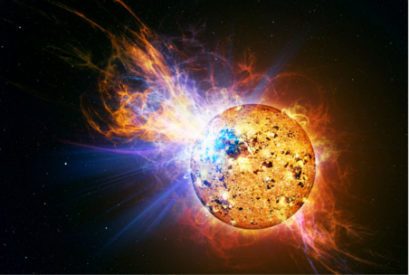 Paul Taylor of Creation Moments has ‘…discussed in previous Creation Moments how those who believe in the Big Bang Theory (let’s call them Big Bang Believers) have a sophisticated model of star formation into which they plug a number of interesting observations which could easily be interpreted in another way. For example, they would claim that certain gas molecule clouds, such as the Eagle Nebula, which contain small, bright stars, are, in fact, nurseries where stars are born. They then make the claim that they have observational evidence for the birth of stars, but this is, logically, a circular argument. The observed nebula is interpreted as the birth of stars only because it is interpreted according to their Big Bang Belief. The nebula cannot then be offered up as evidential proof for the very theory which is used to interpret it.


 whatyareckon