A good question for all of us to ask is ‘Did the eye evolve from a simple layer of photo-sensitive cells into the eyes that we have today? Darwin remarked that … “several facts make me suspect that any sensitive nerve may be rendered sensitive to light” … but how do photo-sensitive cells work? Is the invertebrate eye really wired the wrong way round? Dr George Marshall an expert in anatomy, who specialised in the human eye for several years answers these questions and many more.’ This video is from http://edinburghcreationgroup.org/video/12 which has many more excellent videos that declare the glorious work of our Creator.
Psalm 19:1 “The heavens declare the glory of God; and the firmament sheweth his handywork.”
Paul Taylor of Creation Moments has ‘…discussed in previous Creation Moments how those who believe in the Big Bang Theory (let’s call them Big Bang Believers) have a sophisticated model of star formation into which they plug a number of interesting observations which could easily be interpreted in another way. For example, they would claim that certain gas molecule clouds, such as the Eagle Nebula, which contain small, bright stars, are, in fact, nurseries where stars are born. They then make the claim that they have observational evidence for the birth of stars, but this is, logically, a circular argument. The observed nebula is interpreted as the birth of stars only because it is interpreted according to their Big Bang Belief. The nebula cannot then be offered up as evidential proof for the very theory which is used to interpret it.
In a similar manner, Big Bang Believers have a theory of planetary formation. In most cases, they assume that a cloud of gas and dust orbits the newly formed star and that, following a disturbance by something such as another star passing by, clumps of rock begin to aggregate under gravity until planet-sized lumps are formed.
One cloud of gas was recently reported as emanating from an observed star 685 light years away. The star has an evolutionary age of 2 million years. But what was actually observed is a large stellar flare. A Big Bang interpretation does not constitute proof and cannot undermine the Scriptural position that God made such objects on Day Four.’ https://creationmoments.com/sermons/do-baby-planets-exist/?mc_cid=14f2b34814&mc_eid=00c1dcff3c
The above video is Professor John is Head of Reactive Chemistry at St Andrews University and a Fellow of the Royal Society for Chemistry speaking on the origin of life. .
Matthew Cserhati wrote in CREATION magazine Vol. 42, No. 1, 2020 pages 46, 47 that ‘ACCORDING TO evolutionary theory, living things developed from simpler to more complex organisms over billions of years via several major innovations. One such big step was the evolution of multicellular organisms from single-celled ones. This is a crucial phase of evolution, because multicellular organisms allow for multiple cell tissue types. This in turn permits more variability in living beings, allowing for mutations and natural selection to supposedly create a larger variety of organisms.1 Evolution in a test tube?
You might have heard evolutionists make bold claims about experiments which have supposedly shown this important hypothetical step in evolution actually happening. One example involves laboratory experiments with green algae. These algae include single-cell species from the genus called Chlamydomonas (see fig. 1). Another algal taxon (group) is called Volvox, which includes multi-celled globeshaped algae species of up to several thousand cells (see fig. 2). Between these two forms there are several other taxa with intermediate numbers of cells (see fig. 3);2 e.g. Gonium, which is made up of 8–32 cells. Evolutionists propose that the multicellular Volvox once evolved from a unicellular algal species like Chlamydomonas, through several intermediary stages with progressively greater cell numbers. The experiment
Researchers took several groups of the single-celled Chlamydomonas and put them into test tubes with a singlecelled predator (the protozoan Paramecium tetraurelia) which could consume them. After 750 generations, the researchers discovered that some of the Chlamydomonas had taken on a multicellular form. This way the algae were large enough so that the predators could not eat them.3 They were not ‘fully’ multicellular, breaking apart into single cells before dividing, but seemed to go through a coordinated life cycle. Evolutionists claim that this is a demonstration of at least a significant part of evolution from single-cell forms to multicellular forms, repeating a portion of the history of life. But is it? The genetics of multicellularity Chlamydomonas and Volvox are very similar at a genetic level even though they look very different.4 What caused this change from single-celled existence to at least a form of multicellularity in Chlamydomonas? Certain genes necessary for multicellularity exist in Volvox. One such gene codes for a protein which is sticky. The cells secrete this sticky material, which keeps them anchored in it, creating a multicellular form. Volvox, the multicellular species, has more copies of this gene than the single-celled Chlamydomonas. It is significant that both species have the same gene, leaving the question unanswered as to how this gene, necessary for multicellularity, supposedly evolved in the first place. Researchers also found that several thousand (up to 20% of) Chlamydomonas genes behaved differently after the test tube experiments than at the beginning.5 This suggests that the environment (the presence
of the predator species) caused the Chlamydomonas cells to take up a multicellular form by switching genes on or off (called epigenesis). Evolution from microbes to men requires new genes with new functions to arise, but these experiments show no evidence of any such new genes. It was known that the genes for the multicellular form already existed in the single-cell species. In other words, the single-celled form already had the potential for multicellularity, needing only to be ‘switched on’ by this environmental cue. Whether it was enhanced by the natural selection of types with high sticky-protein production or not is an interesting question, but the point is still the same—no new genes, no new information, no evolution. This process of a single-celled alga becoming multi-celled involves thousands of genes, and it is in any case inconceivable that they would all evolve in such a short time. But it takes only a short amount of time for these genes to merely change their expression and/ or be selected for, as opposed to the genes themselves arising over millions of years of evolution. It is even possible that these algae species devolved from the multicellular Volvox form to the single-celled Chlamydomonas form through genetic loss. This would certainly be consistent with biblical creation, and with the mutational deterioration going on in living things. Summary and conclusion
Evolutionists would have us believe that they were able to rapidly ‘evolve’ a species exhibiting a type of multicellularity from unicellular forms in a very short time. This would give us the impression that a major and important evolutionary step has been observed happening, and that it can occur easily and rapidly. However, this picture is false, as we have seen. There is no evidence of a single new gene being produced, and not the slightest indication of how the genetic machinery for multicellularity could have evolved in the first place. When we look at the finer details, as usual we see that the evidence supports creation and not evolution. The evidence implies that these organisms used a highly complex genetic mechanism for switching from a single-celled state to a multicellular state. This mechanism didn’t evolve but already existed, simply needing to be activated. It was created so as to permit this effect. According to Genesis 1:12, “The earth brought forth vegetation, plants yielding seed according to their own kinds”. Neither plants nor green algae such as Chlamydomonas evolved, but are rather the result of God’s creation. The Creator designed even singlecelled algae to be incredibly complex and with a built-in capacity to adapt to various environments.’
Psalm 94:9 He that planted the ear, shall he not hear? he that formed the eye, shall he not see?
Creation Moments said ‘It’s easy to see why the human eye made it hard for Charles Darwin to sleep at night. Its design is light-years beyond anything that evolution could ever produce! Find out more about our amazing eyes by watching our “Micro Marvels of the Human Eye” video.’
Romans 1:18 For the wrath of God is revealed from heaven against all ungodliness and unrighteousness of men, who hold the truth in unrighteousness; 19 ¶ Because that which may be known of God is manifest in them; for God hath shewed it unto them. 20 For the invisible things of him from the creation of the world are clearly seen, being understood by the things that are made, even his eternal power and Godhead; so that they are without excuse
This video is based on a podcast from the Institute for Creation Research. A Bible believing Christian would have to have a wild imagination to get millions of years out of Genesis Chapters One and Two. Remember, when interpreting Scripture ‘When plain sense makes good sense seek no other sense lest it result in nonsense’.
I became a born again Christian at the young age of ten. I attended public school all the way from kindergarten through high school. Thankfully, my high school science teacher did not believe in evolution and spent only one hour on evolution itself. However, she was sick for several weeks and we had two students from Iowa State University fill in and they pushed the theory of evolution as fact. Even now at the age of 74 I remember their trying to make evolution sound true.
Sadly, there are probably not many teachers in the public schools today like the one I had. The two evolutionary students from Iowa State University have filled the positions. But, God is still on the throne and there are some students who are confronted with Bible creation and they get saved and some of them become scientists who believe the Bible account of creation. This is the testimony of such a man.
One doesn’t have to be a ‘scientist’ to know evolution has a LOT of problems. ‘According to the evolutionary story, humans evolved from an unidentified ape-like ancestor over two million years ago. But this story doesn’t line up with the Bible or scientific evidence. What can we learn from our DNA to decipher the origins debate? How does genetics support the Christian worldview of a recent creation?’ https://www.icr.org/article/mutation-rates-debunk-evolution
2Kings 6:17 And Elisha prayed, and said, LORD, I pray thee, open his eyes, that he may see. And the LORD opened the eyes of the young man; and he saw: and, behold, the mountain was full of horses and chariots of fire round about Elisha.
Pslm 94:9 He that planted the ear, shall he not hear? he that formed the eye, shall he not see?

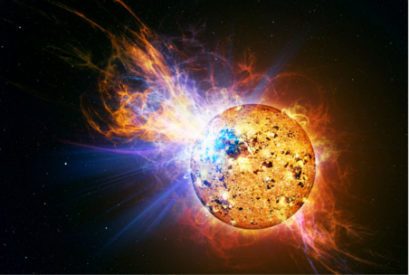 Paul Taylor of Creation Moments has ‘…discussed in previous Creation Moments how those who believe in the Big Bang Theory (let’s call them Big Bang Believers) have a sophisticated model of star formation into which they plug a number of interesting observations which could easily be interpreted in another way. For example, they would claim that certain gas molecule clouds, such as the Eagle Nebula, which contain small, bright stars, are, in fact, nurseries where stars are born. They then make the claim that they have observational evidence for the birth of stars, but this is, logically, a circular argument. The observed nebula is interpreted as the birth of stars only because it is interpreted according to their Big Bang Belief. The nebula cannot then be offered up as evidential proof for the very theory which is used to interpret it.


