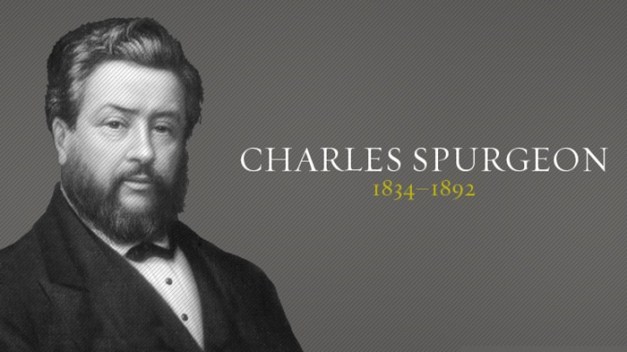
This is the first video report on this interesting book of testimonies of only a few of the thousands who came to know the Lord Jesus Christ under the ministry of C. H. Spurgeon.

MORNING & EVENING:
DAILY READINGS
by C. H. SPURGEON
FEBRUARY 01 — AM
“They shall sing in the ways of the Lord.” — Psalm 138:5
The time when Christians begin to sing in the ways of the Lord is when they first lose their burden at the foot of the Cross. Not even the songs of the angels seem so sweet as the first song of rapture which gushes from the inmost soul of the forgiven child of God. You know how John Bunyan describes it. He says when poor Pilgrim lost his burden at the Cross, he gave three great leaps, and went on his way singing —
“Blest Cross! blest Sepulchre! blest rather be The Man that there was put to shame for me!”
Believer, do you recollect the day when your fetters fell off? Do you remember the place when Jesus met you, and said, “I have loved thee with an everlasting love; I have blotted out as a cloud thy transgressions, and as a thick cloud thy sins; they shall not be mentioned against thee any more for ever.” Oh! what a sweet season is that when Jesus takes away the pain of sin. When the Lord first pardoned my sin, I was so joyous that I could scarce refrain from dancing. I thought on my road home from the house where I had been set at liberty, that I must tell the stones in the street the story of my deliverance. So full was my soul of joy, that I wanted to tell every snow-flake that was falling from heaven of the wondrous love of Jesus, who had blotted out the sins of one of the chief of rebels. But it is not only at the commencement of the Christian life that believers have reason for song; as long as they live they discover cause to sing in the ways of the Lord, and their experience of His constant lovingkindness leads them to say, “I will bless the Lord at all times: His praise shall continually be in my mouth.” See to it, brother, that thou magnifiest the Lord this day.
“Long as we tread this desert land, New mercies shall new songs demand.”
FEBRUARY 01 — PM
“Thy love to me was wonderful.” — 2 Samuel 1:26
Come, dear readers, let each one of us speak for himself of the wonderful love, not of Jonathan, but of Jesus. We will not relate what we have been told, but the things which we have tasted and handled-of the love of Christ. Thy love to me, O Jesus, was wonderful when I was a stranger wandering far from Thee, fulfilling the desires of the flesh and of the mind. Thy love restrained me from committing the sin which is unto death, and withheld me from self-destruction. Thy love held back the axe when Justice said, “Cut it down! why cumbereth it the ground?” Thy love drew me into the wilderness, stripped me there, and made me feel the guilt of my sin, and the burden of mine iniquity. Thy love spake thus comfortably to me when, I was sore dismayed — ”Come unto Me, and I will give thee rest.” Oh, how matchless Thy love when, in a moment, Thou didst wash my sins away, and make my polluted soul, which was crimson with the blood of my nativity, and black with the grime of my transgressions, to be white as the driven snow, and pure as the finest wool. How Thou didst commend Thy love when Thou didst whisper in my ears, “I am thine and thou art Mine.” Kind were those accents when Thou saidst, “The Father Himself loveth you.” And sweet the moments, passing sweet, when Thou declaredst to me “the love of the Spirit.” Never shall my soul forget those chambers of fellowship where Thou has unveiled Thyself to me. Had Moses his cleft in the rock, where he saw the train, the back parts of his God? We, too, have had our clefts in the rock, where we have seen the full splendours of the Godhead in the person of Christ. Did David remember the tracks of the wild goat, the land of Jordan and the Hermonites? We, too, can remember spots to memory dear, equal to these in blessedness. Precious Lord Jesus, give us a fresh draught of Thy wondrous love to begin the month with. Amen.
Romans 3:24 Being justified freely by his grace through the redemption that is in Christ Jesus:
Romans 4:4 Now to him that worketh is the reward not reckoned of grace, but of debt.
Romans 4:16 Therefore it is of faith, that it might be by grace; to the end the promise might be sure to all the seed; not to that only which is of the law, but to that also which is of the faith of Abraham; who is the father of us all,
Romans 5:2 By whom also we have access by faith into this grace wherein we stand, and rejoice in hope of the glory of God.
Romans 5:15 But not as the offence, so also is the free gift. For if through the offence of one many be dead, much more the grace of God, and the gift by grace, which is by one man, Jesus Christ, hath abounded unto many.
Romans 5:17 For if by one man’s offence death reigned by one; much more they which receive abundance of grace and of the gift of righteousness shall reign in life by one, Jesus Christ.)
Ephesians 2:8 For by grace are ye saved through faith; and that not of yourselves: it is the gift of God

MORNING & EVENING:
DAILY READINGS
by C. H. SPURGEON
JANUARY 31 — AM
“The Lord our Righteousness.” — Jeremiah 23:6
It will always give a Christian the greatest calm, quiet, ease, and peace, to think of the perfect righteousness of Christ. How often are the saints of God downcast and sad! I do not think they ought to be. I do not think they would if they could always see their perfection in Christ. There are some who are always talking about corruption, and the depravity of the heart, and the innate evil of the soul. This is quite true, but why not go a little further, and remember that we are “perfect in Christ Jesus.” It is no wonder that those who are dwelling upon their own corruption should wear such downcast looks; but surely if we call to mind that “Christ is made unto us righteousness,” we shall be of good cheer. What though distresses afflict me, though Satan assault me, though there may be many things to be experienced before I get to heaven, those are done for me in the covenant of divine grace; there is nothing wanting in my Lord, Christ hath done it all. On the cross He said, “It is finished!” and if it be finished, then am I complete in Him, and can rejoice with joy unspeakable and full of glory, “Not having mine own righteousness, which is of the law, but that which is through the faith of Christ, the righteousness which is of God by faith.” You will not find on this side heaven a holier people than those who receive into their hearts the doctrine of Christ’s righteousness. When the believer says, “I live on Christ alone; I rest on Him solely for salvation; and I believe that, however unworthy, I am still saved in Jesus;” then there rises up as a motive of gratitude this thought — “Shall I not live to Christ? Shall I not love Him and serve Him, seeing that I am saved by His merits?” “The love of Christ constraineth us,” “that they which live should not henceforth live unto themselves but unto Him which died for them.” If saved by imputed righteousness, we shall greatly value imparted righteousness.
JANUARY 31 — PM
“Then Ahimaaz ran by the way of the plain, and overran Cushi.” — 2 Samuel 18:23
Running is not everything, there is much in the way which we select: a swift foot over hill and down dale will not keep pace with a slower traveller upon level ground. How is it with my spiritual journey, am I labouring up the hill of my own works and down into the ravines of my own humiliations and resolutions, or do I run by the plain way of “Believe and live”? How blessed is it to wait upon the Lord by faith! The soul runs without weariness, and walks without fainting, in the way of believing. Christ Jesus is the way of life, and He is a plain way, a pleasant way, a way suitable for the tottering feet and feeble knees of trembling sinners: am I found in this way, or am I hunting after another track such as priestcraft or metaphysics may promise me? I read of the way of holiness, that the wayfaring man, though a fool, shall not err therein: have I been delivered from proud reason and been brought as a little child to rest in Jesus’ love and blood? If so, by God’s grace I shall outrun the strongest runner who chooses any other path. This truth I may remember to my profit in my daily cares and needs. It will be my wisest course to go at once to my God, and not to wander in a roundabout manner to this friend and that. He knows my wants and can relieve them, to whom should I repair but to Himself by the direct appeal of prayer, and the plain argument of the promise. “Straightforward makes the best runner.” I will not parlay with the servants, but hasten to their master.
In reading this passage, it strikes me that if men vie with each other in common matters, and one outruns the other, I ought to be in solemn earnestness so to run that I may obtain. Lord, help me to gird up the loins of my mind, and may I press forward towards the mark for the prize of my high calling of God in Christ Jesus.

MORNING & EVENING:
DAILY READINGS
by C. H. SPURGEON
JANUARY 28 — AM
“Perfect in Christ Jesus.” — Colossians 1:28
Do you not feel in your own soul that perfection is not in you? Does not every day teach you that? Every tear which trickles from your eye, weeps “imperfection”; every harsh word which proceeds from your lip, mutters “imperfection.” You have too frequently had a view of your own heart to dream for a moment of any perfection in yourself. But amidst this sad consciousness of imperfection, here is comfort for you — you are “perfect in Christ Jesus.”In God’s sight, you are “complete in Him;” even now you are “accepted in the Beloved.” But there is a second perfection, yet to be realized, which is sure to all the seed. Is it not delightful to look forward to the time when every stain of sin shall be removed from the believer, and he shall be presented faultless before the throne, without spot, or wrinkle, or any such thing? The Church of Christ then will be so pure, that not even the eye of Omniscience will see a spot or blemish in her; so holy and so glorious, that Hart did not go beyond the truth when he said —
“With my Saviour’s garments on, Holy as the Holy One.”
Then shall we know, and taste, and feel the happiness of this vast but short sentence, “Complete in Christ.” Not till then shall we fully comprehend the heights and depths of the salvation of Jesus. Doth not thy heart leap for joy at the thought of it? Black as thou art, thou shalt be white one day; filthy as thou art, thou shalt be clean. Oh, it is a marvellous salvation this! Christ takes a worm and transforms it into an angel; Christ takes a black and deformed thing and makes it clean and matchless in His glory, peerless in His beauty, and fit to be the companion of seraphs. O my soul, stand and admire this blessed truth of perfection in Christ.
JANUARY 28 — PM
“And the shepherds returned, glorifying and praising God for all the things that they had heard and seen, as it was told unto them.” — Luke 2:20
What was the subject of their praise? They praised God for what they had heard — for the good tidings of great joy that a Saviour was born unto them. Let us copy them; let us also raise a song of thanksgiving that we have heard of Jesus and His salvation. They also praised God for what they had seen. There is the sweetest music — what we have experienced, what we have felt within, what we have made our own — ”the things which we have made touching the King.” It is not enough to hear about Jesus: mere hearing may tune the harp, but the fingers of living faith must create the music. If you have seen Jesus with the God-giving sight of faith, suffer no cobwebs to linger among the harpstrings, but loud to the praise of sovereign grace, awake your psaltery and harp. One point for which they praised God was the agreement between what they had heard and what they had seen. Observe the last sentence — ”As it was told unto them.” Have you not found the gospel to be in yourselves just what the Bible said it would be? Jesus said He would give you rest — have you not enjoyed the sweetest peace in Him? He said you should have joy, and comfort, and life through believing in Him — have you not received all these? Are not His ways ways of pleasantness, and His paths paths of peace? Surely you can say with the queen of Sheba, “The half has not been told me.” I have found Christ more sweet than His servants ever said He was. I looked upon His likeness as they painted it, but it was a mere daub compared with Himself; for the King in His beauty outshines all imaginable loveliness. Surely what we have “seen” keeps pace with, nay, far exceeds, what we have “heard.” Let us, then, glorify and praise God for a Saviour so precious, and so satisfying.

MORNING & EVENING:
DAILY READINGS
by C. H. SPURGEON
JANUARY 26 — AM
“Your heavenly Father.” — Matthew 6:26
God’s people are doubly His children, they are His offspring by creation, and they are His sons by adoption in Christ. Hence they are privileged to call Him, “Our Father which art in heaven.” Father! Oh, what precious word is that. Here is authority: “If I be a Father, where is mine honour?” If ye be sons, where is your obedience? Here is affection mingled with authority; an authority which does not provoke rebellion; an obedience demanded which is most cheerfully rendered — which would not be withheld even if it might. The obedience which God’s children yield to Him must be loving obedience. Do not go about the service of God as slaves to their taskmaster’s toil, but run in the way of His commands because it is your Father’s way. Yield your bodies as instruments of righteousness, because righteousness is your Father’s will, and His will should be the will of His child. Father! — Here is a kingly attribute so sweetly veiled in love, that the King’s crown is forgotten in the King’s face, and His sceptre becomes, not a rod of iron, but a silver sceptre of mercy — the sceptre indeed seems to be forgotten in the tender hand of Him who wields it. Father! — Here is honour and love. How great is a Father’s love to his children! That which friendship cannot do, and mere benevolence will not attempt, a father’s heart and hand must do for his sons. They are his offspring, he must bless them; they are his children, he must show himself strong in their defence. If an earthly father watches over his children with unceasing love and care, how much more does our heavenly Father? Abba, Father! He who can say this, hath uttered better music than cherubim or seraphim can reach. There is heaven in the depth of that word — Father! There is all I can ask; all my necessities can demand; all my wishes can desire. I have all in all to all eternity when I can say, “Father.”
JANUARY 26 — PM
“All they that heard it wondered at those things.” — Luke 2:18
We must not cease to wonder at the great marvels of our God. It would be very difficult to draw a line between holy wonder and real worship; for when the soul is overwhelmed with the majesty of God’s glory, though it may not express itself in song, or even utter its voice with bowed head in humble prayer, yet it silently adores. Our incarnate God is to be worshipped as “the Wonderful.” That God should consider His fallen creature, man, and instead of sweeping him away with the besom of destruction, should Himself undertake to be man’s Redeemer, and to pay his ransom price, is, indeed marvellous! But to each believer redemption is most marvellous as he views it in relation to himself. It is a miracle of grace indeed, that Jesus should forsake the thrones and royalties above, to suffer ignominiously below for you. Let your soul lose itself in wonder, for wonder is in this way a very practical emotion. Holy wonder will lead you to grateful worship and heartfelt thanksgiving. It will cause within you godly watchfulness; you will be afraid to sin against such a love as this. Feeling the presence of the mighty God in the gift of His dear Son, you will put off your shoes from off your feet, because the place whereon you stand is holy ground. You will be moved at the same time to glorious hope. If Jesus has done such marvellous things on your behalf, you will feel that heaven itself is not too great for your expectation. Who can be astonished at anything, when he has once been astonished at the manger and the cross? What is there wonderful left after one has seen the Saviour? Dear reader, it may be that from the quietness and solitariness of your life, you are scarcely able to imitate the shepherds of Bethlehem, who told what they had seen and heard, but you can, at least, fill up the circle of the worshippers before the throne, by wondering at what God has done.

MORNING & EVENING:
DAILY READINGS
by C. H. SPURGEON
JANUARY 24 — AM
“Surely he shall deliver thee from the snare of the fowler.” — Psalm 91:3
God delivers His people from the snare of the fowler in two senses. From, and out of. First, He delivers them from the snare — does not let them enter it; and secondly, if they should be caught therein, He delivers them out of it. The first promise is the most precious to some; the second is the best to others.
“He shall deliver thee from the snare.” How? Trouble is often the means whereby God delivers us. God knows that our backsliding will soon end in our destruction, and He in mercy sends the rod. We say, “Lord, why is this?” not knowing that our trouble has been the means of delivering us from far greater evil. Many have been thus saved from ruin by their sorrows and their crosses; these have frightened the birds from the net. At other times, God keeps His people from the snare of the fowler by giving them great spiritual strength, so that when they are tempted to do evil they say, “How can I do this great wickedness, and sin against God?” But what a blessed thing it is that if the believer shall, in an evil hour, come into the net, yet God will bring him out of it! O backslider, be cast down, but do not despair. Wanderer though thou hast been, hear what thy Redeemer saith — ”Return, O backsliding children; I will have mercy upon you.” But you say you cannot return, for you are a captive. Then listen to the promise — ”Surely He shall deliver thee out of the snare of the fowler.” Thou shalt yet be brought out of all evil into which thou hast fallen, and though thou shalt never cease to repent of thy ways, yet He that hath loved thee will not cast thee away; He will receive thee, and give thee joy and gladness, that the bones which He has broken may rejoice. No bird of paradise shall die in the fowler’s net.
JANUARY 24 — PM
“Martha was cumbered about much serving.” — Luke 10:40
Her fault was not that she served: the condition of a servant well becomes every Christian. “I serve,” should be the motto of all the princes of the royal family of heaven. Nor was it her fault that she had “much serving.” We cannot do too much. Let us do all that we possibly can; let head, and heart, and hands, be engaged in the Master’s service. It was no fault of hers that she was busy preparing a feast for the Master. Happy Martha, to have an opportunity of entertaining so blessed a guest; and happy, too, to have the spirit to throw her whole soul so heartily into the engagement. Her fault was that she grew “cumbered with much serving,” so that she forgot Him, and only remembered the service. She allowed service to override communion, and so presented one duty stained with the blood of another. We ought to be Martha and Mary in one: we should do much service, and have much communion at the same time. For this we need great grace. It is easier to serve than to commune. Joshua never grew weary in fighting with the Amalekites; but Moses, on the top of the mountain in prayer, needed two helpers to sustain his hands. The more spiritual the exercise, the sooner we tire in it. The choicest fruits are the hardest to rear: the most heavenly graces are the most difficult to cultivate. Beloved, while we do not neglect external things, which are good enough in themselves, we ought also to see to it that we enjoy living, personal fellowship with Jesus. See to it that sitting at the Saviour’s feet is not neglected, even though it be under the specious pretext of doing Him service. The first thing for our soul’s health, the first thing for His glory, and the first thing for our own usefulness, is to keep ourselves in perpetual communion with the Lord Jesus, and to see that the vital spirituality of our religion is maintained over and above everything else in the world.
Swarthmore College began as a Quaker institution of higher education in 1860 https://www.swarthmore.edu/a-brief-history#event-founders-and-the-quaker-tradition. One hundred and fifty eight years later one of the courses now taught at Swarthmore is ‘QUEERING GOD: FEMINIST AND QUEER THEOLOGY’.
‘The God of the Bible and later Jewish and Christian literature is distinctively masculine, definitely male. Or is He? If we can point out places in traditional writings where God is nurturing, forgiving, and loving, does that mean that God is feminine, or female? This course examines feminist and queer writings about God, explores the tensions between feminist and queer theology, and seeks to stretch the limits of gendering-and sexing-the divine. Key themes include: gender; embodiment; masculinity; liberation; sexuality; feminist and queer theory.’ http://catalog.swarthmore.edu/preview_course_nopop.php?catoid=7&coid=8805
If that isn’t enough a 2014 graduate of the school created a tree shrine on campus because
she was ‘Inspired by Hindu and Buddhist icons that she studied in Professor Steven Hopkins’ class The Power of Images in Spring 2012′ making ‘an icon of Lucretia Mott as a transgendered, multi- racial and multi-armed god
dess astride her flaming Phoenix, holding safely in her womb the campus Quaker Meeting House, and brandishing in each of her graceful hands symbols that represent service and leadership, scholarship, the Social Sciences, Natural Sciences, and Humanities, and the virtues of athletic discipline.’
This graduate went on to say ‘When I took The Power of Images. . . I stared and stared at those gorgeous snapshots of Hindu shrines sprung up overnight like miraculous technicolor weeds, at Jizo shrines overflowing with little statues; shimenawa, omamori, baby Krishnas, reliquaries, Shiva processions . . . Do you know what it’s LIKE to be both an artist and a student of religion? Have you ever been forced, starving and depressed, to look at hundreds of professional photos of world-class sushi or baked goods? It was a lot like that. I thought, ‘why don’t we DO anything like this?’ The religious experience—ANY religious experience—is a thing beyond everyday description. To me that comes across best in a riot of color, clutter, sound, smell, and ceremony.’ https://www.swarthmore.edu/religion/making-image-swarthmore
Do the Quakers have any control over this school and what is taught? NOW, the Bible is pretty clear on the subject of making images and gender. For instance on gender, Paul wrote in 1Timothy 3:16 that ‘God was manifest in the flesh…’.
John the Apostle wrote in John 1:14 that ‘…the Word was made flesh, and dwelt among us, (and we beheld his glory, the glory as of the only begotten of the Father,) full of grace and truth’ John 1:14.
Of course both John and Paul were speaking of the Lord Jesus Christ. What gender was Jesus? That’s not hard to answer for when reading the Scriptures the only conclusion one can end with is; He was a male. As to Jesus’ Father ONLY male nouns and pronouns are used of Him. Now, that wasn’t hard, was it?!
So, why would the professors at Swarthmore College try to make the plain sense of Scripture say something else? Paul summed up the religious teaching at Swarthmore College when he wrote ‘Now the Spirit speaketh expressly, that in the latter times some shall depart from the faith, giving heed to seducing spirits, and doctrines of devils’ 1Timothy 4:1.
Mark 16:2 ‘And very early in the morning the first day of the week, they came unto the sepulchre at the rising of the sun. 3 And they said among themselves, Who shall roll us away the stone from the door of the sepulchre? 4 And when they looked, they saw that the stone was rolled away: for it was very great.
5 And entering into the sepulchre, they saw a young man sitting on the right side, clothed in a long white garment; and they were affrighted. 6 And he saith unto them, Be not affrighted: Ye seek Jesus of Nazareth, which was crucified: he is risen; he is not here: behold the place where they laid him. 7 But go your way, tell his disciples and Peter that he goeth before you into Galilee: there shall ye see him, as he said unto you.’
We celebrate Christmas because He died and rose from the dead. If the Lord Jesus had not died and had victory over the grave and death there would be no reason to celebrate His birth (CHRISTMAS).
To His disciples ‘…he shewed himself alive after his passion by many infallible proofs, being seen of them forty days, and speaking of the things pertaining to the kingdom of God’ Acts 1:3.
John 3:16 ‘For God so loved the world, that he gave his only begotten Son, that whosoever believeth in him should not perish, but have everlasting life.’