Genesis 7:21-23 “And all flesh died that moved upon the earth, both of fowl, and of cattle, and of beast, and of every creeping thing that creepeth upon the earth, and every man: All in whose nostrils was the breath of life, of all that was in the dry land, died. And every living substance was destroyed which was upon the face of the ground, both man, and cattle, and the creeping things, and the fowl of the heaven; and they were destroyed from the earth: and Noah only remained alive, and they that were with him in the ark.”
‘Previous writers and presenters of Creation Moments have often talked about fossils. But it is often useful to go over familiar ground again, especially if it is of foundational importance. Evolutionists tell us that fossils are evidence of evolutionary change. Nothing could be further from the truth. As creationists, we find that fossils make much more sense with a biblical explanation.
Fossils are dead. Since there was no death in the world until Adam’s sin, fossils cannot predate that sin. So, when humans were created, there were no fossils. Fossils are a worldwide event, and most of them appear to be of creatures that died rapidly and catastrophically under water, being covered with water-borne sediment. Such a formation is best understood as happening because of the worldwide Flood.
Some of the larger fossils – such as dinosaurs – are found buried in contortions, which looks like the last throes of death; this is consistent with sudden death caused by the Flood. Most such fossils are also found in assemblages, or bone jumbles. We tend to forget these last two facts when we see careful reconstructions of standing dinosaurs in museums. Many fossils closely resemble modern, surviving creatures, so that the fossil record illustrates not change, but stasis or – in the case of those creatures we do not find today – extinction.
Presently in our Bible teaching we are in Genesis 6 and heading to the chapter on the flood. Let me tell you when Noah built the Ark according to the instructions the Creator gave him he was precise in his maths for his family’s lives were at stake. Anyway, now days did you know ‘…mathematics could be racist, and that there is such a thing as ‘white math’? A claim is being made in some US academic circles that to insist that there is a correct answer to a statement like ‘2 + 2 = x’, is inherently racist, and that mathematics needs to be made antiracist. An organization1 funded by the Bill and Melinda Gates Foundation has published a document entitled, “A Pathway to Equitable Math Instruction Dismantling Racism in Mathematics Instruction“2. The document’s Letter to Reader states, “The framework for deconstructing racism in mathematics offers essential characteristics of antiracist math educators and critical approaches to dismantling white supremacy in math classrooms by visualizing the toxic characteristics of white supremacy culture … with respect to math.”
Bertrand Russell (1872–1970) a prominent anti-Christian philosopher and mathematician,3 a professed atheist,4 and Sergiu Klainerman, a professor of mathematics at Princeton University,5 among others, would disagree with the premise that mathematics is inherently racist. From a Christian perspective, we can add the fact that the basic principles of logic and mathematics cannot be racist nor are they in any way subjective human constructs, because they come from the perfect (Psalm 18:30) and holy (1 Samuel 2:2; Revelation 4:8) mind of God. Let us explore the reality that mathematics comes from the mind of God.
In Genesis 1–2, the narrator (God) uses concepts of mathematics embedded within the account without expounding the conceptual depth which underlies these concepts. For example, the enumeration of the days of Creation Week in Genesis 1 and 2 (Genesis 1:5, 8, 13, 19, 23, 31; Genesis 2:2) may appear to be rather routine. After all, we count from our earliest days—a child counts the number of days until his or her birthday. Some writers have observed that the use of the ordinal adjective (‘second’, ‘third’, etc.) with the word ‘day’ indicates that God is speaking of standard 24-hour days, and that the use of the cardinal (‘one’) and ordinals to number the days of creation demands a sequential chronological reading of the text. However, while this is true, they often fail to observe that the use of the ordinals indicates that the enumeration of the creation days is of fundamental importance. In addition, Genesis 5 implicitly uses addition, such as in the statement, “When Seth had lived 105 years, he fathered Enosh. Seth lived after he fathered Enosh 807 years and had other sons and daughters. Thus all the days of Seth were 912 years, and he died.” (Genesis 5:6–8)—i.e., 105 + 807 = 912.
Another use of a fundamental mathematical concept in Genesis 1 is the inclusion of entities in sets (e.g., six days of creative activity and “two great lights” [Genesis 1:16]). Sets are based on the abstract concept that assumes the existence of universals and not merely particulars by which each entity is viewed as independent from all others. A universal is the grouping of instances by their consistent characteristics or qualities. For example, when God later spoke to Adam and told him that he could eat from every tree in the garden, but one (Genesis 2:16–17), he used a universal to describe a set and Adam would have understood the concept to include grapes from vines, berries from bushes, and pears and nuts from trees. Universals are usually grouped into three classes: types or kinds (e.g., boats, birds, or chairs), properties (e.g., heavy, big, or small), and relations (e.g., parent, higher, colder). Since we use universals all the time, we may not understand an inherent difficulty with their existence. The problem of universals has perplexed philosophers from the earliest days.6 The challenge is how to account for their existence: Are they real? Do they exist independent of particulars? Can they exist if the universe is merely the product of random events in a material universe? Are they purely constructs of language?
The correspondence between abstractions—mathematical concepts such as ordinal counting and sets—and phenomena in nature is difficult for materialistic naturalists to explain. If mathematics is purely an invention of human minds, then it is a challenge to explain the correspondence between a mathematical equation and what happens in the natural realm.7
The efficacy of mathematics is astounding. With calculations, men and women guided the Apollo missions to the moon, can triangulate on signals generated by ‘black’ boxes to find a lost airplane at the bottom of the ocean, and can synchronize computers 20,000 kilometers apart so that they receive e-mail messages correctly. A materialistic naturalist cannot explain why pure abstractions—e.g., trigonometric equations, can have such an effect on the physical universe.
The existence of counting and mathematics is evidence that the universe was created by an intelligent designer—the God of the Bible. The laws of mathematics (e.g., commutative, associative, and distributive) come from God’s mind. Mathematics is one form of God’s thought—others include descriptive (Genesis 1), naming (Genesis 1:5), animating (Genesis 2:7), visualizing (Exodus 25:40; Exodus 26:30), and logical (Isaiah 1:18). The laws of mathematics exist in God’s mind and were not affected by the Fall of man into sin. The laws of mathematics are therefore perfect (Psalm 19:7) and can be derived without error. Of course, this does not mean that accountants and engineers (and others), affected by the Curse (Genesis 3:17–19), will always perform their arithmetical calculations without error.
Unbelievers can use the mechanics of mathematics without being able to explain what counting is or provide a logically consistent reason for why mathematics works, particularly when applied to natural systems. The problem is that their worldview claims that the universe came into existence by chance and has no non-material dimension (e.g., everlasting human souls). The fact that materialistic naturalists count and use complex mathematics to accomplish amazing things illustrates that they live in practical terms as if there is a God behind the universe, while denying His existence (Romans 1:18).8
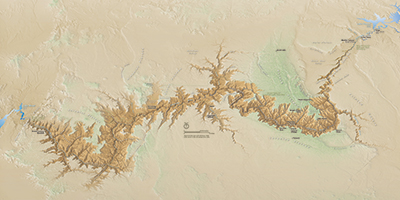
Years ago my family and I visited the Grand Canyon. What a sight it is! The ‘Grand Canyon carves a 277-mile-long chasm through northwestern Arizona. Running from Lee’s Ferry to Lake Mead, the expansive landscape reveals some of the most colorful geology in the world and provides strong evidence for the global Flood.
Lateral Extent of Strata
As you look across Grand Canyon, observe the layers on both walls. The cliffs and the colors match from one side to the other. The gaps between the cliffs were once filled solid, the layers continuous, but the space in between has since been removed by erosion. The bottom flat layers are older and were deposited first; these are called Cambrian system rocks. The youngest layers are on the canyon’s rim; these are identified as Permian system rocks.An explorer carefully navigates a canyon wall trail, circa 1930Image credit: Henry G. Peabody Photographs, Greater Arizona Collection, Arizona State University Library, Tempe, AZ.
All of these layers were deposited during the rising phase of the global Flood. Powerful tsunami-like waves spread massive, continuous sedimentary layers for hundreds of miles in all directions across this part of North America. Even relatively thin layers extend across Grand Canyon.
Flat Contacts Show Little Time Between Layers
Grand Canyon’s layers are like stacked pancakes. The lowermost flat layer at Grand Canyon is called the Tapeats Sandstone. At about 200 feet thick, it makes a thin, dark brown layer from a distant view. This layer represents the first extensive Flood deposit at this location. The basal boundary of the Tapeats is a special type of unconformity1 called a nonconformity, where sedimentary rock resides on top of pre-Flood crystalline rock. This surface is also referred to as the Great Unconformity (Figure 1).Figure 1. ICR geologist Dr. Tim Clarey addresses a Grand Canyon tour group with the Great Unconformity behind himImage credit: Kevin Turley
This global phenomenon is found in countless locations where Cambrian system sedimentary layers overlie Precambrian crystalline rocks. Just below the contact, we observe metamorphic crystalline rocks that are oriented nearly vertically, but the overlying Cambrian Tapeats is horizontal. Although secular geologists claim the Precambrian rock surface here experienced over a billion years of erosion, the contact with the Tapeats is almost perfectly planar—it’s flat! Where are the gullies and chasms from billions of years of erosion?
The Redwall Limestone is Grand Canyon’s most prominent layer—a red, thick, vertical cliff that spans the middle of the exposed rock layers. It’s part of the Mississippian system. Right below it, the Muav Limestone of the Cambrian system appears a bit more grayish. The evolutionary narrative claims 160 million years of erosion occurred between these two rock units. But where are the v-shaped channel patterns that gullies and canyons should have carved on top of the Muav? Instead, one flat limestone lies flat on another nearly everywhere you look.Figure 2. Flat contact shows no erosion and thus no time between the deposition of the Muav Limestone (gray) and the overlying Redwall Limestone (red). The inset shows the Great Unconformity.Illustration by Scott Arledge
A third flat unconformity lies between the Coconino Sandstone and the Hermit Shale. If you look toward the top of the layers in the canyon, you’ll see a thin, light, tan-colored cliff on top of a dark red layer. About a million years of erosion supposedly separates these two units (Figure 2). But if they were really deposited millions of years apart, valleys and canyons should be found between each of these layers. Instead, the contact is almost perfectly flat everywhere we see it.
Badlands Topography Shows Catastrophic Carving
By examining the topography of areas that have been catastrophically restructured recently, we can estimate the effects of the Flood and compare that estimation with Grand Canyon’s topography. A mudflow following the 1982 eruption of Mount St. Helens created a steep-walled, 140-foot-deep canyon system, complete with side canyons, in a single day.2 It looks remarkably like a 1:40 scale of Grand Canyon.
And we see similar deep gorges and butte-and-basin (badlands) topography associated with the flooding that followed the bursting of Ice Age Lake Missoula. This occurred about 4,000 years ago in the American Northwest. Even secular geologists now recognize that this catastrophic megaflood created the Channeled Scablands of eastern Washington and widened the Columbia River Gorge.
Today’s processes do not form broad, flat rock layers or carve such big and clean canyons. Different processes must be responsible—catastrophic processes. Therefore, it’s reasonable to conclude that early floodwaters laid down Grand Canyon rocks while the water was rising, and the receding floodwater carved most of the Canyon.
The present narrative for Grand Canyon’s formation is insufficient. Most of today’s secular scientists assume the Colorado River slowly carved Grand Canyon over a period of six million years. But today’s flow rates simply don’t have the power to push the 1,000 cubic miles of rocks and debris all the way out to the Pacific Ocean. Even after millions of years, we should see a lot more talus and debris. Talus refers to rock piles that lean against the cliff walls where they fell. The canyon’s base looks like it was swept clean. Only catastrophic water flow and water volume many times greater than what flows there today could sculpt badlands topography and wide gaps in the canyon.3
Noah’s Flood Explains Grand Canyon
Secular interpretations still cannot adequately explain why the Colorado River cuts right through the Kaibab Uplift that formed on the western flank of the Colorado Plateau. The Kaibab Uplift has warped an arch of rock about 3,000 feet above the surrounding terrain. Water should have flowed around it, not uphill and through it.4
How do Flood geologists explain this? The year-long Flood narrative in Genesis helps us understand what we see. After sediments like the Coconino, Redwall, and Tapeats were deposited in the rising phase of the Flood, the Colorado Plateau was pushed up 5,000 feet during the receding phase of the Flood. This caused the floodwaters to drain off rapidly. Grand Canyon is on the western edge of that plateau. When packed, wet sand is lifted up, it stretches and cracks. Water naturally follows the cracks and fractures. Some of those would have run through the Kaibab Uplift to create a path for lots of water to flow downhill and carve a vast canyon.
Rapid uplift and drainage of the receding floodwaters provide both the pathway and the necessary volume of water to quickly carve Grand Canyon.4 This was all accomplished before the Ice Age began. How do we know? Because there are about 150 lava flows that originated on the Uinkaret Plateau and poured down into Grand Canyon during the Ice Age. The canyon had to exist before these lava falls poured in.5
The lateral extent of the sedimentary layers, flat contacts between the layers, and vast badlands topography all point to rapid deposition and ultra-high-volume erosion. The rocks reveal the enormity of the global Flood, and the canyon exhibits catastrophic carving from receding floodwaters. Grand Canyon is a reminder of the immense power of the judgment of the Flood.
References
An unconformity is where some amount of erosion has taken place, removing a segment of the rock record. Unconformities can also occur if there was a brief hiatus in deposition. Unconformities do not imply vast amounts of time since they can form quickly as tsunami-like waves wash across the landscape, eroding the surface as they go.
“And I will establish my covenant with you, neither shall all flesh be cut off any more by the waters of a flood; neither shall there any more be a flood to destroy the earth.” (Genesis 9:11)
‘Those Christians who accept the concept of the “geological ages” commonly have to explain away the great deluge by assuming it was not really a global flood. They realize that any flood that would rise until “all the high hills, that were under the whole heaven, were covered” and in which “every living substance was destroyed which was upon the face of the ground” (Genesis 7:19, 23) would undoubtedly eliminate any evidence of the supposed geological ages. Therefore, they have suggested modifying the Bible record to mean an overflow of the Euphrates River or some such phenomenon that would destroy just the peoples of the “known” world at that time.
There are numerous problems with this “local flood” notion, however. Appendix 6 of The Henry Morris Study Bible, for instance, lists 100 reasons why the biblical Flood must be understood as worldwide and cataclysmic.
But probably the best argument is that such an argument makes God out to be a liar! God promised Noah that this kind of flood would never be sent on the earth again. There have been innumerable river floods, tsunamis, torrential regional rains, etc., in the more than four millennia since Noah’s day. If God’s promise referred only to some such flood as one of these, then He has not kept His Word!
Genesis 7:11 “In the six hundredth year of Noah’s life, in the second month, the seventeenth day of the month, the same day were all the fountains of the great deep broken up, and the windows of heaven were opened..”
‘One of the biggest headlines in planetary exploration in recent years was the confirmation that at one time Mars had water. Further exploration and study reveals evidence that there was once quite a lot of moving water on the surface of Mars.
With two rovers having sent back pictures and information from the surface, plus an orbiter exploring the surface, evidence of water action began to mount. At first, small features that looked like they were formed by moving water were discovered. Soon, it looked like that there was widespread water action in the southern hemisphere. Besides erosion, there is widespread evidence of the type of rocks that form underwater. Now, similar evidence suggests widespread water action in the northern lowlands as well. One of the most dramatic features could be the Mars version of the Grand Canyon. Called Valles Marineris, it is 2,000 miles long, 400 miles wide and five miles deep. It is so big, it can be seen from Earth with a good telescope. It would take catastrophic amounts of water to form such a canyon.
While the Bible doesn’t say anything about the flood that would suggest Mars was involved, some creation geologists say that it may have been. One thing is certain. This water action did not take place billions of years ago as those who believe in evolution say.’https://creationmoments.com/sermons/did-noahs-flood-affect-mars-too-2/


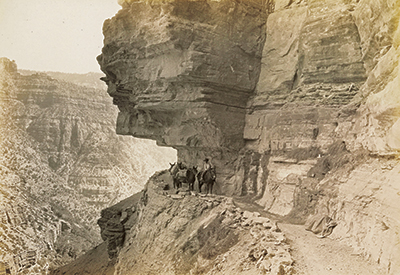 An explorer carefully navigates a canyon wall trail, circa 1930Image credit: Henry G. Peabody Photographs, Greater Arizona Collection, Arizona State University Library, Tempe, AZ.
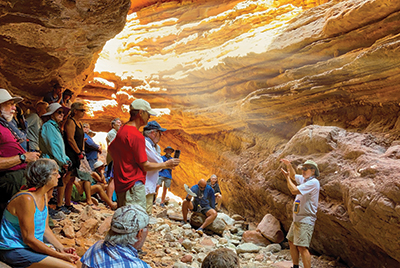 Figure 1. ICR geologist Dr. Tim Clarey addresses a Grand Canyon tour group with the Great Unconformity behind himImage credit: Kevin Turley
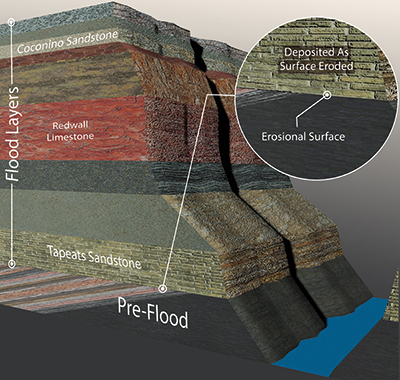 Figure 2. Flat contact shows no erosion and thus no time between the deposition of the Muav Limestone (gray) and the overlying Redwall Limestone (red). The inset shows the Great Unconformity.Illustration by Scott Arledge