‘Last month, the New York Times published an article about Hillsdale College and its Barney Charter School Initiative. As we’ve grown accustomed to expecting from the past year of misinformation, the article was misleading and dishonest. The article serves, however, as an opportunity to remind everyone what exactly these charter schools are and illuminate their purpose.
Probably the occasion for this article was the state of the state address in Tennessee, where Governor Bill Lee mentioned that he was asking Hillsdale College to help with charter schools in the state. This set off a firestorm that touches the most powerful political and educational forces in the land. They are bureaucracies, ruling in the name of their “expertise.” Anyone not a member in good standing of this bureaucratic system is an invader. The articles critical of us and everybody else doing charter schools imply that this bureaucracy is the essence of public education. We hold to the old view that teachers, students, and parents make up the public schools.
Each of our charter schools is a civic project involving hundreds of people from their local community. Often, those involved have school-aged children or grandchildren. If not, they are citizens who care deeply for the families and children who live in their city or town. They educate these kids because they love them—they want to show them things that are beautiful, true, and good.
And so these people—most of them are volunteers, mind you—spend countless hours learning how to manage a school, how to start sports leagues and band programs, create budgets, establish a board, draft applications, or find a school building. Founding a school is difficult, but these people do it for the sake of others—that’s a noble thing.
Why do they work so hard to open these schools in particular? It is because these schools want to help their children become wise, but also become good. Hillsdale charter schools offer an education in the classical liberal arts, emphasizing science, mathematics, literature, and history, but also teaching the arts, Latin, civics, philosophy, and ethics. The purpose of such an education is to form the hearts and minds of its students—to strengthen their characters as well as their intellects.
By the time these schools open, they are big, effective, and excellent. They go on to hire headmasters who know how to build a school culture and make the trains run on time. They attract dynamic teachers who love their subjects because they too have been personally transformed by them. Within a few years, they rank among the best in their districts and states.
When he visited the United States in 1831 and 1832, Frenchman Alexis de Tocqueville wrote about the American spirit of community in his book, Democracy in America: “In no country in the world do the citizens make such exertions for the commonwealth; and I am acquainted with no people which has established schools as numerous and as efficacious … better suited to the wants of the inhabitants.” At our charter schools, these efforts continue for the sake of an education better suited to the needs of the community.
Our charter schools are the work of their communities and those who live in them. They are built with love, and they take on the character of the people and communities that built them. And so, the students flourish there.
In stark contrast to much of what is reported in the news today, the students and parents at these schools are happy. Parents love seeing their children grow into fine young men and women, and the students are proud to see it in themselves, as well.
We use the Latin words alma mater when we refer to our former place of education. The words mean “nurturing mother”—I cannot think of a more nurturing educational environment than these schools.’ An Email from Hillsdale College’s president, Dr. Larry Arnn
‘Tennessee GOP Gov. Bill Lee has invited the private, conservative Hillsdale College to help open charter schools in his state as alternatives to public school that families and others in the state believe have far too liberal curricula.
Lee is making available as much as $32 million in public funds for the charter schools, which receive taxpayer funding to operate but are privately run.
They have traditionally served as an alternative to families with children in under-performing public schools.
The Hillsdale charter schools are neither owned nor managed by Hillsdale. Instead, the schools enter agreements to use the Hillsdale curriculum, and the small Michigan college provides training for faculty and staff, as well as other assistance – all free of charge, according to The New York Times.
A Hillsdale official told Just the News on Thursday it has received three applications to participate in the Tennessee program.
Hillsdale calls its lessons the “1776 Curriculum.”
School officials say the name is not in response to The New York Times’ “1619 Project” about so-called Critical Race Theory – which suggests America is inherently racist – but is “inspired by a deep admiration and respect for America’s Founders and the principles they expressed.
Public school parents have in recent months expressed large concerns about variations of critical race theory being taught to their children and have repeatedly brought their arguments to the public forum – including open school board meetings.
Hillsdale’s version teaches students that America is “an exceptionally good country.”
Critics of the 1776 Curriculum say it has an overly positive take on American history.
“It talks about the enormity of slavery, but in almost every case, everything that’s bad about America will be undone by what is good. Almost, literally, that American ideals will overcome whatever evils may be there,” Sean Wilentz, a Princeton professor told The Times.
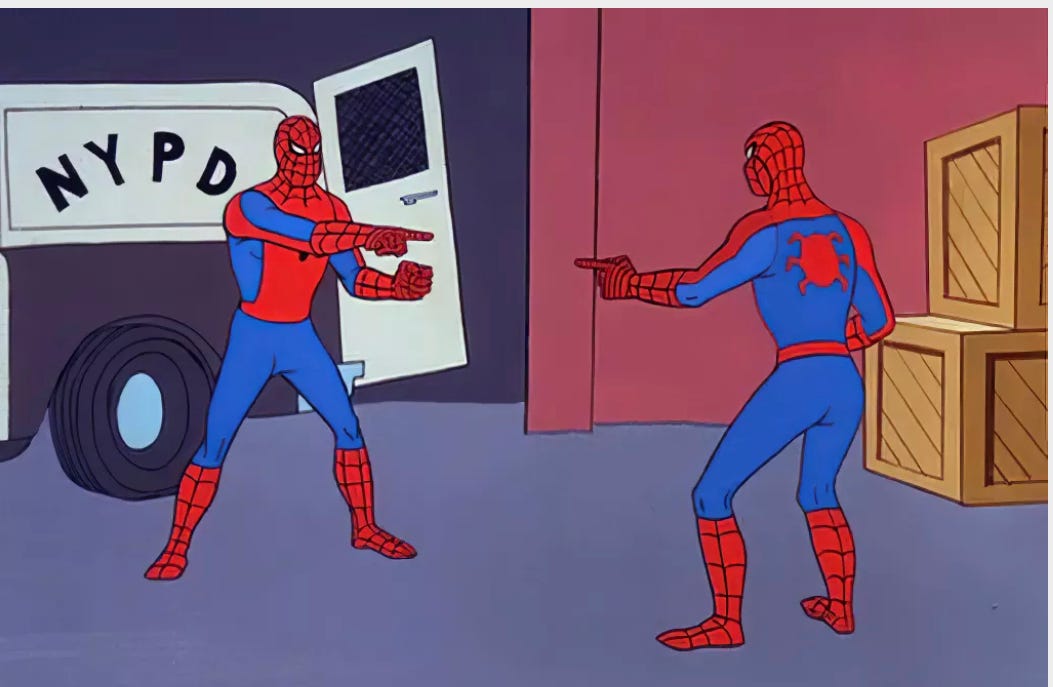
‘When I worked at the New York Times, I don’t think I ever wrote a Spiderman story.
What’s a Spiderman story?
That now-famous meme:
A Spiderman story is any investigative piece where the side the reporter is attacking can say EXACTLY the same things about the other side.
You’re misinforming!
No, you!
No, you!
No, you!
… ad infinitum.
I wrote lots of investigative pieces (mostly about drug and other medical companies) in the 10-plus years I worked for the New York Times; I’m proud of them. Some are still quoted, more than a decade after I left.
Here’s how I viewed my job: finding, investigating, and reporting on criminal/quasi-criminal and concealed/quasi-concealed corporate behavior.
All those words matter. Executives usually try to avoid breaking the law overtly. They don’t like prison. Prison isn’t fun. They prefer golf. (I’m not entirely sure why.)
Of course, there are exceptions. A few executives, like Elizabeth Holmes, are frauds basically from the jump. Other will cross the line when the walls are cracking and they get desperate. But generally, well-lawyered companies prefer to look for loopholes.
If paying a physician directly to prescribe your drug is illegal, offer volume “rebates” for drugs administered directly by physicians.
Or create a “naturalistic” clinical trial – where the physician receives hundreds of dollars for filling out a one-page form every time she enrolls a patient.
Or offer a free, all-expenses paid continuing education seminar for physicians about “new treatments” at a ski area, and keep the schedule light. And hire “key opinion leaders” – other physicians – to give the seminars – you can pay them, they’re working. And pay those KOLs to “consult” with your marketing division about the best ways to promote your drug.
You get the idea. When the product is a pill that costs pennies to make and can be sold for dollars (or sometimes hundreds of dollars), there’s LOTS of money sloshing around. You just need to put it to work.
So criminal OR quasi-criminal.
And concealed OR quasi-concealed. Obviously, companies will not go out of their way to describe clearly illegal behavior – cash in bags, et cetera. Getting at that usually requires whistleblowers (another topic) and internal documents.
But public companies have strict disclosure requirements. And pharma companies have to provide data to the Food and Drug Administration both before and after their products are approved and register their human clinical trials prospectively with the National Institutes of Health (they didn’t always). And lawsuits and the discovery process can also be great sources, which is yet another reason the vaccine immunity is so problematic.
So the truth – some version of the truth – is out there. Getting to it is often an iterative process – write a story, people talk, more documents come out, write another story, new evidence arrives in your email, et cetera. Bethany McLean did this brilliantly with Enron 20 years ago.
But please – pretty please – note two facts about the process I am describing.
First, it is a process of finding HIDDEN facts and data.
Second, Spiderman is nowhere near it. When Eli Lilly tried to hide the dangers of its drug Zyprexa from doctors treating people with schizophrenia – among the most vulnerable people in the world – nobody said the people with schizophrenia were hiding anything from Eli Lilly.
That’s investigative reporting. Bringing hidden facts to light. Protecting people who cannot protect themselves from companies with vast resources – armies of lawyers and marketers.
What Elizabeth Dwoskin (who, by the way, did not include me in her Washington Post story today – either she or her editors must have realized how terrible that would look after what I posted late last night) – is nothing of the sort. It is opinion and argument, pure and simple.
Why?
NOTHING ABOUT WHAT I AM DOING IS HIDDEN. The opposite: I present my findings every day in as close to real time as possible. And I have no hidden financial conflicts of interest.
AND READERS PROVIDE THE VAST MAJORITY OF MY INCOME. Either directly through Substack and Amazon or indirectly through publishers like Regnery and Simon & Schuster – who offer me advances in the hope they will sell enough books to recoup them, and pay me a portion of the money they make after those advances have earned out.
Investigative reporting would be: discovering that I’m lying about this and some bad actor is funding me. (Who? I even don’t know – the Russian government, maybe?) Which would be impossible, because it’s not true.
Investigative reporting would be: discovering that I have been making up sources or lying about what the documents I present say. Also impossible, because it’s not true.
Instead these people who call themselves reporters basically say, what you are saying is wrong – and not merely wrong, misinformation – because the Centers for Disease Control says so.
What?
I say again, WHAT?
You’re not Spiderman, I’m Spiderman!
I am reporting and have reported that public health authorities have vastly overestimated the efficacy of the vaccines for more than year and are presenting their data in a way that is effectively false. To say the CDC disagrees with me is not to shoot me down; it is to confirm what I am saying.
And it is not reporting, it is stenography of government institutions.



 whatyareckon