‘The sound of a great rushing wind descended on the large group of people gathered indoors, and flames of fire became visible on their heads! Can you imagine?
Sort of like being near the center of a hurricane or tornado with everyone suddenly holding lit sparklers! And as they spoke excitedly, the many different multi-national folks who gathered ‘round them for the “noise” of the disturbance “were confounded”. Because “everyone heard them speak in his own language”! They were “amazed and marveled” … “are not all these which speak Galileans? And how hear we every man in our own tongue, wherein we were born?” (Acts 2:7-8)
It was the Tower of Babel in reverse! God – who had divided the nations with a confusion of tongues at the God-denying, mankind-exalting developments of Babel – was here uniting the various people groups in a new covenant for all the nations under the Lordship of Jesus Christ!
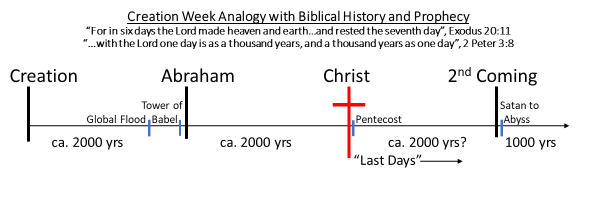
Shortly after Babel fell, Abraham, father of the Hebrew nation, had been drafted into a special covenant with God for a special blessing to all mankind. “And in thee shall all families of the earth be blessed” (Genesis 12:3). Abraham “believed God and it was counted unto him for righteousness” (Romans 4:3, Genesis 15:6, Galatians 3:6, James 2:23). And now all tribes, tongues, and nations of the earth were to become part of a new covenant with God by faith in the Lord Jesus Christ, with the unity of the Spirit. Christ’s Great Kingdom had come in “a preliminary sense”.
The apostle Peter stood up at Pentecost and said to the crowds: “But this is that which was spoken by the prophet Joel; and it shall come to pass in the last days, saith God, I will pour out of my Spirit upon all flesh… (Acts 2:16-17a). “The last days”, according to Acts 2, began with Pentecost, and we’ve been in them ever since. These would be the last days of the present evil “age” in which Satan is “the god of this world”. But how long can we be in the “last days” before the last of the “last days” arrives?
Biblical chronologists have calculated roughly 3800 – 4000 BC as a date for biblical creation. Famously, Bishop Ussher calculated 4004 BC. Isaac Newton calculated 3940 BC. With such calculations and the unfolding of non-evolutionary history, the earth is arguably about 6,000 years old – in a curious and remarkable analogy with the days of the creation week.
In 2 Peter 3:3-9, the Bible mentions “scoffers” coming in the “last days” regarding the promise of the Second Coming of Christ to the creation. And of people being “willingly ignorant” about the Great Cataclysm of Noah with its reminders of divine judgment, and earth’s history not being a uniformitarian one! Noah’s Flood is key for understanding earth history and how the earth fits a biblical timeline – and people deliberately overlook it. In that same passage, the Bible says that “a thousand years” is “as one day”. That’s an interesting phrase.
Because in another passage about the Second Coming of Christ, the Bible says “that old serpent, the Devil, and Satan, which deceiveth the whole world” will be “cast into the bottomless pit” and bound “till the thousand years should be fulfilled” (Revelation 12:9 and 20:2-3). Here is a “day of rest” from this evil age, the seventh day in the analogy with creation week. Interesting indeed. But the Lord is “longsuffering to us-ward…not willing that any should perish but that all should come to repentance” (2 Peter 3:9). We are to be emissaries for the truth of God in these “last days”! Our work is the Great Commission. “This gospel of the kingdom shall be preached in all the world for a witness unto all nations, and then shall the end come” (Matthew 24:14).
In the meantime, there is a whole lot of deception going on – as highlighted in last month’s newsletter (“Lies, Lies, and More Lies”). The devil and his minions are hard at it, and the rebelliousness of human “flesh” continues. When Genesis 1:27 says, “So God created man in His own image, in the image of God created He him; male and female created He them”, there is no room for being “non-binary”. People through all time and cultures have understood this. Why such confusion in today’s “scientific” society?!
In fact, while words may not get their meaning from their etymologies, the Hebrew words for “male” and “female” in the above verse derive from “piercer” and “pierced one”, respectively. These are the same words God used to direct Noah to organize the animals into the Ark by male and female pairs. There are two sexes, and we are either one or the other. It’s in our biology, internally and externally. Gender confusion makes no rational sense.
Biological sex being replaced by gender ideology is really another manifestation of “seducing spirits, and doctrines of devils” (1 Timothy 4:1). The doctrine is very sadly targeting young people and invading the church. Through the bullying activism of LGBTQIA advocates (the so-called “alphabet mafia”), it works in synodical councils to change church policies. The churches and the Christians who succumb to these false doctrines tend to be the same ones who have long succumbed to the grand lie of evolution, allowing it to undermine their view of the historicity and inerrancy of the Bible!
Gender “re-assignment”, transgenderism, connects to transhumanism, a New World Order ideology wanting to make man into something else. Redefining basic biology, so the thinking goes, with assists from micro-chip-embedded artificial intelligence, can help “empower” mankind to “a higher stage of evolutionary development” – and to become more powerful “mediums” of demons.
‘In this video, we delve into the fascinating discovery of soft tissue within dinosaur bones and the scientific challenges it presents. Traditional scientific understanding suggests that soft tissues, such as blood vessels and cells, should not persist in fossils that are millions of years old. How do we explain this inconsistently? Only the existence of God can.’
‘Explaining the origin of sex is widely recognized as a major dilemma after 150 years of attempts to answer it by some of the world’s leading evolutionists. Since Darwin revolutionized the world with his theory, this “masterpiece of nature” is acknowledged as one of evolutionists’ most difficult evolutionary problems, second only to the origin-of-life problem.[1]
Sexual differences are widespread in animals, but no single rule explains them.
The dominant theory is that asexual reproduction somehow slowly evolved into sexual reproduction. However, the evidence is both overwhelming, and widely recognized even by evolutionists, that evolution by small steps cannot bridge the transition from asexual to sexual reproduction. Sexual reproduction cannot occur until both functional and compatible male and female reproductive systems exist. If any part of any component does not exist, reproduction will not occur. Nonetheless, evolutionists continue to look for ways to solve the problem of the origin of sex. One current example is a study by Yadav et al.[2] This study, rather than solve the problem, actually illustrates how difficult it is.
Evolutionists not only readily admit that “eukaryotic sexual reproduction is a mystery,” but also that the “ubiquity of eukaryotic sexual reproduction is a mystery.” In other words, the fact that eukaryotic sexual reproduction exists everywhere in life, from invertebrates to vertebrates, from plants to insects and animals must be explained. Furthermore, a variety of very different types of eukaryotic sexual reproduction systems are observed (see list below). For example, fungi “undergo alternative modes of sexual reproduction (unisexual, pseudosexual, and parasexual) in the laboratory and in nature that share features with alternative sexual processes observed in animals and plants (parthenogenesis, hybridogenesis, gynogenesis, and apomixis).”[3]
Most animals, including humans, after birth live out their entire lives and reproduce as either one sex or the other. With some animals, and many plants, a variety of sex types exist. These will now be briefly described to illustrate the problem this poses for evolution.
The Basic Kinds of Sexual Designs
Unisexual refers to an organism that can reproduce without requiring both male and female gametes. Unisexual plants’ flowers contain either stamens or carpels, but not both. Examples in the plant kingdom include papaya, cucumber, maize, tapioca, pumpkin, musk melon, castor bean, birch, pine (using cones), and watermelon.
Bisexual plant flowers contain both stamens and carpels and require both male and female gametes to reproduce. Common examples include rose, sunflower, hibiscus, lily, and mustard. Attempts to determine patterns related to why some plants can reproduce unisexually, while others require bisexual support, have failed.
Simultaneous hermaphroditism exists in a single organism which has both types of reproductive organs when mature. Consequently, they produce both male and female gametes. In simultaneous hermaphrodites, self-fertilization is possible in some species, but absent in others. Examples include vascular plants, worms, snails, slugs, barnacles, bryozoans (moss), and trematodes (flukes).
Sequential hermaphroditism produces eggs (female gametes) and sperm (male gametes) at different stages in their life. The change from one sex to another is a normal event as part of the organism’s reproductive cycle. The change from male to female is called protandry or protandrous hermaphroditism, and from female to male is called protogyny or protogynous hermaphroditism. Sequential hermaphroditism is actually common in many fish, gastropods, and certain plants.
Bidirectional hermaphrodites possess the capacity for sex change in either direction, male to female and female to male, an alternation potentially repeated several times during the organism’s lifetime.
Pseudosexualincludes animals that experience a tertiary physical attraction which mimics sexual attraction but no transfer of gametes occurs. The problem with this behavior is that it does not normally involve successful reproduction.[4]
Parasexualreproduction is a system that results in the recombination of genes from different individuals, but does not involve meiosis nor the formation of a zygote by fertilization as in sexual reproduction. The main examples include fungi and many unicellular organisms.[5]
Parthenogenesis, is a form of reproduction in which an egg develops into an embryo without being fertilized by sperm. It usually results in the development of a female; and very rarely males. Rotifers, along with several insect species, including aphids, bees, wasps, and ants can reproduce by parthenogenesis.
Hybridogenesis, also called sexual parasitism, involves the selective transmission of one of the parental genomes, while the other genome is renewed by mating with the corresponding species. [6]
Gynogenesisis a system of asexual reproduction that requires the presence of sperm but not the contribution of its DNA. The paternal DNA dissolves, or is destroyed by another means, before it can fuse with an egg. The egg cell then is able to develop, unfertilized, into an adult using only maternal DNA. Most gynogenesic animals are fish or amphibians. Why this reproductive mode even exists, given that it combines the disadvantages of both asexual and sexual reproduction, remains another unsolved problem in evolutionary biology.[7]
Androgenesisis the male equivalent of gynogenesis, where the father is the sole contributor of DNA. Thus a zygote is produced with only the paternal nuclear genes.[8]
Apomixisis asexual reproduction in which seeds are produced from unfertilized ovules. Examples include the genera Crataegus (hawthorns), Amelanchier (shadbush), Sorbus (rowans and whitebeams), Rubus (brambles or blackberries), Poa (meadow grasses), Nardus stricta (doormatgrass), Hieracium (hawkweeds) and Taraxacum (dandelions).
Attempts to Explain the Variety of Reproductive Methods Fail
In their PNAS paper (ref. 2), the authors attempt to theorize how and why organisms could have evolved so many different systems for mating-type determination. This, they claim, could advance the understanding of the evolution-of-sex problem itself. Actually, their attempt creates additional major difficulties for understanding the evolution of sex. For example, they write:
the systems by which sex is defined are highly diverse and can even differ between evolutionarily closely related species. While the most commonly known form of sex determination involves males and females in animals, eukaryotic microbes can have as many as thousands of different mating types for the same species. Furthermore,… several examples are also present among vertebrates suggesting that alternative modes of sexual reproduction evolved multiple times throughout evolution.[9]
It is widely recognized that the evolution of sex is an enormous problem: “no other problem has sowed as much confusion” as have attempts to explain the origin of sexual reproduction.[10] As Richard Dawkins asked, “why did sex, that bizarre prevision of straightforward replication, ever arise in the first place? … This is an extremely difficult question for evolutionists to answer” which he admitted he was “going to evade” due to “the difficulty which theorists have with explaining the evolution of sex.”[11] The late Lynn Margulis added in the introduction of her book on sex was so difficult that “becoming sexual [beings] is one [topic] which we will try to steer well clear of throughout this book.”[12]
How Yaiv et al., in their PNAS Article Deal with the Origin of Sex Problem
Yaiv et al. proposed that the variety of sex behaviors they documented did not evolve from some hypothetical original sexual reproduction system, but rather evolved multiple times. They openly stated that “sexual reproduction evolved multiple times throughout evolution.” The problem is, if sex is unlikely to have evolved once, it is far more unlikely to have evolved as many as 12 different times to explain the different sexual systems listed by Yaiv and noted above.
The authors’ phraseology implies that animals can choose their method of reproduction, as if it were a conscious choice made by the organism. They write,
some species have found alternatives to sexual reproduction, and prefer to grow clonally and yet undergo infrequent facultative sexual reproduction. These organisms are mainly invertebrates and microbes.[13]
Summary
Most evolutionists believe that evolution explains the origin of all types of sexual reproduction but struggle to determine when, how, and why sex evolved. The PNAS paper reviewed here is no exception. All past attempts fail, and the paper reviewed here, published in a leading American science journal, is another example of the norm. Now evolutionists have to explain the evolution of over a dozen types of sexual reproduction. But they must admit that sexual reproduction is evolutionarily conserved, meaning that, when examined historically, it has been shown to have not changed.[14] In other words, no evidence exists that any of the sexual systems the authors discussed have evolved. All evolutionists can do is attempt to speculate how one sex system could have evolved into another reproductive method.
References
[1] Trivers, Robert. The evolution of sex: A review of the masterpiece of Nature: The evolution and genetics of sexuality. The Quarterly Review of Biology 58(1):62-67, March 1983.
[2] Yaiv, Vikas, et al. On the evolution of variation in sexual reproduction through the prism of eukaryote microbes. Proceedings of the National Academy of Sciences 120(10). 3 March 2023; https://doi.org/10.1073/pnas.2219120120.
[4] Dias, Brian, and David Crews. Regulation of pseudosexual behavior in the parthenogenetic whiptail lizard, Cnemidophorus uniparens. Endocrinology 149(9):4622–4631, September 2008.
[5] Mishra, Abhishek, et al. Parasexuality of Candida species. Frontiers in Cell Infection Microbiology 11:796929; doi: 10.3389/fcimb.2021.796929, 2021.



 whatyareckon