The climate scammers have been droning on for over thirty or more years now! If a preacher or any religious person had predicted Jesus’ coming again as many times as these prophets of climate change have they would be laughed out of town! Oh, but the climate change scam is SCIENCE and we trust the EXPERTS! When will this nonsense cease? When will politicians wake up and see it for what it is; a SCAM! This is why they want President Trump out! If 2021 sees Biden/Harris in the WH be sure these lies will be told more and more until the younger generation will not know the truth and all weather history will be rewritten to fit their lies!!
That’s right, the founder of Microsoft apparently thinks that the sun is the Blue Screen of Death in the sky and is funding research at Harvard University into dimming the sun to cool the earth. The solar geoengineering project, called Stratospheric Controlled Perturbation Experiment (SCoPEx), will be flying a test balloon above Sweden next year as part of this research. The plan is to eventually release 2 kg of calcium carbonate dust into the atmosphere in a year or two to study how what impact it may have.
You read that correctly. They want to put chalk dust in the atmosphere.Are you old enough to have ever cleaned blackboard erasers for your teacher? That nasty cloud of chalk dust you inhaled during that process is what they want to put into the atmosphere.
The Climate Scammers are a real work of art. They have taken the China virus and used it to catapult the climate scam not only back in the news BUT on the front page! I trust you (my readers) have not fallen for this false religion! Anyway, ‘With the coronavirus pandemic gripping the planet, industries are shutting down, planes are being grounded and shoppers are staying home. COVID-19 has already reduced China’s greenhouse gas emissions by 25%. Other countries may experience similar trends, leading to lower emissions in 2020 than in previous years. But this doesn’t mean that we should be cheering the climate benefits of the outbreak. Instead, advocates for climate justice recognize that like the climate crisis, the pandemic and its spiraling impacts, will hit women, the poor and most marginalized the hardest. We believe that responses to climate change – and all global emergencies – must have social justice at their core. This means rejecting the idea that the sufferings of vulnerable people and increasing inequality are acceptable trade-offs for reducing emissions.
The global response needed for the pandemic provides lessons for the action needed to tackle climate change. Governments, movements and society must internalize these principles to address these emergencies with solutions that ensure justice for all: Equality: Governments must protect women, the poor and vulnerable from both crises and their impacts, valuing every human life equally regardless of nationality, wealth, gender, race or age. Similarly, it is not acceptable for one generation to continue business-as-usual in the knowledge that they are relatively safe, while increasing the risk and impact for another generation. Social protections: Free, universal healthcare, paid sick leave and unemployment benefits for workers in the formal and informal economies, are urgently needed so that people don’t have to chose between protecting their livelihoods and protecting society during the pandemic. Similarly, social protection measures, such as job guarantees, income support or guarantees of the same wage and benefits, will be key to helping workers in carbon-intensive industries make a just transition away from jobs that harm the climate. Governments must also address the fact that women are disproportionately affected by both crises, as they tend to carry a greater burden of unpaid care and frontline work. Solidarity: No country can ‘go it alone’. Governments must work together and avoid retreating into nationalistic and competitive approaches. As with climate change, wealthy countries must do their ‘fair share’ and scale up financial and technology support for lower-income countries. True solidarity also means embracing and sharing solutions, many of which are being pioneered in the Global South.
The ‘invisible hand of the market’ won’t fix this: Both crises show the need for deep systemic change. These emergencies expose the injustices of neo-liberal economic systems, in which powerful corporations prioritize profits over the common good and do all they can to avoid regulations. Governments’ responses to the pandemic require them to make public policy decisions, including strong regulatory measures, in the interests of their citizens rather than their corporate political donors. Calls for a massive scaling up of public financing, and nationalization of health and other services to deal with the pandemic, must be expanded to energy, water provision and public transport. Build back better: When crises hit, responses must strengthen people’s ability to cope with future emergencies. Just as responses to the pandemic must protect society now and in future, humanitarian responses to climate disasters must also strengthen communities’ longer-term resilience through social protections and climate-resilient interventions. It’s never too late to act: Every day that passes counts. Every action that limits harm is worth it. Even if we’re slower out of the starting blocks than we should have been, we must start now. Giving up is not an option, however bad the situation may appear. Do what it takes – but don’t abuse power: As many governments have been slow to take stringent measures to halt the pandemic, citizens have called for stronger measures to contain the crisis. Society has shown its willingness to accept inconvenience, strong government intervention, social protections and yes, less shopping and flying, if it means protecting millions of vulnerable lives. Governments must take heed of this. Our resolve to do what it takes to solve the climate crisis, in ways that advance social justice, is just as strong. But they must not abuse their power, nor cement measures taken in times of emergency into authoritarian limits on freedom after the crisis has passed.’http://Bringing-climate-justice-thinking-to-the-COVID-19-pandemic.pdf
Now, that last statement is exactly what this is all about. Your and my freedom are at stake here! If the Democrats win the WH then be sure the freedoms you enjoyed before January, 2021 will be only a memory.
Saving the planet from the climate catastrophe is a hard job as Indonesia is finding out.
‘Kermit the Frog once famously quipped “It’s not easy being green.” The nation of Indonesia is no doubt finding this is true — especially as it attempts to transition away from fossil fuels toward so-called green energy.
As reported in the publication Mongabay, Indonesia is currently embarking on an aggressive program to phase out its use of diesel for an alternative made from palm oil. This new biodiesel fuel, the government claims, is cleaner and will help its nation meet its greenhouse reduction goals. The problem is, naturally, it will also lead to massive deforestation and potential harm of endangered species.
To achieve its goal of going green, the government is rolling out its program in stages. Initially it intends to use only a modest amount of the biodiesel in all its blends, but over time it will seek to progressively employ higher concentrations of palm oil-derived biodiesel into its conventional diesel.
The program is currently at what is called the “B30 stage,” which means the diesel sold at the pump contains a 30% blend of palm oil-derived biodiesel. Ultimately by 2025, however, they hope to achieve a B50 (50:50) blend. But to do that, the total planted area of oil palms will have to be at least 22.7 million hectares (56 million acres) – a feat which means the nation will have to chew up and chop down a lot of forested cover.
As reported in Mongabay:
Arkian Suryadarma, a forest campaigner at Greenpeace Indonesia, said it’s highly likely the biodiesel program will lead to deforestation.
“The biodiesel program needs lands for new oil palm plantations which could lead to massive deforestation,” he said. “The biodiesel program is clearly not a solution for the country’s fiscal state and will worsen the implementation of Indonesia’s climate commitment because it is oriented toward deforestation and new land clearing in forest areas. That’s why it’s very wrong if biodiesel is categorized as a renewable energy.”
The Greens maintain Indonesia would be better served to rely on solar and wind energy to power its industry and transportation need. This alternative, the Indonesian government realizes, is completely unrealistic as wind and solar energy have failed to meaningfully meet the energy needs of rich developed nations – let alone poorer developing ones.’https://papundits.wordpress.com/2020/12/28/indonesias-clean-energy-program-sparks-deforestation-worries/
Don’t bother me with the facts! That seems to be what the political elite seem to be saying. However, ‘Using a new observational approach to an old but most important question, CLINTEL President Guus Berkhout finds that about 62% of the atmospheric CO2 increase is due to natural sources, not human emissions.The study then looks at the implications for drastic CO2 reduction measures, finding that these measures will not stop the atmospheric increase. Actually, they will have very limited effect. Hence the title of the report is “Managing the Carbon Dioxide Content in the Earth’s Atmosphere“.
Professor Berkhout’s approach is based on proven technology in geophysical imaging. He calls his method spectral ‘fingerprint detection (FPD)’, because it looks at the relationship between fine-grained details of the atmospheric CO2 increase and anthropogenic emissions over time by computing auto and cross correlation functions.
Note that in the spectral FPD approach knowledge about the existence of different CO2 isotopes (C12 and C13) is not required. This is consistent with the current decarbonization practice, where minimization of the atmospheric CO2 concentration is the target, whatever the isotopic composition.
Note also that spectral FPD reveals that a lot of information is hidden in the variability of observations. Therefore, spectral FPD starts with decomposing observations into trends and changes along the trends.
The study puts it this way:
“The fine-grained variability of the anthropogenic emission represents the ‘fingerprintof the human CO2-source, telling us that most of the anthropogenic CO2-emission is absorbed by the land-ocean reservoir (fingerprint detection). It also reveals the existence of internal oscillations between the atmosphere and the land-ocean reservoir.”
There is a lot of math here, including least-squares minimization, but the results are clear. An estimated 62% of the increased CO2 concentration is entirely natural.
The study then applies these findings to determine the impact of four different emission reduction scenarios, as follows:
“Four policy scenarios for decarbonization purposes have been built: ‘Business as Usual’, ‘Stabilizing the Emission’, ‘Reducing the emission’ and ‘Making use of CCS’. A big impact conclusion for policy making is that zero anthropogenic emission – being a major achievement– does not mean at all that the atmospheric accumulation becomes zero.”
The analysis comes with a warning:
“Each scenario has its own phase diagram, showing the relationship between atmospheric concentration and anthropogenic emission. It is advised that decarbonization policies are designed such that the transition path in the phase diagram is technically, economically and socially feasible.” (Emphasis added)
Given that even the most stringent (and hugely expensive) scenario does not stop the natural CO2 increase, their rationale is greatly diminished. Also, given that most of the past increase is natural, we can stop blaming ourselves for it.
Professor Berkhout says this is just the first step in applying spectral FPD to the science of climate change:
“By considering spectral fingerprint detection on any source variability, there will be a lot of applications. Apart from CO2 variability, we will look at solar-irradiation variability, cloudiness variability, etc. to determine their individual influence on atmospheric temperature. It leads to a multidimensional causality determination. Again, without any theoretical assumptions. It is all based on observations.”
In science new methods often yield surprising results. I look forward to this multidimensional causality determination with great interest. In the meantime, the climate science and policy communities need to rethink the contribution of human emission to the atmospheric CO2 increase, especially with regard to the potentially destructive mitigation actions.
‘President-elect Joe Biden on a daily basis has been announcing high-level appointments to his administration that will take control of the federal executive branch on January 20th. None of the individuals come as a shock, but they are no less objectionable in terms of the radical policy shift they portend for America, particularly on climate policy and energy development.
Mr. Biden is expected to appoint Gina McCarthy to be “Domestic Climate Coordinator,” a new position to be housed in the White House Executive Office of the President. From this perch, she will ensure the multitude of federal agencies regulate and manage their responsibilities around reducing carbon dioxide emissions.
Mr. Biden did announce this week cabinet appointments that will implement climate policy overseen by Ms. McCarthy. They include Jennifer Granholm for Secretary of Energy, who was Michigan Governor and champion of “renewable” solar and wind energy; and Michael Regan for the Environmental Protection Agency, an African American who is the Secretary of the North Carolina Department of Environmental Quality and espouses “environmental justice” for communities of color. The president-elect is expected to name Congresswoman Deb Haaland of New Mexico for Secretary of the Interior, who is opposed to decades long energy development on federal lands.
This appointment of Ms. McCarthy would follow Biden’s naming of former Secretary of State, John Kerry, as “Special Envoy” for climate change with a seat on the National Security Council. These new elevated positions, which overlay all domestic and foreign policy, clearly show the seriousness of the incoming Biden-Harris administration to shift climate and energy policies in a radical, domineering direction.
Ms. McCarthy is fanatical when it comes to climate change, that is, mankind’s tangential role in global warming. She previously served as an environmental regulator in Massachusetts and headed the Environmental Protection Agency in Barack Obama’s second term. She currently heads the Natural Resources Defense Council. One of the major black marks against her time as EPA chief was her mishandling of the catastrophic water crisis in Flint, Michigan. Yet, she will be more influential than ever in the Biden White House.
The enormous regulatory and financial power wielded by the federal government will be steered to all things climate change under Ms. McCarthy. Among the countless policy restrictions coming soon will affect oil and gas leasing on federal lands and offshore, emissions standards, and new mandates on the financial sector for more Green project investments.
Economic activity necessarily results in carbon emissions, including the products we produce and consume, the means by which we travel, and the heat and air conditioning in our homes and workplaces. Proposed Green New Deal policies to reduce carbon emissions necessarily will harm the economy; specifically many of the 300 million non-wealthy Americans whose jobs will be eliminated and the higher costs everyone will pay more for energy, goods and services across the board.
Ms. McCarthy’s obsession is for reducing carbon emissions, regardless of the resulting economic dislocation. Yet any “success” in doing so provides zero guarantees the Earth’s climate will change in a different direction from its present trajectory, which is unpredictable, especially 30 years hence.
As CFACT has frequently documented, actual science shows man-made carbon emissions are a tiny fraction of atmospheric gases, and a variety of other natural phenomena impact the planet’s climate. All of this is well beyond the reach of McCarthy, Kerry and the rest of the Biden-Harris team no matter how many trillions of tax dollars they spend on solar panels and retrofitting office buildings. Scientific climate realities also bereft in the pliant news media, which reports without scrutiny. National Public Radio, for example, when reporting on the McCarthy appointment, which dutifully propagated the falsehood that climate change has resulted in “record wildfires, hurricanes and flooding in recent years.”
During his 36 years in the U.S. Senate, Joe Biden was collegial and often considered moderate or mainstream in the Democratic Party, in contrast to more liberal senators. But the Party itself has shifted sharply to the political Left, especially on climate and energy policies, which are the priority of the Party’s mega-donors such as Michael Bloomberg, Tom Steyer and George Soros. Mr. Biden has shifted accordingly, and these appointments are another example of that reality.
The immediate question becomes, what of the Republicans? Will they be a rubberstamp these Biden cabinet appointments, especially if they retain a majority in the U.S. Senate? That would be the easy route.
The climate and energy appointments by President-elect Biden demand a rigorous debate to check the radicalism that threatens the economy and standard of living of the U.S. With the pandemic expected recede in 2021 due to the vaccine, the climate agenda and energy restrictions that will be imposed by the fledging Biden-Harris team otherwise threaten a return to economic normalcy in America.’https://papundits.wordpress.com/2020/12/18/biden-harris-administration-taking-shape-beware/
‘If ever there was an example of what follows from an obsession with chaotically intermittent wind and solar, Germany has to be it.
No country went harder or faster than Germany did, when it came to carpeting its landscape with solar panels and wind turbines. The results have been an unmitigated disaster.
In the retail power price stakes, Germany jockeys for position with equally wind power obsessed, Denmark and the UK. At the minute, it’s a nose ahead of Denmark, with the UK bearing down on the leaders as they reach the home straight.
That 300,000 households can no longer afford electricity, comes as no surprise. That hundreds of thousands of people in Europe’s richest economy are forced to heat their homes using timber scavenged from forests is criminal.
Isn’t it ironic that school truant Greta Thunberg carries so much weight in this climate scam industry? Here is a girl with no science degree telling world leaders how to save the world from a future climate catastrophe and at the same time the skeptics are told to ‘“Listen to the science!” shouts the Left.
Are they ready to put their money where their mouths are?
No less a scientific expert than Greta Thunberg appeared at a House of Representatives committee hearing and used those very words. Greta came wielding the latest report by the UN’s Intergovernmental Panel on Climate Change (IPCC). Little did she know this very report debunks some of the Left’s favorite global warming talking points — such as those related to storm intensity, sea level rise and extreme weather.
CFACT senior policy analyst Jay Lehr lives to educate the public on science. Jay holds a degree in geology from Princeton and a Ph.D. in groundwater hydrology from the University of Arizona. He is an accomplished scientist. Dr. Lehr has been posting a series of important science articles at CFACT.org, often partnering with Tom Harris and Terrigi Ciccone (who themselves are outstanding engineers). Their work is first rate and much needed.
In 2014, John Oliver devoted an entire episode of his HBO comedy series Last Week Tonight to climate change. Oliver put up a clip of CFACT’s Marc Morano and then brought out Bill Nye the Science Guy. Unfortunately he then had an actor play the role of Morano, instead of inviting Marc himself. Oliver then did something outrageous. He had 96 extras in white lab coats flood the stage to illustrate the phony “96% consensus” trope team warming constantly puts out. This is a straw man argument. Their definition of “consensus,” namely that humans have an impact on climate, includes everyone at CFACT and Marc himself! By the way, just why does Oliver think climate computer modelers would wear white coats? To avoid getting toner on their clothing when they print out a simulation that runs too hot?
Dr. Lehr and his colleagues, on the other hand, are fearlessly laying out the hard science team warming wants to shout down.
Watched a little of the morning news on Sky and the little bit I saw was a big shot from the ANZ Bank talking about the state of the bank. The only thing I realy took away from what he said was the ANZ bank will cease putting money in coal by 2030. Now I say that because many if not most of these financial institutions are cultural warriors appeasing the Leftists as Leftist/Communist China continues to consume more and more coal! Now this hatred of coal is supposedly to save the planet because of CLIMATE CHANGE! Now, have you noticed that these climate change scare mongers are predicting what will occur in ten or twenty years unless something is done NOW BUT the simple weatherman cannot guarantee what the weather will be the next day! That brings me to Part One of the article WEATHER MADE (sort of) UNDERSTANDABLE. This is a long article so just in case you don’t take time to read the entire article this sentence pretty much sums it up and that is ‘AS YOU LEARN MORE ABOUT WEATHER IT WILL BE COME CLEAR TO YOU HOW PREPOSTEROUS IT IS THAT PEOPLE THINK THEY CAN PREDICT AND CONTROL WEATHER A CENTURY FROM NOW.’
‘We shall start at the beginning with possibly a shocking exclamation. Weather is nothing more and nothing less than nature trying to equilibrate the balance of all energy transmitted to the Earth by the sun. It is a never ending multilevel show of physics trying to overcome imbalances and irregularities too numerous to accurately quantify and yet we try hour after hour day after day all across the Earth.
Climate is simply the trends of weather over a long period. We never stop talking about it. It’s too hot. It’s too cold. I’m tired of the rain. I wish this spring would last forever. Don’t worry, there’s plenty of snow at the top of the mountain. This is the weather. We talk about it, we complain about it, we wish about it, but nobody can do anything about it.
With the help of technology in recent decades, like satellites, Doppler radar, telemetry, etc., we are getting pretty good at predicting how the weather is most likely to change over the next SEVERAL days. In Florida and Hawaii, it’s so easy, we don’t even need weather persons. At other locations, say, near tall mountains or along the coastlines, predicting the weather is harder, and forecasts are less reliable.
THE WIND
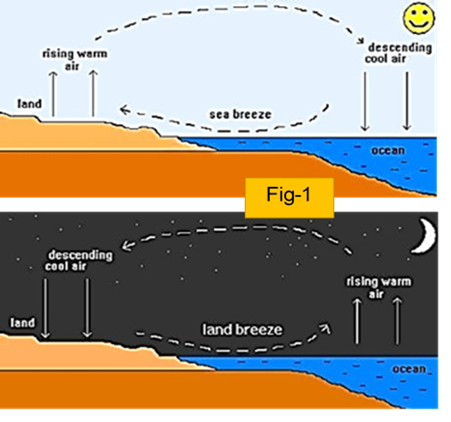
Wind is simply the movement of air. Its action is caused by temperature differences and atmospheric pressure differences from one place to another. Some differences are the result of the sun heating the earth in one area and not another. It also happens where a portion of the land that’s heated is a mountain, and another part is a valley. Along the coast, the earth is warmed faster than the ocean or if half of the sky is cloudy and half is not. Warm air is lighter than cold air, so it climbs into the sky, and then colder air rushes in to fill the void created by the warm air rising. Nature doesn’t like imbalances of any kind.
Near a warm and sunny beach in the early afternoon, we will get a gentle, cooling summer breeze coming in from the ocean to replace the rising warm air which heated up faster than the water. As shown in Fig 1 at night, the process generally reverses, because the water is now warmer than the land.
At other locations and circumstances, it can be a wild ride, like a jet stream. These are fast-moving rivers of air at the boundaries of massive weather fronts. Here one is hot and the other cold. They flow west to east in the opposite direction in response to the sun’s warming rotation from east to west. At the jet stream core, which is about ten to fifteen kilometers high, the airspeeds can reach several hundreds of miles per hour and move in serpentine paths over continents. These fast-moving core winds drag the adjacent air, forming a velocity gradient that’s very -very fast near the center and keeps slowing down and down until it reaches near-zero speeds some hundreds of Kilometers away. Naturally, if mountains or tall buildings get in the way, the wind changes directions and speed in many turbulent and unpredictable ways.
BAROMETRIC PRESSURE
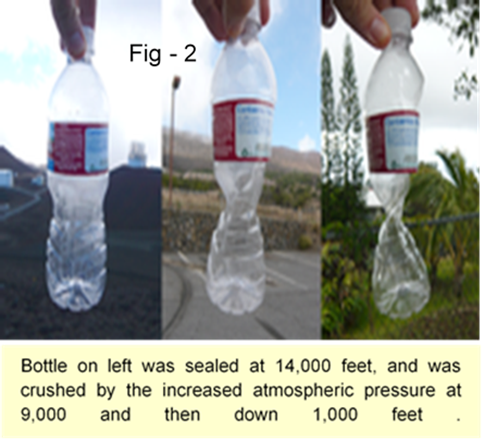
This is the weight of the volume of air on top of you. At sunrise, if you are at the beach at sea level, and the temperature is 15° C, (69 F) there’s a column of air on top of you going all the way up into outer space. The weight of that air pressing down on you has a force of about 14.7 PSI (pounds per square inch) on your body. If you then go to the rooftop restaurant for brunch at 250 feet high, the pressure on you decreases from 14.7 to 14.3 PSI. Meanwhile, if you have a friend, who is mountain climbing at 2,400 feet, the pressure on him is only about 10.9 PSI. Now the heaviest air, meaning the densest air, is at sea level, and as we go up, it progressively gets less and less dense until near outer space, it’s about zero PSI. Figure 2 illustrators the impact of changing atmospheric pressure on a sealed bottle of water moving from 14,000 feet elevation down to 1000 feet.
BAROMETRIC PRESSURE AND TEMPERATURE RELATIONSHIP
Back at the beach the sun has been warming it up for about five hours. It’s the hottest time of the day when the sun is directly overhead, about noon. Now you might say, “But wait. Why does it usually feel warmer an hour or two into the afternoon, when the sun is no longer at its highest position (called the apex). That’s because an hour or two after the apex, while you’re getting a little less energy from the sun on your head, the earth you are standing on has already been heated by the sun and some of that stored heat in the ground starts radiating and convecting up to you. You are now heated on the top by the sun and from the bottom by the warm ground.
If you are a football fan you will remember Deflate-Gate where Tom Brady was accused of deflating footballs to his liking.Maybe he didn’t. It was noon at Indianapolis’ Lucus Oil Stadium, and the footballs are brought to the field for practice and then for play. The balls came out of a toasty locker room at 75° (Fahrenheit ), and the footballs and the air inside the footballs are also at 75° F, and the PSI is 13.0. Where the NFL likes them. But on the playing field, it’s a chilly 25° F. The footballs and the air inside starts to immediately cool down until the balls, and the air inside, reach 25° F. The question is – what’s happened to the balls? The simple answer is that the pressure in the balls decreased to 11 PSI the way Brady likes them.
Michael place picture of footballs Here
BAROMETRIC PRESSURE AND SPECIFIC VOLUME
Let’s now put together these three measures, pressure, temperature, and volume and see how they generate wind. If we decrease the air temperature, the air density will increase, and the volume will decrease. Alternatively, if we reduce the pressure, the air volume will increase, and temperature will rise. So, we will need to specify two of these variables to see what it does to the third. But, you may ask, if hot air rises, why is it colder at the top of the mountain than at the base? The answer is that on top of the mountain, the air is less dense because of the lower barometric pressure. Another example of this relationship is that at sea level, water boils/turns to steam at 100° C. But if you are at the top of Mount Kilimanjaro at 20,000 feet, it will start boiling at 81° C. Or if you’re below sea level, like in parts of Death Valley California, the boiling point is about 103° C.
THE WEATHER VEHICLE
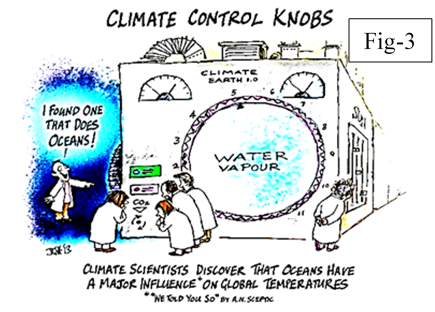
We have laid out our crazy cartoon model weather machine, in Fig 3. The sun is the engine, and it provides nearly 100 percent of the power to drive it, which we’ll call “temperature.” The transmission, is the way, the heat from the sun is distributed geographically in one part of the world and not in the other. It’s like a transmission that sends different speeds to each wheel, resulting in erratic motion. We’ll call this “specific volume.”
We then have barometric pressure, which regulates how much air enters the engine. Does it all seem if not crazy, awfully complex. That is because it is.
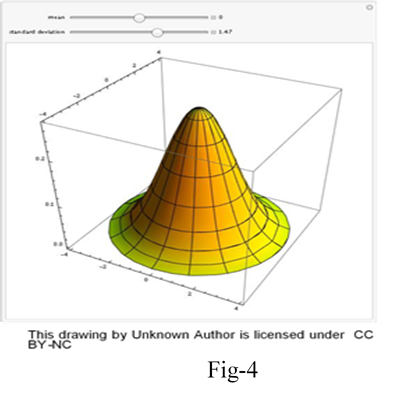
How does the earth receive the sun’s energy. Let’s turn on the engine and see what happens. We have sunlight arriving on the planet and spreading out like a three-dimensional bell curve as shown in Fig 4. The top-center of the bell is precisely on the equator, and it’s at the highest point on the bell. That means that the energy density there is the maximum. At the bottom of the bell are the north and south polar regions. The amount of energy received from the sun is almost the same, but it’s now spread over a vastly larger area.
On earth, where we have land, oceans, and air, they are all set in motion to eliminate these temperature and pressure imbalances. It does so in the atmosphere primarily by the wind. In the seas by water movements like the Gulf Stream in the Atlantic and in the Pacific with the “Pacific Oscillator” and “El Niño Nino/La Niña. On land, it does it primarily by radiation, convection mostly to the air. On the earth, some of this heat is also conducted deeper in the ground, which is essential for plants to grow. It warms up and dries out the soil in the spring, allowing plant roots to grow. Some of the heat in the warmed earth is radiated and convected back up into the air, creating vertical wind streams that help gliders fly around without engines, and birds without flapping their wings.
But along the way, the winds have to overcome many obstacles posed by obstructions like mountain ranges and narrow canyons, plus human-made buildings and cars, trucks, planes, and wind turbines. In rare cases, it can also be caused independently of the effects of the sun. For example, the low temperatures mass of the Antarctic ice will always be much colder than the sea and air temperatures of the southern temperate regions. Thus, like the jet stream in the north, it forms a planetary sub-weather system, which we call a “polar vortex.”
In 2019 Australia voted the Coalition in to lead the Federal government primarily because the Labor Party could not cost their plan to save the planet from climate change. Well, the Coalition won and has been doing exactly what the Labor Party lost the election over. The Coalition is spending millions if not billions on renewables all for cutting emissions and hypothetically saving the planet from disaster!





 whatyareckon