
King James Bible
“And upon the first day of the week, when the disciples came together to break bread, Paul preached unto them, ready to depart on the morrow; and continued his speech until midnight.” (Acts 20:7)
‘Given the fact that everything about God’s Word was specifically inspired by its Author, it is appropriate that this important phrase, “the first day of the week,” occurs exactly eight times in the Bible. The first six of these (Matthew 28:1; Mark 16:2, 9; Luke 24:1; John 20:1, 19) all stress the fact that it was on this day that the greatest event in history (since the creation) had taken place. The creation of the universe had taken place on the first day of the week, and now its Creator had conquered sin and death itself on that day. In the Bible, of course, the number “seven” represents completeness, so “eight” represents a new beginning—a new creation, a resurrection.
The last two references tell us just how the early Christians remembered this day. Our text verse tells us this was a day on which the disciples assembled together, had a preaching service, and then “broke bread.” This was not a special assembly called just for Paul, for he had already been waiting there six days (see the previous verse). This was about 25 years after the resurrection itself, and the Jewish believers were evidently still observing the seventh day as a rest day, but then they also observed the first day of the week as the time to commemorate the Lord’s death in “breaking of bread” to celebrate His resurrection and especially to hear the preaching of His Word. The final reference tells us one other vital thing they did: “Upon the first day of the week let every one of you lay by him in store, as God hath prospered him” (1 Corinthians 16:2). The first day of the week should always be a time of remembering Him in these joyful ways, for He is our living Lord and Savior.’https://www.icr.org/article/12705/?utm_source=phplist9341&utm_medium=email&utm_content=HTML&utm_campaign=April+18+-+The+First+Day+of+the+Week
Translation whether it is the Bible or some other book is taking one language over into another. In the case of the Bible it is taking the Hebrew Old Testament and the Greek New Testament over into the English language. The supreme English translation for over four hundred years has been the Authorized Bible also known as the King James Bible. However, since the late 1800’s there has been hundreds of Bible versions published from what is called the Critical Greek text produced by Westcott and Hort. It is that text that most translators use today in the New Testament.
Does it really matter if the Critical Greek text is used rather than the text the Authorized Bible translators used? Well, yes it does. It has been shown by Dr. Jack Moorman that there are eight thousand difference between the New Testament Greek Words of the King James Bible compared to the Text used by the modern versions such as the ESV and others.
Now, all the above is said because ‘The headlines in Christian media this weekend seemed to tell a remarkable, feel-good story: Attendees at a virtual women’s conference pledged more than $1.5 million to an effort to translate the Bible for unreached people.

More than 750 women viewing the IF: Gathering conference March 6 signed up within the first five minutes to support IllumiNations’ 12 Verse Challenge, which asks donors to pledge $35 a month for a year to help cover translation costs for 12 Bible verses. Christianity Today was among those reporting the story. The women raised enough to translate a full Bible—$1 million—in five hours, CT said.
The total number of givers as of March 16 has topped 6,300, which organizers of the event said would fund more than 46,300 verses.
“IF:Gathering, we are blown away by your generosity,” IllumiNations said in an Instagram post. “After launching the 12 Verse Challenge with you last weekend, over 6,000 of you have given and we’re now close to funding a second translation of God’s Word. Because of you, we’re able to help the Konta, Oyda and Melo people groups of Ethiopia have the Bible in their language.”’https://ministrywatch.com/womens-conference-attendees-pledge-more-than-1-5-million-to-bible-translation-effort/
If you go to https://illuminations.bible/about you will see they partner with many translation organizations including the United Bible Societies (UBS). The UBS’s Greek New Testament second Edition states on page v that one of its four principal translation stages is based ‘on the basis of the Westcott and Hort’s edition of the Greek New Testament’. Westcott and Hort despised the Greek Text underlying the King James Bible!
Any translation from a text other than the one underlying the King James Bible will give you an unreliable version of the Bible. Simply put the money given to IllumiNations and others like it are simply producing counterfeits! As Dr. Floyd Nolen Jones says in his book WHICH VERSION IS THE BIBLE Page 22 ‘Is there someone who has always hated God’s Word, wanted to destroy it, and has attempted to cloud man’s mind and heart about its validity? In other words, as we read the Bible, is there any evidence that somebody has founded a “Yea, has God said” society? According to Genesis 3:1, Bible corruption began with Satan. Satan is the original Bible revisor. When he confronted Eve in the garden, he added to God’s Word, he subtracted, he diluted and finally substituted his own doctrine for that which God had said. We find this occurring today. People are trying to add books to the Old and subtract words from the New Testament. Nothing has changed. We need to understand that the devil is promoting this continuing attack on the Word of God.’
I came into this world in 1945 as a male and have been a male now for seventy five years. Now, you may think I have lost a few marbles in those years for even saying such but that is the state of things in todays society. Some are ‘demanding’ that a sex or gender not be assigned to a baby when born but the choice be made when the child is old enough to choose for themselves. What idiocy. Anyway, the article today discusses the America of 1950 to the America of 2020. Personally, in my own opinion, in so many ways it was better in the 1950s BUT that’s me.

‘If you could go back to 1950, would you do it? There would be no Internet, no cellphones and you would only be able to watch television in black and white. But even though they lacked many of our modern conveniences, people genuinely seemed to be much happier back then.
Families actually ate dinner together, neighbors knew and cared about one another, and being an “American” truly meant something.
Today, we like to think that we are so much more “advanced” than they were back then, but the truth is that our society is in the process of falling apart all around us. Could it be possible that we could learn some important lessons by looking back at how Americans lived 70 years ago?
Of course there has never been any era in our history when everything has been perfect. But without a doubt, things are vastly different today than they were back in 1950…
In 1950, Texaco Star Theatre, The Lone Ranger and Hopalong Cassidy were some of the most popular shows that Americans watched on television.
In 2020, a Netflix film entitled “Cuties” is so trashy and so disgusting that four states have sent a letter to Netflix asking for it to be removed because it is “fodder for those with criminal imaginations, serving to normalize the view that children are sexual beings.”
In 1950, television networks would not even show husbands and wives in bed together.
In 2020, “adult websites” get more traffic than Netflix, Amazon and Twitter combined.
In 1950, people would greet one another as they walked down the street.
In 2020, Americans are too enamored with their cellphones to be bothered with actual human contact.
In 1950, gum chewing and talking in class were some of the major disciplinary problems in our schools.
In 2020, kids are literally gunning down police officers in the streets.
In 1950, people would make an effort to dress up and look nice when they would go out in public.
In 2020, most of the population has become utter slobs and “People of Walmart” has become one of our most popular memes.
In 1950, the typical woman got married for the first time at age 20 and the typical man got married for the first time at age 22.
In 2020, the typical woman gets married for the first time at age 27 and the typical man gets married for the first time at age 29.
In 1950, a lot of people would leave their homes and their vehicles unlocked because crime rates were so low.
In 2020, many that live in urban areas are deathly afraid of all the civil unrest that has erupted, and gun sales have soared to all-time record highs.
In 1950, Americans actually attempted to parent their children.
In 2020, we pump our kids full of mind-altering drugs and we let our televisions and our video games raise our children.
In 1950, Baltimore was one of the most beautiful and most prosperous cities on the entire planet.
In 2020, Baltimore regularly makes headlines because of all the murders that are constantly occurring. Of course the exact same thing could be said about many of our other major cities.
In 1950, 78 percent of all households in America contained a married couple.
In 2020, that figure has fallen below 50 percent.
In 1950, about 5 percent of all babies in the United States were born to unmarried parents.
In 2020, about 40 percent of all babies in the United States will be born to unmarried parents.
In 1950, new churches were regularly being opened all over the United States.
In 2020, it is being projected that 1 out of every 5 churches in the U.S. “could be forced to shut their doors in the next 18 months”, and the mayor of Lubbock, Texas just said that opening a new Planned Parenthood clinic is like starting a church.
In 1950, we actually had high standards for our elected officials, and people actually did research on the candidates before they cast their votes.
In 2020, more than 4,000 people in one county in New Hampshire voted for a “transsexual Satanic anarchist” in the Republican primary, and she is now the Republican nominee for sheriff in Cheshire County.
In 1950, children would go outside and play when they got home from school.
In 2020, our parks and our playgrounds are virtually empty and we have the highest childhood obesity rate in the industrialized world.
In 1950, front porches were community gathering areas, and people would regularly have their neighbors over for dinner.
In 2020, many of us don’t know our neighbors at all, and the average American watches more than five hours of television a day.
In 1950, Americans used words such as “knucklehead”, “moxie” and “jalopy”.
In 2020, new terms such as “nomophobia”, “peoplekind” and “social distancing” have been introduced into the English language.
In 1950, the very first credit card was issued in the United States.
In 2020, Americans owe more than 930 billion dollars on their credit cards.
In 1950, one income could support an entire middle class household.
In 2020, tens of millions of Americans have lost their jobs and filed for unemployment, and more than half of all households in some of our largest cities are currently facing “serious financial problems”.
In 1950, the American people believed that the free market should govern the economy.
In 2020, most Americans seem to believe that the government in Washington and the Federal Reserve must endlessly “manage” the economy.
In 1950, “socialists” and “communists” were considered to be our greatest national enemies.
In 2020, most of our politicians in Washington have eagerly embraced socialist and communist policy goals.
In 1950, the U.S. Constitution was deeply loved and highly revered.
In 2020, anyone that actually admits to being a “constitutionalist” is considered to be a potential domestic terrorist.
In 1950, the United States loaned more money to the rest of the world than anybody else.
In 2020, the United States owes more money to the rest of the world than anybody else.
In 1950, the total U.S. national debt reached the 257 billion dollar mark for the first time in our history.
In 2020, we added 864 billion dollars to the national debt in the month of June alone. In other words, we added over three times more to the national debt in that one month than the total amount of debt that had been accumulated from the founding of our nation all the way to 1950.
In 1950, most Americans were generally happy with their lives.
In 2020, the suicide rate is at an all-time record high, and it has been rising every single year since 2007.’https://www.prophecynewswatch.com/article.cfm?recent_news_id=4290
Things have changed and most are not for the good. One answer to the problem may be 2Chronicles 7:14 If my people, which are called by my name, shall humble themselves, and pray, and seek my face, and turn from their wicked ways; then will I hear from heaven, and will forgive their sin, and will heal their land.
It’s always sad to come to the ending of a good story. But, as with life, there must be an end. So, here we have the last chapter of the God called negro preacher, John Jasper, 1812-1901. It can safely be said ‘There will never be another John Jasper”! To God be the Glory! Great things He hath done!
‘I NEVER heard Jasper preach a sermon on heaven, nor did I ever hear of his doing so. So far as my observation goes, sermons on heaven have failed to edify the thoughtful–sometimes proving distinctly disappointing. It was not to Jasper’s taste to argue on heaven as a doctrine. With him it was as if he were camping outside of a beautiful city, knowing much of its history and inhabitants, and in joyous expectation of soon moving into it. The immediate things of the kingdom chiefly occupied his attention; but when his sermons took him into the neighbourhood of heaven, he took fire at once and the glory of the celestial city lit his face and cheered his soul. This chapter deals only with one of his sermons which, while not on heaven, reveals his heart-belief in it, and its vital effect upon his character.

Imagine a Sunday afternoon at his church–a fair, inspiring day. His house was thronged to overflowing. It was the funeral of two persons– William Ellyson and Mary Barnes. The text is forgotten, but the sermon is vividly recalled.
From the start Jasper showed a burden and a boldness that promised rich things for his people. At the beginning he betrayed some hesitation–unusual for him. “Lemme say,” he said, “a word about dis William Ellersin. I say it de fust an’ git it orf mer min’. William Ellersin was no good man–he didn’t say he wus; he didn’t try to be good, an’ de tell me he die as he live, ‘out Gord an’ ‘out hope in de worl’. It’s a bad tale to tell on ‘im, but he fix de story hissef. As de tree falls dar mus it lay. Ef you wants folks who live wrong to be preached and sung to glory, don’ bring ’em to Jasper. Gord comfut de monur and warn de onruly.
“But, my bruthrin,” he brightened as he spoke, “Mary Barnes wus difrunt. She wer wash’d in de blood of de Lam’ and walk’d in white; her r’ligion was of Gord. Yer could trust Mary anywhar; nuvr cotch ‘er in dem playhouses ner friskin’ in dem dances; she wan’ no street-walk’r trapsin’ roun’ at night. She love de house of de Lord; her feet clung to de straight and narrer path; I know’d her. I seen her at de prarmeetin’–seed her at de supper–seed her at de preachin’, an’ seed her tendin’ de sick an’ helpin’ de mounin’ sinn’rs. Our Sister Mary, good-bye. Yer race is run, but yer crown is shure.”
From this Jasper shot quite apart. He was full of fire, humour gleamed in his eye, and freedom was the bread of his soul. By degrees he approached the realm of death, and he went as an invader. A note of defiant challenge rang in his voice and almost blazed on his lips. He escorted the Christian to the court of death, and demanded of the monster king to exhibit his power to hurt. It was wonderful to see how he pictured the high courage of the child of God, marching up to the very face of the king of terrors and demanding that he come forth and do his worst. Death, on the other hand, was subdued, slow of speech, admitted his defeat, and proclaimed his readiness to serve the children of Immanuel. Then he affected to put his mouth to the grave and cried aloud: “Grave! Grave! Er Grave!” he cried as if addressing a real person, “Whar’s yer vict’ry? I hur you got a mighty banner down dar, an’ you turrurizes ev’rybody wat comes long dis way. Bring out your armies an’ furl fo’th your bann’rs of vict’ry. Show your han’ an’ let ’em see wat you kin do.” Then he made the grave reply: “Ain’t got no vict’ry now; had vict’ry, but King Jesus pars’d through dis country an’ tord my banners down. He says His peopl’ shan’t be troubled no mo’ forev’r; an’ He tell me ter op’n de gates an’ let ‘um pass on dar way to glory.”
“Oh, my Gord,” Jasper exclaimed in thrilling voice, “did yer hur dat? My Master Jesus done jerk’d de sting of death, done broke de scept’r of de king of tur’rs, an’ He dun gone inter de grave an’ rob it uv its victorous banners, an’ fix’d nice an’ smooth for His people ter pass through. Mo’ en dat, He has writ a song, a shoutin’ anthim for us to sing when we go thur, passin’ suns an’ stars, an’ singin’ dat song, ‘Thanks be onter Gord–be onter Gord who give us de vict’ry thru de Lord Jesus Christ.'” Too well I know that I do scant justice to the greatness of Jasper by this outline of his transcendent eloquence. The whole scene, distinct in every detail, was before the audience, and his responsive hearers were stirred into uncontrollable excitement.
“My bruthrin,” Jasper resumed very soberly, “I oft’n ax myself how I’d behave merself ef I was ter git to heav’n. I tell you I would tremble fo’ de consequinces. Eben now when I gits er glimpse–jist a peep into de palis of de King, it farly runs me ravin’ ‘stracted. What will I do ef I gits thar? I ‘spec I’ll make er fool of myself, ’cause I ain’t got de pritty ways an’ nice manners my ole Mars’ Sam Hargrove used to have, but ef I git thar they ain’t goin’ to put me out. Mars’ Sam’ll speak fur me an’ tell ’em to teach me how to do. I sometimes thinks if I’s ‘lowed to go free–I ‘specs to be free dar, I tell you, b’leve I’ll jest do de town–walkin’ an’ runnin’ all roun’ to see de home which Jesus dun built for His people.
“Fust of all, I’d go down an’ see de river of life. I lov’s to go down to de ole muddy Jemes–mighty red an’ muddy, but it goes ‘long so gran’ an’ quiet like ’twas ‘tendin’ to ‘ business–but dat ain’t nothin’ to the river which flows by de throne. I longs fer its chrystal waves, an’ de trees on de banks, an’ de all mann’rs of fruits. Dis old head of mine oft’n gits hot with fever, aches all night an’ rolls on de piller, an’ I has many times desired to cool it in that blessed stream as it kisses de banks of dat upper Canaan. Bl’ssed be de Lord! De thought of seein’ dat river, drinkin’ its water an’ restin’ un’r dose trees–” Then suddenly Jasper began to intone a chorus in a most affecting way, no part of which I can recall except the last line: “Oh, what mus’ it be to be thar?” “Aft’r dat,” Jasper continued with quickened note, I’d turn out an’ view de beauties of de city–de home of my Father. I’d stroll up dem abenuse whar de children of Gord dwell an’ view dar mansions. Father Abraham, I’m sure he got a grate pallis, an’ Moses, what ‘scorted de children of Israel out of bondige thru’ de wilderness an’ to de aidge of de promised lan’, he must be pow’rful set up being sich er man as he is; an’ David, de king dat made pritty songs, I’d like to see ‘is home, an’ Paul, de mighty scholar who got struck down out in de ‘Mascus road, I want to see his mansion, an’ all of ’em. Den I would cut roun’ to de back streets an’ look for de little home whar my Saviour set my mother up to housekeepin’ when she got thar. I ‘spec to know de house by de roses in de yard an’ de vine on de poch.” As Jasper was moving at feeling pace along the path of his thoughts, he stopped and cried: “Look dar; mighty sweet house, ain’t it lovely?” Suddenly he sprang back and began to shout with joyous clapping of hands. “Look dar; see dat on de do; hallelujah, it’s John Jasper. Said He was gwine to prepar a place for me; dar it is. Too good for a po’ sinner like me, but He built it for me, a turn-key job, an’ mine forev’r.” Instantly he was singing his mellow chorus ending as before with: “Oh, what mus’ it be to be thar!”
From that scene, he moved off to see the angelic host. There were the white plains of the heavenly Canaan–a vast army of angels with their bands of music, their different ranks and grades, their worship before the throne and their pealing shouts as they broke around the throne of God. The charm of the scene was irresistible; it lifted everybody to a sight of heaven, and it was all real to Jasper. He seemed entranced. As the picture began to fade up rose his inimitable chorus, closing as always: “Oh, what mus’ it be to be thar!”
Then there was a long wait. But for the subdued and unworldly air of the old preacher–full seventy years old then–the delay would have dissolved the spell. “An’ now, frenz,” he said, still panting and seeking to be calm, “ef yer’ll ‘scuse me, I’ll take er trip to de throne an’ see de King in ‘is roy’l garmints.” It was an event to study him at this point. His earnestness and reverence passed all speech, and grew as he went. The light from the throne dazzled him from afar. There was the great white throne–there, the elders bowing in adoring wonder–there, the archangels waiting in silence for the commands of the King–there the King in His resplendent glory–there in hosts innumerable were the ransomed. In point of vivid description it surpassed all I had heard or read. By this time the old negro orator seemed glorified. Earth could hardly hold him. He sprang about the platform with a boy’s alertness; he was unconsciously waving his handkerchief as if greeting a conqueror; his face was streaming with tears; he was bowing before the Redeemer; he was clapping his hands, laughing, shouting and wiping the blinding tears out of his eyes. It was a moment of transport and unmatched wonder to every one, and I felt as if it could never cease, when suddenly in a new note he broke into his chorus, ending with the soul-melting words: “Oh, what mus’ it be to be thar!”
It was a climax of climaxes. I supposed nothing else could follow. We had been up so often and so high we could not be carried up again. But there stood Jasper, fully seeing the situation.
He had seen it in advance and was ready. “My bruthrin,” said he as if in apology, “I dun fergot somethin’. I got ter tek anuth’r trip. I ain’t visit’d de ransum of de Lord. I can’t slight dem. I knows heap ov ’em, an’ I’m boun’ to see ’em.” In a moment he had us out on the celestial plains with the saints in line. There they were–countless and glorious! We walked the whole line and had a sort of universal handshake in which no note of time was taken. “Here’s Brer Abul, de fust man whar got here; here’s Brer Enoch whar took er stroll and straggled inter glory; here’s ole Ligie, whar had er carriage sent fur ‘im an’ comed a nigher way to de city.” Thus he went on greeting patriarchs, prophets, apostles, martyrs, his brethren and loved ones gone before until suddenly he sprang back and raised a shout that fairly shook the roof. “Here she is; I know’d sh’d git here; why, Mary Barnes, you got home, did yer?” A great handshake he gave her and for a moment it looked as if the newly-glorified Mary Barnes was the centre of Jasper’s thoughts; but, as if by magic, things again changed and he was singing at the top of his voice the chorus which died away amid the shrieks and shouts of his crowd with his plaintive note: “Oh, what mus’ it be to be thar!”
Jasper dropped exhausted into a chair and some chief singer of the old-time sort, in noble scorn of all choirs, struck that wondrous old song, “When Death Shall Shake My Frame,” and in a moment the great building throbbed and trembled with the mighty old melody. It was sung only as Jasper’s race can sing, and especially as only Jasper’s emotional and impassioned church could sing it. This was Jasper’s greatest sermon. In length it was not short of an hour and a half–maybe it was longer than that. He lifted things far above all thought of time, and not one sign of impatience was seen. The above sketch is all unworthy of the man or the sermon. As for the venerable old orator himself he was in his loftiest mood–free in soul, alert as a boy, his imagination rioting, his action far outwent his words, and his pictures of celestial scenes glowed with unworldly lustre. He was in heaven that day, and took us around in his excursion wagon, and turning on the lights showed us the City of the Glorified.
What is reported here very dimly hints at what he made us see. Not a few of Richmond’s most thoughtful people, though some of them laid no claim to piety, were present and not one of them escaped the profound spiritual eloquence of this simple-hearted old soldier of the cross.
Valiant, heroic old man! He stood in his place and was not afraid. He gave his message in no uncertain words–scourged error wherever it exposed its front stood sentinel over the word of God and was never caught sleeping at his post.
When his work ended, he was ready to go up and see his Master face to face.
The stern old orator, brave as a lion, rich in humour, grim, and a dreamer whose dreams were full of heaven, has uttered his last message and gone within the veil to see the wonders of the unseen. If the grapes of Eschol were so luscious to him here, “Oh, what must it be for him to be there.”‘ https://docsouth.unc.edu/church/hatcher/hatcher.html
John Jasper was a preacher that made the Bible literally come alive!
‘IN the circle of Jasper’s gifts his imagination was preëminent. It was the mammoth lamp in the tower of his being. A matchless painter was he. He could flash out a scene, colouring every feature, defining every incident and unveiling every detail. Time played no part in the performance,–it was done before you knew it. Language itself was of second moment. His vocabulary was poverty itself, his grammar a riot of errors, his pronunciation a dialectic wreck, his gestures wild and unmeaning, his grunts and heavings terrible to hear. At times he hardly talked but simply emitted; his pictures were simply himself in flame. His entire frame seemed to glow with living light, and almost wordlessly he wrought his miracles. But do not misunderstand. Some insisted on saying that education would have stripped John of his genius by subduing the riot of his power and chastening the fierceness of his imagination. I think not, for John in a good sense was educated. He was a reverential and laborious student for half-a-century. He worked on his sermons with a marked assiduity and acquired the skill and mastership of faithful struggle. Even his imagination had to work, and its products were the fruit of toil. There was no mark of the abnormal or disproportionate in his sky, but all the stars were big and bright. He was well ballasted in his mental make-up, and in his most radiant pictures there was an ethical regard for facts, and an instinctive respect for the truth. Moreover, his ministrations fairly covered the theological field, were strongly doctrinal, and he grappled with honest vigour the deepest principles of the Gospel. He was also intensely practical, scourging sin, lashing neglect, and with lofty authority demanding high and faithful living.
Think not of Jasper merely as a pictorial preacher. There were wrought into his pictures great principles and rich lessons. But now and then he would present a sermon which was largely a series of pictures from beginning to end. His imagination would be on duty all the time and yet never flag. I cannot forget his sermon on Joseph and his Brethren. It was a stirring presentation of the varied scenes in that memorable piece of history. He opened on the favouritism of Jacob, and was exceedingly strong in condemning partiality, as unhappily expressed in the coat of many colours. That brief part was a sermon itself for parents. From that he passed quickly to the envy of his brothers.
Jealousy was a demon creeping in among them, inflicting poisonous stings, and spreading his malignant power, until murder rankled in every heart. Then came Joseph, innocent and ignorant of offending, to fall a victim to their conspiracy, with the casting of him into the pit, the selling of him to the travelling tradesmen, the showing to Jacob of the blood-stained coat, with scene after scene until the happy meeting at last between Jacob and his long lost son.
One almost lived a lifetime under the spell of that sermon. It was eloquent, pathetic, terrific in its denunications, rich in homely piety, and with strains of sweetness that was as balm to sorrowing souls. The effects were as varied as human thoughts and sentiments. The audience went through all moods. Now they were bent down as if crushed with burdens; now they were laughing in tumults at the surprises and charms of heavenly truth; anon they were sobbing as if all hearts were broken, and in a moment hundreds were on their feet shaking hands, shouting, and giving forth snatches of jubilant song. This all seems extravagant, without sobriety entirely, but those that were there, perhaps without an exception, felt that it was the veritable house of God and the gate of heaven.
At other times, Jasper’s sermons were sober and deliberate, sometimes even dull; but rarely did the end come without a burst of eloquence or an attractive, entertaining picture. But, remember, that his pictures were never foreign to his theme. They were not lugged in to fill up. They had in them the might of destiny and fitted their places, and fitted them well. Often they came unheralded, but they were evidently born for their part. On one occasion his sermon was on Enoch. It started out at a plodding gait and seemed for a time doomed to dullness, for Jasper could be dull sometimes. At one time he brought a smile to the faces of the audience, in speaking of Enoch’s age, by the remark: “Dem ole folks back dar cud beat de presunt ginerashun livin’ all ter pieces.”
As he approached the end of his sermon, his face lighted up and took on a new grace and passion, and he went out with Enoch on his last walk. That walk bore him away to the border of things visible; earthly scenes were lost to view; light from the higher hills gilded the plains. Enoch caught sight of the face of God, heard the music and the shouting of a great host, and saw the Lamb of God seated on the throne. The scene was too fair to lose, and Enoch’s walk quickened into a run which landed him in his father’s house. It was a quick, short story, told in soft and mellow tones, and lifted the audience up so far that the people shouted and sang as if they were themselves entering the gates of heaven.
One of his more elaborate descriptions, far too rich to be reproduced, celebrated the ascension of Elijah. There was the oppressive unworldliness of the old prophet, his efforts to shake off Elisha, and Elisha’s wise persistence in clamouring for a blessing from his spiritual father. But it was when the old prophet began to ascend that Jasper, standing off like one apart from the scene, described it so thrillingly that everything was as plain as open day. To the people, the prophet was actually and visibly going away. They saw him quit the earth, saw him rise above the mountain tops, sweeping grandly over the vast fields of space, and finally saw him as he passed the moon and stars. Then something happened. In the fraction of a second Jasper was transmuted into Elijah and was actually in the chariot and singing with extraordinary power the old chorus: “Going up to heaven in a chariot of fire.” The scene was overmastering! For a time I thought that Jasper was the real Elijah, and my distinct feeling was that the song which he sang could be heard around the world. Of course, it was not so; but there was something in the experience of the moment that has abided with me ever since.
At a funeral one Sunday I saw Jasper attempt a dialogue with death, himself speaking for both. The line of thought brought him face to face with death and the grave. The scene was solemnized by a dead body in a coffin. He put his hands over his mouth and stooped down and addressed death. Oh, death–death, speak to me. Where is thy sting? And then with the effect of a clairvoyant he made reply: “Once my sting was keen and bitter, but now it is gone. Christ Jesus has plucked it out, and I have no more power to hurt His children. I am only the gatekeeper to open the gateway to let His children pass.” In closing this chapter an incident will largely justify my seemingly extraordinary statements as to the platform power of this unschooled negro preacher in Virginia.
In company with a friend I went very often Sunday afternoons to hear Jasper and the fact was bruited about quite extensively, and somewhat to the chagrin of some of my church-members. Two of them, a professor in Richmond College and a lawyer well-known in the city, took me to task about it They told me in somewhat decided tones that my action was advertising a man to his injury, and other things of a similar sort. I cared but little for their criticism, but told them that if they would go to hear him when he was at his best, and if afterwards they felt about him as they then felt, I would consider their complaints. They went the next Sunday. The house was overflowing, and Jasper walked the mountain tops that day. His theme was “The raising of Lazarus” and by steps majestic he took us along until he began to describe the act of raising Lazarus from the dead. It happened that the good professor was accompanied by his son, a sprightly lad of about ten, who was sitting between his father and myself. Suddenly the boy, evidently agitated, turned to me and begged that we go home at once. I sought to soothe him, but all in vain, for as he proceeded the boy urgently renewed his request to go home. His father observed his disquietude and putting an arm around him restored him to calmness. After the service ended and we had reached the street, I said to him: “Look here, boy, what put you into such a fidget to quit the church before the end of the service?” “Oh, doctor, I thought he had a dead man under the pulpit and was going to take him out,” he said. My lawyer brother heard the sermon and with profound feeling said, “Hear that, and let me say to you that in a lifetime I have heard nothing like it, and you ought to hear that man whenever you can.”
I heard no later criticisms from any man concerning my conduct in evincing such cordial interest in this eloquent son of Fluvanna.
It was only necessary to persuade Jasper’s critics to hear him, to remove all question as to his genuine character and effective spiritual ministry. https://docsouth.unc.edu/church/hatcher/hatcher.html
Spurgeon’s Morning & Evening
June 29AM
“Them also which sleep in Jesus will God bring with Him.” — 1 Thess 4:14
‘Let us not imagine that the soul sleeps in insensibility. “Today shalt thou be with me in paradise,” is the whisper of Christ to every dying saint. They “sleep in Jesus,” but their souls are before the throne of God, praising Him day and night in His temple, singing hallelujahs to Him who washed them from their sins in His blood. The body sleeps in its lonely bed of earth, beneath the coverlet of grass. But what is this sleep? The idea connected with sleep is “rest,” and that is the thought which the Spirit of God would convey to us. Sleep makes each night a Sabbath for the day. Sleep shuts fast the door of the soul, and bids all intruders tarry for a while, that the life within may enter its summer garden of ease. The toil-worn believer quietly sleeps, as does the weary child when it slumbers on its mother’s breast. Oh! happy they who die in the Lord; they rest from their labours, and their works do follow them. Their quiet repose shall never be broken until God shall rouse them to give them their full reward. Guarded by angel watchers, curtained by eternal mysteries, they sleep on, the heritors of glory, till the fulness of time shall bring the fulness of redemption. What an awaking shall be theirs! They were laid in their last resting place, weary and worn, but such they shall not rise. They went to their rest with the furrowed brow, and the wasted features, but they wake up in beauty and glory. The shrivelled seed, so destitute of form and comeliness, rises from the dust a beauteous flower. The winter of the grave gives way to the spring of redemption and the summer of glory. Blessed is death, since it, through the divine power, disrobes us of this work-day garment, to clothe us with the wedding garment of incorruption. Blessed are those who “sleep in Jesus.”‘
Way back when I was a boy growing up in rural Iowa a neighbor of ours had the surname Lee. Later I found out that they were relatives of the Southern General Robert Edward Lee and for some reason that impressed me! After I received Christ as my personal Lord and Saviour I learned that Robert E. Lee also professed to be a born again Christian. Some years ago we visited Gettysburg and I purchased the book CHRIST IN THE CAMP by J. William Jones a chaplain in the Confederate Army. Chaplain Jones spoke highly of General Lee’s Christianity.
Today, with these Marxist, Muslim, Loony, Lovies seeking to destroy US history and statues of men like General Lee it just might be a good time to share a little about the man known as General Robert E. Lee.
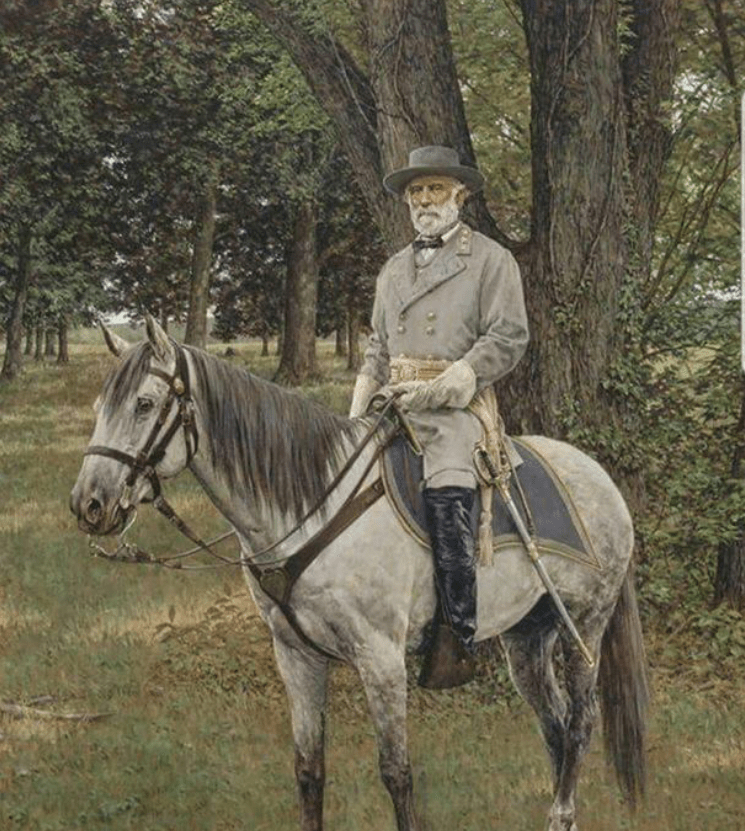
‘2 Tim. 2:3 – “Thou therefore endure hardness, as a good soldier of Jesus Christ.”
One writer called General Lee, “The portrait of a soldier.” Prime Minister Winston Churchill wrote of Lee: “His noble presence and gentle, kindly manner were sustained by religious faith and an exalted character.” His minister told him, “If you are as good a soldier of the cross as you are of the Army, Christ will have a great worker in His Church.” President Theodore Roosevelt described General Robert E. Lee as: “the very greatest of all the great captains that the English-speaking peoples have brought forth.”
General Lee was born January 19, 1807 in Stratford, Virginia, and died October 12, 1870 in Lexington. He was a son of Revolutionary War hero Henry “Light Horse Harry” Lee. He married the granddaughter of President George Washington. He graduated 2nd in his class at West Point, and has the distinction of being the only student to ever graduate without a demerit. When a Colonel stationed in Washington, DC, he was sent to put down a rebellion led by the radical abolitionist John Brown at Harper’s Ferry, Virginia (now West Virginia).
When Abraham Lincoln was elected President South Carolina seceded and was quickly followed by 6 more deep southern states: Georgia, Florida, North Carolina, Alabama, Mississippi, Louisiana, and Texas. At the behest of President Lincoln, Lee’s former commanding officer, General Winfield Scott, asked Colonel Robert E. Lee to take command of the United States Army to put down “the rebellion” in the South. He declined and instead offered his services to the newly formed Confederacy. The primary issue at stake for Lee was States’ Rights, not slavery. (As a matter of fact, Lee freed his slaves during the war, but General U.S. Grant, who fought the war to supposedly free the slaves did not free his until after the war was over: he lived in Maryland, a slave state that was not subject to the “Emancipation Proclamation.” It only applied to Southern states.)
After the war Lee applied to be reinstated as a U.S. citizen, but his paperwork was “lost” by a federal bureaucrat and was not “found” until over one hundred years after his death. His citizenship was finally reinstated by President Gerald Ford in 1974.
General Lee never felt hatred for his enemies, and exhorted the South to forgive and go on. He said: “Abandon your animosities, and make your sons Americans.”
His last words, when he knew his time was short, were: “Strike my tent; call for Hill.” (General A.P. Hill). The hymn sung at his modest funeral was, “How firm a foundation, ye saints of the Lord, is laid for your faith in His excellent Word.”
1. General Lee was a God-fearing Man. 2 Samuel 23:3 says: “He that ruleth over men must be just, ruling in the fear of God.”
General Lee feared God. He was a man of faith and prayer. One of his numerous General Orders he issued in 1862 read: “Habitually all duties except those of inspection will be suspended during Sunday, to afford the troops rest and to enable them to attend religious services.”
On one occasion when he issued one of these orders an Army chaplain wrote: “The work of grace among the troops widened and deepened and went gloriously on until there had been thousands of professions of faith in Christ as a personal Saviour.”
John Cooke said: “He had lived, as he died, with this supreme trust in an overruling and merciful Providence; and this sentiment, pervading his whole being, was the origin of that august [majestic] calmness with which he greeted the most crushing disasters of his military career. His faith and humble trust sustained him after the war, when the woes of the South well nigh broke his great spirit; and he calmly expired, as a weary child falls, asleep, knowing that its father is near.”
Lee had learned through personal hardship and tragedy to possess an unrelenting faith in the sovereign counsel of God, both in personal and national matters. Upon hearing of the death of his 23-year-old daughter, Annie, and unable to attend her funeral, he insisted that these words be carved on her tombstone: “Perfect and true are all His ways, Whom Heaven adores and earth obeys.”
Like Job of old in the Bible, he trusted in God no matter the situation or heartache. He did not get angry with God, but entrusted his life and circumstances with God.
2. General Lee was a Born Again Man.
The Bible teaches that we must be saved and born again through faith and trust in Christ and His shed blood on the Cross of Calvary. Salvation is by grace, not by works of righteousness which we have done. (Titus 3:5; Eph. 2:8,9; John 3:7)
General Lee was a saved, born-again, Christian man and everyone knew and respected him for it. He wrote to his chaplains who informed him of their prayers for him that he thanked them and needed all of the prayers they could offer in his behalf. And then he said: “I can only say that I am nothing but a poor sinner, trusting in Christ alone for salvation.”
Lee considered himself a sinner who had been saved, not by church attendance or by good works or by any other human endeavor, but solely by the grace of God and the blood of Christ. In his Personal Reminiscences, Anecdotes, and Letters of Gen. Robert E. Lee, the Rev. J. William Jones, who was Lee’s chaplain at Washington College, wrote: “If I ever came in contact with a sincere, devout Christian – one who, seeing himself to be a sinner, trusted alone in the merits of Christ, who humbly tried to walk the path of duty, ‘looking unto Jesus’ as the author and finisher of his faith, and whose piety constantly exhibited itself in his daily life – that man was General R. E. Lee.”
3. General Lee was a Bible-believing Man.
The Apostle Paul wrote in 2 Timothy 3:16-17 – “ALL scripture is given by inspiration of God, and is profitable for doctrine, for reproof, for correction, for instruction in righteousness: THAT the man of God may be perfect, thoroughly furnished unto all good works.”
General Lee accepted all of the Bible without claiming to understand all of it.
He once remarked to Chaplain William Jones: “There are things in the Old Book which I may not be able to explain, but I fully accept it as the infallible Word of God, and receive its teachings as inspired by the Holy Spirit.”
He was a constant reader and a diligent student of the Bible.
He obeyed the command of 2 Timothy 2:15 to “Study to shew thyself approved unto God…” He believed what the Bible said in Revelation 1:3, “Blessed is the that readeth the words” of God. He practiced what it spoke of in Psalm 1:2, and he meditated upon the Scriptures.
Those who knew him well said, “Even in the midst of his most active campaigns he made time to read a portion of God’s word every day.”
He was actively engaged in promoting the Word of God (KJV).
The Bible says in Psalm 68:11 – “The Lord gave the word: great was the company of those that published it.” General Lee was in that company. He paid for and bought Bibles and was actively engaged in distributing the word of God to the world.
During the War he helped to provide Bibles and prayer-books to the men at his own expense.
After the War, he was offered and accepted the presidency of the Rockbridge Bible Society in Lexington, VA (where he taught at the Washington College and served as its President). The primary objective of the Bible Society under his leadership, according to his own words, was to place a Bible in every home in the South. He admonished folks to “read the Bible, read the Bible.”
4. General Lee was a Lowly-minded Man.
The Bible says in Philippians 2:5-8 – “LET this mind be in you, which was also in Christ Jesus: WHO, being in the form of God, thought it not robbery to be equal with God: BUT made himself of no reputation, and took upon him the form of a servant, and was made in the likeness of men: AND being found in fashion as a man, he humbled himself, and became obedient unto death, even the death of the cross.” Jesus was a servant who ministered to others.
General Lee had this mindset. He was a lowly-minded man of humility. He said, “What do you care about rank? I would serve under a corporal if necessary!”
His ambition in life was to the best Christian he could be. Lee said: “My chief concern is to try to be a humble, earnest Christian…”
John Cooke, in his Life of General Robert E. Lee, wrote: “The crowning grace of this man, who was thus not only great but good, was the humility and trust in God, which lay at the foundation of his character.”
The Lord Jesus said in Matthew 11:28-30: “COME unto me, all ye that labour and are heavy laden, and I will give you rest.TAKE my yoke upon you, and learn of me; for I am meek and lowly in heart: and ye shall find rest unto your souls. FOR my yoke is easy, and my burden is light.”
General Lee was a meek man who was willing to learn from the Lord through the lessons of life: “We must expect reverses, even defeats. They are sent to teach us wisdom and prudence, to call forth greater energies, and to prevent our falling into greater disasters.”
He believed that “no human power can avail us without the blessing of God.”
For what it is worth, I like this quote from the General: “All I ever wanted was a Virginia farm, no end of cream and fresh butter and fried chicken-not one fried chicken, or two, but unlimited fried chicken.”
5. General Lee was a Church-goimg Man.
General Lee was an Episcopalian by denomination – but a saved, Bible-believing member of that church in the South of his day. (I seriously doubt he would be one today!)
“General Lee was a most active promoter of the interests of his church, and of the cause of Christ in the community; and all of the pastors felt that they had in him a warm friend.”
“He was a most regular attendant upon all the services of his own church.” Gen. Lee took heed to Hebrews 10:25 – “Not forsaking the assembling of ourselves together, as the manner of some is; but exhorting one another: and so much the more, as ye see the day approaching.”
“His pew was immediately in front of the chancel, his seat in the chapel was the second from the pulpit, and he always seemed to prefer a seat near the preacher’s stand. He always devoutly knelt during prayer, and his attitude during the entire service was that of an interested listener or a reverential participant.” While at Washington College, his seat in the chapel was never empty when services were being held.
His habit was to attend church wherever he was stationed. He would stop along the roadside to join his troops in prayer services. Once he was came upon a group of soldiers kneeling in prayer on the eve of a battle. He rode up, dismounted from his horse, Traveller, uncovered his head, and knelt in reverence to engage in prayer with them and their chaplain.
“He was a most liberal contributor to his church.” Gen. Lee was a giver. Not only did he tithe of his income, but It was not unusual for him to ask how much the balance was for a certain need of the church and then give the amount needed to make up for the lack of funds.
6. General Lee was a Soul-winning Man.
He was concerned for the souls of his soldiers & students. He had the heart of the Apostle Paul for those under his command and care (Rom. 10:1): “Brethren, my heart’s desire and prayer to God for Israel is, that they might be saved.”
“General Lee always took the deepest interest in the work of his chaplains and the spiritual welfare of his men.” He attended the Chaplains’ meetings and a faithful chaplain always had a friend at HQ’s in General Lee. While General of the Army, Lee supported his chaplains and urged them to preach the Gospel to his soldiers. He encouraged them to distribute Gospel tracts to the men under his command and try to win them to Christ.
After the war, he became President and instructor at Washington College (later renamed Washington & Lee University) in Lexington, Virginia. He told one of the local pastors: “I shall be disappointed, sir; I shall fail in the leading object that brought me here, unless these young men become real Christians; and I wish you and others of your sacred profession to do all you can to accomplish this.” He said to another: “I dread the thought of any student going away from the college without becoming a sincere Christian.”
Chaplain William Jones, the “Fighting Parson,” the author ofReligion in Lee’s Army, preached at the college, and afterwards General Lee told him: “I wish, sir, to thank you for your address; it was just what we needed. Our great want is a revival which shall bring these young men to Christ.”
Before he died, he said to one of the professors of the college:“Oh, doctor! If only I could know that all the young men in the college were good Christians, I should have nothing more to desire.”
7. General Lee was a Clean-living Man.
The Bible commands God’s people to be clean-living people. We are told to “cleanse ourselves from all filthiness of the flesh and spirit, perfecting holiness in the fear of God.” (2 Cor. 7:1)
General Lee was a man of high moral character. He strove to live an exemplary life. He did his best to live a holy life, one pleasing to God. He lived according to 2 Timothy 2:19 – “Let everyone that nameth the name of Christ depart from iniquity.”
General Lee did not smoke, drink, curse or indulge in crude humor. Once a soldier asked if there were any ladies present before he started to tell a dirty, off-color joke. Lee said, “There are no ladies present, but one gentleman is.” Needless to say, the joke was never told.
He said, “I think it better to do right, even if we suffer in so doing, than to incur the reproach of our consciences and posterity.” He practiced what Jesus and the Apostles taught, and was willing to suffer for doing right rather than to do wrong and avoid criticism and scorn.
As President and instructor at Washington College, he said:“We have only one rule here – to act like a gentleman at all times.”
When it came to honest dealings he remarked: “The trite saying that honesty is the best policy has met with the just criticism that honesty is not policy. The real honest man is honest from conviction of what is right, not from policy.” He believed what he Bible said about lying and liars, about honesty and integrity. With him it was a conviction, not a policy or preference. He believed that God judged men for their actions here and in eternity and he lived in view of that truth.
As a lasting tribute to a man of sterling Christian character and Southern patriotism, War-era Georgia Senator Benjamin Harvey Hill gave us these words in his address before the Southern Historical Society on February 18, 1874, just four years after Lee’s death: “When the future historian shall come to survey the character of Lee, he will find it rising like a huge mountain above the undulating plain of humanity, and he must lift his eyes high toward heaven to catch its summit. He was a foe without hate, a friend without treachery, a soldier without cruelty, a victor without oppression, and a victim without murmuring. He was a public officer without vices, a private citizen without wrong, a neighbor without reproach, a Christian without hypocrisy, and a man without guile. He was a Caesar without his ambition, a Frederick without his tyranny, a Napoleon without his selfishness, and a Washington without his reward. He was obedient to authority as a servant, and loyal in authority as a true king. He was gentle as a woman in life; modest and pure as a virgin in thought; watchful as a Roman vital in duty; submissive to law as Socrates, and grand in battle as Achilles!”
General Robert E. Lee was a Christian man, and not ashamed of his Savior or the Bible.
What if everybody lived like General Lee?Then everybody would be –God-fearing
Born-again
Bible-believing
Lowly-minded
Church-going
Soul-winning
Clean-living
What if you lived like General Lee?‘ http://www.solidrockbaptist.net/the-christian-character-of-general-robert-e-lee.html
Question: “HOMOSEXUALITY? There is no reference to homosexuality in any Bible prior to the 1946 RSV so why do you oppose it?”
Answer: “This question is, beyond a shadow of a doubt, taken from the words of the publishers of the new “Queen James Bible” for gays, which is now available and is a re-version of the King James Bible with editorial changes to make it pro-homosexual. The publishers state their reason for doing this as: “Homosexuality was first mentioned in the Bible in 1946 in the Revised Standard Version. There is no mention of or reference to homosexuality in any Bible prior to this – only interpretations have been made. Anti-LGBT Bible interpretations commonly cite only eight verses in the Bible that they interpret to mean homosexuality is a sin; Eight verses in a book of thousands! The Queen James Bible seeks to resolve interpretive ambiguity in the Bible as it pertains to homosexuality: We edited those eight verses in a way that makes homophobic interpretations impossible.” (LGBT stands for Lesbian, Gay, Bisexual, Transexual.)
It is true the words “homosexuality” and “homosexual” do not appear in the King James Bible, which was printed in the year 1611, but the simple reason is that those words hadn’t even been invented, even though the sexual act between males is clearly described in the King James Version (KJV) Biblical record. e.g. from the Old Testament: “Thou shalt not lie with mankind, as with womankind: it [is] abomination” (Leviticus 18 22 KJV) and: “If a man also lie with mankind, as he lieth with a woman, both of them have committed an abomination: (Leviticus 20:13 KJV). If you like to check the Apostle Paul’s use of the Greek word “arseno – koites” in 1 Corinthians 6: 9 (Strong’s number 733), which shouldn’t need any translation as a description of anal sex. Of course the similarity of the Greek to the vulgar Anglo Saxon ‘arse’ which has been doing the rounds for the past 1,000 years or so does not prove the case. You can either plug the English word homosexual into a modern online English Greek dictionary and find the translation is still arsenokoites, or you can trace the meaning from its parts arsenand koites which refers to men in bed. And when men are sleeping together – we think you’ve got the point.
In 1 Corinthians 6: 9 chapter Paul wrote on the sinfulness of homosexuality. The King James Translators rendered the Greek as “abusers of themselves with mankind.” The word “homosexual” wouldn’t be available in English for at least another two and half centuries. The Oxford Dictionary informs us the word “homosexual” has its origin in the late 19th century, and is a blend of the words “homo” (from the Greek: homos, meaning ‘same’) and “sexual” (no explanation necessary).
Many words have been added to the English language since 1611, and some of these are used in more modern translations of the Bible. As long as they are accurate translations of the original Hebrew and Greek this is quite appropriate, and it is no excuse for perverting the clear meaning of a passage, as the “Gay Bible” crowd have done. Acts of homosexuality (and Lesbianism) are clearly described in the Bible and exclusively mentioned in the context of condemnation and judgement, even in the New Testament, e.g. “For the wrath of God is revealed from heaven against all ungodliness and unrighteousness of men, who hold the truth in unrighteousness; … For this cause God gave them up unto vile affections: for even their women did change the natural use into that which is against nature: And likewise also the men, leaving the natural use of the woman, burned in their lust one toward another; men with men working that which is unseemly, and receiving in themselves that recompence of their error which was meet.” (Romans 1:18, 26-27 KJV)
The argument that “only eight verses” interpret homosexuality as sin is no excuse for changing the meaning of any Scripture. Truth is never determined by the number of times something is mentioned in the Bible. God needs only tell us once to pronounce something right – or wrong!
At the end of their introduction the Queen James publishers quote the famous verse: “For God so loved the world, that he gave his only begotten Son, that whosoever believeth in him should not perish, but have everlasting life.” (John 3:16) We would remind us all that the gift of everlasting life is given to those who repent of their sins, rather than pretend their sins don’t exist. The Apostle John reminds us: “If we say that we have no sin, we deceive ourselves, and the truth is not in us. If we confess our sins, he is faithful and just to forgive us our sins, and to cleanse us from all unrighteousness. (I John 1:8-9)
The Apostle Paul reminded the Christians at Corinth that they once participated in many sins that would exclude them from the kingdom of God, including being “effeminate”, and “abusers of themselves with mankind” as translated in the KJV. Modern translations use the word “homosexual” here, which falls just a little short, as the King James Bible has translated two Greek words referring to both passive (effeminate) and active participants in homosexual acts (abusers). So much for “I am gay but not practising,” claim of some clergy! Paul then reminds the Corinthian Christians of the glorious truth: “And such were some of you: but ye are washed, but ye are sanctified, but ye are justified in the name of the Lord Jesus, and by the Spirit of our God.” (I Corinthians 6:11 KJV)
By deceiving people into denying that homosexuality is sin, the Queen James publishers are hindering their followers from receiving the wonderful free gift of forgiveness and new life in Christ, and in so doing are locking people out of Jesus’ Kingdom here and for eternity. They need to repent now, and do so publically!” http://askjohnmackay.com/no-reference-homosexuality-in-bible-prior-to-1946-rsv-why-oppose/


 whatyareckon