Evolutionists are a part of the crowd of whom Paul speaks in Romans 1:22 ‘Professing themselves to be wise, they became fools’.

Evolutionists are a part of the crowd of whom Paul speaks in Romans 1:22 ‘Professing themselves to be wise, they became fools’.
Scientists that are Christians and Biblical creationists have a habit of making some evolutionists really mad. One person in replying to one of my videos said ‘If you can’t understand that you are attempting to disprove something you have concocted in your own mind, and which has NOTHING to do with evolution, then there is no further point to me wasting my time on you. I am not a psychologist and I have no interest in addressing an obvious psychological defect.’ Hmm, I wonder what they would make of the following article?
‘The archaic human species Homo erectus has been portrayed as an important ape-to-man transitional link. However, these fossils don’t provide any real evidence of evolution. Many paleontologists and a majority of creationists think their unusual features are nothing more than variants of human traits and not transitional at all. Even more, some of them have been found in remote isolated island locations far from Africa and dated by secular calculations at up to 1.9 million years old. This completely derails the evolutionary story that humans migrated out of Africa just a few hundred thousand years ago. A biblical model of human origins provides a much better fit for the data.
How Homo erectus Got Going
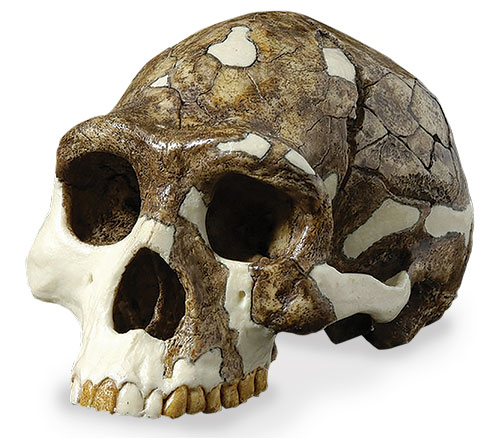
The first Homo erectus finds were given the names Java Man and Peking Man.1,2 Eugène Dubois, a Dutch medical doctor and anatomist, made his famous discovery in 1891 on the island of Java and originally called it Pithecanthropus erectus. His Java Man consisted of just a skullcap, a thigh bone, and a molar tooth found separately in the same layer of volcanic ash. In fact, the skull and thigh bone were about 50 feet apart, but Dubois concluded they belonged to the same individual. An ardent evolutionist and Darwin fan, he immediately claimed he’d found a transitional form. His argument was based primarily on the skullcap’s pronounced brow ridge and size. It was smaller than the average modern human but still well within the known variation for humans. The thigh bone was identical to modern humans.
Specimens of Peking Man, also known as Homo erectus pekinensis (formerly Sinanthropus pekinensis), were discovered between 1923 and 1937 during excavations near Beijing.1,2 These fossils have been given evolutionary dates ranging from 680,000 to 780,000 years old.3,4 The sum fossil total from this work includes six nearly complete crania, 15 partial crania, 11 mandibles (jaws), many teeth, some skeletal bones, and a large number of stone tools.1,2 Modern human fossils were also found in an upper cave at the same site in 1933.
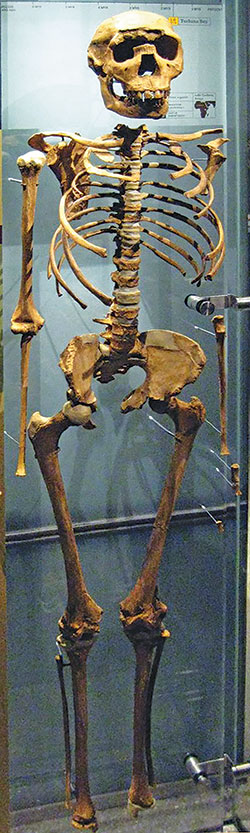
After these initial discoveries in Asia, similar fossil skulls were found throughout eastern Africa. First promoted under the name Homo ergaster, it’s now widely accepted that H. ergaster is the African form of H. erectus. The most complete H. erectus fossil was discovered in 1984 near Lake Turkana in Kenya.5 Known as Turkana Boy, this fossil’s skull features were similar to H. erectus, but its body was essentially identical to modern humans. Most researchers now agree the skeleton was from a juvenile of about 10 to 12 years of age who would have achieved a normal human height of close to six feet at maturity. The generally accepted evolutionary age of this fossil is about 1.6 million years—slightly younger than the Java Man fossils.
The other major group of H. erectus fossils was discovered between 1991 and 2005 in archaeological excavations near the city of Dmanisi, Georgia, northwest of Turkey and situated between the Black and Caspian Seas. According to evolutionary dating, the five crania and four mandibles are about 1.8 million years old.2,6 Although the fossils have been placed in the H. erectus category, the extreme size and shape variation of the skulls has caused controversy. In fact, evolutionists note that due to this variability, if the skulls hadn’t been found close to one another and in the same rock layer, they would have been placed in different species categories. Several of the skulls look as though there may have been some sort of disease pathology at work.
What Makes a Homo erectus a Homo erectus?
The entire story of H. erectus is essentially built on about 300 very fragmentary fossils. The majority of these are nothing more than partial skulls, teeth, and broken bones. The only nearly complete H. erectus fossil is Turkana Boy, whose post-cranial skeleton was found to be nearly identical to modern humans.
Based on the diverse skull fragments and a few nearly complete crania, the defining features of H. erectus are a prominent brow ridge, a sloping forehead, reduced chin, more constricted temples than typical humans, larger teeth, forward-projecting jaw (prognathism), and cranial capacities on the lower end of the normal human-size spectrum.2 In fact, one could say that H. erectus skulls are shaped similarly to Neanderthal craniums except that instead of being larger compared to modern humans, their heads were on average generally smaller. However, H. erectus cranial volume is still within the same range as modern humans. Research has shown that, in general, human or animal intelligence is not based on brain size but on creature-specific organizational properties.2
Recent Homo erectus in Australia and China?
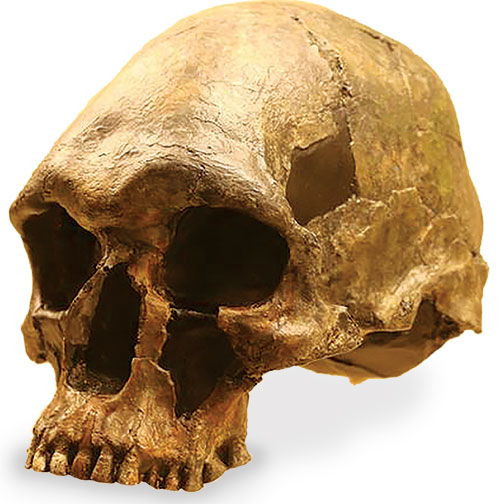
In 1972, the fossil remains of about 50 Aboriginal humans were discovered at a burial site in the Kow Swamp region of Northern Victoria, Australia.2,7 The researchers who reported the discovery described a distinct set of so-called archaic human traits “not seen in recent Aboriginal crania” that closely paralleled the traits of classic H. erectus. These included prominent brow ridges, sloping foreheads, prognathism, large teeth, and a minimal chin. But most importantly, along with the reported “archaic” features, the researchers claimed a very recent date by evolutionary standards for these fossils. The scientists in the report stated, “Analysis of the cranial morphology of more than thirty individuals reveals the survival of Homo erectus features in Australia until as recently as 10,000 years ago.”7
In a 2006 finding in Mongolia, researchers reported a skullcap whose “analysis shows similarities with Neanderthals, Chinese Homo erectus, and West/Far East archaic Homo sapiens.”8 Just like the Kow Swamp fossils, the evolutionary dates don’t fall within the range of typical H. erectus. The most recent study of the Mongolian fossil now lists it at about 34,000 years old—a time considered very recent in the human evolutionary spectrum and on par with the Kow Swamp fossils.
The problem with both of these fossil discoveries is that evolutionarily speaking they have been put in the same age range as very recent anatomically modern humans. Had they been dated at one to two million years, they would have been considered bona fide H. erectus because they would then fit the evolutionary narrative. As things stand, they are considered mere anomalies to be swept under the rug to maintain the evolutionary myth that so-called archaic human traits disappeared long ago.
Archaic Traits Are Still Alive and Well
Secular scientists have discovered a human skull from Jebel Irhoud, Morocco, defined as having “anatomically modern” features and dated at over 300,000 years old.9 This, combined with the fact of very “recent” humans with archaic features (the Kow Swamp and Mongolian fossils), highlights severe inconsistencies in the human evolution story.
If one wants to accept the evolutionary timeline, then H. erectus-like humans with archaic features and humans with anatomically modern features have hung out together on Earth for a long time, even up to the very recent past. But it gets even worse for the evolutionary picture because so-called archaic traits like prominent brow ridges, sloping foreheads, prognathism, and small craniums can still be found in living humans.10
Advanced Culture and Behavior of Homo erectus
Not only is there strong anatomical evidence that H. erectus fossils are just a variant of the human kind, there is also copious archaeological evidence that they were highly intelligent and exhibited a broad range of human behaviors. The condensed list below is based on an extensive scientific literature survey published in 2017.2
Homo erectus and the Out-of-Africa Myth
The H. erectus fossil presence in China and southeast Asia, particularly on remote islands like Java, causes major problems for the reigning human evolutionary migration paradigm. First of all, it’s obvious that intelligent seafaring humans made the journey over long stretches of open ocean to reach these islands. And if we accept the deep-time dating of H. erectus at up to two million years in remote places like this, then there are severe evolutionary time frame discrepancies.
For one thing, the supposed initial phase of human evolution is represented by the ape-like Australopithecus, which overlaps significantly in time with H. erectus. If they coexisted, how could one have been the evolutionary predecessor of the other? Even worse is the problem it presents for the current out-of-Africa model. This model proposes that humans migrated from Africa only about 100,000 to 200,000 years ago. But if that is the case, then how could they have existed on remote southeast Asian islands two million years before that?
Homo erectus Was Human After All
Not only is the H. erectus fossil record fragmentary and incomplete, but the bulk of the data indicates this category is simply a variant of the human kind. As mentioned above, so-called archaic H. erectus traits can still be found in humans today. Even many evolutionists recognize this. A recent article stated, “If you bumped into a Homo erectus in the street you might not recognise [sic] them as being very different from you.”11
So, if H. erectus was fully human and the evolutionary narratives and timelines don’t make sense even within a secular worldview, how does this fit with the Bible? First of all, the Scriptures are quite clear that God created an ancestral human couple uniquely in His image on the sixth day of the creation week. We also know that death, sin, and corruption entered the picture when Adam and Eve rebelled (Genesis 3). As the human population grew, people became so wicked that God destroyed the world in a global flood. It’s possible that some of the H. erectus fossils may have been humans buried in the highest sedimentary layers of Flood rock, exactly where we would expect them.
Alternatively, some H. erectus fossils may have been from specific people groups that dispersed from the Tower of Babel after the Flood. The Kow Swamp burial site would be a good example. When human languages were confused at Babel, the resulting isolated groups would have led to a large number of genetic bottlenecks and lineages of humans with unique suites of trait variations such as skin color, skeletal sizes, and skull shape variations. Some creation scientists also speculate that genetic abnormalities would have surfaced more rapidly in small, isolated, inbred populations, which may explain some of the unusual variations seen in H. erectus skulls.2
Clearly, the biblical account of human creation and Earth history offers a much more satisfying framework in which to place human fossil discoveries than the scientifically flawed evolutionary narrative.
References
If you question Darwinian evolution you may be interested to know there are many others just like you. Below is a pdf of those who say “We are skeptical of claims for the ability of random mutations and natural selection to account for the complexity of life. Careful examination of the evidence for Darwinian theory should be encouraged.”

Genesis 1:11 And God said, Let the earth bring forth grass, the herb yielding seed, and the fruit tree yielding fruit after his kind, whose seed is in itself, upon the earth: and it was so.
12 And the earth brought forth grass, and herb yielding seed after his kind, and the tree yielding fruit, whose seed was in itself, after his kind: and God saw that it was good.
‘Does it seem to you that climate change alarmism, like evolutionism years ago, is making its big push to become the one and only acceptable theory in official circles? I think it is!
With the end of a hot summer, all the news about hurricane Dorian and the election cycle heating up, climate change alarmism is being pushed to new heights of hysteria. There is less tolerance than ever for any disagreement that climate change is “the greatest existential threat” to mankind.
Is there an agenda to try to push the science in one direction? With evolution, the agenda of those who are pushing this pseudo-science is for sinful mankind to eliminate God and to eliminate man’s moral accountability to his Maker. As Richard Dawkins famously put it: “Evolution is intellectual justification for atheism,”
With climate change alarmism, there is another, though similar, agenda behind the so-called “science”.
What is interesting is that in the midst of all the climate alarmist rhetoric, a great deal of data suggests otherwise. For example, an ongoing record from the National Oceanic and Atmospheric Administration (NOAA) has noted that there has been no warming since their improved data stations began measuring temperatures in 2005. NOAA said at the outset of this century that many of the temperature-measuring data stations have been influenced by local effects such as airport runways or by being in cities where temperatures are artificially inflated (a local “micro-climate”). American population has grown and so have American cities with local micro-climates influenced by asphalt, machinery, concrete, etc.
And so, in 2005, NOAA established the US Climate Reference Network (USCRN) of 114 pristinely maintained and monitored temperature stations spaced relatively uniformly across the lower 48 states. From the raw temperature readings, there is good reason to believe that US temperatures are the same now as in the 1930s! Any asserted US warming is the product of controversial adjustments, sloppy measurement and bias to the raw data.
It must be noted that there has been a short-term increase in the number and intensity of hurricanes, as shown in the historical data since the 1960s. But that was when weather satellites began documenting hurricanes. As scientists look further back in time through 100 years, they saw a natural cycle for hurricanes. NOAA’s Hurricane Research Division has carefully reanalyzed the original records of all hurricanes affecting North America up to 1960. Its HURDAT database shows that no increase in the frequency of hurricanes or major hurricanes (Category 3 and over) has taken place since 1851!
The record year for hurricanes was 1886, when seven hurricanes made landfall. Only three Category 5 hurricanes have actually hit the US mainland: the Labor Day hurricane in 1935, Camille in 1969 and Andrew in 1992.
But to listen to the constant barrage of climate alarmism, you would not know any of this! Let’s see now, what’s the old adage attributed to Hitler’s propagandist Joseph Goebbels? – “If you tell a lie big enough and often enough, people will come to believe it.”
Historical data shows that Atlantic hurricanes, particularly major ones, were much more common between about 1930 and 1960 than in the following three decades. Since 1990, the numbers have returned to the earlier levels. It has generally been accepted that this pattern is linked to the Atlantic Multidecadal Oscillation (AMO), a natural reoccurring cycle of temperature changes in the sea surface temperatures. The database for worldwide hurricanes has only been kept reliably since 1970, and its information is also affected by the AMO cycle, which requires a longer cycling of data.
So why would the climate change alarmists want to shut down debate about all this? It’s like the salesman who pressures you to “buy now before it’s too late!” If you are like me, you get suspicious.
As we discussed in a letter earlier this year, climate change alarmism is an excuse for more government control and less freedom for we, the people. It is also a driver for Socialism. Climate change alarmism plays to people’s fears. And it plays to an evolutionary view that the actions of evolving species (such as ourselves) can bring about a fragile evolving Earth, finely tuned and balanced only by chance. If it were to slip “out of balance”, it would destroy us. It plays to unbelief in God.
So let’s look at the lies we are being told: “Evolution is true”; “Climate change is going to kill us off”; “Socialism is necessary to bring justice and to save us from disaster.” And there are other big and constantly repeated lies. Among them: “Marriage can be between people of the same sex,” and “I can change my sex if I don’t like the way I was born.” Hmmm.
We’re told to forget the actual data on all these lies and get on board the bandwagon! And let’s not discuss any of this because we might cause some controversy. After all, it’s not nice to go against world opinion, hurt somebody’s feelings, get stuck in some old-fashioned tradition that fails to advance our species, or fail to save the planet by taking too long to act!
Fortunately, truth prevails. Even Joseph Goebbels’ recognized the power of truth, writing a key guideline for fascists, socialists and other totalitarian ideologues that it “is vitally important for the State to use all of its powers to repress dissent, for the truth is the mortal enemy of the lie, and thus by extension, the truth is the greatest enemy of the State.”
We need to continue being people of the Word. Jesus said, “If ye continue in my word, then are ye my disciples indeed; and ye shall know the truth, and the truth shall make you free” (John 8:31-32). Christianity has paved the way for freedom – freedom within ourselves and freedom in society as well.
P.S. In many ways, climate change alarmists behave just like evolutionists. They are poisoning the minds of millions with lies, supported by pseudo-science, frauds and failed predictions.’ https://creationmoments.com/newsletter/the-devils-deceit-is-not-science/?mc_cid=0d1acbd940&mc_eid=00c1dcff3c
Can there be design without a designer? That’s a pretty simple question which requires a fairly simple answer! No, there cannot be. Now, evolutionists try to explain how there can be but when it comes down to reality they are ‘deceiving, and being deceived.‘ True science will NEVER back up what the evolutionist teaches.
Exodus 20:11 For in six days the LORD made heaven and earth, the sea, and all that in them is…
Before the 19th century, the majority of scientists, clergy and professing Christians believed the Bible and its account of creation as given in Genesis. That’s not to say there weren’t those with the evolutionary lie floating around in their head and it even being spouted albeit privately.
However, that deceiver, the Devil, knew when the right time had come for the populace to fall for The LIE. That time came when Charles Darwin wrote his book On the Origin of Species by Means of Natural Selection, or the Preservation of Favoured Races in the Struggle for Life. The Western world was ready for the BIG LIE and Darwin’s book sold out in a few days and the rest is history.
Today, most if not all schools of higher learning teach macroevolution as a fact rather then a theory even though there is absolutely NO evidence of a monkey changing into a man or non-life evolving into a living cell.
Yes, He that sitteth in the heavens shall laugh…, when men stand before Him and try to explain why they taught something so contrary to real observational science and His Word!
I grew up in Iowa so the picture below certainly caught my attention (Isn’t it beautiful?). How I well remember those hot humid Iowa summers which promoted the growth of some of the best corn in the world. As a boy, I never really stopped to think about how corn showed the glory of my God but it does! Psalm 107:21 Oh that men would praise the LORD for his goodness, and for his wonderful works to the children of men!

‘Discoveries in biology keep pouring in that confirm biological functions are best described by engineering principles. A prime example is the recent description of a sophisticated control system in flowering plants that regulates their stem cells. A biological design theory expects to uncover elements in biological systems that would correspond to human-designed systems performing similar functions. Government funded research conducted by Zachary B. Lippman at Cold Spring Harbor Laboratory in New York identified mechanisms that confer “redundancy” to critical genetic control systems.1 Redundancy is an important engineering principle built into designs that enables something to maintain its function when being stressed.
Cells responsible for growth in roots, stems, leaves, and flowers all begin as stem cells. (Note: Plant stem cells don’t exclusively grow into physical stems.) Growth occurs in the apices (tips) of stems and roots in stem-cell clusters known as meristems. Stem cells have the potential to develop into different kinds of cells, but both their differentiation and proliferation must be highly regulated or the result can be a disorganized mess. In Figure 1, Lippman produced some remarkable examples in tomato plants highlighting why control systems must tightly regulate stem cells by showing what happens when the system’s function becomes disrupted through mutations.
In a press release from Cold Spring Harbor Laboratories, Lippman emphasized the critical nature of stem cell control systems, saying, “Those players are critical for ensuring a plant has the right number of stem cells throughout life, and we discovered there are backup systems that kick in when these players are compromised through chance mutations.”2
Lippman’s research on Arabidopsis, corn, rice, and tomatoes underscores two important findings: 1) a matching “core genetic circuitry [is] found in all flowering plants” that he claims is “a deeply conserved stem cell circuit,” and 2) compensatory “backup systems” provide redundancy for the plant by “buffering” results—literally saving the information—if the core stem cell circuit is damaged. While all plants use the same core genetic circuit, “the genetic backup systems can vary drastically from plant to plant.”
Lippman and his colleague, David Jackson, believe that describing the diversity of these backup systems was their most important discovery. This led to their research paper being titled, “Evolution of buffering in a genetic circuit controlling plant stem cell proliferation.”1 Jackson says, “We were surprised to see such big differences but in retrospect it reveals the power of evolution in finding novel ways to protect critical developmental circuits.”2
Lippman and Jackson’s innovative experiment revealed some impressive systems. But when the interpretation of their findings is squeezed into evolutionary theory, so much imagination is integrated into their explanations that their plausibility is akin to that of a “just-so” story.
How do the researchers know the genetic circuits are deeply conserved? For them, it’s because they are all similar.
How do they know that these buffering systems evolved? Because they are drastically different.
How do they explain why “for 150 million years” the core circuits somehow escaped radical mutational changes, but in sharp contrast, the buffering systems in the same plants mutated wildly all around them? They chalk that feat up to “the power of evolution”…an explanation akin to magic. This shows frustratingly fickle characteristic of selectionism. In this case, selection causes drastic system variation—except when it keeps them quite unchanged. This characteristic was previously documented with many similar cases.3
But there’s an alternative way to interpret these experimental observations more precisely. It uses a framework that expects rapid and targeted responses, includes every system element, and doesn’t appeal to the mystical “power of evolution.” ICR is developing a theory of biological design as a more scientific approach to selectionism.4 One major assumption is that biological functions are far more suitably explained by engineering principles. The way in which stem cell control and genetic backup systems produce redundancy is evidence supporting that assumption. These control systems may also play a role in adaptive mechanisms, since, “function[ing] both to buffer stem cell homeostasis [a state of balance] and provide developmental flexibility.”
Innate control systems aren’t only essential to all dynamic entities, they are a hallmark of sophisticated engineering—especially the back-up redundancy systems. The myriads of phenomenally complex control and backup systems are evidence of the astounding creative genius of nature’s Creator, the Lord Jesus Christ.’
References
1. Rodriguez-Leal, D. et al. 2019. Evolution of buffering in a genetic circuit controlling plant stem cell proliferation. Nature Genetics. 51: 786-792.
2. Stallard, B. To protect stem cells, plants have diverse genetic backup plans. Cold Spring Harbor Laboratory. Posted on cshl.edu on April 15, 2019, accessed May 24, 2019.
3. Coppedge, D. 2018. Darwinians Cannot Agree on What Natural Selection Is. Creation Evolution Headlines. posted on crev.info on April 2, 2018, accessed on May 10, 2019.
4. Guliuzza, R. J. 2018. Engineered Adaptability: Adaptive Changes Are Purposeful, Not Random. Acts & Facts. 47 (6): 17-19. https://www.icr.org/article/plants-show-engineering-principles/
Romans 1:19 Because that which may be known of God is manifest in them; for God hath shewed it unto them.
20 For the invisible things of him from the creation of the world are clearly seen, being understood by the things that are made, even his eternal power and Godhead; so that they are without excuse


