Vaccine passports create a two tiered society! This is HEALTH apartheid!!!! THE ONLY CHOICE WE THE CITIZENS HAVE ARE THOSE EXPERIMENTAL VACCINES THE GOVERNMENT HAS APPROVED. WE CANNOT USE INVERMECTIN OR HYDROXYCHLOROQUINE! NO FREEDOM OF CHOICE HERE!!! As the Premier of New South Wales said she doesn’t want to be around the UNVAXXANATED ! The UNVAXXANATED are in the eyes of the government UNCLEAN Lepers!!!
‘Media release: New COVID-19 digital certificate simplifies proof of vaccination
9 June 2021
Senator the Hon Linda Reynolds CSC
Minister for the National Disability Insurance SchemeMinister for Government Services
Everyone who has received all required doses of their COVID-19 vaccination can now access the recently launched COVID-19 digital certificate.
Minister for Government Services, Senator the Hon Linda Reynolds CSC, said the new record makes it simple and easy for people to show their COVID-19 vaccination status.
“The COVID-19 digital certificate makes proof of vaccination accessible anytime, anywhere,” Minister Reynolds said.
“We’re also giving people control over the level of vaccination history they share, as the certificate only shows your COVID-19 vaccination status.
“Once your provider has reported both doses of an approved vaccine, you’ll be able to access your COVID-19 digital certificate online through myGov or in the Express Plus Medicare app.
“I’m encouraging all Australians to ensure you’ve linked your Medicare account to myGov.
“Linking Medicare to myGov is simple, and more than 10 million Australians have already completed this process.”
The Morrison Government is securing the health and safety of all Australians, and Medicare’s trusted systems are making this happen.
“We’re guaranteeing everyone in Australia can get free COVID-19 vaccinations and making sure you can easily show proof of your immunisation,” Minister Reynolds said.
‘A recent essay by Pete Shmigel on Flat White is a poignant reminder of how people who experienced tyranny behind the Iron Curtain have been among the first to fear the creeping authoritarianism of Western democracies in thrall to China’s brutal suppression of the Wuhan virus. Way back in the mists of time, I was living in New Delhi when Indira Gandhi declared a 21-month emergency in June 1975 to impose dictatorial rule. Overnight, the political and social atmosphere changed with a palpable sense of fear as political opponents were imprisoned and colleagues and neighbours turned into informants and snitches. My first academic article was on that experience. Two observations are worth recalling. We take freedom for granted but feel the sting of its absence when abruptly robbed of it. In a revealing statement, PM Gandhi said when the government had ‘allowed’ freedoms, but people had abused them, implying that liberties are in the gift of governments to dispense or withhold. I didn’t forsee that belief taking hold in almost all Western democracies within my lifetime, terrified by a disease of relatively moderate severity in the history of pandemics. Like frogs in water coming slowly to the boil, we have remained unconcerned as liberties were steadily stripped away and our attachment to freedom proved to be virus-thin.
The widespread proliferation of masks in public is part of the slow boil process. The pointlessness of the most common types of masks outside healthcare settings, unless you are unwell, is easy to show both on the science and visually with charts. The trajectory of infection curves is unaffected by imposing and lifting mask mandates: there is no visible inflection point on the slope to coincide with masks. ‘Don’t be selfish. For the sake of others, just mask up, it’s no big deal’, we’ve been admonished. Except their most potent result has been to normalise unquestioning and habitual obedience to diktats as citizens became subjects.
‘Grab a mask’ has been replaced with ‘get the jab’ as the metaphorical equivalent of the 100 degrees Celsius setting on the dial to bring the water to boil. Vaccines don’t stop infection and spread but reduce severe illness and death for the most vulnerable elderly group. According to 2021 data from Public Heath England, the unvaccinated over-50s are more than three times at higher risk of death from a Delta variant infection than the fully vaccinated. A recent Lancet study found vaccinated healthcare workers in a Vietnamese hospital were carrying 251 times the viral load in their nostrils as the unvaccinated. Dr Peter McCullough comments the vaccine transforms people into ‘presymptomatic superspreaders’. If – a big ‘if’ – this is replicated and confirmed, the vaccinated will pose the greater danger to others. Would digital certificates be used to keep them away from public spaces? Australian authorities haven’t bothered to justify vaccine apartheid despite similar transmissibility. Nor to explain what happens to those with naturally acquired immunity through infection that is both more effective and lasts longer.
Ross Clark reports on a new Israeli study which found that ‘double-jabbed, previously uninfected people are 13 times as likely to get Covid’ as unvaccinated people with natural immunity through infection. The bigger long-term danger of lockdowns is their ready public acceptability will empower every wannabe social engineer, power-hungry politician and control-freak bureaucrat to impose draconian controls for their favoured emergency du jour.
Also, like deer caught in Covid headlights, we ignore other grave health costs with accumulating undiagnosed and untreated illnesses. The latest Australian Bureau of Statistics monthly update on mortality shows that until 31 May this year, 3,475 more Australians died than the five-year average in 2015–19. That’s forty times more excess deaths in the first five months than Covid deaths in eight months of 2021. The worst affected were cancer, diabetes and dementia. Lockdowns impair the capacity of the health system to treat illnesses in a timely manner, with heightened distress and anxiety from isolation and loneliness, increased fear of contracting the illness by going to the GP or hospital, cancelled screenings for illnesses that are treatable if caught early and deferred operations. Yet no government or chief health officer will be held accountable.
Hell, no one has even been subjected to aggressive questioning by reporters. There’s no daily solemn agonising by politicians and CHOs about the tragic toll, the unacceptability of just one preventable death and the determination to pursue zero excess death. James Allan is right to ask if journalists are lazy or dumb in not challenging the growing gulf around the world between official claims and contrary data. Hysteria, hypocrisy and selective morality reign supreme, with the PM and state premiers in office but the health bureaucrats and police commissioners in power. At about the same time as the myth of US exceptionalism was buried in Afghanistan by the Taliban, the myth of Australia’s Covid exceptionalism has been felled by the Delta variant. Scott Morrison has used new modelling from the Doherty Institute to outline a multi-phase roadmap with 70 and 80 per cent adult vaccinations as key milestones. Given the wildly inaccurate original Doherty modelling in March 2020, why exactly should we have confidence in the new model?
With 3,668 new infections recorded on 23 August, Chancellor Angela Merkel announced Germany will stop using the infection rate as the metric for deciding if restrictions should be in force. They’ve been using 7-day thresholds of 35, 50 and 100 infections per 100,000 people to trigger openings and closures. Instead, Germany will monitor hospitalisations to assess if the health system is becoming overburdened. After two months of tightening restrictions and accelerated vaccine take-up, NSW’s daily ‘cases’ broke the 1,000 barrier on 26 August. Rather than accept lockdowns don’t work and vaccines are leaky, authorities blame insufficient public compliance with arbitrary and draconian but not always scientifically justified regulations. Who knew that watching sunsets should come with a compulsory health warning? Against all overseas experience, CHO Kerry Chant insists that vaccinating 16-39 year olds will ‘break the transmission chain’. Meanwhile Canberra recorded nine new Covid cases on 25 August, taking its total of active cases to 176 from 1 when the lockdowns were first brought in.
Today at 11am I was watching Sky as the New South Wales Premier gave her daily scare talk on the Wuhan flu vaccines and there was a news report given across the bottom of the screen announcing that Australia would have a Covid Passport in a couple of weeks. This is Hitler’s Germany!
‘Alongside skyrocketing new “cases,” infections and hospitalizations among the fully-vaccinated, Israel has announced it’s going to start pushing a fourth covid shot, which it claims will accomplish what the third shot — and the first two shots — could never achieve: the eradication of covid.
This is, of course, the definition of insanity: Doing the same thing over and over again while expecting a different result. How compliant, exactly, will the Israeli people be, given that their ancestors were once marched into Zyklon B death camps under nearly the same demanded obedience to authority? The vaccine holocaust is somehow fully embraced by about 80% of Israelis, none of whom seem to realize they are exterminating themselves under a globalist depopulation agenda. (This is called “auto-antisemitism,” by the way.)
But Israel isn’t the only nation declaring a never-ending pandemic. In Australia, now home to the most outrageous medical dictatorship on the planet, Victorian Premier Daniel Andrews seems to have declared that unvaccinated people will be denied access to hospitals, doctors and health care services altogether. In his view, those who don’t take the vaccine should be cut off from civilization and denied everything, including groceries, health care services and presumably all forms of transportation.
In the USA, bioweapons mastermind Anthony Fauci is also pushing the idea of endless booster shots, perhaps requiring shots every five or six months.
Those world citizens who were gullible enough to go along with the initial requirement of taking two shots to be “fully vaccinated” are now finding themselves caught in a vaccine trap from which there is no escape. With each booster shot weakening their immune response, the consequences of obedience increasingly look like suicide. And the most obedient vaccine takers are setting themselves up for a high risk of death from future variants or outbreaks… which seems to be the whole point in all this.
Unless the people of the world peacefully rise up and reject the authoritarian nonsense, they will be subjected to a never-ending medical police state under the guise of a plandemic that perpetuates itself as fully-vaccinated individuals produce and shed highly infectious viral variants that keep killing people. As you might suspect, all blame will be placed on the unvaccinated, who are the scapegoats for this global depopulation biological weapons deployment.’https://www.naturalnews.com/2021-09-07-infinite-pandemic-multiple-nations-announce-never-ending-booster-shots-lockdowns-covid-compliance.html
The Australian Greens Party is a far left Marxist party as most if not all Green Parties are. The sad part of all this is that most of the major Australian political parties are going along with many of the Greens’ issues. The non-use of Ivermectin is just one of those issues!
‘The fight for press freedom continues with Sky News Australia subjected to hours of questioning regarding its editorial choices.
Sky News Australia Chief Executive Paul Whittaker opened the Senate Inquiry into Media Diversity by rubbishing accusations that the network deliberately peddled Covid conspiracy theories. Whittaker called the assertion, ‘frankly ridiculous!’
The inquiry was put together by a Greens MP from the far-left minor party that routinely criticises Sky New Australia’s centre-right position. Senator Sarah Hanson-Young chaired the inquiry accompanied by Labor Senator Kim Carr.
Senator Hanson-Young’s topic of the day was ‘Covid-Lies’, an idea that she repeatedly used interchangeably with unresolved political subjects that remain the topic of global debate.
The inquiry unfolded in a politicised atmosphere set up by Sarah Hanson-Young, whose personal website features a ‘take action’ talking point devoted to attacking Murdoch media.
‘In an embarrassing move, Senator Hanson-Young blocked Rebel News journalists Alexandra Marshall and Avi Yemini from covering the inquiry online – apparently violating her devotion to media diversity.
Senator Hanson-Young’s specific complaint about Sky News Australia revolved around it being ‘allowed’ to discuss Ivermectin on-air as a potential treatment for Covid.
After failing to correctly pronounce Ivermectin repeatedly throughout her questions, the Senator eventually resorted to calling it ‘horse wormer’.
“Do you accept that Sky News has created and published content that is either directly or indirectly promoted disinformation about Covid and Covid-Lies in relation to restrictions, health measures, cures?” asked Hanson-Young.
Sky News Australia replied to the entire day’s questioning with an official statement.
“We operate within the same legal framework as all media and are subject to both the Commercial Television Industry Code of Practice and the Subscription Broadcast Television Codes of Practice.
“There is no evidence that Sky News breaches existing regulations or that the current regulatory framework is failing, or that further regulatory intervention is required.
“Indeed, it should be noted we have not been found in breach of the Codes of Practice for more than ten years.”
As a major news network, Sky News Australia maintains that it involves a wide range of discussion involving scientists, epidemiologists, GPs, pharmacists, researchers, chief health officers, politicians, doctors, and bureaucrats.
“But it now appears commonplace to discredit any debate on contentious issues as ‘misinformation’.
“So, the question becomes, why does a tech giant, YouTube, and faceless, nameless individuals backed by an algorithm, based in California, get to decide that holding governments and decision makers to account is ‘misinformation’? Why do they get to decide what is and isn’t allowed to be news?” added the official statement.
Despite insisting that Sky News Australia must only publish Covid information approved by the prime minister, state premiers, and the World Health Organisation – Senator Hanson-Young’s comments about Ivermectin proved inaccurate against the facts.
Its entry into the Covid conversation was heavily politicised by the American election. Ivermectin remains the subject of peer-reviewed studies, ongoing trials, and experimental use around the world – none of which involve horse paste.
Australia’s own Monash University in alliance with the Peter Doherty Institute of Infection and Immunity proved that Ivermectin could kill Covid within 48 hours under laboratory conditions.
Globally speaking, the discussion on Ivermectin is far from over, with its off-label use against Covid widespread in Africa and South America. Public health experts, medical scientists, and South African health practitioners have banded together in a campaign to achieve formal approval for its use. There are similar stories in the Philippines and Latin America.
Senator Young’s main reasoning for wanting all discussion of Ivermectin banned was because it conflicted with official advice from the Therapeutic Goods Administration. It is difficult to find an example of this method being used to censor discussion on a media broadcaster.
Hospital admissions and injures associated with Ivermectin come from people consuming non-human approved animal treatments not the Ivermectin discussed in the studies. One could argue that governments banning the distribution of Ivermectin are the real cause behind these accidents.
Considering the ‘Ivermectin topic’ is central to both YouTube’s strikes and the Senator’s desire for stricter government regulation over the content of media broadcasters, it’s essential that this narrative is examined.
Ivermectin was not the only glaring inaccuracy brandished by those accusing Sky News Australia of misleading the public.
Labor Senator Kim Carr questioned Whittaker over a petition asking for a Royal Commission into media diversity.
This turned out to be ex-Prime Minister Kevin Rudd’s e-petition of ‘over half a million signatures’. The petition was earlier revealed to be riddled with computer-generated signatures and fake names, accounting to Sky News host Sharri Markson’s earlier investigation.
“Greens Senator Sarah Hanson-Young has used this petition to launch a media inquiry into two ASX-listed companies; News Corp Australia and Nine Entertainment, to have a whole Senate inquiry into the media industry, so this petition is being used as the basis for policy formation,” explained Sharri Markson.
The fake names on Rudd’s petition included ‘this sucks’, ‘Nacho cheese’, and ‘Jesus Christ’ which were generated by off-shore bot accounts.
The inaccuracy of the petition and its subsequent failure to trigger a Royal Commission was not mentioned at the inquiry.
The Inquiry into Media Diversity played out like a witch trial against Sky News Australia specifically.
Several Sky News Australia hosts declined to partake.
“There’s only one reason why I didn’t appear at today’s Senate hearing. I will not be party to a witch hunt, nor waste my time in the services of satisfying the paranoid fantasies of a failed former PM. The Senate Committee on Media Diversity came about as a result of a petition organised by former PM Kevin Rudd,” said Rita Panahi on Alan Jones.
Anti-Murdoch voices have waged campaigns to cancel the network for many years – including the use of anonymous online trolls to harass advertisers.
The situation did not become serious until YouTube issued a strike against the digital arm of the media empire in July of 2021.
YouTube is a commercial earner for Sky News Australia with almost two million subscribers. Three strikes in 90 days results in an immediate and permanent suspension of the account, regardless of size.
Sky News Australia was forced to remove twenty-three videos that allegedly violated YouTube’s policy on Covid misinformation. The videos included content up to a year old.
“Specifically, we don’t allow content that denies the existence of COVID-19 or that encourages people to use Hydroxychloroquine or Ivermectin to treat or prevent the virus. We do allow for videos that have sufficient countervailing context, which the violative videos did not provide,” said a statement from YouTube.
The majority of the content in question fell under the banner of ‘opinion’ rather than news, but YouTube did not provide any further clarity for their strike.
To be clear, YouTube’s policies are not a statement of absolute fact, but a compliance order to keep the material on their platform consistent with the health guidance from various authorities – even if this information is contested or later shown to be false. Strikes are not removed if health information changes.
Sky News Australia Chief Executive Paul Whittaker pointed this inconsistency out to the inquiry. Whittaker also strongly rejected the claim that Sky News Australia promoted an anti-vaccination narrative.
“Sky News Australia strongly supports vaccination. Any claims to the contrary are false and a blatant attempt to discredit and harm our news service,” said Whittaker.
When Lucinda Longcroft, Director of Public Policy, Google Australia and New Zealand was asked to provide examples of left-wing content removed by YouTube, she took the question on notice.
“Our Covid-19 misinformation policies are applied equally to all YouTube content and channel owners,” said Longcroft, but did not offer any data to prove the point.
It is a widely held opinion that YouTube applies its community standards unequally to users, with many conservative accounts taken down while fringe accounts – such as domestic terror group Antifa – remain up.
“YouTube’s actions make clear that it is not a neutral platform, but a publisher selectively broadcasting content and censoring certain views, while allowing videos that are patently false, misogynistic, and racist to proliferate. […] With no transparency provided, Sky News took the proactive approach of removing a batch of videos, all published during 2020, from online platforms to ensure ongoing compliance with YouTube’s arbitrary editorial guidelines,” Mr Whittaker added.
Social Media platforms such as YouTube, Facebook, Twitter, and Instagram have become significant tools for political parties during election campaigns. As such, there is growing concern of foreign interference in Australian politics by these entities, especially when they brazenly remove elected members of parliament like Craig Kelly.
Platforms exist in a special legal limbo, where they are immune from prosecution regarding the third-party content they host on the proviso they refrain from engaging in publishing privileges. Under American Law, they are distinct from publishers and yet in the last few years they have made headlines for selective political censorship.
Whittaker insisted that the videos taken down by YouTube had no public complaints – which begs the question why they were flagged in the first place. He wrote to Google’s CEO in the hope of clarification, but received nothing in return, not even an acknowledgement of the query.
Australia’s media landscape has taken a bizarre path to this inquiry.
Chief among those leading the anti-Murdoch charge are full-time campaigner ex-Prime Minister Kevin Rudd and occasional contributor ex-Prime Minister Malcolm Turnbull. While the men come from opposing sides of politics, they share a history of unkind headlines enjoyed by readers at their expense.
The inquiry soon expanded to criticism regarding Sky News Australia allowing alternative discussion on Climate Change before accusing some of its hosts of racism.
This was swiftly followed by Hanson-Young asking Whittaker how many of his staff were female before elaborating that they were ‘rather young’. Her point was to suggest a power imbalance between young female producers and the more experienced network hosts.
Implying that young women are not capable of doing their jobs because of their age and gender is considered a sexist remark by most people. Whittaker was similarly bewildered by Hanson-Young’s line of questioning, pointing out that there is plenty of support for producers to do their jobs.
Inquiries are normally launched from an impartial basis so that the search for truth can be conducted without prejudice.
Even the Left leaning THE CONVERSATION carried an article concerning the new law here in Australia, that seems to me, takes away even more of our freedoms and privacy. All this is occurring under a supposed CONSERVATIVE Federal government! Is this law truly meant to catch REAL criminals or is it to actually meant to spy on those citizens that may not swallow all the Kool Aid handed out by government? Personally, laws such as this only provides more reasons why many do not trust the government! With that said ‘A new law gives Australian police unprecedented powers for online surveillance, data interception and altering data. These powers, outlined in the Surveillance Legislation Amendment (Identify and Disrupt) Bill, raise concerns over potential misuse, privacy and security.
The bill updates the Surveillance Devices Act 2004 and Telecommunications (Interception and Access) Act 1979. In essence, it allows law-enforcement agencies or authorities (such as the Australian Federal Police and the Australian Criminal Intelligence Commission) to modify, add, copy or delete data when investigating serious online crimes.
What’s more, legal hacking by law enforcement may make it easier for criminal hackers to illegally access computer systems via the same vulnerabilities used by the government.
What’s in the law?
The bill introduces three new powers for law-enforcement agencies:
“data disruption warrants” allow authorities to “disrupt data” by copying, deleting or modifying data as they see fit
“network activity warrants” permit the collection of intelligence from devices or networks that are used, or likely to be used, by subject of the warrant
“account takeover warrants” let agencies take control of an online account (such as a social media account) to gather information for an investigation.
There is also an “emergency authorisation” procedure that allows these activities without a warrant under certain circumstances.
However, the new bill gives agencies unprecedented interception or “hacking” powers. It also allows “assistance orders”, which could require selected individuals to assist government hacking or face up to ten years in prison.
Why do police argue this bill is required?
According to the Department of Home Affairs, more and more criminal activity makes use of the “dark web” and “anonymising technologies”. Previous powers are not enough to keep up with these new technologies.
In our view, specific and targeted access to users’ information and activities may be needed to identify possible criminals or terrorists. In some cases, law enforcement agencies may need to modify, delete, copy or add content of users to prevent things like the distribution of child exploitation material. Lawful interception is key to protecting public and national security in the fight of global community against cybercrimes.
How does lawful data interception work?
“Lawful interception” is a network technology that allows electronic surveillance of communications, as authorised by judicial or administrative order. There are standards (which means regulations and rules) for telecommunication and internet service providers to achieve this, such as those recommended by the European Telecommunications Standards Institute.
Law-enforcement agencies may require service providers to hand over copies of communications data, decrypted data, or intercepted data without notifying users. Service providers may also have to make available analytical tools such as graphs or charts of target behaviours.
What are the privacy concerns?
The Office of the Australian Information Commissioner and others have also raised privacy concerns. The bill may impact third parties who are not suspected in the investigation of criminal activities. In particular, the bill can authorise access to third party computers, communication and data.
The Human Rights Law Centre argues the proposed broad powers can potentially compel any individual with relevant knowledge of the targeted computer or network to conduct hacking activities. In some cases this may clash with an individual’s right to freedom from self-incrimination.
Enabling law enforcement agencies to modify potential evidence in a criminal proceeding is also a major issue of concern. The detection and prevention of inappropriate data disruption will be a key issue.
The implementation of the new warrants needs to be in line with Privacy Act 1988 which was introduced to promote and protect the privacy of individuals and to regulate Australian government agencies and organisations. Where some agencies may have exemption against the Privacy Act, it is important to balance between public safety and privacy impacts.
What are the security issues and impacts?
The Identify and Disrupt Bill is a part of an extensive set of Australian digital surveillance laws, including the Telecommunications and Other Legislation Amendment (Assistance and Access) Act 2018 (TOLA), and the Telecommunications (Interception and Access) Amendment (Data Retention) Act 2015 (the Mandatory Metadata Retention Scheme).
Under the Identify and Disrupt Bill, access can be gained to encrypted data which could be copied, deleted, modified, and analysed even before its relevance can be determined. This significantly compromises users’ privacy and digital rights.
Modern encryption can be very hard to crack, so hackers often exploit other vulnerabilities in a system to gain access to unencrypted data. Governments too are reportedly using these vulnerabilities for their own lawful hacking.
Specifically, they depend on “zero-day exploits”, which use software vulnerabilities that are unknown to software vendors or developers, to hack into a system. These vulnerabilities could be exploited for months or even years before they are patched.
A conflict of interest may arise if law enforcement agencies are using zero-day exploits for lawful hacking. To protect citizens, we would expect these agencies to report or disclose any software vulnerabilities they discover to the software manufacturers so the weakness can be patched.
However, they may instead choose not to report them and use the vulnerabilities for their own hacking. This puts users at risk, as any third party, including criminal organisations, could exploit these so-called zero day vulnerabilities.
It’s not an abstract concern. In 2016, the CIA’s secret stash of hacking tools itself was stolen and published, highlighting the risk of these activities. The Chinese government has claimed the CIA was hacking targets in China for more than a decade using these and similar tools.
Government use of hacking tools may result in worse cyber security overall. The warrant powers given to Australian law enforcement agencies may protect public safety and national interests, but they may also provide powerful means for adversaries to access government data.
This includes the data and online accounts of targeted individuals like state officials, which may significantly impact national security. This possibility needs to be considered in light of the passing of the new bill.
I thought Hitler was dead! However, if Hitler is dead, is Australia doing Hitler’s bidding from the grave? It seems that the CCP isn’t considered as much of a threat as the ordinary Australian citizen! Now, ‘With Labor’s support, the Australian government passed a law giving police unprecedented powers to spy on anyone they deem a criminal suspect online. They can also interrupt their data, and take over their accounts.
The bill was rushed through parliament and passed in 24 hours.
Despite worries about the low bar for who can issue a warrant and the government’s failure to adopt all of the protections proposed by the bipartisan joint committee on intelligence and security, the Senate passed the identify and disrupt bill on Wednesday,WION reports.
The Surveillance Legislation Amendment (Identify and Disrupt) Bill 2020 (Identify and Disrupt Bill) provides three new types of warrants that allow the Australian Federal Police and the Australian Criminal Intelligence Commission to edit and erase data, take over accounts, and spy on Australians who are suspected of being involved in criminal networks.
These three additional authorities to combat online crime:
The ability to “disrupt data” by modifying, copying, adding, or removing it is granted by a data disruption warrant.
A network activity warrant permits the authorities to gather information from devices or networks used or anticipated to be used by those who are the subject of the order.
Politics in Australia is much like it is in the USA except for the names of the major political parties. The supposedly conservatives are the Liberal and National Parties. These two form a coalition and are presently the ones in power. The Leftist party is the Labor Party. However, there doesn’t seem to be much difference between the major parties on many issues. Nevertheless, now, ‘Labor’s deputy leader Richard Marles has told the National Press Club that his party wants to assist in finding “life beyond earth”.
Yes, our alternative Deputy Prime Minister wants to find intelligent life somewhere else in the universe.
Couldn’t he find any in Canberra? He would have been hard-pressed if he was looking among his own ranks during a recent Senate debate.
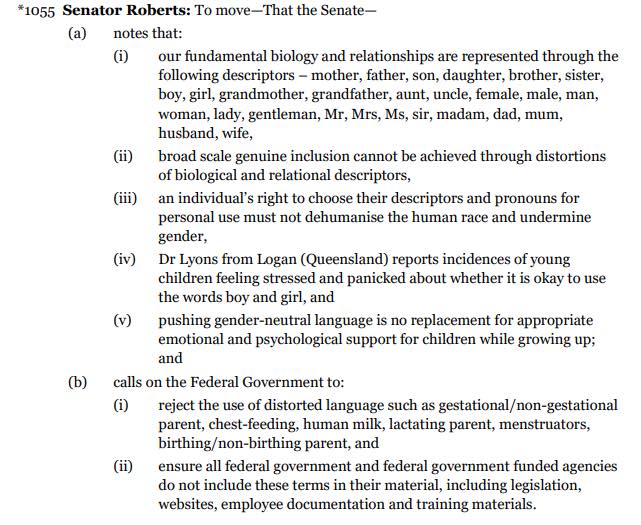
Responding to the onward march of insane and mindboggling “gender-neutral” terms such as “chest-feeding”, One Nation Senator Malcolm Roberts brought a motion to Parliament.
It called for such ridiculous language to be banned from Government usage. Thankfully, the Government supported the move, and the motion was carried 33 votes to 31.
But that means that an astonishing 31 senators, including Labor, voted AGAINST the ban.
Among other things, the motion called on the Federal Government to:
“reject the use of distorted language such as gestational/non-gestational parent, chest-feeding, human milk, lactating parent, menstruators, birthing/non-birthing parent, and ensure all federal government and federal government funded agencies do not include these terms in their material, including legislation, websites, employee documentation and training materials”.
Posting on Twitter soon afterwards, Greens Senator Janet Rice said:
“I expect this sh*t from One Nation. But the Morrison Government just voted to support One Nation’s disgusting, bigoted Senate motion trying to deny the identity of trans & non binary people. So the motion passed. What happened to governing for all Australians? Scumbags!”
It’s hardly surprising that the Greens opposed the motion or engaged in this sort of rant. Par for the course, really.
But what’s truly alarming is that Australia’s alternative government, the Labor Party – currently leading opinion polls 52-48 on a two-party preferred basis – sided with the Greens against common sense.
Scary stuff.
Some may be tempted to look at the current state of affairs in Canberra and turn away. But that’s not the solution. It will only make things worse.
Now more than ever, we need common sense Australians to join and engage in the political process.
‘Australians who test positive to Covid-19 and are at risk of being admitted to hospital will soon have access to a new drug to prevent virus symptoms from worsening.
Australia’s medical regulator, the Therapeutic Goods Administration, on Friday granted provisional approval for the use of antibody treatment drug sotrovimab.
Emergency Use Authorization (EUA) for the Treatment of COVID-19′
‘There are limited clinical data available for sotrovimab. Serious and unexpected adverse events may occur that have not been previously reported with sotrovimab use.’https://www.sotrovimab.com/
This is an experimental drug as is Pfizer! We are lab rats for these pharmaceutical companies and governments. Personally, this is another way of depopulating the world which is a part of The Great Reset. Conspiracy, don’t think so!
Australia is NOT what it was ten years ago. The Wuhan virus has sent the state and Federal governments into CCP mode. Honestly, Australians do not have time to think about China overthrowing Taiwan as they are living under the CCP totalitarianism RIGHT NOW! These videos shows the totalitarian CCP at work in Australia via the politicians and police!