May you have a very blessed Christmas. John 3:16 For God so loved the world, that he gave his only begotten Son, that whosoever believeth in him should not perish, but have everlasting life.
The following was written by Inglis Fleming (1859-1955) (One of his grandsons was Pete Fleming, one of the five missionaries killed by the Auca Indians in 1956.)
‘”Let the saints be joyful in glory: let them sing aloud upon their beds.” Psa. 149:5. “Any bird can sing in the daytime; God gives songs in the night,” it has been remarked.
Above all the power of trial and weariness and pain, the Holy Spirit of God can lift the suffering Christian, so that “in the night” of testing and “upon their beds” of affliction, they may sing aloud with joy.
Happy is the believer who, confident in his God, can thus rise above his present circumstances and rejoice in the Lord. Such an one, in the spirit of Habakkuk of old, may exultingly say,
“Although the fig tree shall not blossom, neither shall fruit be in the vines; the labor of the olive shall fail, and the fields shall yield no meat; the flock shall be cut off from the fold, and there shall be no herd in the stalls: yet I will rejoice in the LORD, I will joy in the God of my salvation. The LORD God is my strength, and He will make my feet like hinds’ feet, and He will make me to walk upon mine high places.” Hab. 3:17-19.
To the Jew, the fig tree, the vine, the olive, the fields, the flocks and the herds spoke of prosperity. Without these and their produce, famine would stare them in the face. Habakkuk’s confidence is of a marked character therefore. Is not such faith to be followed? May we not say that it honors God and is delighted in by Him?
“How great is Thy goodness,” exclaims David, “which Thou hast laid up for them that fear Thee; which Thou hast wrought for them that trust in Thee before the sons of men!” Psa. 31:19.
Paul could write from the Roman imprisonment which he was enduring, “Rejoice in the Lord alway: and again I say, Rejoice.” Phil. 4:4.
“Songs in the night” are these. And perhaps the night seasons are allowed to come upon us in order that such songs may rise from our hearts.
Amid the changing circumstances of life we may not be able to rejoice in them, but the Lord in His all-sufficiency is above all circumstances. In Him let us rejoice, as we journey on to our everlasting portion.
“And there in mine inheritance, My kingly palace home: The leaf may fall and wither, Not less the spring will come. Like winds and rains of winter, These earthly sighs and tears, Till the golden summer dawneth Of the endless year of years.”‘https://www.wholesomewords.org/etexts/fleming/songs1.html
John 1:29 “The next day John seeth Jesus coming unto him, and saith, Behold the Lamb of God, which taketh away the sin of the world”.
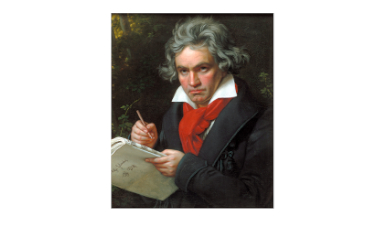
‘One of my favorite classical composers is Ludwig van Beethoven. While Bach wrote theological notes in the margins of his manuscripts, and his well-thumbed Bible also contained comments, Beethoven’s music is honest in its skepticism. There is power and passion in it, as well as a great deal of anger.
Beethoven rarely wrote church music, but, when he did, he gave it everything. His own assessment of his work suggests that he considered his Mass in D Minor (the Missa Solemnis) to be his greatest work. Following the liturgy of a Roman Catholic mass, in five sections, the work concludes with Agnus Dei – a liturgical prayer, sometimes used in certain Protestant churches. For example, the Church of England Prayer Book has this prayer, translated thus:
O Lamb of God, that takest away the sins of the world, have mercy upon us.
O Lamb of God, that takest away the sins of the world, grant us thy peace.
In this section, Beethoven keeps repeating the word miserere (“have mercy”) over and over again, as if he is saying he is unable to find mercy. After this, the music suddenly breaks into an angry fugue.
Beethoven spent much of his life in anger. He was angry with God for his various infirmities, especially his deafness, which was total by the time of the premier of Missa Solemnis.




 whatyareckon