‘China’s top diplomat Yang Jiechi warned the Biden administration not to cross Beijing’s “red line” in a half-hour speech on the evening of Feb. 1.
“The United States should stop interference in the affairs of Hong Kong, Tibet, and Xinjiang,” Yang said, calling the issues regarding the three regions China’s “internal affairs.” He made the remarks while speaking at a virtual event hosted by New York-based nonprofit the National Committee on U.S.-China Relations.
Yang added: “They constitute a red line that must not be crossed. Any trespassing would end up undermining China-U.S. relations and the United States’ own interests.”
What’s happening in Hong Kong with Jimmy Lai will soon be happening in other parts of the world! The CCP has long arms and now that Sleepy Joe is in charge only time will reveal how secure you really are!
‘Hong Kong Chief Executive Carrie Lam appointed three more national security law judges to hear the appeal challenging Hong Kong media mogul Jimmy Lai’s bail. The trial will now go ahead without any overseas non-permanent judge at the Court of Final Appeal.
The appeal will be heard by five judges, Chief Justice Andrew Cheung, Judges Roberto Ribeiro, Joseph Fok, Patrick Chan, and Frank Stock.
Cheung and Ribeiro were confirmed to be security law judges, and the Chief Executive’s Office told HKFP that Lam had also appointed Fok, Chan, and Stock as designated judges for security law cases on Wednesday.
Lai and eight other democrats – including Margaret Ng, Leung Kwok-hung and Martin Lee – had been charged for allegedly organising and participating in an unauthorised protest in August 2019.
Perry withdrew from the case following criticism from the UK, including from British Foreign Minister Dominic Raab. Critics also questioned the government’s plan to work around the coronavirus restrictions, as travellers from the UK are banned from entering the city.
If Biden is inaugurated on the 20th of January, 2021 we can say good bye forever to a free Hong Kong. China’s CCP cannot allow a truly free people to exist under their style of government.
‘Today 11 individuals were arrested in Hong Kong under the National Security Law for allegedly helping the 12 Hong Kong youths currently detained in Shenzhen flee Hong Kong.
The group of individuals arrests for “assisting criminals”, include 8 males and 3 females between the ages of 18-72. Among them is the lawyer and current District Councilor Wong Kwok-hung, independent musician Fok Long-chai, and a Ukrainian national.
A source within the National Security Department said that the 11 individuals were accused of sponsoring the fugitives’ attempt to abscond, with the level of funds offered by each of them ranging from a few thousand Hong Kong dollars to tens of thousands. They also are accused of providing “assistance such as introducing middle men to the fugitives, arranging shoreline pickups and providing hiding locations.”
Commenting on the arrests, Hong Kong Watch’s Chief Executive, Benedict Rogers said:
“Today has brought more arrests under the National Security Law and a further crackdown in Hong Kong. Increasingly it is clear that Beijing intends to use this draconian law as a blunt tool to crush dissent, where the hiring of a boat, the providing of accommodation, and the offering of free legal advice is now punishable to a minimum of ten years in prison.
This latest crackdown makes a mockery of previous claims that the draconian National Security Law would be used sparingly and be applied only to cases with a direct and imminent threat to security. The case of the 12 Hong Kong youths who languish in a jail in Shenzhen has never had anything to do with national security.
There is also reason to believe that the evidence against the 11 individuals arrested today has been extracted from the 12 Hong Kong youths detained in Shenzhen through mistreatment and even torture.
I have seen interviews with Jimmy Lai on Sky News Australia before he was arrested and he said he would be willing to die for Hong Kong’s freedom. Well, many politicians and well to do business people in America and Australia don’t seem to have the same love for their country as Jimmy does for Hong Kong. Jimmy Lai’s situation should disturb all of us who love liberty!
‘Hong Kong pro-democracy media tycoon Jimmy Lai has been charged under the territory’s controversial new national security law.
Mr Lai, 73, is accused of conspiring with foreign forces to endanger national security, and could face a lengthy jail term.
He is the most high-profile person charged under the new law.
Mr Lai founded the Apple Daily newspaper and is a fierce critic of the Beijing authorities.
Beijing has said the new security law will return stability to the territory after a year of unrest, but critics say it has silenced dissent.
Mr Lai also holds UK citizenship and a spokesman for PM Boris Johnson said on Friday that the UK remained “deeply concerned about the Hong Kong authorities’ focus on pursuing legal cases against pro-democracy figures like Jimmy Lai”.
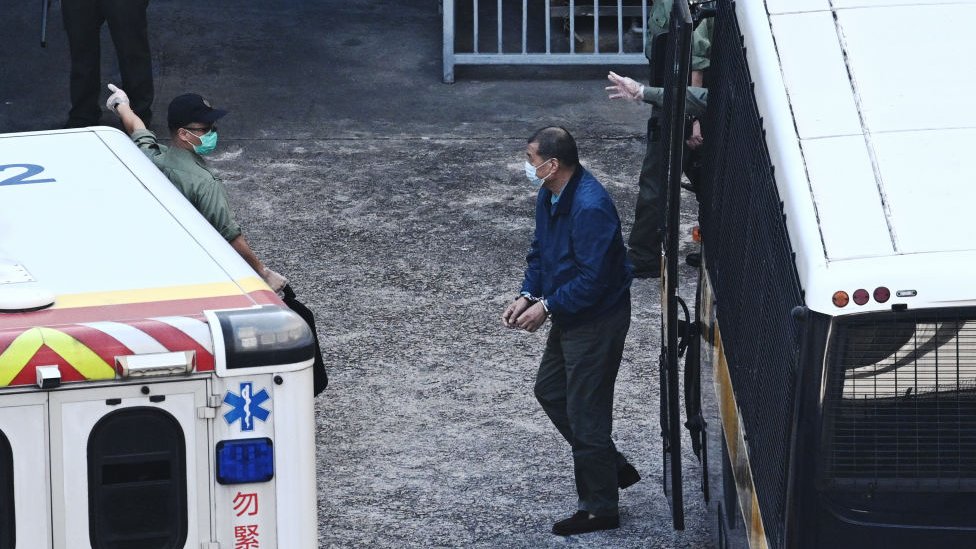
image captionMr Lai was seen in handcuffs after his arrest on 2 December
Ms Fan, a Chinese citizen, had been missing since Monday when she was seen being escorted from her apartment by plain-clothes security officials. Her detention was confirmed on Thursday. A Bloomberg spokesperson said they were “very concerned for her”.
In a separate case in Hong Kong earlier, teenage activist Tony Chung was convicted of desecrating the Chinese flag and unlawful assembly. He could now be facing up to five years in prison.
Chung, the leader of a now disbanded pro-democracy group, is also the first public political figure to be prosecuted under the national security law. He faces a charge of secession, which carries a maximum sentence of life in prison.
China has accelerated its crackdown on Hong Kong’s opposition since the law was imposed in June, with legislators disqualified and dozens of activists charged or investigated.
One of the city’s most prominent supporters of the pro-democracy movement, Mr Lai is estimated to be worth more than $1bn (£766m). Having made his initial fortune in the clothing industry, he later ventured into media and founded Next Digital.
Next Digital publishes Apple Daily, a well-read tabloid which is frequently critical of Hong Kong and mainland Chinese leadership.
In a local media landscape increasingly fearful of Beijing, Mr Lai is a persistent thorn for China – both through his publications and writing.media captionJimmy Lai told the BBC he would not give in to intimidation
It has seen him become a hero for many residents in Hong Kong but on the mainland he is viewed as a traitor who threatens Chinese national security.
Interviewed by the BBC before his arrest earlier in December, he said he would not give in to intimidation.
“If they can induce fear in you, that’s the cheapest way to control you and the most effective way and they know it. The only way to defeat the way of intimidation is to face up to fear and don’t let it frighten you.”
What is in the National Security Law?
A former British colony, Hong Kong was handed back to China in 1997 but under the “one country, two systems” principle.
It was supposed to guarantee certain freedoms for the territory – including freedom of assembly and speech, an independent judiciary and some democratic rights – which mainland China does not have.
But the National Security Law has reduced Hong Kong’s autonomy and made it easier to punish demonstrators.
The legislation introduced new crimes, including penalties of up to life in prison. Anyone found to have conspired with foreigners to provoke “hatred” of the Chinese government or the Hong Kong authorities may have committed a crime.https://emp.bbc.com/emp/SMPj/2.36.7/iframe.htmlmedia captionHong Kong security law: The BBC’s Stephen McDonell explains what it means, and what people there think
Trials can be held in secret and without a jury, and cases can be taken over by the mainland authorities. Mainland security personnel can legally operate in Hong Kong with impunity.
After the law was introduced, a number of pro-democracy groups disbanded out of fears for their safety.
The Chinese government defends the law, saying it will help return stability to the territory, which has been shaken by pro-democracy protests, and bring it more into line with the Chinese mainland.’https://www.bbc.com/news/world-asia-china-55271020
Even though Sleepy Joe and the other person have not yet won the WH Hong Kong’s legislature has been taken over by Beijing and if SJ and the other person do win the WH Taiwan is next.
News has it that ‘Hong Kong’s legislature has today moved one step closer to becoming a local branch of the Chinese Communist Party, after the disqualification of four of the most moderate, mainstream pro-democracy legislators resulted in the resignation en masse of every single pro-democracy legislator in protest.
For the first time since 1997 the body now has no pro-democracy voices, marking yet another nail in the coffin of ‘one country, two systems.’
The four legislators who were ousted by Beijing – Alvin Yeung, Kwok Ka-ki, Dennis Kwok and Kenneth Leung – are hardly radical pro-independence activists. As lawyers and accountants, for years they have represented the pro-democracy establishment, working within the system to protect the rule of law, due process and autonomy Hong Kong was promised in the Sino-British Joint Declaration.
The decision by the rest of the pro-democracy legislators to resign in protest at their ousting is courageous and right. It is a tragedy it has come to this, but they clearly could not continue to work in a legislature that is rapidly becoming a mouthpiece for the Chinese regime. In taking this dramatic step today, they have not walked out or abandoned their duties as representatives of the people – it is Beijing that has forced them out.
The removal of the four pro-democracy lawmakers took place after the Standing Committee of the National People’s Congress in Beijing ruled that:
‘lawmakers should be disqualified if they support Hong Kong independence, refuse to acknowledge China’s sovereignty, ask foreign forces to interfere in the city’s affairs or in other ways threaten national security.’
This arbitrary and vaguely-worded edict represents a grave violation of the city’s autonomy and Basic Law (the territory’s mini-constitution). In the same way that Beijing imposed the national security law on Hong Kong in July, this decree directly threatens due process and the rule of law in Hong Kong.
Every legislator who has ever talked to a foreign parliamentarian, journalist or activist could fall foul of Beijing’s new measure, which bans legislators from asking ‘foreign forces to interfere’ – a truly ridiculous situation. And now that there is no opposition in the legislature, judicial independence will likely be next in Beijing’s sights.
A week ago Xi Jinping’s regime published its 14th five-year plan, in which it proposes ‘comprehensive jurisdiction’ over Hong Kong by 2025. In other words, direct rule. The five-year plan emphasises the need to ‘implement the central government’s comprehensive jurisdiction over the two [cities], as well as their legal systems and enforcement mechanisms.’ In the end it only took Beijing a week to further the implementation process with the removal of Hong Kong’s parliamentarians.
The British government must lead the international community in a robust outcry against this move. Not only has Beijing torn up its international agreement with Britain – an act which calls into question its reliability when it comes to any other treaty it has signed – but it now directly threatens the viability of Hong Kong as an international financial and trading centre. Now that we are seeing lawyers and accountants being kicked out of the legislature at Beijing’s instruction today, what is the future for the city’s lawyers, accountants, and professionals? Those who uphold transparency or challenge corruption could simply disappear, as they do in the mainland.
In response, the Foreign Secretary Dominic Raab should establish an international group of like-minded allies to coordinate a global response to the emasculation of Hong Kong. That should include the imposition of targeted sanctions against officials in the Chinese and Hong Kong governments for breaches of international law. It should also include efforts at the United Nations, to establish a mechanism to monitor and report on human rights violations. And the UK should encourage others to offer a lifeboat rescue package, to offer those who now wish to flee Hong Kong a place of sanctuary.
Britain should lead, but the response should be multilateral. The free world must stand together. This is no longer only about Hong Kong – it is about freedom itself. A global response is more likely to have some effect on Beijing and a failure to stand together will mean Beijing will try to pick us off one by one.



 whatyareckon