
Fossils
All posts tagged Fossils
‘A 159-year-long debate has finally been resolved. It concerns the first fossil feather ever found.1 Did it belong to a member of the famous bird type Archaeopteryx or not? (Archaeopteryx, an extinct perching bird with fully formed flight feathers, is widely considered the ‘oldest’ bird fossil under evolutionary ‘dating’). The isolated feather is alleged to be 150 million years old, or Upper Jurassic. It was discovered in 1861 in the same Solnhofen Limestone deposit in Bavaria, Germany where the first Archaeopteryx skeleton was later found, also the same ‘age’.’ Whether you are a creationist or evolutionist you should read the rest of this article at https://creation.com/oldest-feather
Genesis 1:24 ¶ And God said, Let the earth bring forth the living creature after his kind, cattle, and creeping thing, and beast of the earth after his kind: and it was so.
25 And God made the beast of the earth after his kind, and cattle after their kind, and every thing that creepeth upon the earth after his kind: and God saw that it was good.
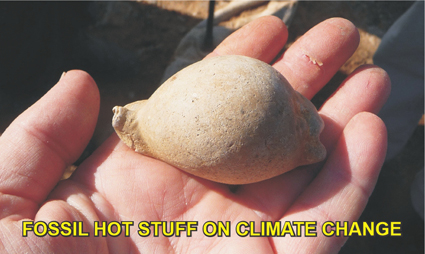
‘Phillip McGibbony found a fossil Cowrie shell (above) on our recent Victorian field trip. Today’s cowries live only in tropical and subtropical areas and Phillip’s fossil shell is evidence that the southern part of Australia was once much warmer. Politicians need to take much more notice of what the actual evidence is, instead of what green votes mean to them. Phillip has donated his find to Creation Research.’https://creationresearch.net/exciting-research/climate-change/hot-stuff-on-climate-change/
Prager U’s Will Witt asks others about the high cost of gas. https://www.prageru.com/video/why-are-gas-prices-so-high
RICH DIVERSITY OF FOSSILS FROM “THE ‘DEAD’ HEART OF AUSTRALIA”. A team of researchers in Australia have been studying a mass of exquisitely preserved fossils found in the Central Tablelands in the Australian state of New South Wales. The deposit contains a great variety of plants and animals, including insects, spiders, fish and a bird feather. The fossils are so well preserved that microscopic structures and soft tissues can be clearly seen. Scientists were also able to identify pollen grains on the insects, and the stomach contents of fish. According to Matthew McCurry, of the Australian Museum, who led the study, “Our analyses suggest that the fossils formed when iron-rich groundwaters drained into a billabong, and that a precipitation of iron minerals-encased organisms that were living in or fell into the water.”
The rich diversity of the fossils, including many rainforest plants indicate they lived in a warm, moist environment. McCurry commented: “The fossils we have found prove that the area was once a temperate, mesic rainforest and that life was rich and abundant here in the Central Tablelands, NSW.” The fossil site is dated as 16 million years old, putting it in the Miocene epoch, considered to be a time when Australia was starting to dry out, and the landscape was changing from widespread rainforest to scrubland and arid regions.
Sources: Science Alert and SciTech Daily 7 January 2022, ABC News 8 January 2022 Science Advances 7 January 2022, doi: 10.1126/sciadv.abm1406
ED. COM. The description “The ‘Dead’ Heart of Australia” comes from the headline in Science Alert and SciTech Daily. While this may inspire visions of scientists toiling in a lifeless desert in a remote area of outback Australia, the Central Tablelands is a farming and woodland region in the mountain range that runs parallel to the eastern seaboard. This region may not be lifeless, but it is no longer a rainforest. It has a temperate climate with frosty winters, and the areas that are not farmed are dry sclerophyll forest, consisting mainly of gum trees and scrubland. This fossil site, with its rich diversity of plants and animals, is a good reminder that climate change is real and Australia has dried out significantly, but it happened without any human industry.
For those who don’t speak Australian, a billabong is an oxbow lake. However, merely falling into a lake would never preserve the delicate structures and soft tissues found in these fossils. The exquisite preservation of these fossils could only happen if they were rapidly and deeply buried before any decay processes could destroy the delicate structures. Such fine preservation and the huge variety of organisms, including fish, land animals and land plants, fits well however with it being a washed in deposit, where floodwaters have washed across the landscape collecting and mixing whatever was living there and then dumping it quickly.
PS – Climate change has been happening ever since God warned Noah that there would be hot times and cold times as long as the earth endured. See Genesis 8:22.’https://mailchi.mp/creationresearch.net/creation-research-email-update-9th-february-2022?e=ce21bf0337
‘DINO SKIN FOUND BUT NO FEATHERS, according to University of New England News 10 September 2021, also reported in Science Alert and SciTech Daily 13 September 2021, and Cretaceous Research, published online 13 August 2021 doi:10.1016/j.cretres.2021.104994. Palaeontologists Phil Bell of University of New England (UNE) Australia, and Christophe Hendrickx of Unidad Ejecutora Lillo in San Miguel de Tucumán, Argentina have studied fossilised skin from a large theropod dinosaur named Carnotaurus sastrei, which included six pieces from the shoulder, chest, tail and neck The skin was covered in scales of various sizes and shapes. Christophe Hendrickx described them as “large and randomly distributed conical studs surrounded by a network of small elongated, diamond-shaped or subcircular scales”. The cone shaped scales varied from 2 to 6.5cm in diameter. Researchers suggest the knobbly skin scales would have been useful for thermoregulation, as they gave the skin a large surface area for losing heat and preventing overheating. According to UNE News the skin “was entirely scaly, with no evidence of feathers”.
Links: Science Alert, SciTech Daily, UNE
ED. COM. These findings fit with all known specimens of actual fossilised dinosaur skin. They are covered in scales which vary in size, shape and thickness, but are typical of scales found in living reptiles. The suggestion that thick raised scales were used for thermoregulation is a good one, as living reptiles use scales this way. Reptiles are “cold blooded”, so thick knobby scales can be used to absorb heat when the animal needs to raise its body temperature and lose heat when they get too hot. Therefore, the scales are an example of good design, well integrated into the whole body function.
Once again, evolutionists are disappointed there are no feathers. (See our previous report Featherless Dinosaur Surprise here.) We predict that no dino feathers will be found, since all feathers are found in the fossil record, are either isolated specimens, unattached to anything, or they are attached to a fossil bird. There are some feathered creatures in the fossil record (e.g. Archaeopteryx, Microraptor) that are different to living birds, but these were not dinosaurs. They are now extinct and a reminder there was once a greater variety of birds than exists now – a sign that the world is going downhill and losing complexity, not evolving upwards.’https://mailchi.mp/creationresearch.net/enews-20210929?e=ce21bf0337 https://creationresearch.net/
Genesis 7:21-23 “And all flesh died that moved upon the earth, both of fowl, and of cattle, and of beast, and of every creeping thing that creepeth upon the earth, and every man: All in whose nostrils was the breath of life, of all that was in the dry land, died. And every living substance was destroyed which was upon the face of the ground, both man, and cattle, and the creeping things, and the fowl of the heaven; and they were destroyed from the earth: and Noah only remained alive, and they that were with him in the ark.”
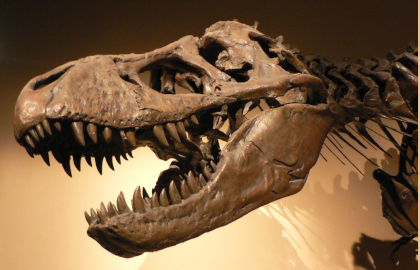
‘Previous writers and presenters of Creation Moments have often talked about fossils. But it is often useful to go over familiar ground again, especially if it is of foundational importance. Evolutionists tell us that fossils are evidence of evolutionary change. Nothing could be further from the truth. As creationists, we find that fossils make much more sense with a biblical explanation.
Fossils are dead. Since there was no death in the world until Adam’s sin, fossils cannot predate that sin. So, when humans were created, there were no fossils. Fossils are a worldwide event, and most of them appear to be of creatures that died rapidly and catastrophically under water, being covered with water-borne sediment. Such a formation is best understood as happening because of the worldwide Flood.
Some of the larger fossils – such as dinosaurs – are found buried in contortions, which looks like the last throes of death; this is consistent with sudden death caused by the Flood. Most such fossils are also found in assemblages, or bone jumbles. We tend to forget these last two facts when we see careful reconstructions of standing dinosaurs in museums. Many fossils closely resemble modern, surviving creatures, so that the fossil record illustrates not change, but stasis or – in the case of those creatures we do not find today – extinction.
Far from being a problem for creationists, fossils are our allies, and we can be confident that a biblical explanation for their formation is the most effective.’https://creationmoments.com/sermons/fossils-and-the-flood/?mc_cid=2e116164ee&mc_eid=00c1dcff3c


