Matthew 16:2 “He answered and said unto them, When it is evening, ye say, [It will be] fair weather: for the sky is red.”
‘One good test of whether a theory is scientific is whether the theory can accurately predict new and surprising findings. If you have a barometer, you may do this all the time. The sky may be clear, but the barometer is falling fast. No matter how nice the weather looks, you know that rain is likely.
Creation scientists believe that humans have been on Earth in their present so-called “modern” form ever since the model first came out. Since that was on day six of creation, humans have been on Earth as long as any creature. So creation scientists have predicted that as we find more fossils, we will find fossils of “modern man” in older and older rocks. Such a discovery would shock the evolutionists!
Evolutionists say that, according to their theory, “modern” humans have been around for only a small part of the world’s history. In their inflated estimate, they say we have been here for only 35,000 years. Evolutionists received a surprise when that age recently had to be almost tripled. A new discovery pushed the date for “modern” humans back 92,000 years. As a result, evolutionists had to admit that we turn out to be older than some of the creatures from which we were supposed to have evolved!
Of course, one has to take the hot air out of those evolutionary dates. They can be adjusted down to a number that fits the biblical calendar. However, the scientific prediction made by creation scientists has proven out. And creationists are predicting that the history of “modern” humanity will continue to be pushed back further and further!
Psalm 51:11 “Cast me not away from thy presence; and take not thy holy spirit from me.”
‘Even though many frogs live much of their lives out of the water, they need water to reproduce. This can be a problem since some frogs live in trees and some even live in the desert!
For a tree frog, the trip from the treetops to a nearby pool is a long and dangerous journey. However, the Creator cares about all of His creatures. The leaves of the bromeliad that grows in the branches of many trees in the tropical forest form a private pool far above the ground. As a result, mama frog can raise her young without ever leaving the treetops!
The desert would seem to offer an even greater challenge for a frog. However, since it pleased the Creator to place frogs in the desert – maybe to challenge the evolutionists – He has also provided for their needs. It may rain only once every two years in the deserts of central Australia. When it does rain, the water-holding frogs emerge from their underground hideaways to lay their eggs in the puddles. Before the puddles disappear, not only do the eggs hatch, but the young grow and develop into frogs that are able to store water until the next rain. As the desert again takes over, the frogs dig themselves back into the ground and go into suspended animation until the next rains come. A year or two later, the new generation will emerge after the next rain to raise their young.
‘The existence of humans suggests that, at some point, there must have been a first human. Neither evolutionists nor creationists deny this. However, creationists believe that Adam (Genesis 1–2) was the first human. But whether the first human was Adam or some unnamed, recently-evolved person, where did that person learn to speak?
Evidence suggests that humans do not learn to speak unless they are taught by someone who already knows how to speak. Additionally, the archaeological record indicates that fully-developed languages have been in existence as long as humans have been (Elgin 1973, 44). For these reasons, Curtis, in a 1990 article, argues that a personal creator was responsible for the existence of the first human.
Linguistic Evidence
Linguistic research suggests that languages have not evolved from a prehistoric development period (Eglin 1973, 44). Rather, languages have always existed with the same communication potential as they currently possess. In fact, it is possible that they even held greater communication potential in the past.
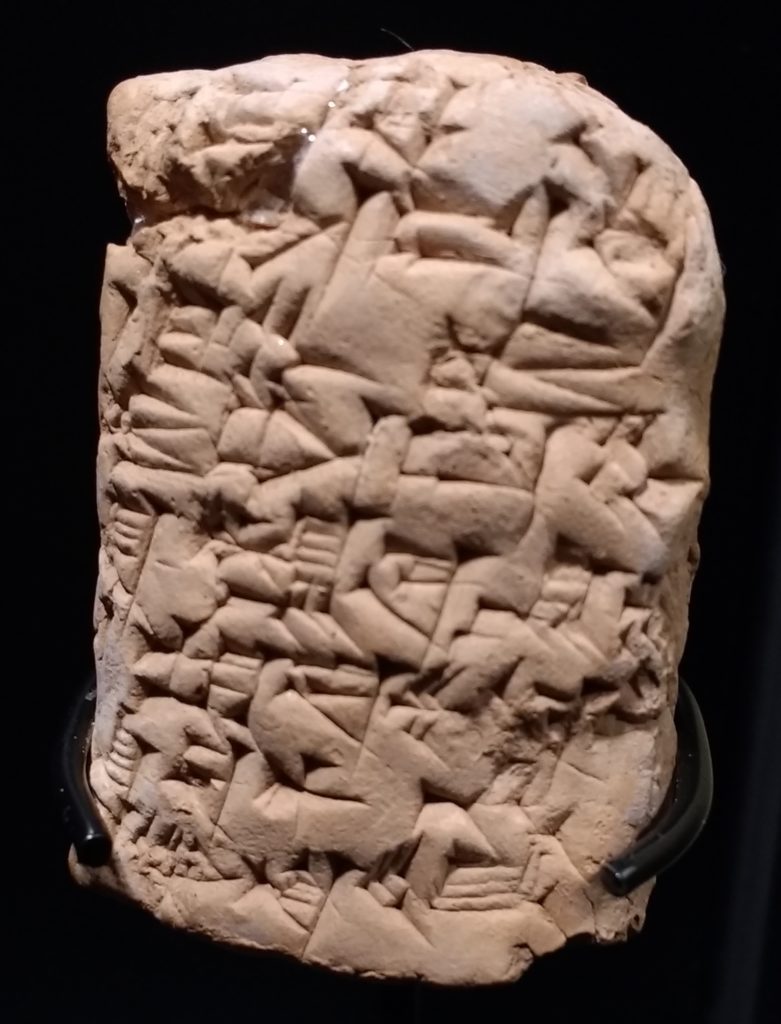
An example of an inscribed clay tablet
Archaeological Evidence
The archaeological finds from the past 100 years of excavations have demonstrated that written language appears well developed in the earliest records of civilization. For example, the Ebla tablets date to about 2000 BC. These tablets contain writing in a fully-developed, phonetic language.
How Do People Learn How to Speak?
Some Darwinian anthropologists have suggested that if, in the process of evolution, there was a transition from animal to man, this transition would have included the acquisition of language. However, one of these anthropologists, Humbolt, realized that man cannot speak without already being human. For him, this created an unsolvable problem regarding the origin of speech (Lyell 1873).
Another problem with determining the origin of speech from an evolutionary perspective is that in so-called primitive cultures, the languages tend to be more complex than in more advanced cultures. Furthermore, animals with the physical capability to use logical speech do not do so. Studies have shown that animals that respond to commands do so based on vocal tones rather than the spoken words. Thus, all attempts to solve the evolutionary origin of language have failed.
Every child that learns how to speak learns from someone who already knows how to speak. There do not seem to be any exceptions to this rule. Feral children who grow up without contact with spoken language did not learn to speak until they came into contact with speaking individuals. Once they had heard speech, they were able to learn how to speak (Tomb 1925).
What Does this All Mean?
Since multiple languages appear to have existed in fully developed forms in the earliest known civilizations, it appears that the languages do not have one common root. Rather, each language appeared independently of the others.
This evidence aligns well with the biblical account. From the creation of Adam until the Tower of Babel, there was only one language on earth (Genesis 11:1). Curtis suggests that God taught the first man, Adam, to speak. It is clear that Adam spoke a well-developed language because he was able to name the animals (Genesis 2:19). From that point on, each generation learned to speak from the previous one.
Later, when God confused the languages at the Tower of Babel (Genesis 11:7), He miraculously created a number of additional unrelated, fully-formed languages. The pattern of language learning continued. Each person learned to speak from the previous generation.
Conclusion
The scientific evidence obtained through linguistic and archaeological studies suggest that the first human who learned how to speak must have learned from someone who already possessed the capability of speech. This first person must have learned from someone of a higher order than humans. This correlates well with the biblical account of God’s creation of Adam. Adam must have received the ability and knowledge to speak from God himself. The study of language demonstrates that there must be a creator God. No human can speak a language unless that person has been taught. Furthermore, languages have not arisen from some lesser forms of communication. They appeared early in history, fully developed. The languages present today do not share a common root, suggesting that they appeared as separate, well-developed languages. This accords well with the account of the Tower of Babel.
References
Curtis, William M. 1990. “Human Language Demands a Creator.” The Proceedings of the International Conference on Creationism 2:1, 69–72.
Elgin, Suzette H. 1973. What is Linguistics? Englewood Cliffs: Prentice-Hall Inc.
Isaiah 55:8-9 “‘For My thoughts are not your thoughts, nor are your ways My ways,’ says the Lord. ‘For as the heavens are higher than the earth, so are my ways higher than your ways, and my thoughts than your thoughts.’”
‘Our Creator’s work reflects some of His incredible inventive creativity. In Matthew 6:30 Jesus reminds us how God provides for all the needs of all His creatures. Each creature is perfectly suited for its life, even if that requires special creativity from God.
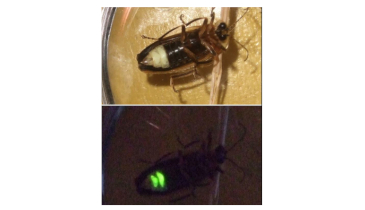
Many of the creatures that live in the deepest and darkest parts of the sea are equipped with lights. One has a very bright headlamp to light its way. Others have lights on their tails, jaws or sides. The light they produce, as the light produced by the firefly, is a cold light. The light is generated when chemicals manufactured by the creatures are mixed together.
Or consider the small bird that has an “engine” powerful enough to allow it to fly for 10,000 or more miles. The construction of the bird’s heart differs from yours and mine in important ways. However, we couldn’t get by with the bird’s heart just as it couldn’t get by with ours.
While it seems strange to think of the penguin as a bird that flies under water, that’s exactly what it does. The penguin can reach speeds of 30 miles per hour underwater, as fast as the fastest marine mammal, the dolphin.
1 John 4:19 “We love Him because He first loved us.”
‘Imagine a huge living creature covering about one square mile and made up of almost a third of a billion cells. Imagine each of those living cells being able to move about independently of the others.
No, it’s not the plot of a new science fiction movie. Some scientists have suggested that ant colonies may be thought of as one large living organism. They suggest this because of the way individual members within ant colonies behave. Ant colonies have many kinds of members, each with its own specific task. The soldier ants in a colony have extra large heads and heavy-duty jaws for fighting. Other ants are concerned only about finding and returning food. Still other workers do nothing but process and store food.
Within the colony another caste of ants does nothing but tend the eggs. Others prepare the food for the larvae and deliver it to other specialized ants who do nothing but feed the next generation.
If this sounds complex, imagine the largest known ant colony. This Japanese ant colony has an estimated 306 million worker ants, and more than a million queens. The colony occupies 45,000 interconnected underground nests that range over about a square mile!









 whatyareckon