
Age
All posts tagged Age
Genesis 2:16-17
“And the LORD God commanded the man, saying, Of every tree of the garden thou mayest freely eat: But of the tree of the knowledge of good and evil, thou shalt not eat of it: for in the day that thou eatest thereof thou shalt surely die.”
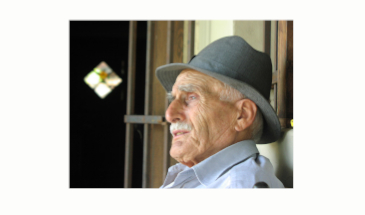
‘Freddie Mercury posed the rhetorical question “Who wants to live forever?”, ending with the line “Who waits forever anyway?” But scientist and author David Sinclair claims to have discovered why we age and how we could undo that aging.
In his 2019 book, Lifespan: Why We Age and Why We Don’t Have To, Sinclair says that it is a family of proteins called sirtuins which cause us to age. These proteins ought to repair the DNA, but they malfunction, leading to decay of the necessary portions of our DNA. Therefore, Sinclair claims that in the future it might be possible to reverse this aging process.
The Bible has an entirely different account of why we age. It is entirely possible that Sinclair could be right over the chemical mechanism for aging, but that is not why we age. God gave Adam, and therefore Eve as well, a commandment not to eat of the fruit of the tree of the knowledge of good and evil, and told them that breaking that command would start the process of death. So aging and death are caused by sin. Aging is actually a mercy from God. Immortality, while possessing sin, with all its ramifications, would be a dreadful ordeal – a nightmare scenario. But one day, God will undo death and, therefore, undo aging – not by chemical process but by resurrection to life, for those who have trusted in His salvation, or resurrection to everlasting punishment for those who would not.’https://creationmoments.com/sermons/why-do-we-age/?utm_source=rss&utm_medium=rss&utm_campaign=why-do-we-age&mc_cid=05b2f77057&mc_eid=00c1dcff3c
“Now also when I am old and greyheaded, O God, forsake me not; until I have shewed thy strength unto this generation, and thy power to every one that is to come.” (Psalm 71:18)
‘One tends to grow resentful against the limitations and increasing infirmities associated with aging, even complaining to God and others about growing old—at least until one considers the alternative! We need to remember that as long as the Lord preserves our lives, He has some ministry for us to perform for “this generation” and “to every one that is to come.”
The Scriptures abound with promises of blessing in old age, so growing old should be an occasion for rejoicing and deepened commitment to whatever the Lord enables one to do. “The righteous shall flourish like the palm tree:…Those that be planted in the house of the LORD shall flourish in the courts of our God. They shall still bring forth fruit in old age” (Psalm 92:12-14). But if there develops a tendency to grow spiritually cold with age, the admonition of Paul is appropriate. “Aged men [should] be sober, grave, temperate, sound in faith, in charity, in patience. The aged women likewise, that they be in behaviour as becometh holiness,…teachers of good things” (Titus 2:2-3).
Thus, the heartfelt prayer of the psalmist in our text is still appropriate today, for all who will, sooner than they think, enter the time of old age. Note also the following prayer: “Cast me not off in the time of old age; forsake me not when my strength faileth” (Psalm 71:9). That God will answer such a prayer, offered in faith and sincerity, was affirmed by David when he said: “I have been young, and now am old; yet have I not seen the righteous forsaken, nor his seed begging bread” (Psalm 37:25). The time of old age can be a time of happy harvest if we have sowed the seeds of good fruit.’ https://www.icr.org/article/13129/?utm_source=phplist9748&utm_medium=email&utm_content=HTML&utm_campaign=December+28+-+The+Time+of+Old+Age
‘In December 2019, the journal Expert Review of Proteomics published a paper I authored with Stephen Taylor titled “Proteomes of the past: the pursuit of proteins in paleontology.”1 The article features a table that lists 85 technical reports of still-existing biomaterial—mostly proteins—discovered inside fossils.
Can proteins last millions of years? Not according to decay rate measurements. Five incriminating trends emerged from these 85 secular reports. Our review sharpens the tension between how short a time biochemicals last and the supposed age of the fossils that contain them. We wrote:
Collagen decay rate experimental results build a temporal expectation that restricts bone collagen to archeological time frames, yet many reports of collagen and other proteins in older-than-archeological samples have sprinkled the paleontological literature for decades. Tension between the expectation of lability [susceptibility to chemical breakdown] and observations of longevity has fueled steady debate over the veracity of original biochemistry remnants in fossils.1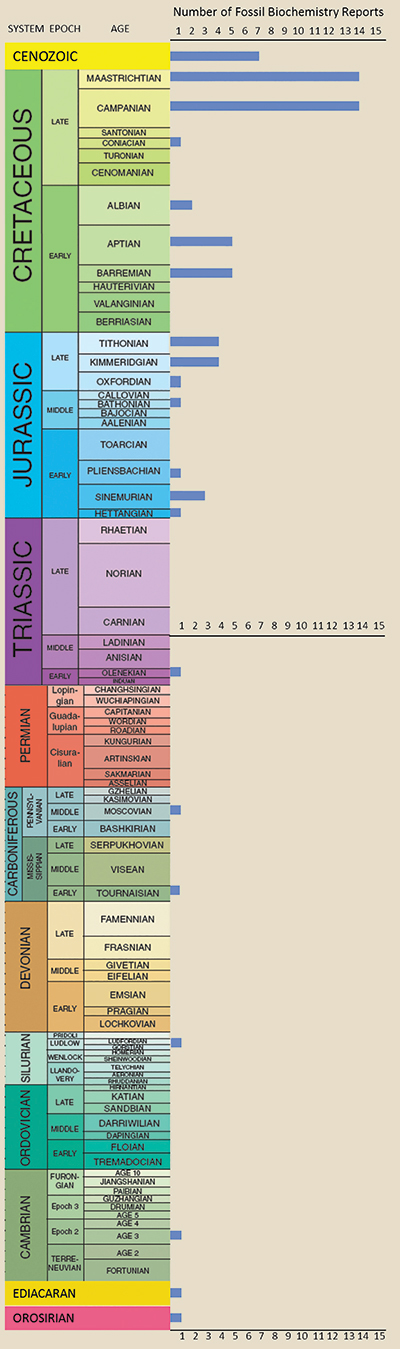 Image credit: Thomas, B. and S. Taylor. 2019. Proteomes of the past: the pursuit of proteins in paleontology. Expert Review of Proteomics. 16 (11-12): 881-895.
The 85 reports included descriptions of original skin, connective tissues, flexible and branching blood vessels, bone cells, and probable blood cells. Original biochemistry includes tattered but still-detectable osteocalcin, hemoglobin, elastin, laminin, ovalbumin, PHEX, histone, keratin, chitin, possible DNA, collagen, and collagen sequence—all inside fossil bones.
The first trend we found noted biomaterials from all kinds of different fossilized animals, not just dinosaurs.2 Thus, researchers need not restrict their searches for fossil biomaterials to any specific plant or animal type.
The second trend from all of these reports, which span over a half century of exploration, found no better preservation in one ancient environment over another. Whether living in air, oceans, lakes, swamps, or forests before they were fossilized, fossils could still contain biomaterials.3
Third, a bar graph of the number of relevant publications per year showed an increased interest in this field within the last two decades. Additionally, Figure 5 from our paper plots discoveries onto a world map to show that biomaterials in fossils occur virtually worldwide. We predict that future investigations could discover original biomaterials wherever fossils are found.
The fifth and final trend presents the biggest obstacle for those who insist that rock layers represent vast eons. We found reports of original biomaterials from seven of the 10 standard geologic systems plus one report each from the Precambrian and Ediacaran layers—the bottommost sediments on Earth. As one of our anonymous peer reviewers protested in response to these findings, having biomaterials last over 70 million years—let alone 500 million—is simply fantasy.
Proteins decay relentlessly and relatively fast. Yet protein discoveries keep piling up. Thus, “it is likely that contention will persist.”1 Our secular colleagues now have a sharper look at the vast depth and wide spread of young-looking biomaterials from fossils.
References
- Thomas, B. and S. Taylor. 2019. Proteomes of the past: the pursuit of proteins in paleontology. Expert Review of Proteomics. 16 (11-12): 881-895.
- Tissues or biochemistry were reported in dinosaur, eggshell, turtle, bird, marine worm casings, sponge, clam, mosasaur, tree, insect, arachnid, frog, salamander, and crinoid fossils.
- “Fossilized” does not necessarily mean “mineralized,” as this list clearly shows. Fossils include remains of once-living things that were totally replaced by minerals, partly replaced by minerals, mineralized only in tiny pore spaces, or not mineralized at all—like natural mummies.’https://www.icr.org/article/soft-tissue-fossils-reveal-incriminating-trends/?utm_source=phplist9203&utm_medium=email&utm_content=HTML&utm_campaign=Free+Downloads%2C+Soft+Tissue+Fossils%2C+New+Book%2C+and+More%21
Recently my journey through this life reached a milestone. That milestone is exactly what Moses was speaking of in Psalm 90: 10. However, no matter what age you may find yourself the following is worth reading, considering and then acting upon.
“The days of our years are threescore years and ten; and if by reason of strength they be fourscore years, yet is their strength labor and sorrow; for it is soon cut off, and we fly away.” (Psalm 90:10)
When Moses wrote these words near the end of his life, he was 120 years old (Deuteronomy 34:7), but all the rest of the people of Israel (except Caleb and Joshua) who had been over 20 at the beginning of the 40-year wilderness wanderings, had died there (Numbers 14:28-34), and so there were no others over 60 years old.
In former days men had lived much longer. Adam died at 930 and Noah at 950, but then Shem only lived to 600, and Abraham died at 175 years of age. Thus, the normal lifespan by Moses’ time was down to 70 or 80 years, and he prophesied that this would continue.
It is remarkable that, with all the increase in medical knowledge, this figure has stayed about the same, and there seems to be little the gerontologists can do to increase it.
Furthermore, the latter years are largely “labor and sorrow,” just as God told Adam when his sin brought God’s curse on the earth (Genesis 3:17-20). No matter how much we try to prolong our lives, we are “soon cut off.”
But then, we “fly away”! The soul/spirit complex of the Christian believer, released from its weary body, flies away to be with the Lord. Those left behind may sorrow, but “to depart, and to be with Christ . . . is far better.” The Christian may confidently say with Paul: “For to me to live is Christ, and to die is gain” (Philippians 1:23, 21). In the meantime, as our time grows shorter, it is more important than ever that we “walk in wisdom toward them that are without, redeeming the time” (Colossians 4:5). “So teach us to number our days,” prayed Moses (and so should we), “that we may apply our hearts unto wisdom” (Psalm 90:12).”


 whatyareckon