My personal opinion of the whole Jerry Falwell Jr. thing is that he is a man who has no self control and too much money and seemingly too much time on his hands. Whether he is a true born again believer or not is a question that comes about because his life shows that he is not. If he is saved he is truly snubbing his nose at the Lord, certainly grieving the Holy Spirit that dwells within every individual believer and is showing total disregard to other believers. It also seems he could care less for those students who are seeking to get a ‘Christian’ education at the school which his father literally put his life into! The following is another piece by Julie Roys on the debauchery of Jerry Falwell Jr., family and employees.
‘For the past three weeks, the media has largely ignored the video Jerry Falwell Jr. posted from his now infamous “costume party,” and instead has focused on the racy picture of Falwell and his wife’s assistant with their pants unzipped. Yet the video, showing members of Falwell’s family—most of whom are employed by Liberty University, one at a very high level—may be even more shocking.
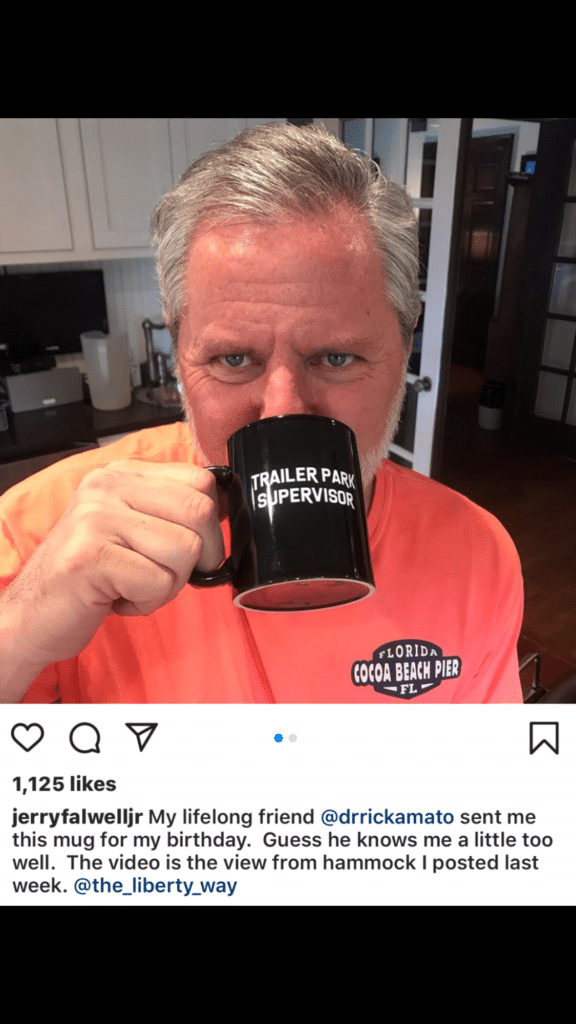
The video shows multiple Falwell family members dressed as characters from an extremely raunchy Canadian TV series called Trailer Park Boys (TPB). The show is riddled with profanity and drug use. And it features multiple forms of immorality—from group sex and pornography to homosexual affairs and prostitution.
This debauchery isn’t occasional. It’s frequent, as a scan through the episode titles show. Here are just a few. WARNING: they’re vile: “F**king’ F**ked Out of Our F**kin’ Minds’”; “Wh*re-aggedon”; “I Banged Lucy and Knocked Her Up… No Big Deal”; and “You Want the Lot Fees, Suck Them Out of the Tip of My C*ck.”
Yet the Falwells appear to be not merely casual watchers of TPB, but part of the show’s loyal cult following. The costumes donned by Falwell and his wife, his sons, daughter, daughters-in-law, and close assistants span several seasons of the program and reveal an intimate knowledge of the show.’ The rest of this article details the sordid shenanigans Falwell Jr. and others have gotten up to. The rest of the article may be read at https://julieroys.com/video-raunchy-falwell/?mc_cid=21cef7cb2b&mc_eid=b13d34ad49
In my own opinion (which doesn’t carry much weight with some) Liberty University has never been what you might call a Biblically separated Baptist school of higher education. However, as far as I know Jerry Falwell Sr. never had a stain on his public reputation BUT that cannot be said for his son Jerry Falwell Jr. The following is from https://save71.org/ which is comprised of Liberty alumni which have been for some time advocating for reform at Liberty. They say ‘In the wake of Falwell’s resignation, the focus of Save71 is not on the salacious details of the most recent reporting on the Falwell family. Our focus is on improving our university, and for improvement to be possible, we must look beyond Falwell’s personal behavior and confront the failure of the university’s derelict Board of Trustees. Dramatic changes are necessary.
For years, Liberty’s Board of Trustees allowed Falwell to frequently, publicly harm Liberty’s reputation. The Board permitted Falwell and his family to run the school like a personal business at the expense of its faculty and students. Board members sat by while Falwell’s words and deeds disgraced the name of the Lord again and again.
The Board of Trustees is not a legitimate governing body. For years, Board meetings have been infrequent, brief, and filled with propaganda from Falwell and his staff. While some of its members, like Acting Chair Allen McFarland, take an active role at the university, many others do not. The Board is not qualified to determine who is best fit to lead Liberty, and its members should humbly recognize that.
After accepting Falwell’s permanent resignation, four things need to happen for Liberty to move in a positive direction. First, the Board of Trustees must permanently remove all the beneficiaries of Falwell’s inappropriate nepotism. Second, the Board should hire independent legal counsel to investigate the claims of financial corruption documented in previous reporting. Third, SACS, Liberty’s accreditor, should open an investigation into Liberty to determine whether its Board and executive leadership meet SACS’s principles of accreditation.’https://save71.org/
Where did Jerry Falwell Jr. go wrong? He had a prominent position that paid very well and a certain prestige among evangelical Christians. Falwell Jr. had what many would view as the ‘good life’. However, as Julie Roys’ writes ‘Suspended Liberty University President Jerry Falwell, Jr., released a statement late last night to Washington Examiner columnist Paul Bedard, divulging that his wife had an affair with a young pool attendant the couple had befriended eight years ago.
Falwell said the “inappropriate personal relationship” was short-lived and that he and his wife “forgave each other.” But Falwell added that the affair was “very upsetting,” caused him to lose 80 pounds, “and people who saw me regularly thought that I was physically unwell.”
Falwell claimed that the young man— identified in multiple news reports as Giancarlo Granda, or the “pool boy”—also tried to extort money from the couple and Liberty University. Falwell added that recently Granda had stepped up his “threats to share more outrageous and fabricate(d) claims about us.” Falwell said he and his wife “decided the only way to stop this predatory behavior is to go public.”
The questionable relationship between the Falwells and Granda first surfaced last year. That’s when Trump’s former lawyer, Michael Cohen, told comedian Tom Arnold that he had buried racy “personal” photographs of the Falwells that involved the “pool boy.”
‘Earlier Monday, Reuters published a story, saying Falwell’s onetime business partner, Giancarlo Granda, a former pool attendant at the Fontainebleau Miami Beach hotel had a six-year relationship that involved him having sex with Becki Falwell while Jerry Falwell looked on.
“Becki and I developed an intimate relationship and Jerry enjoyed watching from the corner of the room,” Granda said in the Reuters story.
Evolution is a teaching from the pit of Hell! The theory of evolution is a fairy tale from Satan’s book on how to miss Heaven and go to Hell. The following is the first part of an article concerning evolutionary belief and ‘…the horrific and inhumane treatment of Ota Benga, a young African man who was taken from Congo in 1904 by noted African explorer and former slave trader Samuel Verner. Samuel Verner was known for his belief in evolution and for his support of white supremacist ideals. On his maiden voyage onboard the Roquelle from Antwerp to Congo, Verner was surprised that dark-skinned individuals were allowed to dine together with Caucasian shipmates. In a letter to his mother, he lamented that, “the helplessness of that race is simply appalling.” So from the very beginning of his journey to the West, Ota found himself strongly influenced by racist evolutionists.
Ota was first displayed as an ‘emblematic savage’ in the anthropology wing at the 1904 St Louis World’s Fair with other pygmies. He was eventually presented by Verner to the Bronx Zoo director, William Hornaday who came up with the idea of using Ota Benga to ‘educate’ the public about human evolution. At this time Ota Benga was just twenty-three years old. His height was only 1.5 metres (4 feet 11 eleven inches) and he only weighed 46.7 kg (103 lb). Ota Benga, which meant ‘friend’ in his native language, was often thought to be just a boy, but he was actually a twice-married father. His first wife and two children were murdered by white colonists, and his second spouse died from a poisonous snake bite.
Ota Benga became a sensation, drawing large crowds to the Zoo including over 40,000 on Sunday, 16 September 1906. Despite criticism, particularly from some church leaders at the time, Dr Hornaday insisted that he was merely offering an ‘intriguing exhibit’ for the public’s education and:
… apparently saw no difference between a wild beast and the little black man; [and] for the first time in any American zoo, a human being was displayed in a cage. Benga was given cage-mates to keep him company in his captivity—a parrot and an orang-utan named Dohong.
Nevertheless, Hornaday’s racist Darwinian ideas were clear elsewhere in his writings where he described Ota Benga as:
“… a genuine African pigmy, belonging to the subrace commonly miscalled ‘the Dwarfs.’”
The other co-founder of the Bronx Zoo was Henry Osborn. Henry Osborn was regarded as the leading evolutionist of his day, and is famed for the discovery of many dinosaurs, including the T. rex. Like Hornaday, Henry Osborn was highly racist as a result of his belief in evolution. For example, before Madison Grant (who was also influential in the founding of the Bronx Zoo) wrote his racist book, On the Passing of a Great Race, Grant shared his transcript with Osborn who made many suggestions. In the preface to the fourth edition Osborn wrote:
[I]n no other human stock which has come to this country is there displayed the unanimity of heart, mind and action which is now being displayed by the descendants of the blue-eyed, fair-haired peoples of the north of Europe. If I were asked: “What is the greatest danger which threatens the American republic to-day? I would certainly reply: The gradual dying out among our people of those hereditary traits through which the principles of our religious, political and social foundations were laid down and their insidious replacement by traits of less noble character.”
Grant’s book, as we know, was largely influential on Adolf Hitler. Hitler called the book, ‘his bible’ for it advocated a rigid system of selection through the elimination of those who are weak or unfit.
Public Libraries here in Australia exist because people pay taxes. Now, if some of those people do not agree with something their local library is doing what is their recourse? Well, in Brisbane, Queensland a petition was made against Brisbane public libraries having Drag Queen story time. Here is how the Brisbane City Council responded.
Residents draw to the attention of Council and the Lord Mayor the controversial and divisive practice of hosting drag queen story time in our public libraries. The appropriateness of Drag Queen entertainment for children when a person, usually male, imitates and exaggerates female gender signifiers and gender roles for entertainment purposes, is highly contested and should not be a tax payer funded activity for many reasons, including: 1.The practice is highly offensive to females 2. The sexual nature of drag queen entertainment is inappropriate for children 3. Telling our kids that trans is great is highly controversial. Medical experts warn of the danger of confusing children about their biological gender when the effects of puberty blockers, cross sex hormones and surgery are known to be harmful. The use of our public libraries for such events is a divisive practice rather than inclusive.
Your petitioners therefore request that our public libraries no longer be used for drag queen story times.
Council response
Council’s libraries are welcoming, inclusive community hubs that have a range of events that reflect and support Brisbane’s diverse communities. Every family is different, and Council acknowledges this fact and celebrates our different cultures, race, sexuality, genders, and religions.
Children’s Storytime sessions provide an opportunity for the development of reading, literacy and learning skills through interactive and engaging sessions.
Drag Queen Storytime events are held in conjunction with Rainbow Families Queensland, a community organisation that provides support to families from the LGBTIQ+ community. Events are presented by performers who hold appropriate Blue Card registration. As with all library events, all children attending events are required to be accompanied by a parent or carer.
Given that all families are different, parents and carers will have different views on what activities are suitable for their own children to participate in. Council respects the decisions of parents and carers to determine which activities are suitable for their children to participate in, and therefore their decision to attend library events. Council continues to ensure that parents and carers accompany their children at any library events.
Drag Queen Storytime is one of hundreds of different events held in Council libraries each year that foster a diverse and inclusive city. Council remains committed to its values of inclusion, tolerance and diversity and will continue to offer Drag Queen Storytime in libraries as part of the range of events offered in response to community needs.’https://www.epetitions.brisbane.qld.gov.au/petition/view/pid/810
Our Internet has been down for almost a week so that is the main reason you have not heard from me. Well, we are back up and running. Now, this article by Don Boys just might be a little controversial to some, however, it will make you think; I hope!
‘Is it right to do one monstrous wrong in order to produce a world-changing positive impact on all deprived, desperate, deformed, diseased, and dying people of the world? The Russian novelist Fyodor Dostoyevsky, in perhaps the world’s greatest novel The Brothers Karamazov, seeks to answer that question.
The character Ivan Karamazov, a flaming atheist, blames God for permitting the innocent to suffer. (Don’t they all?) Then Ivan asks his brother Alyosha, a professed believer, if he would do a bad act if it resulted in the eternal happiness of mankind. His required act would be to torture an innocent child after which this eternal happiness would come into existence.
Ivan asks, “Would you consent to be the architect under those conditions? Tell me honestly!”
“No, I wouldn’t agree,” said Alyosha quietly.
Neither would I. The basic premise doing evil that good may come of it is flawed.
It is tempting to do one act of cruelty that would give sight to every blind person, permit the crippled to walk, and eliminate all deadly diseases in the world. However, my refusal would not be a lack of concern for others but because of personal honor, responsibility, and accountability. Every person on earth must give an account for his or her own actions.
I am not responsible for decisions made by world leaders; however, I must give a personal account for what I do and my motives for doing it. Even if doing wrong would result in much good, I cannot do it—no matter how strong my altruistic desires may be.
That now brings me to a very practical, personal, and problematic decision made in time of war. What are my obligations before God for actions in time of a national emergency?
I have often silently questioned the bombing of Hiroshima and Nagasaki (neither was a vital military target) to end WWII and restore relative peace, permanency, and prosperity to the world. After much thought, I would not have dropped those bombs nor done the bombings of Hamburg and Dresden!
It has been long recognized that bombing of enemy barracks, communication centers, railroads, airports, and fuel depots was acceptable, but never targeting civilians. Churchill changed that followed by Hitler’s nightly bombing of London.
No, I am not a pacifist. I believe in personal defense and I believe a nation must defend itself. Japan attacked us; we had to respond. Roosevelt had cut off Japan’s oil supply, basically a death blow to an oil-starved nation, so the Japanese leaders retaliated; however, they did attack us. But was there justification for dropping the atomic bombs killing 185,000 innocent civilians?
The experts told us that up to a million American lives would be lost if an invasion of Japan were launched. Moreover, the argument was made that in killing so many people in nuclear blasts, it would drive Japan to the negotiating table; however, Japan had been willing to surrender but not “unconditionally” as required by the Allied Powers. That is what continued the war.
If I had been a soldier during WWII, I suppose I would have been a pilot since I later became one and a plane owner. I would have had no problem being a fighter pilot since that is a one-on-one fight between two soldiers in defense of their nation’s objectives. However, if I had flown over Hamburg with a load of bombs knowing there were thousands of innocent people below that had nothing to do with the war, I could not have pushed a button and released the bombs on innocent people. From 42,000 to 45,000 people died in the destruction of Hamburg with more people dying in that bombing alone than in the entire German bombing campaign against England!
Many would call my refusal to bomb German civilians treason to my country but I’m convinced it is faithfulness to God; however, this is one time I must not be too hard on my critics. I might be, notice I said, I might be wrong; but my Bible-based conscience says I’m right.
During the closing stages of the war in 1945, Churchill reveled in bombing the German populace and refugees as they tried to escape from Germany. He knew terror worked. Churchill revealed his desire to use terror bombing in a memorandum in November 1942 in which he declared that “all the industrial cities should be attacked in an intense fashion, every effort being made to terrorise and paralyse the population.” Yes, Churchill was a terrorist, but he was “our” terrorist and President Roosevelt agreed with his decision to terrorize and kill civilians. Stalin was delighted.
Dresden was an old city with few military targets (and not one anti-aircraft gun) and was crowded with refugees from Breslau fleeing the Russian advance into Germany. Breslau had experienced a killing field that cost the lives of 170,000 civilians. The refuges and Dresden citizens, thinking they were relatively safe were shocked on the night of February 13, 1945 to see 800 RAF bombers drop more than 1,400 tons of bombs and more than 1,100 tons of incendiaries over the city creating a massive firestorm that incinerated an estimated 25,000 to over 300,000 civilian deaths!
The Dresden bombing was the most controversial and tragic bombing of the war. Even a certified butcher would have difficulty defending it.
About six months later, President Truman decided to end the war by using the atomic bomb against Hiroshima and Nagasaki; but contrary to what most people think, it was not a universally approved decision. However, it was a popular decision in America at the time.
Under Secretary of the Navy Ralph Bird, General Curtis LeMay, Fleet Admiral Chester W. Nimitz, former President Herbert Hoover, and President Truman’s chief of staff Admiral William Leahy had voiced protests about using the bomb but their protests had no impact on Truman’s decision.
The President, no doubt thinking it was the wise decision, ordered the Japanese cities to be bombed in August of 1945. In 1946, Truman ordered a U.S. Bombing Survey to be done a few months after the two Japanese cities were bombed, and it decided, “Japan would have surrendered even if the atomic bombs had not been dropped, even if Russia had not entered the war, and even if no invasion had been planned or contemplated.”
The use of nuclear bombs killing 185,000 innocent people within a few days and injuring 135,000 more was unnecessary, and the nuclear genie was released from the bottle.
It was discovered years later that many famous, powerful American officials disagreed with the decision to use the Bomb.
Norman Cousins, a famous author, editor, and aide to General MacArthur, asked the general about dropping the bomb and “He replied that he saw no military justification for the dropping of the bomb. The war might have ended weeks earlier, he said, if the United States had agreed, as it later did anyway, to the retention of the institution of the emperor.”
General Eisenhower confessed, “The Japanese were ready to surrender and it wasn’t necessary to hit them with that awful thing” (Newsweek, 11/11/63).
Soon after the bombing of Japan, Admiral William F. Halsey, commander of the Third Fleet, was publicly quoted as stating that the atomic bomb was used because the scientists had a “toy and they wanted to try it out…The first atomic bomb was an unnecessary experiment…It was a mistake to ever drop it.”
Concerning the war in Europe, Hitler said, “Terrorism is the best political weapon for nothing drives people harder than a fear of sudden death.” The definition of terrorism is “the targeting of innocent civilians to achieve a political goal.” Churchill, Roosevelt, and Stalin used terror against a German terrorist with a bad haircut and funny mustache who had grandiose military ambitions.
The Allies, ostensibly taking the high ground in all matters, decided to become temporary terrorists!
Only God requires and deserves unqualified obedience. However, to quote Alyosha, the youngest of the Karamazov brothers, “If God is dead, everything is permitted.” But God is not dead. He’s not even sick. And it is He to whom each person is responsible.
The dropping of atomic bombs on Japan and the unnecessary bombing of civilians was wrong; but then only a fool or fanatic says military leaders always make the right decisions.
With Marxism and Islam growing worldwide be assured the following story will be repeated again just as spoken of in the Word of God! Mark 13:14 But when ye shall see the abomination of desolation, spoken of by Daniel the prophet, standing where it ought not, (let him that readeth understand,) then let them that be in Judaea flee to the mountains
‘Tibor Spitz, a retired chemical engineer turned renowned artist and educator, spoke to Aish.com about the extraordinary events of his life before, during and after the Holocaust.
Born in 1929, Tibor Spitz grew up in the small town of Dolny Kubin, nestled in a picturesque mountainous region of Orava, Slovakia, shouldering the country’s border with Poland. “It was a very beautiful place to grow up, but it wasn’t in my parents plans to live in Slovakia at all,” Spitz explains. “Several years earlier they had moved to the Land of Israel but had to return to Europe.”
Tibor Spitz, one year old, in 1930
Tibor’s parents Yosef Tzvi and Shoshana Spitz had realized their dream to settle in the Land of Israel in 1920, living in what was then the small town of Bnei Brak. “It was there that my oldest sister Esther Spitz was born, but she died at a young age from illness.” The couple’s fortunes continued to decline when Yosef Tzvi was shot by Arab marauders. Suffering from an infection to the wound, and with Shoshana pregnant, they were advised to return to Europe to receive medical care.
The Spitz family in 1936. Tibor is on the left
Back in Slovakia, the Spitz’s had three children, Ernest, Chava and Tibor. “It was more or less a happy childhood. Living in the mountains made us tough, there was snow on the ground for around eight or ten months of the year and we became strong and healthy.”
“My father had the most beautiful voice. Before moving to Israel, he had trained as an opera singer in Vienna and he had mixed with so many well-known composers.“ In Slovakia he found work as a chazan. “My father was angelic person, and his voice was a healer.”
“Music was a basic part of my life, our home was filled with singing. My father often played music on a gramophone, and aside from leading services, he taught Hebrew and would give talks about living in the Land of Israel.” Tibor’s father also acted as the shochet (ritual slaughterer). “He did everything except circumcisions, and I was like the rabbi’s son.”
The Jewish community of Dolny Kubin numbered just 100 families. “We were not big enough to have a cheder, (Jewish school) so I along with the other Jewish children went to public school. Despite the small size of the community, it was rich in its diversity.”
Tibor was ten years old when the Nazis began their conquest of Europe.
Anti-Semitic measures
In March 1939, Slovakia aligned itself as an ally to the Nazis, with Josef Tiso, a Catholic priest turned politician, introducing harsh anti-Jewish measures. (After the war in 1947, Tiso would be tried and executed for war crimes and crimes against humanity).
One day Tibor returned home with tears in his eyes. “As the only Jewish boy in a large elementary class, I asked my mother what I should do, as I was being cursed for being Jewish. She gave me this advice, ‘You better live the way that people would have reasons to envy you rather than feel sorry for you.’ It was then that I learned in any situation to try to remain a mensch, a decent human being.”
“In 1940, we were kicked out of public school and overnight my mother became a teacher to the town’s 24 Jewish children aged 6 to 16.”
Josef Tiso meeting Adolph Hitler. Slovakia aligned itself as a Nazi client state
In 1941, the Jews of Slovakia were forced to wear a star, and in the same year, the Slovak government negotiated with Nazi Germany for the mass deportation of Jews to German-occupied Poland. By 1942 deportations had begun. By the end of the war, around 69,000 of the country’s estimated 90,000 Jews had been murdered, although the deportations were staggered and typically shrouded in false promises.
“I used to ask myself: why they didn’t just deport all of the Jews straight away? But I realized, of course, that we would have tried to run away.”
“Tiso announced that the country would remain civilized, but each week or two, another measure was introduced against us. They took our property, musical equipment, eventually also our fur coats, jewelry and our money but life somehow just seemed to carry on.”
It was all a ruse; we were being sent to our deaths.
“When deportation orders were given, they told us to learn a manual trade for our new lives in the East, and they even provided workshops.” Tibor learned to be a bricklayer, while his father learned glass making. “It was all a ruse; we were being sent to our deaths. They turned up the heat of the water little by little until we were too weak and were trapped.”
On the last train
After the deportations began, some Jews were left to run some confiscated businesses, pharmacies, essential services including the cemetery. “Part of my father’s duties had been to officiate at the Jewish funerals. My brother and I also helped with the manual cemetery work.” Yosef Zvi was told that his family would be deported on the last train.
“We didn’t trust the authorities and every time there was a deportation, we went into hiding.”
In 1943 Germans began to lose ground against the Russians on the Eastern front. “By that time, almost all Jews were gone and only some remained in either Slovak Labor camps or waiting in limbo, as we did.”
This situation continued until 1944 when part of the Slovak army along with many civilians joined partisans and started an uprising against the Slovak fascist government. The Red Army was already in neighboring Ukraine in the east and in Poland across the northern border, so the rebels expected a quick victory. But the Germans crushed the uprising and took over the entire territory of Slovakia.
Escape to the forest
Amid aerial bombardment and mortar fire, the Nazi invasion had seen many Slovaks leave the cities to seek refuge in the outlying villages. “One night, accompanied by my grandfather who had been staying with us, we collected our things and left, pretending to be refugees. It was chaos.
“The Germans put up posters – ‘Come back to your homes, even Jews! You will have rights.’” The Spitz family was not convinced. “My parents said we would be crazy to go back to our homes.”
Briefly renting a room in a nearby village but knowing it still might take the Red Army months to break through on the Eastern front, Tibor’s brother Ernest came up with a plan.
“The Nazis were on every corner looking at documents. We were thinking of hiding under the ground in a forest for several months before my brother Ernest thought it over to the smallest detail. He said we needed to find a stream that would give us a water supply, in a steep valley far enough off the beaten track that no one would pass through.”
Ernest’s plan was to cut a triangle out of the slope near to the floor of the valley, which would provide the family with cover from the rain and shade from the sun.
“With neither pen, nor ink or paper to draw on, he used charcoal from the brick stove to draw a plan on the wall of the apartment we were hiding in, and we tried to remember every detail.”
After Ernest had located a steep valley that closely matched their needs, they began to prepare for their escape.
“During the day we would stay in the village, pretending to be war refugees helping the villagers with their harvest, but at nights we would build our shelter. We had neither tools, nor nails or ropes. Just a small military trench shovel we found, a small hatchet, and our bare hands.
“It was extremely difficult to dig the ground in a pristine forest, pull out boulders and rocks, cut roots, and move the dirt. Our hands were bloody. To make a hole to squeeze six people into the side of a steep hill took days. We improvised, used fallen tree trunks and branches and then camouflaged the area so that nothing would reveal any human presence.”
After completing the shelter and camouflaging the area the family disappeared into the forest.
Illustration by Spitz of how the family built their forest hideout
Surviving
“Not all Slovaks were fanatical believers in the Nazi victory, and the German Army was close to collapse, so it did not even cross our minds that we would have to spent such a long time in the snow-covered mountain. Also nobody forecast that 1944 would be the coldest winter of the century.
“We hid for 200 days, and every day was the longest I have ever experienced. As patrols on horseback and foot searched the forests, each day could have been our last.
“Under the ground, we didn’t feel the cold so much, and we also had three layers of clothes. I vividly remember that the hole was smaller than we needed and we could not stretch or lie out. We were squeezed into uncomfortable positions.
A painting by Spitz of the family’s underground hideout. Patrols were a common threat
“We lived like animals, like foxes, instinctively, surviving from one minute to the next. We ate berries, we knew the mushrooms that we could eat, and sucked the water from the snow and ice to stay alive. The forests and the wild nature felt like friends helping us to hide from the human predators and murderers.
“When I would go to find food, I would fill in my footprints with snow to prevent anyone discovering our whereabouts.”
“It was just a biological level of survival. That’s all.” Spitz says, “On the most basic level that you could imagine, nothing else mattered.”
Brush with death
In February 1944, just over two months into hiding, Ukrainian partisans assisting the Red Army and operating in the forest discovered the Spitz family.
“They lined us up, one of them guarded us while the other went through our things. My mother said we should pray, but my father just wanted it to be over with, they began arguing. ‘We are not your enemies,’ my mother pleaded with them. ‘It’s not worth it, Hitler wants to kill us all,’ my father interrupted her. Meanwhile, the soldiers began laughing watching them argue it out.”
The end of family, by Spitz
Amid the scene, Tibor hedged his bets and ran away, returning hours later after he hadn’t heard any shots.
“It turned out that they had been under strict orders not to kill civilians, but they had taken all of our clothes and the primitive food supply we had. It was a miracle to not be killed, but that winter was the coldest of the century and it was practically a death sentence.”
That night, the family wondered whether they should risk going to a nearby village to ask for help, or stay where they were and freeze or starve to death. “The SS Gestapo was absolutely desperate to kill us; we had witnessed enough of their crimes to know how much money they put on Jewish heads.”
Miracle
“As we were freezing, something incredible happened to us that I look at as a miracle. We were so cold, and from nowhere, there erupted a warm spring of water with a strong smell of sulphur. It warmed our tiny hole in the valley. It was such a healer and raised our spirits.”
With renewed hope, Tibor’s mother took the risk of asking for help. “These villages were stricken with poverty. Eventually she found partisans who also had very little but they were sympathetic to our family’s needs.”
Menorah, by Tibor Spitz, a message of hope
“If you are alive come out”
In April 1945 news of the end of the war reached the Spitz family hiding in the forest. Tibor was 14 years old. “One day peasants came through the forests calling out, ‘If you are alive, come out.’ This was our liberation.”
“At first, we went back to my grandfather’s home where he and our grandmother had raised their seven children.” The grandfather had suffered from the physical and emotional strain of the war. “Aside from us, all of his other children and grandchildren were wiped out. He was broken by the loss, and lasted just three months before he died.”
In July, 1945 the family returned to Dolny Kubin. “People looked at us like we were ghosts, and were even coming up to us and touching us. Because of all that had happened, we couldn’t have been real people.
“Life was so unpleasant, yet we tried to continue our lives. At the end of that summer, in September we went back to school. I had lost a year of studies and it was not easy.”
Later, the Spitz family moved to another town, Liptovsky Mikulas, 50km away, where Yosef Zvi once again took on the role of rabbi and cantor for the Jews that remained there. Later Tibor and Ernest headed to Prague to complete high school and then university. “I went on to study chemistry while my brother studied art.
“Prague was the best place to be as a chemistry student.” He scored the highest grades in his school. Meanwhile, Ernest was making a reputation as a talented artist.
“He was outspoken in fighting against the communist regime for artists’ expression. He opened a gallery, and shared messages through his paintings and murals promoting human rights.” Sadly, he died a young man aged 33. “I don’t have the proof, but I think the authorities were behind his death.”
Self portrait by Ernest Spitz, 1955, five years before his death aged 33
Judaism seen as a hostile ideology
“When I look back now, what motivates me to tell my story is my forced silence while living in communist Czechoslovakia. Judaism was considered a hostile, subversive ideology and Jewish suffering and the subject of the Holocaust became practically forbidden in politics, cultural life, art and literature alike.
“There was no outlet for either healing or reducing the pain. To the contrary, we were constantly reminded and suspected of having connections to democratic Israel that was oriented towards the West and became an adversary to the USSR. Religious institutions were persecuted but the accumulated traditional hatred and hostility against the Jewish religion became specifically intense. Judaism, with its wisdom and promotion of freedom, particularly irritated the dictators who considered the Jews to be subversive enemies.”
Tibor’s family
During his time in Prague, Tibor’s father also passed away. “He was taken to hospital with something trivial and never came out. He was not even 60.”
His sister Chava cared for their mother who died in Slovakia in 1986. “Chava later moved to Kfar Saba in Israel and was married and had children but died just ten years later.”
In 1967, aged 38, after graduating with a PhD in chemistry, Spitz was encouraged to meet Noemi, a daughter of the head of the Jewish community of Bratislava, and also a survivor of the Holocaust.
“I was raised deeply as a Jew, and so after the war it was absolutely essential to me that I could only marry a Jew. I was a good catch,” he laughs. “As a husband, I had everything a girl could imagine, I was educated, and had job prospects, but for years I resisted marriage as I felt a built-in conflict. Life was still far from normal, where a person could just walk up to you and call you a dirty Jew.”
Tibor and Noemi met and their second meeting was their wedding – a private ceremony in Prague City Hall.
Escaping communist rule
“God gives us the strength to survive.” Tibor says. “Survival is not only about dodging the bullets, God gave us a ‘seichel’ a brain, and we are given all the tools we need.”
Accepting a work contract in Cuba, Tibor and Noemi left Prague. Nine months later, they made a successful attempt to escape from a refueling Cuban airplane and became political refugees living in Canada. “At home the courts sentenced us to 15 years in prison.”
After nine years in Canada, they settled in the US in Kingston, where Tibor worked for a company pioneering magnetic recording heads.
Holocaust education
Over the years, Spitz has taken a prominent role in Holocaust education and is a regular speaker at universities, high schools and embassies in the US. Last year, he gave 26 lectures alone.
Delivering a lecture in May 2019 to Baruch College, NYC
“Jewish collective ignorance, disbelief in unlimited cruelty and lack of unity before and during the Nazi era cost us the lives of a third of all Jews on this planet. No other nation or country would have survived such impact, yet three years after it ended, the Jews proclaimed the existence of the State of Israel on the territory of their ancestors.
“I have visited Israel many times. It is a 2,000-year-old dream. It is a miracle and we live in a generation when it is happening before our eyes. We need to be proud of who we are.
“To be a Jew, for me, is to live with an uncompromising moral fight for justice. I was raised to be proud as a Jew and I still feel that. Every holiday is my favorite holiday, they each teach such important lessons with unprecedented wisdom. But now, I think to myself, I am alive and I see every day as a holiday.”
World leaders have also been guests at his lectures, especially from Slovakia of whom he has been invited to meet successive presidents.
“I stress the importance of seeing world events truthfully without adjusting them to be either more pleasant or harmless, to learn from our mistakes and the mistakes of others and to eliminate fear as an emotion.
“We should also remember that Western civilizations based their values on Jewish Scriptures connected to pursuing peace, cooperation and tolerance, including the Jewish principle ‘Do not do to others you do not want done to you.’”
Together with his wife, Noemi and former Slovakian President Andrej Kiska
Revisiting Dolny Kubin
In 2002, Tibor was invited by a film crew to try to relocate their hideout. “An old woman who remembered our family from the war times explained that for many years villagers had visited our hiding place to commemorate the superhuman endurance of a Jewish family hiding in their forest.
“After more than seven decades it was not easy to find the remnants of an underground place covering just a few square yards. Topography of the area had changed significantly as the forest wood was harvested and the areas covered by trees have significantly changed.
At the site in the forest of what remains of the hideout
Five years ago, an annual ‘Peace March’ began, with hundreds of people walking from the nearest village to the hideout, with Tibor and his wife participating as an eyewitness giving public lectures and interviews for local and national TV and radio.
“Revisiting brought memories of the terrible times and so many victims, too many of them children, my cousins, and schoolmates – one of them shot dead while also hiding in the forest. I also felt celebration for freedom and life as well. I was filled with an awareness of breathing, feeling, loving, and the ability to perceive colors, shapes and sounds to listen to music and human speech. Not to be hungry to the level of counting the last drop of energy before your body shuts down and to be in the presence of people you do not have to be afraid of.”
Artwork
Over the last few decades, Tibor Spitz’s artwork has been displayed in the US, Canada and Europe. His artwork shares a variety of themes, not only the Holocaust, but also Kabballah, Jewish heritage and identity. He paints, sculpts and works with ceramic, wood among other artforms.
The March to Eternity, artwork by Tibor Spitz
“In 2002 I received an offer to exhibit my Holocaust paintings in Bratislava, Slovakia. Slovak President Schuster sponsored the event, and arrived there personally together with other government representatives.”
Several additional exhibitions of Tibor’s artwork have also been held in the country since. The last was held in August 2019 in Dolny Kubin on the occasion of Tibor’s 90th birthday.
The Spitz’s living room is adorned with 50 of his own works. One of his latest creations was a wood carving shaped into a horse with a rider, in honor of a local bar mitzvah boy. “This piece of wood had a hole in it, he says. I found a good use for it.” He adds, showing how it became the horse’s eye. “I say, don’t cry over spilt milk, you can turn everything in life into a positive. You have to stay positive; if not, you live your life in disharmony.”’https://www.aish.com/ho/p/Hiding-from-Nazis.html?s=ss2
Nothing really surprises me anymore and especially in Christendom! Christian leaders sometimes get too big for their britches or as Solomon put it ‘Can a man take fire in his bosom, and his clothes not be burned?‘. Perhaps that is what has happened to Jerry Falwell Sr’s son Jerry Jr. Yes, ‘Liberty University President Jerry Falwell Jr. is at the center of controversy once again, after posting (and then deleting) a racy picture of himself and a woman seemingly at a party on his yacht.
In the picture, Falwell and a woman, described as a friend, appear with their shirts hiked up and pants unzipped with the caption: “Lots of good friends visited us on the yacht. I promise that’s only black water in my glass.”
A video of the party also showed up on the internet, featuring Falwell and others at what appears to be a Trailer Park Boys themed party. The scenes are surprising, given that Falwell is the president of a the largest Christian university in the country. One guest in the video makes a vulgar gesture toward the camera. Some are wearing tight clothes with bellies exposed. Many have cigarettes dangling from their mouths.
Initially, some on social media questioned whether Falwell, a married father with three children, was truly the person in the photo with the woman.
At one point, Malachi O’Brien, a fellow with the Falkirk Center, a think tank launched by Liberty University, tweeted that the picture was not Jerry Falwell. But O’Brien later retracted his statement, saying, “It was Jerry, so I was wrong. It was a photo taken out of context of the other photos w/ it.”
I emailed Scott Lamb, vice president of communications at Liberty University, early Monday morning asking for comment, but he did not respond. In the meantime, several media outlets, including Relevant magazine, reported the photos.
Other Scandalous Photos
This is not the first time Falwell has been embroiled in a scandal involving photos.
In October, Falwell paid an undisclosed amount to settle a lawsuit brought by a former pool attendant who had become a part-owner with Falwell and his wife of a gay-friendly hostel in Florida. According to news reports, the attendant—and potentially others—may have had sexually compromising photos of the Falwells, which the attendant used as leverage in the case.
Also, in 2019, pictures of Falwell and his wife at a Miami nightclub sparked controversy after they were published in an article by Politico.
Initially, Falwell denied visiting the nightclub and said that the images were manipulated.
However, Seth Browarnik of World Red Eye, who took the photos , later published even more pictures of Falwell at the nightclub. Browarnik added that when he sold the pictures to Politico, he didn’t even know why Politico wanted them.
“We . . . were as surprised as anyone to discover that Mr. Falwell was among the partygoers we photographed,” Browarnik said.
This latest controversy involving Falwell comes just two-and-a-half weeks before classes resume at Liberty.
Earlier this summer, 35 black alumni called on Falwell to resign after Falwell tweeted a racist image, mocking Virginia Governor Ralph Northam. The leaders said Falwell’s tweet was a “microcosm” of his divisive rhetoric over the past several years and did not display the “Christlike leadership that the University deserves.”
‘“And I will establish my covenant with you; neither shall all flesh be cut off any more by the waters of a flood; neither shall there any more be a flood to destroy the earth.” (Genesis 9:11)
When God gave Noah this promise, the world had just been through the devastating cataclysm that flooded the entire globe and destroyed all except those on the Ark. The world was fearful and barren, and there seemed nothing to prevent another such flood from coming on the earth.
Nevertheless, God’s promise—not only to Noah but also to the animals (Genesis 9:9-10)—has been kept for over 4,000 years. God later reminded Job of this promise when He told him that He had “shut up the sea with doors.…And said, Hitherto shalt thou come, but no further: and here shall thy proud waves be stayed” (Job 38:8, 11). The psalmist also referred to this covenant. When the whole earth had been covered “with the deep as with a garment: the waters stood above the mountains. At thy rebuke they fled.…Thou hast set a bound that they may not pass over; that they turn not again to cover the earth” (Psalm 104:6-7, 9).
God has kept His Word, and there has never been another worldwide flood. Sadly, however, many modern compromising Christian theologians and scientists have said that the Flood must have been only a local or regional flood in order (they hope) to please the evolutionists, practically all of whom insist that the earth is 4.6 billion years old and never had any global flood.

 Tibor Spitz, one year old, in 1930
 The Spitz family in 1936. Tibor is on the left
 Josef Tiso meeting Adolph Hitler. Slovakia aligned itself as a Nazi client state
 Illustration by Spitz of how the family built their forest hideout
 A painting by Spitz of the family’s underground hideout. Patrols were a common threat
 The end of family, by Spitz
 Menorah, by Tibor Spitz, a message of hope
 Self portrait by Ernest Spitz, 1955, five years before his death aged 33
 Delivering a lecture in May 2019 to Baruch College, NYC
 Together with his wife, Noemi and former Slovakian President Andrej Kiska
 At the site in the forest of what remains of the hideout
 The March to Eternity, artwork by Tibor Spitz


 whatyareckon