
The West is moving faster and faster towards being governed like the CCP.
Christians
Julie Roys writes that ‘It’s known as the “nuclear option.” And it’s a way the church that founded Liberty University can remove any university trustee, including embattled trustee and president, Jerry Falwell, Jr.
I recently became aware of this “nuclear option” when an anonymous source reached out to me and encouraged me to research Liberty’s articles of incorporation and an official letter Jerry Falwell, Jr., sent to the U.S. Department of Education.
Sure enough, the “nuclear option” exists, according to these documents. And given Falwell’s recent behavior, and the trustee board’s historic reluctance to hold him accountable, this could be an option that Thomas Road Baptist Church (TRBC)—the church that founded Liberty University—may want to consider.
Currently, Falwell is on indefinite leave as president and chancellor of Liberty for posting, and then deleting, a racy photo of himself and his wife’s assistant.
The “Nuclear Option”
Liberty’s articles of incorporation clearly state that TRBC’s board has the power to remove trustees it believes are failing to protect Liberty’s mission.
This is what Jonathan Falwell—pastor of TRBC and the son of Jerry Falwell Sr., who founded TRBC—referred to as the “nuclear option” in the 2016 book, Falwell Inc.
“Dad set it up so the church forever will be the rudder that guides the university,” Jonathan Falwell said. “He said that if Liberty ever turns to the left, members of the board should fire everyone and shut the place down. The nuclear option exists. They will use it if they have to.”
Specifically, Liberty’s articles of incorporation state:
(T)he Board of Trustees is obligated to act upon a determination by the Board of Directors of Thomas Road Baptist Church that any Trustee has affirmatively engaged in efforts that maliciously undermine or attempt to significantly alter the Christian mission of the Corporation insofar as that mission is reflected in the Liberty University Doctrinal Position . . . Such a determination shall be made only after the Trustee is given notice and the opportunity to appear before the Board of Directors of Thomas Road Baptist Church to address its concerns prior to its determination. If requested, the Trustee shall be given notice and the opportunity to appear before the Board of Trustees to address any determination of the Board of Directors of Thomas Road Baptist Church. The Board of Trustees may request that the Board of Directors of Thomas Road Baptist Church reconsider its determination and take into account the information submitted to it by the Board of Trustees. . . .
This oversight function of Thomas Road Baptist Church was also mentioned in a letter Jerry Falwell Jr. wrote to the U.S. Department of Education on January 16, 2014.
The letter states that the “University’s Articles of Incorporation provide the TRBC’s Board of Directors with the power to remove any University trustee the Board finds to be ‘undermining the mission of the university . . .’”
It further states:
This ongoing oversight ensures that TRBC’s mission-oriented intentions in founding Liberty University continue to be implemented. Thus, the TRBC Board of Directors maintains this continuing oversight of the University’s board of trustees and has the power to make its own interpretations on important issues related to the religious doctrine of the university.
I reached out to TRBC to ask if the church board is considering using its “nuclear option,” but no one responded. I also reached out to TRCB Pastor Jonathan Falwell, who also serves as a trustee at Liberty, but he did not respond either.
I contacted Scott Lamb, vice president of communications at Liberty University, by phone and email, specifically asking about TRBC’s ability to remove Liberty trustees. But Lamb did not respond.
Liberty’s Trustees Praise Falwell, While Others Call for His Removal
Currently, Liberty University’s Board of Trustees appear at odds with Liberty’s larger community of constituents. While many alumni, students, faculty, and staff are calling for Falwell’s removal, the trustees seem inclined to retain him.
Jerry Prevo, who served as chairman of Liberty’s Board of Trustees from 2003 until becoming Liberty’s interim president, said in a statement: “In the 13 years that Jerry Falwell, Jr. has served as president of Liberty University, Liberty has experienced unprecedented success, not only academically and financially, with a world-class campus, but also spiritually.”
Prevo also attributed Falwell’s recent lapse in judgment to the “substantial pressure” that comes with leading “a large and growing organization.”
Similarly, Franklin Graham, whose son William Graham IV serves as a trustee at Liberty, said: “(Falwell) is a great leader and he has taken this school—it is one of the largest universities in the United States. He’s done an incredible job. He is a great leader and I certainly support him.”
About Falwell’s recent racy photograph, Franklin Graham added: “All of us in life have done things that we’ve regretted. I think he certainly has regretted that. It was a foolish thing.”
However, Save71—a group of more than 400 Liberty alumni, students and faculty—are calling on Liberty’s Board of Trustees to fire Falwell. The group says its actions are not based on just “one photo,” but “a pattern of behavior and toxic culture that trickled down from Liberty’s leadership into every part of the school.”
The group adds: “Over the past several years, President Jerry Falwell Jr. has damaged the spiritual vitality, academic quality, and national reputation of Liberty University. We are a group of Liberty alumni, students, and faculty calling on the Board of Trustees to permanently remove President Falwell and replace him with a responsible and virtuous Christian leader.”
Similarly, U.S. Representative Mark Walker, a former instructor at Liberty, tweeted that Falwell’s “ongoing behavior is appalling” and Falwell should “step down.”
And Liberty alumnus Colby Garman, who serves on the executive committee of the Virginia Southern Baptist denomination, tweeted: “In order to preserve the many great advances that have been made at @LibertyU and honor the ongoing work of the excellent faculty there he should step down and make way for new leadership.”
Time to Act?
It remains to be seen whether the directors of Thomas Road Baptist Church side more with Liberty’s Board of Trustees or with Falwell’s many detractors. And even if TRBC’s board wants Falwell out, does the board have the resolve necessary to use its “nuclear option”?
But the option is there should TRBC’s board choose to use it. And given the deep divide that appears to exist between Liberty’s trustees and the rest of Liberty’s community, it may be TRBC’s board that steps in to break the stalemate.’https://julieroys.com/nuclear-option-remove-trustees-falwell/?mc_cid=df814d03c1&mc_eid=b13d34ad49
With Marxism and Islam growing worldwide be assured the following story will be repeated again just as spoken of in the Word of God! Mark 13:14 But when ye shall see the abomination of desolation, spoken of by Daniel the prophet, standing where it ought not, (let him that readeth understand,) then let them that be in Judaea flee to the mountains
‘Tibor Spitz, a retired chemical engineer turned renowned artist and educator, spoke to Aish.com about the extraordinary events of his life before, during and after the Holocaust.
Born in 1929, Tibor Spitz grew up in the small town of Dolny Kubin, nestled in a picturesque mountainous region of Orava, Slovakia, shouldering the country’s border with Poland. “It was a very beautiful place to grow up, but it wasn’t in my parents plans to live in Slovakia at all,” Spitz explains. “Several years earlier they had moved to the Land of Israel but had to return to Europe.”
 Tibor Spitz, one year old, in 1930
Tibor’s parents Yosef Tzvi and Shoshana Spitz had realized their dream to settle in the Land of Israel in 1920, living in what was then the small town of Bnei Brak. “It was there that my oldest sister Esther Spitz was born, but she died at a young age from illness.” The couple’s fortunes continued to decline when Yosef Tzvi was shot by Arab marauders. Suffering from an infection to the wound, and with Shoshana pregnant, they were advised to return to Europe to receive medical care.
 The Spitz family in 1936. Tibor is on the left
Back in Slovakia, the Spitz’s had three children, Ernest, Chava and Tibor. “It was more or less a happy childhood. Living in the mountains made us tough, there was snow on the ground for around eight or ten months of the year and we became strong and healthy.”
“My father had the most beautiful voice. Before moving to Israel, he had trained as an opera singer in Vienna and he had mixed with so many well-known composers.“ In Slovakia he found work as a chazan. “My father was angelic person, and his voice was a healer.”
“Music was a basic part of my life, our home was filled with singing. My father often played music on a gramophone, and aside from leading services, he taught Hebrew and would give talks about living in the Land of Israel.” Tibor’s father also acted as the shochet (ritual slaughterer). “He did everything except circumcisions, and I was like the rabbi’s son.”
The Jewish community of Dolny Kubin numbered just 100 families. “We were not big enough to have a cheder, (Jewish school) so I along with the other Jewish children went to public school. Despite the small size of the community, it was rich in its diversity.”
Tibor was ten years old when the Nazis began their conquest of Europe.
Anti-Semitic measures
In March 1939, Slovakia aligned itself as an ally to the Nazis, with Josef Tiso, a Catholic priest turned politician, introducing harsh anti-Jewish measures. (After the war in 1947, Tiso would be tried and executed for war crimes and crimes against humanity).
One day Tibor returned home with tears in his eyes. “As the only Jewish boy in a large elementary class, I asked my mother what I should do, as I was being cursed for being Jewish. She gave me this advice, ‘You better live the way that people would have reasons to envy you rather than feel sorry for you.’ It was then that I learned in any situation to try to remain a mensch, a decent human being.”
“In 1940, we were kicked out of public school and overnight my mother became a teacher to the town’s 24 Jewish children aged 6 to 16.”
 Josef Tiso meeting Adolph Hitler. Slovakia aligned itself as a Nazi client state
In 1941, the Jews of Slovakia were forced to wear a star, and in the same year, the Slovak government negotiated with Nazi Germany for the mass deportation of Jews to German-occupied Poland. By 1942 deportations had begun. By the end of the war, around 69,000 of the country’s estimated 90,000 Jews had been murdered, although the deportations were staggered and typically shrouded in false promises.
“I used to ask myself: why they didn’t just deport all of the Jews straight away? But I realized, of course, that we would have tried to run away.”
“Tiso announced that the country would remain civilized, but each week or two, another measure was introduced against us. They took our property, musical equipment, eventually also our fur coats, jewelry and our money but life somehow just seemed to carry on.”
It was all a ruse; we were being sent to our deaths.
“When deportation orders were given, they told us to learn a manual trade for our new lives in the East, and they even provided workshops.” Tibor learned to be a bricklayer, while his father learned glass making. “It was all a ruse; we were being sent to our deaths. They turned up the heat of the water little by little until we were too weak and were trapped.”
On the last train
After the deportations began, some Jews were left to run some confiscated businesses, pharmacies, essential services including the cemetery. “Part of my father’s duties had been to officiate at the Jewish funerals. My brother and I also helped with the manual cemetery work.” Yosef Zvi was told that his family would be deported on the last train.
“We didn’t trust the authorities and every time there was a deportation, we went into hiding.”
In 1943 Germans began to lose ground against the Russians on the Eastern front. “By that time, almost all Jews were gone and only some remained in either Slovak Labor camps or waiting in limbo, as we did.”
This situation continued until 1944 when part of the Slovak army along with many civilians joined partisans and started an uprising against the Slovak fascist government. The Red Army was already in neighboring Ukraine in the east and in Poland across the northern border, so the rebels expected a quick victory. But the Germans crushed the uprising and took over the entire territory of Slovakia.
Escape to the forest
Amid aerial bombardment and mortar fire, the Nazi invasion had seen many Slovaks leave the cities to seek refuge in the outlying villages. “One night, accompanied by my grandfather who had been staying with us, we collected our things and left, pretending to be refugees. It was chaos.
“The Germans put up posters – ‘Come back to your homes, even Jews! You will have rights.’” The Spitz family was not convinced. “My parents said we would be crazy to go back to our homes.”
Briefly renting a room in a nearby village but knowing it still might take the Red Army months to break through on the Eastern front, Tibor’s brother Ernest came up with a plan.
“The Nazis were on every corner looking at documents. We were thinking of hiding under the ground in a forest for several months before my brother Ernest thought it over to the smallest detail. He said we needed to find a stream that would give us a water supply, in a steep valley far enough off the beaten track that no one would pass through.”

Ernest’s plan was to cut a triangle out of the slope near to the floor of the valley, which would provide the family with cover from the rain and shade from the sun.
“With neither pen, nor ink or paper to draw on, he used charcoal from the brick stove to draw a plan on the wall of the apartment we were hiding in, and we tried to remember every detail.”
After Ernest had located a steep valley that closely matched their needs, they began to prepare for their escape.
“During the day we would stay in the village, pretending to be war refugees helping the villagers with their harvest, but at nights we would build our shelter. We had neither tools, nor nails or ropes. Just a small military trench shovel we found, a small hatchet, and our bare hands.
“It was extremely difficult to dig the ground in a pristine forest, pull out boulders and rocks, cut roots, and move the dirt. Our hands were bloody. To make a hole to squeeze six people into the side of a steep hill took days. We improvised, used fallen tree trunks and branches and then camouflaged the area so that nothing would reveal any human presence.”
After completing the shelter and camouflaging the area the family disappeared into the forest.
 Illustration by Spitz of how the family built their forest hideout
Surviving
“Not all Slovaks were fanatical believers in the Nazi victory, and the German Army was close to collapse, so it did not even cross our minds that we would have to spent such a long time in the snow-covered mountain. Also nobody forecast that 1944 would be the coldest winter of the century.
“We hid for 200 days, and every day was the longest I have ever experienced. As patrols on horseback and foot searched the forests, each day could have been our last.
“Under the ground, we didn’t feel the cold so much, and we also had three layers of clothes. I vividly remember that the hole was smaller than we needed and we could not stretch or lie out. We were squeezed into uncomfortable positions.
 A painting by Spitz of the family’s underground hideout. Patrols were a common threat
“We lived like animals, like foxes, instinctively, surviving from one minute to the next. We ate berries, we knew the mushrooms that we could eat, and sucked the water from the snow and ice to stay alive. The forests and the wild nature felt like friends helping us to hide from the human predators and murderers.
“When I would go to find food, I would fill in my footprints with snow to prevent anyone discovering our whereabouts.”
“It was just a biological level of survival. That’s all.” Spitz says, “On the most basic level that you could imagine, nothing else mattered.”
Brush with death
In February 1944, just over two months into hiding, Ukrainian partisans assisting the Red Army and operating in the forest discovered the Spitz family.
“They lined us up, one of them guarded us while the other went through our things. My mother said we should pray, but my father just wanted it to be over with, they began arguing. ‘We are not your enemies,’ my mother pleaded with them. ‘It’s not worth it, Hitler wants to kill us all,’ my father interrupted her. Meanwhile, the soldiers began laughing watching them argue it out.”
 The end of family, by Spitz
Amid the scene, Tibor hedged his bets and ran away, returning hours later after he hadn’t heard any shots.
“It turned out that they had been under strict orders not to kill civilians, but they had taken all of our clothes and the primitive food supply we had. It was a miracle to not be killed, but that winter was the coldest of the century and it was practically a death sentence.”
That night, the family wondered whether they should risk going to a nearby village to ask for help, or stay where they were and freeze or starve to death. “The SS Gestapo was absolutely desperate to kill us; we had witnessed enough of their crimes to know how much money they put on Jewish heads.”
Miracle
“As we were freezing, something incredible happened to us that I look at as a miracle. We were so cold, and from nowhere, there erupted a warm spring of water with a strong smell of sulphur. It warmed our tiny hole in the valley. It was such a healer and raised our spirits.”
With renewed hope, Tibor’s mother took the risk of asking for help. “These villages were stricken with poverty. Eventually she found partisans who also had very little but they were sympathetic to our family’s needs.”
 Menorah, by Tibor Spitz, a message of hope
“If you are alive come out”
In April 1945 news of the end of the war reached the Spitz family hiding in the forest. Tibor was 14 years old. “One day peasants came through the forests calling out, ‘If you are alive, come out.’ This was our liberation.”
“At first, we went back to my grandfather’s home where he and our grandmother had raised their seven children.” The grandfather had suffered from the physical and emotional strain of the war. “Aside from us, all of his other children and grandchildren were wiped out. He was broken by the loss, and lasted just three months before he died.”
In July, 1945 the family returned to Dolny Kubin. “People looked at us like we were ghosts, and were even coming up to us and touching us. Because of all that had happened, we couldn’t have been real people.
“Life was so unpleasant, yet we tried to continue our lives. At the end of that summer, in September we went back to school. I had lost a year of studies and it was not easy.”

Later, the Spitz family moved to another town, Liptovsky Mikulas, 50km away, where Yosef Zvi once again took on the role of rabbi and cantor for the Jews that remained there. Later Tibor and Ernest headed to Prague to complete high school and then university. “I went on to study chemistry while my brother studied art.
“Prague was the best place to be as a chemistry student.” He scored the highest grades in his school. Meanwhile, Ernest was making a reputation as a talented artist.
“He was outspoken in fighting against the communist regime for artists’ expression. He opened a gallery, and shared messages through his paintings and murals promoting human rights.” Sadly, he died a young man aged 33. “I don’t have the proof, but I think the authorities were behind his death.”
 Self portrait by Ernest Spitz, 1955, five years before his death aged 33
Judaism seen as a hostile ideology
“When I look back now, what motivates me to tell my story is my forced silence while living in communist Czechoslovakia. Judaism was considered a hostile, subversive ideology and Jewish suffering and the subject of the Holocaust became practically forbidden in politics, cultural life, art and literature alike.
“There was no outlet for either healing or reducing the pain. To the contrary, we were constantly reminded and suspected of having connections to democratic Israel that was oriented towards the West and became an adversary to the USSR. Religious institutions were persecuted but the accumulated traditional hatred and hostility against the Jewish religion became specifically intense. Judaism, with its wisdom and promotion of freedom, particularly irritated the dictators who considered the Jews to be subversive enemies.”
Tibor’s family
During his time in Prague, Tibor’s father also passed away. “He was taken to hospital with something trivial and never came out. He was not even 60.”
His sister Chava cared for their mother who died in Slovakia in 1986. “Chava later moved to Kfar Saba in Israel and was married and had children but died just ten years later.”
In 1967, aged 38, after graduating with a PhD in chemistry, Spitz was encouraged to meet Noemi, a daughter of the head of the Jewish community of Bratislava, and also a survivor of the Holocaust.
“I was raised deeply as a Jew, and so after the war it was absolutely essential to me that I could only marry a Jew. I was a good catch,” he laughs. “As a husband, I had everything a girl could imagine, I was educated, and had job prospects, but for years I resisted marriage as I felt a built-in conflict. Life was still far from normal, where a person could just walk up to you and call you a dirty Jew.”
Tibor and Noemi met and their second meeting was their wedding – a private ceremony in Prague City Hall.
Escaping communist rule
“God gives us the strength to survive.” Tibor says. “Survival is not only about dodging the bullets, God gave us a ‘seichel’ a brain, and we are given all the tools we need.”
Accepting a work contract in Cuba, Tibor and Noemi left Prague. Nine months later, they made a successful attempt to escape from a refueling Cuban airplane and became political refugees living in Canada. “At home the courts sentenced us to 15 years in prison.”
After nine years in Canada, they settled in the US in Kingston, where Tibor worked for a company pioneering magnetic recording heads.
Holocaust education
Over the years, Spitz has taken a prominent role in Holocaust education and is a regular speaker at universities, high schools and embassies in the US. Last year, he gave 26 lectures alone.
 Delivering a lecture in May 2019 to Baruch College, NYC
“Jewish collective ignorance, disbelief in unlimited cruelty and lack of unity before and during the Nazi era cost us the lives of a third of all Jews on this planet. No other nation or country would have survived such impact, yet three years after it ended, the Jews proclaimed the existence of the State of Israel on the territory of their ancestors.
“I have visited Israel many times. It is a 2,000-year-old dream. It is a miracle and we live in a generation when it is happening before our eyes. We need to be proud of who we are.
“To be a Jew, for me, is to live with an uncompromising moral fight for justice. I was raised to be proud as a Jew and I still feel that. Every holiday is my favorite holiday, they each teach such important lessons with unprecedented wisdom. But now, I think to myself, I am alive and I see every day as a holiday.”
World leaders have also been guests at his lectures, especially from Slovakia of whom he has been invited to meet successive presidents.
“I stress the importance of seeing world events truthfully without adjusting them to be either more pleasant or harmless, to learn from our mistakes and the mistakes of others and to eliminate fear as an emotion.
“We should also remember that Western civilizations based their values on Jewish Scriptures connected to pursuing peace, cooperation and tolerance, including the Jewish principle ‘Do not do to others you do not want done to you.’”
 Together with his wife, Noemi and former Slovakian President Andrej Kiska
Revisiting Dolny Kubin
In 2002, Tibor was invited by a film crew to try to relocate their hideout. “An old woman who remembered our family from the war times explained that for many years villagers had visited our hiding place to commemorate the superhuman endurance of a Jewish family hiding in their forest.
“After more than seven decades it was not easy to find the remnants of an underground place covering just a few square yards. Topography of the area had changed significantly as the forest wood was harvested and the areas covered by trees have significantly changed.
 At the site in the forest of what remains of the hideout
Five years ago, an annual ‘Peace March’ began, with hundreds of people walking from the nearest village to the hideout, with Tibor and his wife participating as an eyewitness giving public lectures and interviews for local and national TV and radio.
“Revisiting brought memories of the terrible times and so many victims, too many of them children, my cousins, and schoolmates – one of them shot dead while also hiding in the forest. I also felt celebration for freedom and life as well. I was filled with an awareness of breathing, feeling, loving, and the ability to perceive colors, shapes and sounds to listen to music and human speech. Not to be hungry to the level of counting the last drop of energy before your body shuts down and to be in the presence of people you do not have to be afraid of.”
Artwork
Over the last few decades, Tibor Spitz’s artwork has been displayed in the US, Canada and Europe. His artwork shares a variety of themes, not only the Holocaust, but also Kabballah, Jewish heritage and identity. He paints, sculpts and works with ceramic, wood among other artforms.
 The March to Eternity, artwork by Tibor Spitz
“In 2002 I received an offer to exhibit my Holocaust paintings in Bratislava, Slovakia. Slovak President Schuster sponsored the event, and arrived there personally together with other government representatives.”
Several additional exhibitions of Tibor’s artwork have also been held in the country since. The last was held in August 2019 in Dolny Kubin on the occasion of Tibor’s 90th birthday.
The Spitz’s living room is adorned with 50 of his own works. One of his latest creations was a wood carving shaped into a horse with a rider, in honor of a local bar mitzvah boy. “This piece of wood had a hole in it, he says. I found a good use for it.” He adds, showing how it became the horse’s eye. “I say, don’t cry over spilt milk, you can turn everything in life into a positive. You have to stay positive; if not, you live your life in disharmony.”’https://www.aish.com/ho/p/Hiding-from-Nazis.html?s=ss2
Nothing really surprises me anymore and especially in Christendom! Christian leaders sometimes get too big for their britches or as Solomon put it ‘Can a man take fire in his bosom, and his clothes not be burned?‘. Perhaps that is what has happened to Jerry Falwell Sr’s son Jerry Jr. Yes, ‘Liberty University President Jerry Falwell Jr. is at the center of controversy once again, after posting (and then deleting) a racy picture of himself and a woman seemingly at a party on his yacht.
In the picture, Falwell and a woman, described as a friend, appear with their shirts hiked up and pants unzipped with the caption: “Lots of good friends visited us on the yacht. I promise that’s only black water in my glass.”
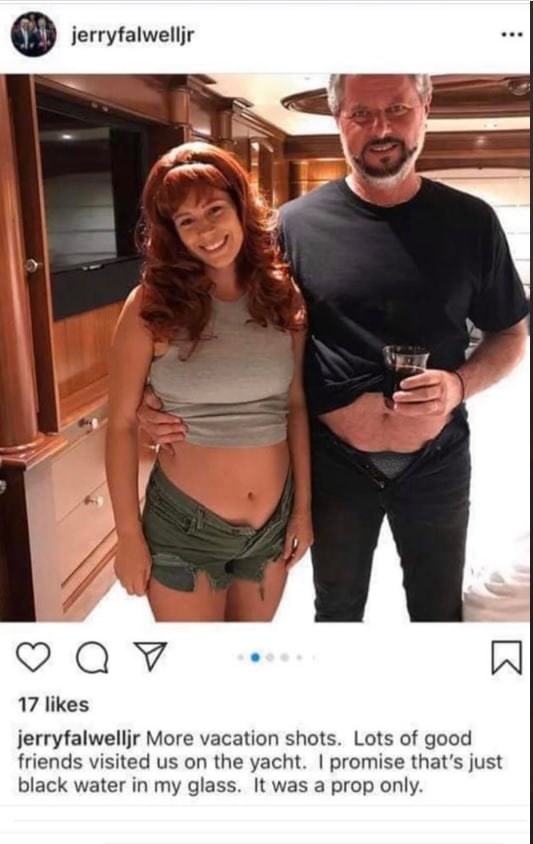
A video of the party also showed up on the internet, featuring Falwell and others at what appears to be a Trailer Park Boys themed party. The scenes are surprising, given that Falwell is the president of a the largest Christian university in the country. One guest in the video makes a vulgar gesture toward the camera. Some are wearing tight clothes with bellies exposed. Many have cigarettes dangling from their mouths.
Initially, some on social media questioned whether Falwell, a married father with three children, was truly the person in the photo with the woman.
At one point, Malachi O’Brien, a fellow with the Falkirk Center, a think tank launched by Liberty University, tweeted that the picture was not Jerry Falwell. But O’Brien later retracted his statement, saying, “It was Jerry, so I was wrong. It was a photo taken out of context of the other photos w/ it.”
I emailed Scott Lamb, vice president of communications at Liberty University, early Monday morning asking for comment, but he did not respond. In the meantime, several media outlets, including Relevant magazine, reported the photos.
Other Scandalous Photos
This is not the first time Falwell has been embroiled in a scandal involving photos.
In October, Falwell paid an undisclosed amount to settle a lawsuit brought by a former pool attendant who had become a part-owner with Falwell and his wife of a gay-friendly hostel in Florida. According to news reports, the attendant—and potentially others—may have had sexually compromising photos of the Falwells, which the attendant used as leverage in the case.
Also, in 2019, pictures of Falwell and his wife at a Miami nightclub sparked controversy after they were published in an article by Politico.
Initially, Falwell denied visiting the nightclub and said that the images were manipulated.
However, Seth Browarnik of World Red Eye, who took the photos , later published even more pictures of Falwell at the nightclub. Browarnik added that when he sold the pictures to Politico, he didn’t even know why Politico wanted them.
“We . . . were as surprised as anyone to discover that Mr. Falwell was among the partygoers we photographed,” Browarnik said.
This latest controversy involving Falwell comes just two-and-a-half weeks before classes resume at Liberty.
Earlier this summer, 35 black alumni called on Falwell to resign after Falwell tweeted a racist image, mocking Virginia Governor Ralph Northam. The leaders said Falwell’s tweet was a “microcosm” of his divisive rhetoric over the past several years and did not display the “Christlike leadership that the University deserves.”
A petition posted with the letter from the alumni has nearly 40,000 signatures.’ https://julieroys.com/jerry-falwell-jr-sparks-controversy-after-posting-racy-picture-video-of-party/?mc_cid=e02142b2b5&mc_eid=b13d34ad49
I have attached the video below. The ‘Shocking police body camera footage has revealed the brutal arrest of a father for refusing to leave the bedside of his critically ill six-year-old daughter, after doctors announced life-saving treatment would be withdrawn without the family’s consent.
The arrest led to long serving NHS respiratory consultant, Dr Rashid Abbasi, 58, having a heart attack outside his daughter’s hospital room as four police officers arrested him on 19 August 2019.
Doctors at the hospital, which cannot be named for legal reasons, called for the police to remove or arrest Dr Abbasi after they announced they would withdraw treatment and ultimately enforce end of life ‘treatment’ on his six-year-old daughter, Zainab, through extubating her.
The case, hitherto unknown to the public, is reminiscent of the high-profile tragedies of Alfie Evans and Charlie Gard.
Reluctant to treat six-year-old girl
Six-year-old Zainab was suffering from a rare life-limiting neurodegenerative condition called Niemann-Pick Disease. Unrelated to that, she also contracted swine flu at the age of two, which led to serious respiratory problems requiring treatment.
The parents believe that the doctors became increasingly reluctant to treat even the treatable respiratory problems because of her underlying life-limiting neurodegenerative disease. Fighting for her life was seen as pointless by the hospital because the genetic disease would make it likely that she would die during childhood.
This caused numerous disputes between the parents, who are both doctors, and the medical team supporting Zainab, about the appropriate intensity of treatment, culminating in the incident captured on video in August 2019.
Zainab sadly died four weeks later.
Legal challenge
Supported by the Christian Legal Centre, Dr Abbasi and his family have begun legal proceedings against the police for wrongful arrest and are considering legal action against the NHS.
Responding to the video footage the police have said to the Mail on Sunday that it “sets out a very different picture to the limited version of events which have been presented to us.”
Dr Abbasi said: “We have lost our daughter Zainab, but we want to take action for future Zainabs so that no one else has to go through what she did and what we have.”
‘They just want to kill her’
Shortly before the police body-cam video footage begins, Dr Abbasi and his family had been informed by the medical team responsible for Zainab’s care that they would be withdrawing life-saving treatment.
In recorded audio, Dr Abbasi can be heard saying that medical staff are trying “to kill my daughter.”
One doctor can be heard saying in the meeting that the process of withdrawing life support needs to start “straight away.”
Fearful that his daughter was being extubated in their absence from the intensive care unit, Dr Abbasi rushed back to her bedside and medical staff tried to block his way.
When Dr and Mrs Abbasi refused to consent to their daughter’s immediate extubation, the doctors tried to hand over a letter to severely restrict him from visiting his critically ill daughter. A few days earlier staff had tried to restrict his access due to claims that he was difficult but had to step down after he challenged the decision.
At Zainab’s bedside, Dr Abbasi’s wife, Dr Aliya Abbasi can be heard crying and saying: “They have made their decision already; they just want to kill her…they are going to just take the tube out. Let’s take her home.”
‘I’m having a heart attack’
The video footage begins with Dr Abbasi sitting tenderly holding his daughter’s hand with his wife and son at his side. Dr Abbasi has said that when his daughter developed the debilitating illness, she would communicate by squeezing his fingers with her little hand.
The police ask to speak to Dr Abbasi outside saying that “they have some concerns about his behaviour.” He replies quietly and calmly: “This is a lie…I don’t want to leave my daughter; my daughter is dying,” and he kisses her hand.
A six-foot police officer then approaches Dr Abbasi and says: “If you do not comply with what I am saying, there may be a necessity to place you under arrest.”
At no point, however, were the police able to produce any paperwork justifying this course of action. Police have still not produced an justification for Dr Abbasi’s arrest, despite our requesting all footage from the police officers.
As Dr Abbasi again refuses to leave, a police officer uses a metal spiked instrument to unclasp his hand from his daughter’s.
Meanwhile his wife pleads with the police and medical staff to show compassion but is then pulled by the shoulders away from the bedside and falls and screams in distress.
Alarmed at what is happening to his wife, Dr Abbasi shouts “what are you doing to my wife?” Two officers then drag him from the bedside and onto the floor.
A struggle follows with four police officers and Dr Abbasi breathlessly shouts: “I’ve got chest pains; I’m having a heart attack” and urgently asks for the medicine in his pocket to relieve his angina.
His repeated requests, however, are ignored by the police and he is instead told that he is ‘disgusting’ and is an ‘animal’ who has brought it all on himself. The police handcuff him, kick him, strap his legs together, dump him on a trolley and wheel him out of the unit.
Dr Abbasi is then taken to A&E where he is later de-arrested. Medical records later confirm that he had indeed had a heart attack. His health has not been right since. The day following the arrest he had to have an emergency procedure, and has since had two more.
Emergency hearings
Following his arrest and heart attack, Dr Abbasi was only allowed back to see Zainab under harsh restrictions. This included a two-hour visiting window where he was escorted throughout the building and was prevented from questioning or challenging the care his daughter was receiving.
Despite the threat of Zainab being immediately extubated, this did not escalate further, but instead the steroid treatment she needed to survive was slowly withdrawn.
On 29 August 2019, the Hospital made an application to the High Court for an order authorising a withdrawal of life support.
The trial was listed for 19-20 September 2019 and the Court imposed an anonymity order to prohibit identification of the parties in any reporting of the case.
On 15 September 2019, Zainab’s condition deteriorated. The parents secured two emergency telephone hearings before Mr Justice Cohen, where they argued for an escalation of life-saving steroid treatment which had been reduced.
The application was refused, and Zainab died the following morning.
‘I was treated like a criminal’
The Abbasi family say that there was a ‘toxic environment’ surrounding the medical care of their daughter.
Dr Abbasi said: “I reacted as any father would who is suffering from grief, but I also knew in my professional capacity that my daughter was purposefully not receiving the treatment she needed to live.
“For challenging this and trying to protect my daughter’s life, I was treated like a criminal and an animal. This was brutal and unacceptable, but we want to emphasise that it was the doctors and the hospital who escalated the situation and involved the police unnecessarily.
“Ultimately, this story is about life and the value the NHS places on life and the wishes and rights of the parents involved.
“We are still grieving deeply, but we have no choice but to expose what has happened and to fight for justice for our daughter.
“We insist that what happened to Zainab should be rigorously investigated by an independent and impartial tribunal.”
‘Culture of death must be exposed’
Andrea Williams, chief executive of the Christian Legal Centre, said: “Any parent or indeed anyone who has ever lost a loved one will be deeply moved and appalled by this story. You could not find more caring and loving parents who simply wanted their daughter to have a chance to continue to live.
“The family showed an extraordinary amount of restraint in the face of their brutal treatment by the police and the hospital. They genuinely feared that their only daughter, their youngest child was about to die.
“Can you imagine how in such a moment it would feel to be treated as they were?
“The whole system needs a major overhaul. These tragic cases occur in a shroud of secrecy. Nothing breaks through because of the way in which the law operates to prevent close and open inspection and accountability. Parents are expected to navigate a complicated system weighted against them. It is almost impossible. This has to change.
“Sadly, the culture of death has resulted in more and more of this type of story, from Alfie Evans to Charlie Gard, where deeply disturbing decisions have been made by treating clinicians, police and the courts. The family, in their grief, have the whole legal machinery tumble down on them and no one advocating for them during the most harrowing life experience anyone could imagine.
“At a time when the parents need support and compassion, they are met with a court order to extubate their child meaning certain death. The order is enforced by judges and the police and backed up by medical establishment opinion.
“Why is it that time and time again when parents resist end of life treatment being imposed on their children, the police swiftly appear?
“We are living in a culture of death, and when our society and frontline services unilaterally decide that death is in a child’s best interest, and the parents are left powerless in the face of the ‘system’, it has to be exposed.
“We will stand every step of the way with families at the point when they have needed compassion and support most but have received the opposite. We will help the Abbasi family to seek justice.” ‘ https://christianconcern.com/news/video-reveals-brutal-arrest-of-father-for-refusing-to-leave-dying-daughter/
Genesis 8:22 While the earth remaineth, seedtime and harvest, and cold and heat, and summer and winter, and day and night shall not cease. “

‘Burning fuel for heat and cooking in developing countries could be harmful to health. In many cases, dwellings may not have chimneys. Add to this the fact that the scarcity of other fuels may result in people, for example, burning animal and human excrement, with health hazards resulting from the process.
Most developing countries would be in a position to establish electrical power grids, which would vastly improve health conditions. However, what fuel would be used to generate the electricity? Many developing countries have large coal reserves, which they would like to exploit in order to emulate the development of Western countries. Their development would be better than that of the west, given that pollutants released in coal burning, such as sulfur dioxide and nitrous oxides, are, today, easy to remove. So what prevents such countries from rapid development? The answer is global warming policies imposed by international bodies, such as the UN. Such bodies are fearful of the possible increase in atmospheric carbon dioxide and therefore apply restrictions on the development of coal-fired power plants. This prevents such countries from industrial development and leaves large numbers of people trapped in poverty. Yet, as we have previously discussed on Creation Moments, these regulations are based on false science, which has nevertheless become the accepted standard.
Those who claim a biblical concern for the poor should note that so-called green policies trap much of the world’s population in a poverty cycle.’https://creationmoments.com/sermons/global-warming-policies-affect-the-poor/?utm_source=rss&utm_medium=rss&utm_campaign=global-warming-policies-affect-the-poor&mc_cid=ece2fc0d16&mc_eid=00c1dcff3c
“Ye also, as lively stones, are built up a spiritual house, an holy priesthood, to offer up spiritual sacrifices, acceptable to God by Jesus Christ.” (1 Peter 2:5)
In the Old Testament theocracy of Israel, it was the responsibility of the Levitical priesthood to be “daily ministering and offering oftentimes the same sacrifices” in atonement for the sins of the people, and this continued until Jesus Christ “offered one sacrifice for sins for ever” (Hebrews 10:11-12). The old priesthood has now been set aside. Only the sacrifice of Christ and our identification with Him through faith is acceptable for our salvation.
Nevertheless, there is a new priesthood—a spiritual priesthood offering spiritual sacrifices—and it is vital that we who are now His priests offer sacrifices that are acceptable and pleasing to God. The first and most basic sacrifice is set forth in one of the Bible’s key verses: “I beseech you therefore, brethren, by the mercies of God, that ye present your bodies a living sacrifice, holy, acceptable unto God, which is your reasonable service” (Romans 12:1).
Three other acceptable sacrifices are outlined in the concluding chapter of Hebrews. “By him therefore let us offer the sacrifice of praise to God continually, that is, the fruit of our lips giving thanks to his name. But to do good and to communicate forget not: for with such sacrifices God is well pleased” (Hebrews 13:15-16).
The continual offering of praise to God, in all circumstances acknowledging His wisdom and goodness, is an acceptable sacrifice. Doing good works—not for our salvation but because of our salvation—is acceptable. So is “communicating” (Greek koinonia)—sharing what we have with others. With these sacrifices, God is “well pleased.” It is our high privilege as His holy priesthood to offer up these spiritual sacrifices.’https://www.icr.org/articles/type/6/?utm_source=phplist8651&utm_medium=email&utm_content=HTML&utm_campaign=August+3+-+Acceptable+Sacrifices
“Mine hand also hath laid the foundation of the earth, and my right hand hath spanned the heavens: when I call unto them, they stand up together.” (Isaiah 48:13)
‘The human hand is an anatomical marvel; nothing remotely comparable exists among the primates or any other animals. It is a marvel of design. But surely the “hand of God”—of which a human’s hand is only a very dim shadow—is infinitely more powerful and skillful.
Note the testimony of Isaiah 45:12: “I have made the earth, and created man upon it: I, even my hands, have stretched out the heavens, and all their host have I commanded.” God did not have to use intermediate processes or pre-existing materials. Everything was “commanded” into existence, and “I, even my hands,” made all of it, including humans. Creation was direct—a direct product of God’s mighty hands.
Not only was it direct, it was also immediate, as our text above makes emphatically plain. His hand laid the earth’s foundation and spanned the heavens. Then, “when I call unto them,” He says, “They stand up together!” Not one by one— first the universe, then the sun, then the earth, and so on. No, “they stand up together.” “He spake, and it was done” (Psalm 33:9). It did not take 16 billion years; it took six days—and the only reason it took that long was so that God’s workweek could serve as a pattern for people (Exodus 20:8-11).
God’s hand is omnipotent, and “He’s got the whole world in His hands.” It is wonderful to know His hand is gentle and loving as well as powerful. His hands will bear eternal scars where they were spiked to the cross, because He loved us and died for us. “My sheep hear my voice,” He says, “and I give unto them eternal life; and they shall never perish, neither shall any man pluck them out of my hand” (John 10:27-28). The hand that spanned the heavens can hold on to those who trust Him.’https://www.icr.org/articles/type/6/?utm_source=phplist8638&utm_medium=email&utm_content=HTML&utm_campaign=July+31+-+The+Powerful+Hand+of+God
Revelation 13:17 And that no man might buy or sell, save he that had the mark, or the name of the beast, or the number of his name. How far off is this prophecy? Well, ‘If some Congress members get their way, the Federal Reserve may soon be able to track many of your purchases in real time and share that information with government agencies. This is just one of the problems with the proposed “digital dollar” or “fedcoin.”
Fedcoin was initially included in the first coronavirus spending bill. While the proposal was dropped from the final version of the bill, there is still great interest in fedcoin on Capitol Hill. Some progressives have embraced fedcoin as a way to provide Americans with a “universal basic income.”
Both the Senate Banking Committee and the House Financial Services Committee held hearings on fedcoin in June. This is the first step toward making fedcoin a reality.
Fedcoin would not be an actual coin. Instead, it would be a special account created and maintained for each American by the Federal Reserve. Each month, Fed employees could tap a few keys on a computer and — bingo — each American would have dollars added to his Federal Reserve account. This is the 21st century equivalent of throwing money from helicopters.
Fedcoin could effect private cryptocurrencies. Also, it would limit the ability of private citizens to protect themselves from the Federal Reserve-caused decline in the dollar’s value.
Fedcoin would not magically increase the number of available goods and services. What it would do is drive up prices. The damage this would do to middle- and lower-income Americans would dwarf any benefit they receive from their monthly “gift” from the Fed. The rise in prices could lead to Congress regularly increasing fedcoin payments to Americans. These increases would cause prices to keep rising even more until we face hyperinflation and a dollar crisis. Of course, we are already on the path to an economic crisis thanks to the Fed. Fedcoin will hasten and worsen the crisis.
Fedcoin poses a great threat to privacy. The Federal Reserve could know when fedcoin is used, who is using it, and what they use it for. This information could be shared with government agencies, such as the FBI or IRS.
The government could use the ability to know how Americans are spending fedcoin to limit our ability to purchase goods and services disfavored by politicians and bureaucrats. Anyone who doubts this should recall the Obama administration’s Operation Choke Point. Operation Choke Point involved financial regulators “alerting” banks that dealing with certain businesses, such as gun stores, would put the banks at “reputational risk” and could subject them to greater regulation.
Is it so hard to believe that the ability to track purchases would be used in the future to “discourage” individuals from buying guns, fatty foods, or tobacco, or from being customers of corporations whose CEOs are not considered “woke” by the thought police? Fedcoin could also be used to “encourage” individuals to patronize “green” business, thus fulfilling Fed Chair Jerome Powell’s goal of involving the Fed in the fight against climate change.
Fedcoin could threaten private cryptocurrencies, increase inflation, and give government new powers over our financial transactions. Fedcoin will also speed up destruction of the fiat money system. Whatever gain fedcoin may bring to average Americans will come at terrible cost to liberty and prosperity.’ http://www.ronpaulinstitute.org/archives/featured-articles/2020/july/27/fedcoin-a-new-scheme-for-tyranny-and-poverty/
This video caused a petition to be made to the Parliament of the Australian state of Queensland. People will believe almost anything but the Words of God.
‘TO: The Honourable the Speaker and Members of the Legislative Assembly of Queensland
Queensland residents draws to the attention of the House certain religious organisations operating in Queensland have a prime belief that a supreme being created the Earth about 6000 years ago. This is an anathema to many sciences and in particular to Aboriginal culture which is 60,000 to 120,000 years old. The creationist religions effectively deny Aboriginal history and culture thereby breaching our racist vilification laws.
Your petitioners, therefore, request the House to ensure that religious organisations preaching that a supreme being created the Earth about 6000 years ago not receive any State government assistance, exemptions, subsidies or funding.’ https://www.parliament.qld.gov.au/work-of-assembly/petitions/petition-details?id=3380


 whatyareckon