
A friend sent this to me on Messenger and I thought it worth sharing. God bless America and may America get back to its roots. Oh, by the way, may President Trump be reelected in November!
Christian
It was interesting to read Jonathon Van Marren when he said ‘I’ve always been skeptical of the “pro-life celebrity.” Not because I don’t think that celebrities who sincerely oppose abortion don’t exist, but because I believe celebrities are both unreliable and often undesirable advocates.
An artist or actor may oppose abortion while creating sexually-charged entertainment that contributes to the degradation of our culture, for example. Or, as in the case of pop stars like Selena Gomez (who swapped her purity ring for abortion bling) they discard their previous views due to industry pressures or peers.
Pro-life celebrities generally fall into two categories. First, there are those oppose abortion for profoundly personal reasons. Jack Nicholson, for example, discovered later in life that his “mother” was actually his grandmother and that the woman he thought was his sister was his mother, who had been pressured to abort him.
As a result, he noted in one interview when asked about abortion, “I’m positively against it. I don’t have the right to any other view.” Similarly, singer Celine Dion was her mother’s fourteenth child, and initially considered an abortion before being talked out of it.
Justin Bieber’s mother was also pressured to abort him, and he has stated that he thinks abortion is “like killing a baby.” Martin Sheen’s wife was conceived through rape, a fact which he has referenced with regard to his anti-abortion views. Despite this, Sheen is a dedicated Democrat, and it is important to note that many “pro-life celebrities” still vocally support pro-abortion politicians.
Discovering just how close one came to becoming what Christopher Hitchens has referred to as a “forgotten whoosh” often makes it impossible for people to regard abortion as a simple matter of rights or healthcare. A near miss can be morally clarifying.
There are also those who are pro-life as part of a larger worldview. Patricia Heaton, who often shares pro-life content on social media, is a Catholic. So is Mel Gibson, who has shared his pro-life views in interviews (and has also contributed financially to pro-life work in the past.)
Hollywood’s handful of conservatives are generally pro-life as well, including Jon Voight, Tom Selleck, and Chuck Norris. Conservatives, of course, are becoming even rarer in Hollywood in the wake of the Great Awokening, which is accompanied by purges of those with even liberal sentiments.
And then there is Kanye West, a man who defies all categories.
On Independence Day, he announced that he is off the Trump Train and running for president of the United States, although thus far no campaign has materialized (he says he will be running for “the Birthday Party,” because “when we win it’s everybody’s birthday.”)
Back in 2011, West tweeted that “An abortion can cost a ballin’ n**ga up to 50gs maybe 100. Gold diggin’ b**** be getting pregnant on purpose,” later clarifying that “it ain’t happen to me but I know people.” Then, an interview for his latest album, he criticized the Democrats for “making us abort our children.”
Last week he expanded on those views, telling Forbes that “Planned Parenthoods have been placed inside cities by white supremacists to do the Devil’s work,” a reference to the racist and eugenicist history of the American abortion giant. “I am pro-life because I’m following the word of the Bible,” he added.
Planned Parenthood’s director of Black Leadership and Engagement responded by stating that the “real threat to Black communities’ safety, health, and lives stems,” among other things, from “the criminalization of reproductive healthcare by anti-abortion opposition.”
Kanye recently tweeted and then deleted a screenshot of a Google search for “what does a 6 month fetus look like.” Along with the now deleted image, he wrote, “These souls deserve to live.”
It is unquestionably good for the pro-life cause that a man with such an enormous platform is using it to call out the American abortion industry, as West reaches an audience that pro-lifers have often had difficulty reaching. With that said, pro-lifers would do well to be cautious. West is notoriously erratic, and a lot of his ramblings can end up being pretty weird.
In a culture obsessed with celebrity, there is a huge temptation to immediately promote and embrace any famous person saying some of the right things. While encouraging and affirming those things is essential, we shouldn’t give these folks the status of moral leadership overnight.
West in particular has gone on a roller-coaster with regard to many of his different views, and his reliability, despite hopeful indicators, remains to be seen. We should not make celebrities — even those going after the abortion industry — into our heroes.’ https://www.prophecynewswatch.com/article.cfm?recent_news_id=4163
Ever since Adam made the choice to partake of eating the forbidden fruit man has been making wrong choices. Life is made of making choices. All of us have made good choices and some bad choices.
One does not have to have a medical degree to know there are two genders. However, today, there are those in education who are seeking to lead others into making the choice of being a so-called transgender. Transgenderism, like being a sodomite has been in the so-called closet for years but it is NOW OUT in the open. Allowing sodomite’s to marry OPENED the gate for transgenderism. Transgenders are now teaching your children in the schools and this is being accepted as normal. This is just another anti-Creator God worldview that is being foisted upon society.

‘It was an early January morning in Maine and the temperature outside was somewhere below zero. I don’t think it matters all that much once the mercury drops below freezing; it was cold. I was sitting in my warm car trying to find the courage to walk across the parking lot and go inside. I had cafeteria duty at the high school where I was a teacher for eight years. During my tenure at this school and at all the other schools I taught at for seventeen years, I was know as Mr. Drew, but that was all about to change.
Like many trans people, I knew from an early age that my gender identity was special, and that I was more like my two sisters and my mom, than my four brothers and my dad. I tried to explain my feminine feelings to my loving, yet bewildered parents when I was about twelve, and all I got was an invitation to talk to our priest. I passed on their offer and my life continued onward, or should I say, my two lives. I lived outwardly as a boy, man, and eventually a husband, but on the inside as a girl and woman. By the fall of 2010, I was emotionally exhausted and had come to the realization that I needed to be honest with myself, to save myself. But those words are easier said, than the reality of showing up to work, as a well known high school teacher and track coach in Southern Maine, as Ms Drew instead of Mr. Drew. What I didn’t know then was I was to become one of the first OUT transgender public school teachers in Maine, and one of the first transgender high school coaches in the country.’ https://hhrcmaine.org/blog/transgender-maine-the-kids-are-alright-by-gia-drew/
If you are a parent or grandparent you need to speak out. Make your voice heard that this is sin and you will not accept it being portrayed as normal or taught in your school. Remember, that’s how Hitler came to power, people kept their mouth shut.
Mark 10:6 But from the beginning of the creation God made them male and female.
The Marxist, Leftist, Muslim, Loony, Lovies are out to indoctrinate your children with their worldview. The Southern Poverty Law Center (SPLC) is one of the most vile Marxist groups there is and the SPLC is playing a major part in this Leftist indoctrination of Maine children.
‘PORTLAND (WGME) – The Black Lives Matter protests that swept across the country last month led to many conversations about race in America, many of them between students and teachers.
Leaders at the Holocaust and Human Rights Center of Maine say not every student has the same experience in school.
“Children of color and other marginalized groups are disproportionately impacted by bias and discrimination at school,” Shenna Bellows of the Holocaust and Human Rights Center of Maine said.
This is why the center partnered with the Southern Poverty Law Center to put on eight online sessions dealing with racism in school.
“These are very important topics to be having, especially in these times, as we are so mindful of racial inequity,” Bellows said.
These classes are a direct response to social justice movements across the country such as Black Lives Matter, and organizers say they’re focusing on teachers in grades K-12 so students can grow up knowing how to address racism.’ https://wgme.com/news/local/social-justice-groups-offer-online-sessions-dealing-with-racism
Names of organizations can be deceiving. A little research and discernment will show that the SPLC https://www.splcenter.org/ and the Holocaust and Human Rights Center of Maine https://hhrcmaine.org/ have a Marxist Leftist worldview.
‘To the protests of some Democrats, Republican President Theodore Roosevelt had Booker T. Washington as an honored guest for dinner at the White House, October 16, 1901.’ https://myemail.constantcontact.com/Booker-T–Washington–The-Bible-should-be-read-as-a-daily-guide-to-right-living—positive-Christian-service-.html?soid=1108762609255&aid=eSjx-Sps5VA

The Democrats today like to think they are the party of the Black man but in 1901 a Southern Democrat newspaper stated ‘”The most damnable outrage which has ever been perpetrated by any citizen of the United States was committed yesterday by the President, when he invited a n—– to dine with him at the White House.
It would not be worth more than a passing notice if Theodore Roosevelt had sat down to dinner in his own home with a Pullman car porter, but Roosevelt the individual and Roosevelt the President are not to be viewed in the same light.”‘ https://myemail.constantcontact.com/Booker-T–Washington–The-Bible-should-be-read-as-a-daily-guide-to-right-living—positive-Christian-service-.html?soid=1108762609255&aid=eSjx-Sps5VA
Not much has changed in the Democrat Party.
With all this anarchy and hatred that encompasses BLM it is good to review the life of a man of color and true Christian character. That man is George Washington Carver.
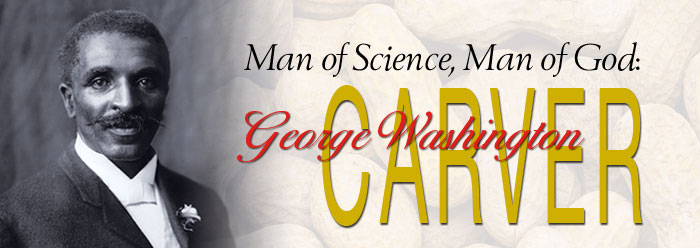
‘Who: George Washington Carver
What: Father of Modern Agriculture
When: 1864 or 1865 – January 5, 1943
Where: Diamond Grove, Missouri
Probably no other scientist has had to face as many social barriers as George Washington Carver, the black American botanist noted for revolutionizing agriculture in the southern United States. He was born towards the end of the Civil War to a slave family on the farm of Moses Carver. As an infant, he and his mother and sister were kidnapped by Kentucky night raiders.
It’s unclear what happened to his mother and sister, but George was rescued and returned to the Carvers, who raised him and his brother James. He grew up in a deeply segregated world, and very few black schools were available in the South. But his desire for learning prompted him to persevere, and he earned his diploma from Minneapolis High School in Minneapolis, Kansas.
Entering college was even more difficult, but he was eventually accepted at Simpson College in Indianola, Iowa, to study art. In 1891, he transferred to Iowa State Agriculture College in Ames (now Iowa State University) to study botany, where he was the first black student and later the first black faculty member. While there, he adopted the middle name “Washington” to distinguish himself from another George Carver. He received his undergraduate degree in 1894 and his masters in 1896, and became a nationally recognized botanist for his work in plant pathology and mycology. After receiving his masters, he joined Booker T. Washington at the Tuskegee Normal and Industrial Institute (later Tuskegee University) in Alabama to teach former slaves how to farm for self-sufficiency.
Carver revolutionized agricultural science with his cultivation of soil-enriching crops, such as peanuts and soybeans, to revive earth that had been depleted of nutrients from cotton farming. He discovered over 100 uses for the sweet potato and 300 uses for the peanut, including beverages, cosmetics, dyes and paints, medicines, and food products. He conducted numerous research projects that also contributed to medicine and other fields, and used his influence to champion the relief of racial tensions.
He was offered many honors and substantial wealth from patents, but Carver chose not to patent his discoveries: “One reason I never patent my products is that if I did it would take so much time, I would get nothing else done. But mainly I don’t want my discoveries to benefit specific favored persons.”1
Frugal in finance and humble in character, Carver was undoubtedly a deeply devoted Christian. He attributed inspiration of his work to God,2 and his studies of nature convinced him of the existence and benevolence of the Creator: “Never since have I been without this consciousness of the Creator speaking to me….The out of doors has been to me more and more a great cathedral in which God could be continuously spoken to and heard from.”3
Carver died January 5, 1943 of complications from injuries he incurred in a bad fall. His life savings of 60,000 dollars was donated to the museum and foundation bearing his name. The epitaph on his grave on the Tuskegee University campus summarizes the life and character of this former slave, man of science, and man of God: “He could have added fortune to fame, but caring for neither, he found happiness and honor in being helpful to the world.”’ https://www.icr.org/article/science-man-god-george-washington-carver

References
- Carver Quotes. Posted on the George Washington Carver National Monument website at www.nps.gov/gwca.
- Carver is quoted as saying, “I never have to grope for methods. The method is revealed at the moment I am inspired to create something new. Without God to draw aside the curtain I would be helpless.” Federer, W. J. 1994. America’s God and Country Encyclopedia of Quotations. Coppell, TX: FAME Publishing, 96.
- Ibid, 97.

* Ms. Dao is Assistant Editor.
Cite this article: Dao, C. 2008. Man of Science, Man of God: George Washington Carver. Act & Facts. 37 (12): 8.
It’s always sad to come to the ending of a good story. But, as with life, there must be an end. So, here we have the last chapter of the God called negro preacher, John Jasper, 1812-1901. It can safely be said ‘There will never be another John Jasper”! To God be the Glory! Great things He hath done!
‘I NEVER heard Jasper preach a sermon on heaven, nor did I ever hear of his doing so. So far as my observation goes, sermons on heaven have failed to edify the thoughtful–sometimes proving distinctly disappointing. It was not to Jasper’s taste to argue on heaven as a doctrine. With him it was as if he were camping outside of a beautiful city, knowing much of its history and inhabitants, and in joyous expectation of soon moving into it. The immediate things of the kingdom chiefly occupied his attention; but when his sermons took him into the neighbourhood of heaven, he took fire at once and the glory of the celestial city lit his face and cheered his soul. This chapter deals only with one of his sermons which, while not on heaven, reveals his heart-belief in it, and its vital effect upon his character.

Imagine a Sunday afternoon at his church–a fair, inspiring day. His house was thronged to overflowing. It was the funeral of two persons– William Ellyson and Mary Barnes. The text is forgotten, but the sermon is vividly recalled.
From the start Jasper showed a burden and a boldness that promised rich things for his people. At the beginning he betrayed some hesitation–unusual for him. “Lemme say,” he said, “a word about dis William Ellersin. I say it de fust an’ git it orf mer min’. William Ellersin was no good man–he didn’t say he wus; he didn’t try to be good, an’ de tell me he die as he live, ‘out Gord an’ ‘out hope in de worl’. It’s a bad tale to tell on ‘im, but he fix de story hissef. As de tree falls dar mus it lay. Ef you wants folks who live wrong to be preached and sung to glory, don’ bring ’em to Jasper. Gord comfut de monur and warn de onruly.
“But, my bruthrin,” he brightened as he spoke, “Mary Barnes wus difrunt. She wer wash’d in de blood of de Lam’ and walk’d in white; her r’ligion was of Gord. Yer could trust Mary anywhar; nuvr cotch ‘er in dem playhouses ner friskin’ in dem dances; she wan’ no street-walk’r trapsin’ roun’ at night. She love de house of de Lord; her feet clung to de straight and narrer path; I know’d her. I seen her at de prarmeetin’–seed her at de supper–seed her at de preachin’, an’ seed her tendin’ de sick an’ helpin’ de mounin’ sinn’rs. Our Sister Mary, good-bye. Yer race is run, but yer crown is shure.”
From this Jasper shot quite apart. He was full of fire, humour gleamed in his eye, and freedom was the bread of his soul. By degrees he approached the realm of death, and he went as an invader. A note of defiant challenge rang in his voice and almost blazed on his lips. He escorted the Christian to the court of death, and demanded of the monster king to exhibit his power to hurt. It was wonderful to see how he pictured the high courage of the child of God, marching up to the very face of the king of terrors and demanding that he come forth and do his worst. Death, on the other hand, was subdued, slow of speech, admitted his defeat, and proclaimed his readiness to serve the children of Immanuel. Then he affected to put his mouth to the grave and cried aloud: “Grave! Grave! Er Grave!” he cried as if addressing a real person, “Whar’s yer vict’ry? I hur you got a mighty banner down dar, an’ you turrurizes ev’rybody wat comes long dis way. Bring out your armies an’ furl fo’th your bann’rs of vict’ry. Show your han’ an’ let ’em see wat you kin do.” Then he made the grave reply: “Ain’t got no vict’ry now; had vict’ry, but King Jesus pars’d through dis country an’ tord my banners down. He says His peopl’ shan’t be troubled no mo’ forev’r; an’ He tell me ter op’n de gates an’ let ‘um pass on dar way to glory.”
“Oh, my Gord,” Jasper exclaimed in thrilling voice, “did yer hur dat? My Master Jesus done jerk’d de sting of death, done broke de scept’r of de king of tur’rs, an’ He dun gone inter de grave an’ rob it uv its victorous banners, an’ fix’d nice an’ smooth for His people ter pass through. Mo’ en dat, He has writ a song, a shoutin’ anthim for us to sing when we go thur, passin’ suns an’ stars, an’ singin’ dat song, ‘Thanks be onter Gord–be onter Gord who give us de vict’ry thru de Lord Jesus Christ.'” Too well I know that I do scant justice to the greatness of Jasper by this outline of his transcendent eloquence. The whole scene, distinct in every detail, was before the audience, and his responsive hearers were stirred into uncontrollable excitement.
“My bruthrin,” Jasper resumed very soberly, “I oft’n ax myself how I’d behave merself ef I was ter git to heav’n. I tell you I would tremble fo’ de consequinces. Eben now when I gits er glimpse–jist a peep into de palis of de King, it farly runs me ravin’ ‘stracted. What will I do ef I gits thar? I ‘spec I’ll make er fool of myself, ’cause I ain’t got de pritty ways an’ nice manners my ole Mars’ Sam Hargrove used to have, but ef I git thar they ain’t goin’ to put me out. Mars’ Sam’ll speak fur me an’ tell ’em to teach me how to do. I sometimes thinks if I’s ‘lowed to go free–I ‘specs to be free dar, I tell you, b’leve I’ll jest do de town–walkin’ an’ runnin’ all roun’ to see de home which Jesus dun built for His people.
“Fust of all, I’d go down an’ see de river of life. I lov’s to go down to de ole muddy Jemes–mighty red an’ muddy, but it goes ‘long so gran’ an’ quiet like ’twas ‘tendin’ to ‘ business–but dat ain’t nothin’ to the river which flows by de throne. I longs fer its chrystal waves, an’ de trees on de banks, an’ de all mann’rs of fruits. Dis old head of mine oft’n gits hot with fever, aches all night an’ rolls on de piller, an’ I has many times desired to cool it in that blessed stream as it kisses de banks of dat upper Canaan. Bl’ssed be de Lord! De thought of seein’ dat river, drinkin’ its water an’ restin’ un’r dose trees–” Then suddenly Jasper began to intone a chorus in a most affecting way, no part of which I can recall except the last line: “Oh, what mus’ it be to be thar?” “Aft’r dat,” Jasper continued with quickened note, I’d turn out an’ view de beauties of de city–de home of my Father. I’d stroll up dem abenuse whar de children of Gord dwell an’ view dar mansions. Father Abraham, I’m sure he got a grate pallis, an’ Moses, what ‘scorted de children of Israel out of bondige thru’ de wilderness an’ to de aidge of de promised lan’, he must be pow’rful set up being sich er man as he is; an’ David, de king dat made pritty songs, I’d like to see ‘is home, an’ Paul, de mighty scholar who got struck down out in de ‘Mascus road, I want to see his mansion, an’ all of ’em. Den I would cut roun’ to de back streets an’ look for de little home whar my Saviour set my mother up to housekeepin’ when she got thar. I ‘spec to know de house by de roses in de yard an’ de vine on de poch.” As Jasper was moving at feeling pace along the path of his thoughts, he stopped and cried: “Look dar; mighty sweet house, ain’t it lovely?” Suddenly he sprang back and began to shout with joyous clapping of hands. “Look dar; see dat on de do; hallelujah, it’s John Jasper. Said He was gwine to prepar a place for me; dar it is. Too good for a po’ sinner like me, but He built it for me, a turn-key job, an’ mine forev’r.” Instantly he was singing his mellow chorus ending as before with: “Oh, what mus’ it be to be thar!”
From that scene, he moved off to see the angelic host. There were the white plains of the heavenly Canaan–a vast army of angels with their bands of music, their different ranks and grades, their worship before the throne and their pealing shouts as they broke around the throne of God. The charm of the scene was irresistible; it lifted everybody to a sight of heaven, and it was all real to Jasper. He seemed entranced. As the picture began to fade up rose his inimitable chorus, closing as always: “Oh, what mus’ it be to be thar!”
Then there was a long wait. But for the subdued and unworldly air of the old preacher–full seventy years old then–the delay would have dissolved the spell. “An’ now, frenz,” he said, still panting and seeking to be calm, “ef yer’ll ‘scuse me, I’ll take er trip to de throne an’ see de King in ‘is roy’l garmints.” It was an event to study him at this point. His earnestness and reverence passed all speech, and grew as he went. The light from the throne dazzled him from afar. There was the great white throne–there, the elders bowing in adoring wonder–there, the archangels waiting in silence for the commands of the King–there the King in His resplendent glory–there in hosts innumerable were the ransomed. In point of vivid description it surpassed all I had heard or read. By this time the old negro orator seemed glorified. Earth could hardly hold him. He sprang about the platform with a boy’s alertness; he was unconsciously waving his handkerchief as if greeting a conqueror; his face was streaming with tears; he was bowing before the Redeemer; he was clapping his hands, laughing, shouting and wiping the blinding tears out of his eyes. It was a moment of transport and unmatched wonder to every one, and I felt as if it could never cease, when suddenly in a new note he broke into his chorus, ending with the soul-melting words: “Oh, what mus’ it be to be thar!”
It was a climax of climaxes. I supposed nothing else could follow. We had been up so often and so high we could not be carried up again. But there stood Jasper, fully seeing the situation.
He had seen it in advance and was ready. “My bruthrin,” said he as if in apology, “I dun fergot somethin’. I got ter tek anuth’r trip. I ain’t visit’d de ransum of de Lord. I can’t slight dem. I knows heap ov ’em, an’ I’m boun’ to see ’em.” In a moment he had us out on the celestial plains with the saints in line. There they were–countless and glorious! We walked the whole line and had a sort of universal handshake in which no note of time was taken. “Here’s Brer Abul, de fust man whar got here; here’s Brer Enoch whar took er stroll and straggled inter glory; here’s ole Ligie, whar had er carriage sent fur ‘im an’ comed a nigher way to de city.” Thus he went on greeting patriarchs, prophets, apostles, martyrs, his brethren and loved ones gone before until suddenly he sprang back and raised a shout that fairly shook the roof. “Here she is; I know’d sh’d git here; why, Mary Barnes, you got home, did yer?” A great handshake he gave her and for a moment it looked as if the newly-glorified Mary Barnes was the centre of Jasper’s thoughts; but, as if by magic, things again changed and he was singing at the top of his voice the chorus which died away amid the shrieks and shouts of his crowd with his plaintive note: “Oh, what mus’ it be to be thar!”
Jasper dropped exhausted into a chair and some chief singer of the old-time sort, in noble scorn of all choirs, struck that wondrous old song, “When Death Shall Shake My Frame,” and in a moment the great building throbbed and trembled with the mighty old melody. It was sung only as Jasper’s race can sing, and especially as only Jasper’s emotional and impassioned church could sing it. This was Jasper’s greatest sermon. In length it was not short of an hour and a half–maybe it was longer than that. He lifted things far above all thought of time, and not one sign of impatience was seen. The above sketch is all unworthy of the man or the sermon. As for the venerable old orator himself he was in his loftiest mood–free in soul, alert as a boy, his imagination rioting, his action far outwent his words, and his pictures of celestial scenes glowed with unworldly lustre. He was in heaven that day, and took us around in his excursion wagon, and turning on the lights showed us the City of the Glorified.
What is reported here very dimly hints at what he made us see. Not a few of Richmond’s most thoughtful people, though some of them laid no claim to piety, were present and not one of them escaped the profound spiritual eloquence of this simple-hearted old soldier of the cross.
Valiant, heroic old man! He stood in his place and was not afraid. He gave his message in no uncertain words–scourged error wherever it exposed its front stood sentinel over the word of God and was never caught sleeping at his post.
When his work ended, he was ready to go up and see his Master face to face.
The stern old orator, brave as a lion, rich in humour, grim, and a dreamer whose dreams were full of heaven, has uttered his last message and gone within the veil to see the wonders of the unseen. If the grapes of Eschol were so luscious to him here, “Oh, what must it be for him to be there.”‘ https://docsouth.unc.edu/church/hatcher/hatcher.html
This is a follow up to yesterday’s blog on EARLY CHILD QUEER THINKING. There is a lot that is irritating here, at least to this blogger, and one major irritation is that the New South Wales government is paying for this monster. Like I said yesterday, ever since the Garden of Eden when God had to thrust our great grand parents out of the Garden the world has been in rebellion against God the Creator. The following is an example of how the Marxist, Leftist, Loony, Lovies are seeking out your children to mold them into this new society.
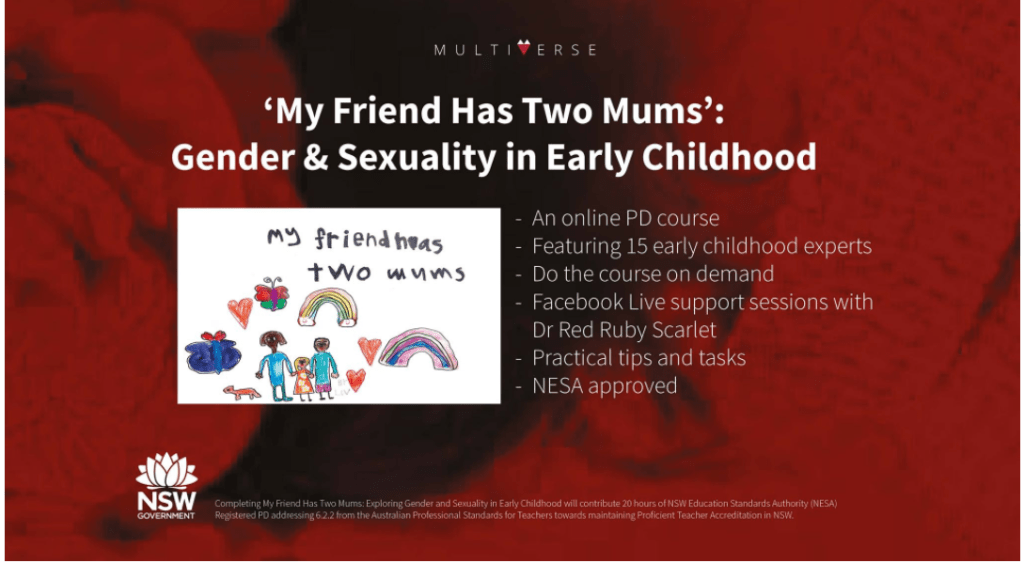
‘As society changes, the issues we face in early childhood change. Things we may have never thought of impacting on our work, now do. Things like sexuality and gender.
Our services are now working with children who identify with a different gender, with same sex parents, with openly gay and lesbian educators. And, importantly how we deal with these issues are part of the National Quality Standard!
But how do we learn about them? We now know a lot more about gender and sexuality than we probably did when you studied at Uni or TAFE. But, till now, there has never been a course where you could learn about things such as:
• how to do inclusion right for children and families of all genders and sexualities
• what the I in LGBTI+ actually means
• unknowing discrimination of children and families
• rainbow families
• heterosexual, lesbian, and, gay educators
But now there is.
‘My friend has 2 mums’: exploring gender and sexuality in early education and care, is the course you need to learn all the things you’ve wondered about.’
‘Course Content and Presenters:
The content videos will consist of interviews between Dr Red Ruby Scarlet and those listed below:Module 1. Queer Thinking in Early Childhood – Professor Kerry H Robinson Module 2. The National Quality Framework – Nicholas Stewart Module 3. Putting Inclusive Policies in Place – Anthony Semann Module 4. Using Anti-Bias Approaches – Jill Huntley Module 5. A Transgender Early Childhood Educator – Sharon Priestley Module 6. Heterosexuality as an Identity – Michael McGirr Module 7. Transitioning as Parents – Teighan & Tammie Cosier Module 8. Queer Pedagogies – Stephen Gallen Module 9. Intersex Identities – Dr Agli Zavros-Orr Module 10. Living Non-Binary – Danny Xanadu Module 11. Leadership and Life – Sarah Louise & Ace Dean Module 12. Aboriginal Queerness and Queeness – Nana Miss Koori/Graham Simms Module 13. Rainbow Families – Ashley Scott and Cathy Brown’ https://multiverse.com.au/my-friend-has-two-mums/
Here is something that should cause some REAL concern for those who still have a moral compass. The following are testimonials from past participants of this sexually deviant rebellious anti-God NSW government sponsored course.
‘“My Friend has Two Mums” is the course on gender and sexuality that I didn’t realise I was needing. I signed up on a whim, and it turns out this has been the most significant professional development of my career. The long term structure of this course allowed me to absorb the information, process how I could put this new knowledge into action at my service, and bounce ideas off the supportive Facebook group – all before moving onto the next content piece.
Through this learning our service has been able to build on our sexuality and diversity resources and policy, develop LGBTQIA+ support networks, and look at our paperwork through a queer lens to build on our inclusive practice. I strongly endorse this course for all early childhood professionals, as you will gain so much from the content both individually and for your service.” Tash Croft
Director, Cooks Hill Preschool’ The Cook Hills Preschool’s web site https://cookshillpreschool.com/ was in maintenance mode when I went to it.
This is from a kindergarten teacher!
‘“My friend has two mums” is an absolutely brilliant course for all early childhood educators. For me as an early childhood teacher, I used to struggle with how to tackle gender and sexuality bias among children. For some people, it can be challenging and even hard to bring it up. After taking this course, I started to look into my practice and put my queer lens on, especially in children’s play and how the room is set up. I enjoyed the theoretical part of this course which lays the foundation of the anti-bias practice. I particularly enjoyed the interviews with different guest speakers and listening to their stories, which left me with heaps questions to think about. I am a practitioner of the anti-bias approach and I am just grateful about the existence of this course which gave me some really good perspectives on how to practice the anti-bias approach in a genuine and meaningful way – so much love for this course and everyone who was involved.” Sylvana Li Kindergarten Teacher’
“In signing up for My Friend Has Two Mums, I envisioned getting a range of resources and connections that would expand my knowledge and passion for an area of human development i found intriguing. What I didn’t expect was the multiple other doors, concepts and ways of thinking that I would engage with. I found myself challenging my practice, my thought processes and the learning community around me. I went on a journey into the depths of my personal soul that allowed me to reconnect with who I am and how I connect with others. This is a course that educators must sign up for to expand their knowledge and ways of thinking around inclusion. Those that do join should ultimately be prepared for the life this will take on and the ripples that will form around you in the most magical way.” Alistair Gibbs Director, Lady Gowrie Victoria’ Now, a little web search reveals some interesting background about Mr. Gibbs.
‘Alistair jumped into the Master of Teaching for early childhood which quickly reaffirmed the affinity he felt with the early years.
Alistair said that he could see how the work done in early childhood had the power to set children up for their future: “really getting to the core of their development, their emotions, their abilities, their thirst and drive to better themselves and get to their next stage of development.”
It was in the kindergarten classroom that Alistair started to notice little things that piqued his curiosity.
One day, a corner was turned into the hairdressers with makeup and that type of thing. It was imaginative play, role play, pretend play- all wonderful for a child’s skill development. It was the children’s response that surprised Alistair, when he stepped in to relieve the female educator:
“I mimicked the exact same actions and language she was using within the space- which was, ‘can you make me look pretty’ and the response the children gave me was, ‘No. You’re not allowed to be pretty, you’re handsome. Girls are pretty, boys are handsome.’ I started to really question, where does this from?”
What stemmed from this was a learning course for Alistair himself and for the children he worked with. Both prompted one another with their curiosity and imagination. Alistair said that he aimed to tackle gender stereotypes through his own actions, his language and through the experiences the educators were providing for the kids.
“I then extended that further into different people’s abilities and how we could support and help each other in different ways.”
Alistair said he had the desire to share his findings and the experiences he was going through with others.
“I started to seek out conferences that I could speak at and different ways that I could engage in different learnings and different ways to support other people’s thinking and other people’s practice.”
He was keenly interested in bias in the early years in the most practical sense. He was drawing upon his own experiences and much like the BBC documentary, No More Boys and Girls: Can Our Kids Go Gender Free?, research was backing up his own observations that stereotypes were established at quite an early age.
“When I took on a role that allowed us to engage in these practices through a whole centre approach, it wasn’t necessarily to announce that we were doing gender or anti-bias or anything like that, we simply started asking families- what bias do you face. What do you come up against and people started to put up responses.”
“People started talking about their age or their gender or their sexuality or their parenting skills.”’
‘Alistair is now an Early Learning Manager at Gowrie Victoria, a not-for-profit organisation that specialises in championing good early childhood education through their early learning services as well as professional development and accredited training courses to the early childhood and education sector.’ https://www.playgroupblog.org/alistair-gibbs
I’ll finish these testimonials with this one. ‘Do you want access to some brilliant minds who understand (and live) advocacy around gender and sexuality and their beautiful venn-diagramminess with early childhood practice? Are you looking for a new lens with which to view humanity and our ethical responsibilities to the wonderfully diverse children, families and colleagues within our profession and community?
This course is the full package -
- get clear explanations and demystifications of sex, gender, orientation, and the ways we identify ourselves on the spectrum of human sexuality
- consider what this beautiful rainbow spectrum means in our practice and what thinking we may need to shift or expand to see from new (child and adult) perspectives
- critique the messages that mainstream binaryheterornormativestandards send to children from birth and the exclusion that is all around us (once you see it clearly, you see it everywhere… you know? ‘I see heteronormatively-biased people. All the time. Walking around. They don’t know they’re biased…’)
- learn a squillion affirming strategies – from tweaking forms to reflect family reality, to resourcing and supporting play, to advocating with your peers (you won‘t be a lone voice in this…you’ll have Red and a great group of interactive kindred colleagues along with you on your journey).
- hear from academics, practitioners, families, lawyers (well, one), artists –pioneers in our diverse landscape whose lived experiences add priceless richness to this important learning.
I didn’t quite expect the impact this course would have on my personal and professional selves! (Intrinsically ‘entwingled‘ as they are 😉).
I have learnt so much, (aka blown my mind) and as well as working away at changing aspects of practice in my current workspace, I am now looking at moving into this area of work in the early childhood and community sector. I have growing engagement with the Queer community, have challenged lil ol‘ me to live my own authentic self, have been on a beautiful advocacy journey with one of my offspring, have met amazing new people and learned first-hand how demystifying and celebrating diverse gender and sexuality is the only route that makes sense.
This course is a springboard for diving into wonderful new waters! Truly transformative!
(Red, thankyou from the bottom, sides and top of my heart for all the you you have put into this ground-breaking course!) Peta Fitzpartick Family Day Care Coordinator , Wesley Mission Queensland” https://multiverse.com.au/my-friend-has-two-mums/
A government that uses tax dollars to pay for this sexual deviant teaching should be charged with child abuse. Society and governments are so rebellious to the things of God that what we have just been reading is the so-called norm for them. However, the above teaching is not for the true born again Bible believing parents that desire the best for their children to be able to go out and live as a good citizen in this world.
Matthew 19:14 …Jesus said, Suffer little children, and forbid them not, to come unto me: for of such is the kingdom of heaven.
‘THE paper which follows is a composite, embodying many incidents and facts connected with the Jasper sensation, and designed to reflect, so far as possible, the impression made by the fiery old philosopher upon those who though out of sympathy with his astronomical notions fell as helpless victims beneath the spell of his eloquence and honesty.
For quite a while the Jasper sensation had grown acute in Richmond. Beginning as a freak, it bloomed into a fad, got in the air, and actually invaded private homes. It was a pentecost for the curious, a juicy apple for the hard-driven reporter, a festival for the scoffer, and a roaring financial bonanza for the saints of Sixth Mount Zion.
I confess that, for my part, it struck me as a ridiculous business at best, the big bubble of an hour, and that if not caught at the exact moment it would speedily disappear, and while I was a sprig of a reporter it was the sort of thing which did not come my way. Being, however, of a prying and curious turn of mind I determined to take one glimpse at the black elephant. It took time, however, to get my purpose into working order, but my day came in due course. I awoke one morning to find the Saturday papers “festering” with Jasper. He was in the advertisements, in the communications, and in the local columns, and the show was to come off the next day. They told once more of his astronomical absurdities, as I believed them to be, and informed me that the exhibition would come off at 3 P. M. on the next afternoon. At noon, I dropped into Reugers’ for my lunch, and a table of hayseed legislators were filling the room, with noisy gabble about Jasper and his planetary crochets. I found that some of them had signed a paper asking for the approaching Jasperian exhibition, and others of them were twitting and punching them for their folly; but I found that both sides of them were going.
Later in the day, I got into a West Main Street car and found a seat next to three ladies who evidently had a serious attack of Jasper, and they, too, were bargaining to go. At the supper table in my boarding-house that evening I found a sickly old Yankee minister loafing in Richmond for his health, in a swivet of excitement about Jasper and his coming oration. My landlady’s fourteen year old boy told me that his mother had promised that he should go to hear Jasper, on the hampering condition that he could get some gentleman to go with him, and his appeal for my company would have beaten Jasper in the point of passionate eloquence. To me, it all seemed a stew of folly, and yet I found myself gratified to have this earnest lad as an excuse in favour of my going.
I finally bargained with the eager youngster that I would waylay him the next morning on his early escape from the Sunday-school, and we would stroll out into the vicinity of the Sixth Mount Zion Church, and make a preliminary reconnoissance of the general situation. We did not find it quite a well-odoured stroll at all points, particularly as we got in the neighbourhood of the church, for we encountered a tangle of streets and alleys some of which were not in the best condition.
Not long after crossing Broad Street we began to run afoul of squads and groups of coloured people, and the total strain of their chat was Jasper and what was coming later on. The nearer we came to the church, the combat, as the poet said, deepened, that is, the groups multiplied and the Jasperian element grew. A huge negro woman hanging on a side-gate on Clay Street was shouting in a piping voice about Jasper and the sun, and telling to several dumb listeners that “she wuz gwine ter be dar ef de Lord ‘sparred’ her an’ it wuz de las’ thing she done on de yerth.”
I observed also several of those Virginia solons already mentioned,–those big footed, badly shaven, and consequential legislators,–prowling in the neighbourhood of the church, as if they were studying and planning for burglaries. As we meandered the crooked streets which admitted us to a sight of the great Sixth Mount Zion, we saw in every direction the sign of a prodigious expectancy. Front yards, streets, and alleys had their contingents, and you could not get within ear-shot without getting some novel and surprising hints as to John Jasper and the Solar System. We could hear singing in the church, and we assumed that something in the way of worship was in process. That, however, was not IT. That was a tame and pithless performance, and if Jasper was in it at all he was evidently resting his better forces for the bigger battle at three o’clock in the impending afternoon.
The attraction on the inside was out of gear and didn’t draw. My young companion, who was vastly my superior as to the Jasper situation, informed me with marked conviction that the thing for us to do, and to do at once and with a rush, was to go back to the house, swallow our dinner, and get back with the utmost speed. We did not get away, however, before we noted that all avenues in the vicinity of the church seemed to be filling. Some were coming and going; some were knotted into groups looking very solemn and apparently awestruck, and some were crowding in like late comers at a circus; but whenever you caught a word it had to do with Jasper. As we walked away, the son of my landlady, full of the fidgets and outraged by my slow motion remarked sagely: “Ain’t he got ’em?” I had to admit it; he had ’em,–by a grip tighter than if he had ’em by the nape of the neck. Evidently enough, he had them, and in a bunch as big as the town.
But I didn’t know it fully then. Being untutored in Jasper’s holding power, I was fresh enough to suppose that all that buzzing, swarming gang of negroes would scatter away to their frugal Sunday meal, and that the alleys and streets would empty into their usual vacancy, though the boy’s mien of hurry and eagerness was warning me to the contrary. He mentioned several times that from what other boys had told him we must go very early, and in order to gratify him we got out of the boarding-house at a quarter after one, and we needed only fifteen minutes of quiet walking to get a front seat.
Shades of the Pharaohs and shadows of the Pyramids! As we headed towards the seat of planetary conflict the streets looked like black rivers. Great lines of blacks, relieved here and there by companies of whites, thronged the sidewalks. Were Hannibal’s Carthagenian legions being turned loose in Richmond? Or had some mighty earthquake ripped open the foundations of Richmond, and were the people, caked with the soot, fleeing for life? It was more tranquil than that, thank heaven! It was however the town, upheaved and agitated, striving fiercely for Sixth Mount Zion, to hear the supreme sensation of all his race,–as I now began to realize he was. Squares before we got to the church we collided with the returning tide. “No use of going,” they said,–“house already packed; streets full, men fighting and women fainting,” and a deal more of the-same sort.
But these appalling things only urged me on. If there was to be a congestion or a catastrophe, it was just to my taste as well as to my profession to attend. Besides, I had in me a desperate purpose to get into that house, and I promised the boy that we’d sink or swim together. I understood it was perfectly scriptural to rip off the roof as the last resort. The occasion had jumped the common road, and it was folly to falter now before any obstacle. The fight through that mob has left me some marks to be noticed when I am dressed for my burial. My toes were tramped into jelly. At one time I was lifted by a rush, and one of my knees aches yet in bad weather as a consequence. Several times I thought the landlady’s boy was doomed to become an unrecognizable mangle. It began to sift into me that Jasper was more than a man, and nothing short of an entire situation and a public menace. My business was more and more to see him.
The church, when first seen, looked like a tall boat borne on the heads of thousands, and yet I pushed along. Now, right here, I have to drop my honesty and become a hypocrite. How I got into that house must not be told. There is a muscular, ginger-bread fellow who stays in the office down town, and he broke all rules and I know not how many bones, and, miraculous as it was, landed me and the boy into the pulpit with blood on the boy’s nose.
Now, excuse me from describing the music and the praying, though I would like to mention that the song that the old darkey in the Amen corner with the white nape and the quivering voice started up, and which it looked to me like all the people in the world were singing, rather jerked me out of myself and took me off on its waves, and when I got back I had to use my handkerchief in an unusual way.
Jasper made a prayer also, and the way he talked to the Lord about his own meanness and his ignorance, knocked out of me about half of my notion that he was a dribbling old egotist and numbskull. He caused cold chills to pass up my back by several surprising things which he said to the Lord in a most serious way, and I have to own that by the time he said “Amen,” I was a little prejudiced in his favour.
Further, allow me to say right here that I know positively that I never saw so many people in a house of that size at one time as was in the church that afternoon. Women sat in each other’s laps, the pulpit was piled up, and all the spaces chinked, packed, and doubled up. I ought to add that the look of eagerness, expectation, and attention was oppressive. No whispering, no looking around; only silence, except when Jasper started them. Then you felt the mastery and the subduing sovereignty of the man. I saw that the white people had been favoured in getting seats, and there were hordes of them. The legislators abounded, and there were preachers, lawyers, notable men, fashionable women, and not a few strangers in Richmond, all herding together and very serious. It wasn’t, I confess, what I expected. I looked for a circus, and had hooked a funeral,–no, not a funeral; it wasn’t dismal enough for that, but far more thoughtful and wakeful than a funeral can be.
I looked Jasper over with a critical eye, and before he began to preach I had his age down for sixty-two, but when he began to career over the pulpit I knocked off ten years. He had an unattractive bulge on his face around his cheekbone, but his head looked like an alpine cliff. His eye, I noted, was an all sufficient redeemer, and its flash and laugh would cover acres of ugliness. His whiskers were decidedly undistinguished, except in their cut, and I marked his blood as unmixed. He dressed in a manner best suited to prevent people from noticing how he dressed, and his tall form and alert action made him attractive in the pulpit.
During the sermon he had something to say about himself. “I’ll be sixty-six years old on de fo’th day uv dis coming July. I set out ter seek de salvation uv my Gord in 1839. I have never been in any school, but I spent some months trying ter learn ter spell. I wuz converted in Marse Sam Hargrove’s terbakur fac’try in dis city, on de 25th day uv July, 1839, and frum dat day I have know’d dat Gord had anintid me wid de Holy Ghost ter preach de Gorspil uv His Son.”
You couln’t hear Jasper say that and doubt. He seemed to assert a mastery over me from the start as to his sincerity. It was impossible, moreover, to question the honesty of anything he said. He made another remark at the outset which made everybody smile, but it was not a frivolous smile by a long shot. He said he was so ignorant when he first felt he must preach that he thought maybe God wouldn’t want a man to preach who could not read, and that maybe the devil had put that notion into him. Then he stopped, and with a decided smile he said, “I got a notion dat ef de debbul put dis thing in me, den he wuz a bigger fool dan I ever thought he cud be. I don’t think he hav made much by settin’ me out ter preach ef he did fer I done knocked his kingdom hard blows many a day, but arter more dan forty years servin’ my Gord I know who I hev b’lieved. I feel dat wenever I stan’ up in His name, de Lord is wid me.”
After these remarks he gave out his text and started in.
“Ef I don’t prove ter you by de word uv my Gord ter day dat de sun do move, den I ergree never ter preach agin es long es my head is ‘bove de clods. I spek ebbry lady an’ gentl’man presunt dis evenin’ ter say wedder wat I say is so or not, arter dey hear wat I hav ter say. I’ll speak out’n de Bibul, an’ I want evrybody ter mark de words dat I giv ’em.”
I found that Jasper had a keen eye for business. He did things according to the book. He had ferreted out of the Bible every passage that bore upon the motions of the sun, and he had them all printed in a sort of tract. A copy of these passages he placed in the hands of every one who could read and wished to follow him. He stumbled considerably over the big words, but he skipped none, and kept along, and when he would read a passage he would ask to be corrected if, in any small degree, he had not read it as it ought to be. He was greatly set on doing clean work, and not seeming to be willing to fool anybody
After reading a passage, then “the fun” would begin. He would pluck out of it the part that helped his argument, and it was a sight to see him with this passage as if it were a broad sword. He would charge upon his antagonists, shouting and laughing, and whacking them as he went until he would close that part of his work in a storm of eloquence. How he did move the people! He moved with the stride of the conqueror.
I am not skilled in religious reporting and cannot undertake to follow Jasper in that fusillade of comment and criticism with which, for a full hour and a half, he bore down upon his adversaries, crashing and scattering them as he went. A few of his sayings, however, stuck. He drove them into my flesh like fangs, and possibly a concrete show of them may help outsiders towards a conclusion as to what Jasper is after.
His text, so far as I could see, was not within ninety-five millions of miles of the question as to the movement of the sun. It did however suit exactly for that part of his sermon which had to do with the Lord as the defender of His ancient people. He grew vivid in picturing ancient Israel travelling through the great wilderness, and in showing how God delivered them from all their foes.
His wonder as an orator broke out in unmeasured splendour as he portrayed the power of God at the crossing of the Red Sea. A pathetic spectacle were the Hebrew slaves, as they fled out of Egypt pursued by the embattled legions of Pharaoh. As the Lord’s people, as he called them, got hemmed up with the sea in front of them and the great armies charging in the rear, he actually made the people cry in dread and terror lest these refugees should be totally extinguished. The scene was so lifelike and overmastering that shudders swept through the crowd, and women were wild with actual fright. Then when Moses came; when the rod was stretched over the sea and the waters, as if appalled by the presence of the Lord God, began to part and roll back until they left a clear passage between;–why everybody could see it. It was as plain as a great road in the broad daylight, and as the Hebrews, with revived hope, in solid columns, moved across, his people took fire; they literally shouted the children of Israel over. Jasper himself was leading the host, cheering, shouting to them not to be afraid, and telling them that God would bring them safely through. It looked to me as if half of the women were clapping their hands or dancing, and the other half were rolling off the benches in the excess of their rapture, as the last of the children of Israel came trudging out upon the banks.
But instantaneously Jasper brought a revulsion of feeling. He discovered the vast host of Pharaoh marching with music and with banners through the parted walls of the Red Sea. They were coming too! After all, the people had shouted too soon. The triumphant Egyptians would soon be upon them, and the chosen of the Lord, after all, must be destroyed.
Why, look! The host is half-across; three-fourths now, getting nearer and nearer. “Oh, my God,” Jasper cried, with a shriek of despair. “Help! Help! or Thy people will be blotted out.”
All over the house there were sobs and groans and cries of fright. Once more the hand of the master was upon them, and he swayed them as he would. Then with a shout he cried: “De walls of de Red Sea are fallin’! De partid waturs rush inter each udder’s imbrace. Oh, ye heavens, shout an’ let de earth be glad. Let hell ter its mos’ remotes’ dep’s quake and cry: ‘De Lord Gord is a man uv war. De Lord is His name!’ Tell de tidin’s. Shout it everywhar dat Gord hav’ delivured His people.”
I have always liked fine speaking. Oratory has a resistless charm for me. I bow to the man who thrills me. If Jasper wasn’t the soul of eloquence that day, then I know not what eloquence is. He painted scene after scene. He lifted the people to the sun and sank them down to despair. He plucked them out of hard places and filled them with shouting. As long as I live all that Red Sea business, with Egypt and the fleeing Hebrews and Pharaoh and his great legions and the sea and the ruin and the great deliverance, are mine to keep as long as my mental powers can act. True, Jasper made me ridiculous three or four times by so convulsing me with laughter that I wanted to roll on the floor, but it didn’t make me frivolous a bit. I never knew that wit was such a deep and serious thing before.
The old orator had to stop “to blow” awhile, and it was a strictly original noise he made, as he refilled his exhausted lungs with a fresh supply of oxygen. The rush of air fairly shook the glass in the windows and could have been heard perhaps for a square off. All at once his face began to brighten with a smile, which almost amounted to an illumination. He said it “kinder ‘mused him ter ubsurv Gord’s keen way uv wurryin’ Pharo’ inter lettin’ His people go.”
I am a failure on dialect, but this part of the afternoon’s entertainment came with such surprise that it was photographed on my memory in a way it can never be blotted out. Jasper took up the several plagues which he asserted that God sent upon the Egyptian monarch, declaring that as Pharo’ was too much of a brute to hear reason, or to feel afraid, the Lord decided to tease and torment him with reptiles and insects, and then he added: “I tell yer, my brudderin, dis skeme did de buzniss fer Pharo’. He kum frum ridin’ one day an’ wen he git in de pallis de hole hall is full uv frogs. Dey iz scamperrin’ and hoppin’ roun’ tel dey farly kivur de groun’ an’ Pharo’ put his big foot an’ squash’d ’em on de marbul flo’. He run inter his parler tryin’ ter git away frum ’em. Dey wuz all erroun’; on de fine chars, on de lounges, in de pianner. It shocked de king til’ he git sick. Jes’ den de dinner bell ring, an’ in he go ter git his dinner. Ha, ha, ha! It’s frogs, frogs, frogs all erroun’! Wen he sot down he felt de frogs squirmin’ in de char; de frogs on de plates, squattin’ up on de meat, playin’ ovur de bred, an’ wen he pick up his glas ter drink de watur de little frogs iz swimmin’ in de tum’ler. Wen he tried ter stick up a pickul his fork stuck in a frog; he felt him runnin’ down his back. De queen she cried, and mos’ faintid an’ tol’ Pharo’ dat she wud quit de pallis befo’ sundown ef he didn’t do somthin’ ter cler dem frogs out’n de house. She say she know wat iz de mattur; twuz de Gord uv dem low-down Hebrews, an’ she wantid him ter git ’em out uv de country. Pharo’ say he wud, but he wuz an awful liar; jes’ es dey tel me dat mos’ uv de pollitishuns iz.”
Just then my vagrant eye caught the string of legislators who had high seats in the synagogue and it looked to me as if every Senegambian in that seething herd was sampling those rustic statesmen while they took on an awfully silly look; or rather I think it was on most of them before. “I can’t pikshur up all dem plagues, but I mus’ giv you more ‘sperunce uv dem brutish people in de pallis dat wuz so cruel ter de Hebrew folk. One mornin’ de king wake up an’ he wuz ackin’ from hed ter foot. He farly scratch’d his skin off his body, an’ out he jumps, an’ as I liv’ he finds hisse’f farly civured ovur wid vermin. ‘Bout dat time de queen, she springs up, an’ sich scratchin’ an’ hollerrin’ Pharo’ nevur herd frum her befo’, an’ when he look at her dey is crawlin’ all over her an’ she, fergitten her queenship, iz dashin’ erroun’ de room shakin’ her rappurs an’ scratchin’ and screamin’ tel presn’tly she brek loose on de king agin. ‘Bout dat time dar wuz a yell in de nussery, an’ in kums de little Pharoes an’ dey runs scratchin’ and hollerin’ an’ kickin’ ter der mudder. Der heds wuz full wid ’em; dere hands wuz all bit an’ swell’d, an’ wen der mudder jerk’d off der nite gowns jes’ thousans uv’em iz runnin’ over’em frum hed ter foot. Pharo’ wuz rich, but riches don’t kill fleas. Pharo’ had big armis, but soljeers can’t conquer an army of lice. Pharo’ had servunts by de thousans, but all uv’em put togedder cudn’t pertek’ dem little Pharoes an’ princesses frum dat plague dat an angry Gord sent ter skurge Pharo’ an’ mek ‘im willin’ ter let His chil’n go.”
This is a sample. Jasper’s imagination was like a prairie on fire. The excitement in the congregation was of a new order; he was tickling them in a new spot, or rather in forty spots at once, and the noise in the house was almost like the roar of a tempest. I never was in such a conglomerate mood. His picture of the plagues convulsed me with laughter,–would have killed me dead, I verily believe, but for the counteracting effect of the horror excited in me. And more than that, the trials of the Hebrew slaves loomed up before me all the time. I was subconsciously pitying them, and anxious to get my fingers on the damnable throat of the tyrant. I never knew what it was, until that day, to have all sorts of feelings at the same time. It seemed to me that the strain would have to be ended without going further.
But Jasper wasn’t done, and things were coming on which it was impossible to foresee. Suddenly I found Jasper on a new trail. This time it was what he called the assassination of Isaac. I discovered that Jasper could talk quite grammatically when he was on his dignity; but, when he struck the abandon and lawlessness of his imagination, he dropped back into his dialect and then he was at his greatest I found also that he delighted in ponderous and sesquipidalian words. He rolled them under his tongue,–save when the words themselves sometimes rolled his tongue up,–and when he hit assassination, the pronunciation would have made a thoughtful mule smile. But the word was simply a bit of dynamite to blow up his crowd and to kindle new flames in his fancy.
Jasper’s picture of Abraham had the flavour of a poem. He stood him up on a lofty pedestal, painted him as a man without a vice;– the pink of a gentleman, the prince of his tribe, the companion of the Lord God, the faithful father and the Father of the Faithful. Since that day, whenever I get tired or feel that I have done something mean, and want to give my moral nature a set up, I recall Jasper’s poem on Abraham.
The incident upon which he fastened was the tragical story of the sacrifice of Isaac. He told how the Lord waked Abraham up at night and tickled the old gentleman with the thought that there were some new honours coming on for Isaac, and then in a flash, commanded him to take the boy and go on a three days’ run to a mountain and kill and burn him up. The way he portrayed the mental and emotional conflicts of Abraham during those days was like a steel pointed plow in the soil of the soul. Then when they got in sight of the mountain and Abraham halted the cavalcade, and he and the boy, parting from the rest, set out to climb the mountain alone I got mad and felt like ripping the whole schedule into fragments. There was a deadly hush on the crowd. The air was tense, and all who were capable of it turned pale. Just then Jasper gave a slight jerk to the turn of things and came to my relief.
“Why yer reckin Gord try dis thing on Abraham?” Jasper asked in a singularly cool manner. “I tell yer why. Gord not only wants ter know His people iz all rite, but He wants de wurl’ ter know dat dey iz all rite, an’ more dan dat, He wants His people ter hev de comfut dat dey is all rite too. Over in de Hebrews, most near de en’ uv de Bibul, we iz inform’d dat by faith Aberham, wen he wuz tried, offur’d up Isuk. God know’d dat Aberham lov’ Isuk better dan anything on de earth, an’ dat he got mity big hopes ’bout his son’s futur. So de Lord broke on ‘im onexpectid an’ order’d ‘im ter git out ter Mount Morier an’ put his son ter death. It look mity hard an’ strange ter Aberham, but he wuk’d it out. He say ef Gord es gwine ter carry out de plan ’bout Isuk raisin’ a gret nashun an’ he kill Isuk, den de Lord hav ter rais’ ‘im up agin, an’ so he say I’ll do wat de Lord tel me an’ ax no questions.
“By de way, yonder dey iz, on de top uv de mountin. Aberham put up thar a big altur an’ he done tuk dat wood dat Isuk kerried an’ put it under de altur to start de fire. He also got de knife laid out dar shinin’ in de sun, sharp es a razer. He call Isuk an’ Isuk walk up pert an’ willin’ an’ mity intristid in wat’s gwine on, an’ wonderrin’ whar his father gwine to git an offrin’, whar de lam’ fer de slaughter wuz. Den Aberham ondress Aisuk an’ tie his feet an’ han’s an’ lay ‘im up on dat altur. Solem time, I tell yer. Den he turn roun’ an’ pick up dat blade an’ he turn roun’ ter de altur an’ up he lif’ his gret arm high over his hed wid de knife in his han’. It stay up dar a sekkun’, an’ den wid a suddin flash down it starts.
“Oh, my Gord! Aberham’s han’ ‘s parrerlized; fer de earth farly shuk wid de mity vois uv de Lord Gord: ‘Aberham, Aberham, hol’ on! Lay not thy han’ erpon de chile uv de Promis’. I jes’ wan’ ter try yer!’ Wat dat out dar in de brush erblatin’ and erscramblin’? Gord had prepar’d de sacrerfice, an’ Aberham, undoin’ de boy’s han’s an’ feet, hugs ‘im ter his hart and cries and shouts tell it look lik de pillers uv de heavens trimbul’d wid de joy.”
Now this is the way I remember it, but Jasper was never put on paper. If you were not there, you don’t understand. Of course, it was foolish in me, but that great crowd was in such a tumult, and John Jasper seemed in some way so transfigured, and, without knowing why, I was greatly tempted to let out one tremendous yell. There was something in me that needed to be let off, and I cannot tell what I really did, and no matter any way. The strain was so pitiless that I wanted fresh air and would probably have gone out, except that it was the one thing that was physically impossible.
Yet another scene comes back to me. Jasper had paraded his Scriptures in long array in support of his view, that the sun do move, and he had such a tempestuous sense of victory that he turned loose all of his legions upon his scientific antagonists. He called them his “Ferloserfers” and talked hotly about the books which they were all the time sending him. He said that he would like to “huddle all dese books in a pile an’ cornsine ’em ter de flames. Dat’s wat ought ter be done. Dey ar weppuns wid wich Satun wud ‘stroy de Word uv Gord.”
The approval of this radical proceeding was accentuated with groans, and shouts, and scornful laughter, which surged through the house like a maddened river. As a fact, I am not much ahead of Jasper in scientific knowledge, but I am not one of those flabby sort who jumped up to say that Jasper was simply voicing what they had believed all the time. Through it all, I kept on believing in the rotation of the earth, just as I had before, and I really thought before I got there that I would get enough fun out of the occasion to supply me for scores of Sundays. The curious result of it all was that Jasper didn’t convert me to his theory, nor did he convert me to his religion, but he did convert me to himself. I found myself turning to him with a respect and kindliness of feeling that greatly surprised me. I felt his greatness. I believed in his sincerity, and to me he was a philosopher, sound in his logic, mighty in his convictions, though he might be wrong in his premises.
Now in plain contradiction of what I have said I must make an admission. In the triumph of his ending Jasper polled his crowd to see how his theory was prospering. He bade everybody who really endorsed his theory that the sun moved to show the hand. I stretched up my arm about four feet, and would have punched the ceiling with my fingers if it could have been done. Yes, I voted that the earth was flat and had four corners, and that the sun drove his steeds from the gates of the morning over to the barns in the West, and I never asked the question for a moment as to how the team was got back during the night. Call me a hypocrite, if it will comfort you to do it; that’s a very gentle way to speak to a reporter, but I was dead sincere. My vote was in favour of Jasper’s logic, his genuineness, his originality, his philosophic honesty, and his religion. If it was hypocrisy to hold up the hand on that occasion, then there was a mammoth pile of hypocrites; for it seemed to me that there were forty hundred of the Brirareus family present and that the last one of them tried to hold up each one of his hands higher than all of his other hands and higher than anybody else’s hands.
I got full wages for my vote. To look at old Jasper with his parted lips, his smile, which belied every sign of his oratorical ferocity and vengefulness, and his unspeakable aspect of conquest and glory as the people wrung his hand and poured their happy benedictions upon him.
After the sermon the old brother, with the snow-capped head and the shaking voice, struck up one of the prayer-meeting choral songs. He spun it out rather thin, but reinforcements came in, and by the time they struck the chorus the tramp of the feet all in unison seemed to me strong enough to crash down the bridge over Niagara, and as for the singing, its appeal was to the imagination,–at least to mine,–and I actually fancied that I could hear the invisible choirs in which armies of angels and nations of the ransomed were joining with full voice.
I had Jasper for breakfast, dinner, and supper that week. Down at the office they called me “Jasper,” and up at the boarding-house the landlady’s boy, who stayed in bed next day from his bruises, was constantly singing, and making me help him, the choral song with which the meeting broke up and the old Yankee preacher and the inevitable boy had me telling all the time of the multitudinous things that happened at Jasper’s church.
Months and months have since gone. The Jasperian uproar has ebbed, and I am still the bad reporter, and latterly have changed my desk and work on Sunday, but often and often I dream about Jasper, and every time I dream I fancy that I have joined his church and that he and I shouted when he baptized me. No, I have never been back. I do not wish to build on to my experience, and I do not want it marred by finding Jasper less commanding and kinglike than he was on that spring time Sabbath that afternoon of ’78.’ https://docsouth.unc.edu/church/hatcher/hatcher.html
‘I don’t know when it happened precisely, but Mark Latham has become one of the champions of religious freedom in the state of NSW. It’s strange, because by his own admission he doesn’t even consider himself ‘religious’. However, the NSW One Nation leader is taking on the thought police with a bill to protect free speech online.

For anyone keen to still be able to express their religious point of view online via social media, Latham’s proposed bill offers the much-needed protection. According to Latham’s Facebook post, the Bill will seek to do two main things:
- Empower/Make further provisions for the President of the NSW Anti-Discrimination Board to decline certain complaints as frivolous or vexatious.
- Remove the requirement for the President to refer declined complaints to NCAT (NSW Civil and Administrative Tribunal).
In the light of everything that happened people such as Israel Folau last year, this is a welcome move. Because the Anti-Discrimination Act has been weaponised by certain activists to financially destroy those whom they disagree with. As Latham argued in the NSW Parliament:
Activists are using the legal system to try to score the political points they cannot achieve by democratic means, or even worse, they are using the legal system to try to destroy their opponents financially to break them with the cost of using lawyers and going through tribunals to defend themselves. This is not justice; it is a lawyer’s picnic.
In the four decades since the Anti-Discrimination Act was legislated the political environment has changed substantially. We now live in an era of heightened political activism, much of it driven by the intense polarised and at times obsessive nature of social media, and tactics such as ‘de-platforming’ and ‘cancelling culture’ have become common.
Bernard Gaynor, a former army major, is another example of someone who has had to engage in modern “law-fare” to financially defend himself against numerous defamation lawsuits. For example, over the past five years, Gaynor has had up to 37 complaints brought against him by just one individual.
Latham has asked the public to issue a long or short submission in support of the bill (you can do so by clicking here). But in response to the proposed legislation, Gaynor has said:
The NSW Anti-Discrimination Board … should be abolished and Mark Latham’s common-sense bill to force it to dismiss vexatious complaints is a good first step.
The Anti-Discrimination Board is a totalitarian, state-funded activist organisation that is hell-bent on using the coercive power of the state to silence mainstream conservative opinion.
These types of ‘Thought Police’ should have no place in Australia.
Hear, hear. I mean, “Amen!” I’m still getting used to the use of religious language after a speech by a secular politician. We can thank God though that there’s someone who’s willing to speak up for the many quiet Australians.’ https://www.spectator.com.au/2020/04/mark-latham-takes-on-the-anti-discrimination-industry/


