Since the Garden of Eden there has been anti-God movements. Here in Australia one of the many anti-God movements is working overtime in the school system. Here in New South Wales State Parliamentarian ‘Mark Latham took aim at the NSW education system and the secret return of the controversial “Safe Schools” program, an issue he alluded to in our webinar last week.
You may be among the many – including me – who thought “Safe Schools” was dead. From 2010, FamilyVoice campaigned long and hard to have it removed from schools. We were very thankful when most state governments did so.
But Mark Latham has discovered that all is not what it seems. His new post is headed:
SAFE SCHOOLS BY THE BACK DOOR: The Ongoing Sexualisation of Young Children.
He goes on: “In 2017 the NSW Government ended the teaching of the Safe Schools program. But what if teachers are now being trained to teach gender fluidity (boys becoming girls and girls becoming boys) by other means, as a regular part of their classroom practice?
“While the formal stand-alone program might have been abolished, Safe Schools has actually become more dangerous, as it has been adopted as a regular part of teacher professional development (PD) and pedagogy in NSW.”
Mark continues: “The NSW Education Standards Authority (NESA) accredits organisations for teacher PD and training. One such accredited body is ‘Multiverse’, run by someone named Red Ruby Scarlet (who changed her name from Miriam Giugni).
“In August 2017 she came to prominence campaigning to rename Father’s Day as ‘Special Person’s Day’, so as not to upset children without dads.
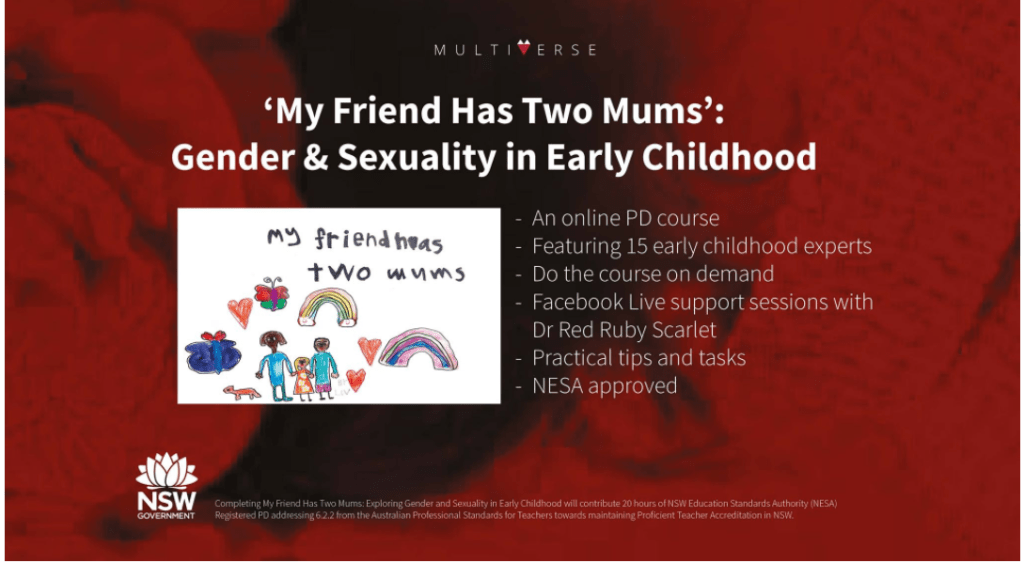
“Scarlet now runs NESA-accredited school-teacher training courses, and also accredited courses for preschool/childcare staff through the Australian Education and Care Workforce professional body. … One of her course offerings is ‘My Friend has Two Mums: Gender and Sexuality in Early Childhood’.
“It has modules in ‘Queer Thinking in Early Childhood’, ‘Queer Pedagogies’, ‘Intersex Identities’, ‘Living Non-Binary’ and ‘Aboriginal Queerness and Queeness’. This is for teaching children as young as three years old.”
If this information disturbs you, you are not alone. As Mark Latham said in his maiden speech last year:
“With few exceptions, people are born either male or female. We shouldn’t be confusing young people and risking their mental health by pushing gender fluidity upon them.
“We shouldn’t be taking away from parents their essential role as the primary carers of their children – in matters personal and sexual.
“We shouldn’t be changing the purpose of our education system: transforming schools from places of skill and academic attainment into gender fluidity factories. Most of all, we shouldn’t be losing sight of the interests of mainstream, majority Australia.’ https://familyvoice.org.au/news/safe-schools-by-the-back-door
While Australia sells its coal overseas it has an obsession with so-called renewable energy like wind and solar for Australia. Here Alan Jones is scolding Federal Energy Minister Angus Taylor for not doing the right thing by Australia.
‘I don’t know when it happened precisely, but Mark Latham has become one of the champions of religious freedom in the state of NSW. It’s strange, because by his own admission he doesn’t even consider himself ‘religious’. However, the NSW One Nation leader is taking on the thought police with a bill to protect free speech online.
For anyone keen to still be able to express their religious point of view online via social media, Latham’s proposed bill offers the much-needed protection. According to Latham’s Facebook post, the Bill will seek to do two main things:
Empower/Make further provisions for the President of the NSW Anti-Discrimination Board to decline certain complaints as frivolous or vexatious.
Remove the requirement for the President to refer declined complaints to NCAT (NSW Civil and Administrative Tribunal).
In the light of everything that happened people such as Israel Folau last year, this is a welcome move. Because the Anti-Discrimination Act has been weaponised by certain activists to financially destroy those whom they disagree with. As Latham argued in the NSW Parliament:
Activists are using the legal system to try to score the political points they cannot achieve by democratic means, or even worse, they are using the legal system to try to destroy their opponents financially to break them with the cost of using lawyers and going through tribunals to defend themselves. This is not justice; it is a lawyer’s picnic.
In the four decades since the Anti-Discrimination Act was legislated the political environment has changed substantially. We now live in an era of heightened political activism, much of it driven by the intense polarised and at times obsessive nature of social media, and tactics such as ‘de-platforming’ and ‘cancelling culture’ have become common.
Bernard Gaynor, a former army major, is another example of someone who has had to engage in modern “law-fare” to financially defend himself against numerous defamation lawsuits. For example, over the past five years, Gaynor has had up to 37 complaints brought against him by just one individual.
Latham has asked the public to issue a long or short submission in support of the bill (you can do so by clicking here). But in response to the proposed legislation, Gaynor has said:
The NSW Anti-Discrimination Board … should be abolished and Mark Latham’s common-sense bill to force it to dismiss vexatious complaints is a good first step.
The Anti-Discrimination Board is a totalitarian, state-funded activist organisation that is hell-bent on using the coercive power of the state to silence mainstream conservative opinion.
These types of ‘Thought Police’ should have no place in Australia.
The politicians in Australia in particular and the West in general have gone crazy in seeking to save the Earth! While they throw tax dollars at wind and solar energy prices continue to rise. These people are modern day crooks and should be made to answer for their actions. For example, ‘To call Australia’s energy debacle a ‘crisis’ is mastery in understatement: its obsession with wind and solar means its economy now operates around the vagaries of mother nature. The availability of sunshine and suitably beneficial breezes dictates when and where electricity gets delivered to power consumers.
New South Wales State Politicians at a Government subsidized Solar Farm
The cause of Australia’s power pricing and supply calamity is so simple and obvious it can be laid out in a handful of pictures.
Depicted above – courtesy of Aneroid Energy – is the output delivered by Australian wind power outfits to the Eastern Grid so far this month.
Spread from Far North Queensland, across the ranges of NSW, all over Victoria, Northern Tasmania and across South Australia its entire capacity routinely delivers just a trickle of its combined notional capacity of 7,728MW.
Collapses of over 3,000 MW or more that occur over the space of a couple of hours are routine, as are rapid surges of equal magnitude, which make the grid manager’s life a living hell, and provide the perfect set up for power market price gouging by the owners of conventional generators, who cash in on the chaos.
Set out below are a few examples of daily output figures showing some of those staggering collapses, and lengthy periods when the combined output of every wind turbine connected to the Eastern Grid struggled to top 400 MW (5.1% of total capacity). Occasions like:
11 June when output collapsed to a trifling 86 MW (1.1% of total notional capacity);
17 June when total output fell to 134 MW (1.7% of total notional capacity);
26 June when, after a 1,200 MW slide, output was between 300-400 MW (3.8% to 5.1% of total notional capacity); and
27 June when output dropped over 900 MW to bottom out at 96 MW (1.2% of total notional capacity) .
So, what does all that daily power delivery chaos mean for Australian business?
We’ll cross to the team at JoNova for an insight into the prospects for enterprise in a country where power rationing is dressed up as solid economic policy. [Note to Ed: did you mean to refer to the old Soviet Union here?]
Desperate signs: Australian companies will be paid to use less electricity JoNova Blog JoNova 11 June 2020
Another hidden renewables tax buried in complexity Here in Renewables World we now have to pay companies to make less of the products we want. It’s a sign of how fragile and dysfunctional the Australian grid is.
“Big energy users like factories and farms will be able to earn money by saving energy during heatwaves and at other times when electricity prices are high,” the Australia Institute’s energy lead Dan Cass said.
They call it “wholesale demand response”. We call it planned blackouts. All over the country equipment will be switched off when its needed most so that our green grid doesn’t fall over, or create billion dollar price spikes.
With some of the most expensive electricity in the world, there is already a strong price signal driving companies to use electricity efficiently. This new “price signal” drives them to be less efficient. Because the grid is now incapable of providing regular reliable electricity whenever it’s most useful to companies, the government is adding a whole new layer of complexity to try to squeeze out the spikes they can’t handle.
This move will mean more people will have to be employed in account-management, but the products made will shrink, so the price of those products will rise. It’s not possible that this change would increase the Australian GDP.
It’s all being rushed in to start in October 2021*, presumably because no one has the confidence that the Australian Grid will survive the next two summers without either price bonfires or a major blackout.
Electricity users will get paid to cut energy use under historic new market reform By Stephen Long, ABC
Electricity consumers will be paid for reducing their power demands under a radical change to the market that will be introduced next year.
The historic rule change announced today will allow what’s known as “wholesale demand response” — where the wholesale market can pay users for cutting electricity consumption, rather than paying electricity generators to increase supply, when the system is under strain.
Big conglomerate generators and retailers don’t want this change, because it’s partly aimed at them. They like the price spikes and this threatens their profits:
The shift, which will begin in October 2021, has been adopted by the Australian Energy Market Commission (AEMC) despite opposition from big energy generators and retailers, who were using the COVID-19 crisis to pressure for delaying the rule changes.
Instead of making the market fairer and more transparent by removing all renewable subsidies, and asking renewable generators to pay fair prices for transmission costs, stability costs and back up of their unreliable product, this is a desperate workaround that leaves former agreements in place but adds a new layer of complexity to try to get rid of the spikes so the generators can’t game the system.
This is a change to enable the forced transition to renewables.
Head of energy policy at the Public Interest Advocacy Centre Craig Memery said it was “a critical reform that will bring much-needed benefits to consumers, and a key part of a secure, zero-carbon energy system”.
The propaganda makes out this is a win for all: [AMEC] argues it will reduce electricity prices for consumers and improve reliability on the network, by allowing demand response to compete with “peaking” electricity generators that typically receive very high prices for supplying additional electricity during times of heavy demand.
“The benefits of wholesale demand response will flow through to all households and businesses through lower electricity bills and improved network reliability.
Obviously, the ABC repeats the propaganda and doesn’t ask any hard questions about how Australian citizens get richer by doing less.
Nobody mention the real costs: Instead of “earning money” consumers will pay via their shareholding and superannuation losses, and via the increased prices of products. Some consumers will gain jobs, but more will lose their jobs as the net efficiency of a Greener economy means companies produce less, move overseas, generate less profit and thus employ fewer Australians. Less profitable companies will also pay less tax. Meaning that individual taxpayers will have to make up for lost tax income or the government will have to offer less services.
And so yet again, the cost of a green economy is buried so deep not even a PhD can unravel “who pays”.
They call it a win for environmental groups, which tells us it’s there to prop up the renewables industry, but of course, the only parts of the “environment” that will benefit from this are the unintended parts. Wind Turbines are the new top predator in the ecosystem. So lizards living under wind farms will be happy because predatory birds will be killed off.
Complexity breeds corruption: Somehow we have to estimate what customers would have used to pay them for what they didn’t. This is a market of nullities again.
Under the change, large electricity users (such as big farms, factories and commercial enterprises) will be able to bid reductions in demand into the wholesale market and get paid for taking their demand out of the system.
Over time, demand response is expected to be extended to households and smaller businesses who sign up with companies that “sell” power reductions from thousands of customers into the market at times when wholesale prices are high.
One doesn’t have to be a scientist of any kind to know the sun does not produce as much heat in the winter as the summer. Duh! All this solar and wind renewable talk is lies. For instance there is an ad for solar that tells the viewer that the solar panels will be paid for by the savings. Nah, for most average homes this is an out and out lie. Sadly, governments contribute to this lie sometimes by millions of taxpayer dollars https://www.theland.com.au/story/6781773/solar-farm-at-goulburn/?src=rss&utm_email=1ec342a17f.
‘When energy policy sounds like something from Lewis Carroll’s Through the Looking Glass it’s because lunatics have overrun of the asylum.
Sure, those with skin in the game will say and do anything that needs to be said and done to profit from the most obscene subsidy rort in history. But, their licence to operate comes from the great unwashed proletariat, plenty of whom are convinced that we’re well on our way to an all wind and sun powered future. It is, of course, just another example of mass delusion and the madness of crowds.
As the adage goes, people go mad in herds and regain their senses, slowly, and one by one.
Films like Michael Moore’s Planet of the Humans may herald just such a turning point, where logic and reason re-enter the fray to do battle with the unhinged emotions and irrational ideology of those who would readily drive us all back to the Dark Ages.
Norman Rogers delivers a neat little essay on the current state of energy insanity and how we landed where we are.
Green Electricity Delusions American Thinker Norman Rogers 22 May 2020
With global warming the alleged science is so complicated that nobody, including the global warming scientists, can really understand what is going on. Green electricity, mostly solar and wind, is different. It’s relatively clear cut. No supercomputers spewing out terabytes of confusing data are needed.
Green electricity is quite useless. The latest trend in green electricity is wind or solar with battery backup. This green electricity costs about nine times more than the fossil fuel electricity it displaces. The true cost is hidden from the public by hidden subsidies and fake accounting. (My book, Dumb Energy, goes into great analytical detail.)
Green electricity is ineffective for preventing climate change. The climate change alarmists James Hansen and Michael Shellenberger make the case forcefully in this video. Hansen is the most important and most famous scientist warning against climate change. His followers consider him to be the greatest authority on the dangers of climate change. He calls wind and solar energy a “grotesque idea” and a “fantasy.”
It’s true that we won’t run out of wind or sunshine. That doesn’t mean that wind and sunshine are effective tools for making electricity. They aren’t. The exhaustion of fossil fuels has been predicted many times. The current situation is that fossil fuels are in great over supply and the prices have crashed to low levels. Natural gas, currently the most economical fossil fuel for generating electricity, is painfully cheap and is being extensively exported from the United States to other countries.
Natural gas from wells, not served by pipelines to take it to market, is burned or flared to get rid of it. Only the more valuable oil is kept. Thanks to fracking, we have plenty of natural gas for the next 100-years.
Promoters of quack medicine sell various pills guaranteed to improve your memory or your sex life. Green energy is quackery too. It is promoted by green organizations like the Sierra Club. At one time the Sierra Club was a harmless club of backpackers and bird watchers. But it was taken over by ideologues driven by the delusion that modern society is a destructive fraud that must be rescued by the adoption of green principles. These armchair green commandos are math handicapped. They regularly propose policies that make no sense. The green commandos pontificate confidently without real understanding.
Coal is an excellent fuel for generating electricity. Unlike natural gas or oil, coal has limited uses other than generating electricity. The Sierra Club hates coal because it competes successfully against their beloved green wind and solar.
No lie is too outrageous as long as it is useful for discrediting coal. The Sierra Club uses trick photography to make it look like coal plants emit clouds of black smoke. The trick is to photograph clean white clouds of “steam” with the sun behind the plant. That makes the harmless white clouds look black. The exhaust products are composed of water vapor and carbon dioxide with very little pollution. As the exhaust mixes with the cool air, it condenses into a white cloud of clean water droplets commonly called steam.
In modern coal plants, almost all pollution is scrubbed away before the exhaust goes into the smokestack.
Residential rooftop solar energy is an uneconomic method for generating electricity but it sounds convincing to the naïve. Rooftop solar panels lack economy of scale. These small installations generate electricity for about three times more per kilowatt hour than the large-scale utility installations. The homeowner reduces his consumption of grid electricity, reducing his electric bill. Excess solar electricity is sold back to the utility, often at a price far higher than the cost of wholesale electricity.
The beauty of this scheme is that if the rules are sufficiently rigged in favor of the homeowner, it is possible for the homeowner to save money. No one could complain if the homeowner disconnected from the electric utility. But no one is disconnecting unless they live off grid. The utility is expected to maintain a power line to the home and maintain excess generating capacity to take over supplying electricity if it is cloudy or it is nighttime.
The true cost of maintaining this backup service, exclusive of any electricity sales, is around $100 per month, but utilities commonly charge only around $10 or $15 a month for a connection before the first kilowatt hour is sold. Every kilowatt hour of utility electricity displaced by solar costs the utility gross profit. If the utility is forced to buy the homeowner’s electricity at retail rates the utility may end up paying much more than the reasonable wholesale cost of the electricity.
In some places the homeowner is even allowed to bank excess solar electricity and draw it at a later time. The utility doesn’t have a bank where it can store electricity. In short, rooftop solar is a scheme of making everyone else subsidize the homeowner. The homeowner is under the delusion that he has discovered cheaper electricity. It is cheaper only because everyone else bears the cost.
The crippling weakness of wind or solar electricity is their intermittent and erratic nature. A fossil-fuel generating plant can be fired up as needed and throttled up and down as the consumption of electricity changes. Wind or solar generates electricity according to the vagaries of the weather. The grid operators, except in extreme circumstances, are required to accept all the green electricity presented. In order to do this, fossil-fuel plants have to seesaw their output to compensate for the erratic wind or solar.
Wind and solar plants can’t replace fossil-fuel plants for the simple reason that at times the wind and solar plants are not generating electricity. You must have enough fossil fuel along with hydro and nuclear to carry the full load. The consequence is that the system has to continue to maintain and pay for its traditional plants regardless of how much wind and solar is added to the grid. The only economic contribution of wind or solar is to reduce fuel consumption in the fossil-fuel plants during times when wind or solar electricity is being generated.
The proper cost comparison is to compare the cost of green electricity versus the marginal cost (fuel) of operating the fossil-fuel plants. Natural-gas plants have a fuel cost of about $15 per megawatt hour. Wind or solar with battery backup costs about $130 per megawatt hour.
For grid stability reasons new wind and solar plants are being equipped with battery storage, greatly increasing the cost. Without the battery backup wind or solar electricity costs around $75 per megawatt hour. To be clear, the electricity supplied by wind or solar at $75 to $130 per megawatt hour (not counting subsidies) could be generated in existing fossil fuel plants for $15 per megawatt hour.
The Australian Broadcasting Corporation (ABC or sometimes known as ‘aunty’) is one BIG Leftist Loony Lovie Marxist Australian Government sponsored waste of money.
Now, ‘Hundreds of jobs will be axed from the ABC as its executive team – clearly stricken with arithmophobia – struggles to balance its measly $1.1 billion budget. ABC Life has become the first causality. You might remember the lifestyle website cost taxpayers $3 million a year to run, and in return, produces articles about what might happen in a zombie apocalypse or how to cook tofu. The website will be rebranded ABC Local and those journalists will be redeployed to doing real journalism instead of the aforementioned strange lifestyle pieces. Still, ABC Life editor Bhakthi Puvanenthiran appears defiant in the face of imminent change. “We are losing up to half the ABC Life team as we rebrand as ABC Local,” she wrote today. “It’s devastating news and the details are unclear right now, but what I know for sure is I’m really proud of what we’ve built, telling diverse stories the ABC has never told before.” And despite the ABC putting out statements that the content would dramatically shift, she hopes to do the same sort of work with the new brand. “I hope we can keep doing that under a new banner but right now I am thinking of this incredible team of winners,” she said. While job losses in journalism are always sad and should never be celebrated the announcement by ABC Managing Editor David Anderson’s five-year plan is a step in the right direction. The national broadcaster only spends 20 per cent of its budget on news right now. That figure is disturbingly low when you consider what the core function of the ABC is supposed to be. Thankfully the reforms will put an end to ABC Comedy and redirect resources back to news gathering and breaking. Ironically, ABC Comedy, which has come under fire in the past for producing skits mocking religion, will be tasked with reporting on religious affairs and science. The changes have certainly ruffled the feathers of Ultimo’s elite – who have been told may have to vacate their prime real estate. Mr Anderson has promised to base 75 per cent of content creators outside of Sydney by 2025. The freed up space will then be leased to the private sector to return $40 million to the ABC’s poorly managed budget. In whole, the changes are a positive sign that Australia’s toxic culture of identity politics does not have to be supplemented by taxpayers. Instead many jobs will move to the regions and more people will be reporting stories of significance. Hopefully the culture continues to shift away from its churn-and-burn approach to digital journalism and returns to the days of boots-on-the-ground journalism in country towns. The ABC has morphed in recent years to become a Digital Monster. It now eclipses the largest news websites in the country. Granted the organisation breaks stories – many of national importance – but it also re-writes and publishes every good scoop journalists break from the private sector, drastically limiting the monetisation opportunities for that content. It is undoubtedly the best-resourced collective newsroom in the country and competes commercially against organisations for traffic and social media presence. One way it unfairly does this is by spending, millions of dollars boosting Facebook posts and paying Google to manipulate search algorithms to ensure its content stays at the top of searches. When the ABC was last questioned about this figure at Senate estimates it revealed the total cost each yeah of promoting its content online was $2 million. Roughly $1.4 million was handed over to Facebook while hundreds and thousands of dollars went to Google. It would seem that if the ABC wanted to save a few million dollars it could stop boosting its content and let its stories perform as they would naturally perform. In a coronavirus media environment marketing budgets are the first thing to go from a newsroom, but Aunty is not plagued by pesky limitations of COVID-induced funding cuts. Its budget remains untouched – impervious to advertising constraints which are being felt everywhere else in the industry. An industry which has been facing job cuts since this writer began his career. The ABC has never had to feel this burden on the same scale. Perhaps its current financial woes will serve as a lesson for the importance of learning to balance a budget.’ https://www.skynews.com.au/details/_6166816175001?utm_medium=email&utm_campaign=Viewpoint%2024-06-2020&utm_content=Viewpoint%2024-06-2020+CID_2e8c29f4eb8761b5b42bc652f89411ff&utm_source=Daily%20newsletter&utm_term=ABC%20Life%20axed%20as%20Aunty%20announces%20major%20editorial%20reforms
The Australian PM MUST understand that ‘Whatever policies are directed at recovering from the coronavirus lockdown, without reliable and affordable power Australia’s energy hungry businesses are doomed. With rocketing power prices, and an intermittent supply, mineral processors and manufacturers are terminal, and have been for years.
Politicians and academic boffins have been giving lip service to improving Australia’s “resilience” and “self-sufficiency”, resulting in the renaissance of Australian manufacturing and industry.
With Australian businesses suffering among world’s highest power prices (thanks to its obsession with intermittent wind and solar, South Australian households and businesses suffer the highest prices in the world), the rebirth of manufacturing and industry sounds like so much wishful thinking.
International supply chains may have ground to a halt and the orderly flow of goods to market disrupted, but, before too long China will regain its primacy as the world’s manufacturing powerhouse. Two factors are responsible for China’s dominance in that domain: a cheap and flexible labour supply; and a reliable and affordable power supply. The latter being generated by hundreds of coal-fired power plants, with more being added every day.
I suppose one doesn’t really appreciate their freedom of speech etc. until it is limited or gone completely. The following is ‘Reprinted by permission of FamilyVoice Australia, 4th floor, 68 Grenfell Street, Adelaide SA 5000.’
The following is from an Australian Senator bringing her constituents up to date concerning the Religious Freedom Bill. This will not turn out good for those who have religious beliefs based on the Christian Scriptures. As Paul wrote in Romans 1:18, 24, 26, 27 For the wrath of God is revealed from heaven against all ungodliness and unrighteousness of men, who hold the truth in unrighteousness; 24 Wherefore God also gave them up to uncleanness through the lusts of their own hearts, to dishonour their own bodies between themselves: 26 For this cause God gave them up unto vile affections: for even their women did change the natural use into that which is against nature: 27 And likewise also the men, leaving the natural use of the woman, burned in their lust one toward another; men with men working that which is unseemly, and receiving in themselves that recompence of their error which was meet.
Here is what the Senator wrote; ‘Australians of family and faith want to be able to live their lives in accordance with their faith and their convictions. The growing body of cases in Australia of people facing harassment, intimidation and persecution because of their religious beliefs and actions highlights the need for positive religious freedom laws. Some are even losing their livelihoods.
Indeed, since the 2017 same-sex marriage campaign and postal survey, people who hold and practice traditional values of marriage and family have been intimidated and harassed.
When freedom of speech, thought, conscience and belief is framed only as an “exemption” to other rights, they are “read down” against positive rights, rendering them subordinate to those other rights. A regime of positive rights in the form of religious freedom legislation would give greater effect to the right to manifest one’s freedom of thought, conscience and belief as outlined in Article 18 of the International Covenant on Civil and Political Rights.
Consequently, in June 2019, I launched a petition in the Australian Senate calling for the enactment of a Religious Freedoms Act to protect the right to freedom of speech, thought, conscience and religion.
To date more than 30,000 original hardcopy signatures have been tabled in the Senate and I thank you to those of you who have signed my petition. My petition is ongoing and more signatures will be tabled this year.
I have continued to regularly speak in the Senate and in other forums on the need for protection of religious freedom as well as working with faith leaders and their communities toward this end.
On 29 August 2019, the Federal Government released its first exposure draft of the Religious Discrimination Bills. Following almost 6,000 submissions and strong pressure from religious leaders, experts and stakeholders from across the faith spectrum, on 10 December 2019, the Federal Government released its second exposure draft of the Religious Discrimination Bills.
Whilst the Second Draft did address some changes, there are still major issues of concern including:
The current draft bills DO NOT include or define religious bodies as being involved in “commercial activities”. Therefore, no full legal protection is provided to aged care facilities, retirement villages, residential colleges, school boarding houses, camps, conference facilities or marriage counselling organisations being operated by religious organisations. Protections should extend to all bodies which are conducted in accordance with, or in furtherance of, the doctrines, tenets and beliefs of a religion. That a religious body pursuing a religious purpose could cease to be a religious body because of “commercial activities” is deeply problematic. The solution is to ensure the commercial activities test MUST be removed.
The current draft bills DO NOT provide legal protections from discrimination to religious corporate bodies and unincorporated associations. The definition of “persons” should not just include corporate bodies, but there needs to be a mechanism by which a religious belief can be attributed to a corporate body in light of judicial rulings that a corporate body cannot have a belief. The solution is to ensure religious corporate bodies and religious unincorporated associations MUST be protected.
The current draft bills DO NOT provide full legal protections to religious bodies to preference the employment of staff that support the religious ethos of the organisation as well as to religious bodies to preference people of faith in the use of their facilities. This should include any consequential amendments to the Fair Work Act and the Sex Discrimination Act. The proposal that faith-based aged care, retirement villages and hospitals only be permitted to discriminate in respect of employment, but not services, will seriously compromise their ability to act consistently with their religious ethos. The solution is to ensure religious bodies MUST be afforded full legal protections to preference the employment of staff that support their religious ethos as well as preference people of faith in the use of their facilities
The current draft bills DO NOT extend to State vilification laws. “Vilify” needs to be defined to remove the implication that “causing harm” amounts to vilification. The interaction between the protection of statements of belief and the protections to employees against indirect religious discrimination needs greater clarity. The “reasonableness test” (clause 8) leaves open the prospect that an employer may dismiss an employee, or a professional may have their accreditation removed, even though their statement of belief is protected under clause 42. The solution is for the protection for statements of belief MUST NOT be removed or watered down but extended to include State vilification laws.
The current draft bills DO NOT provide protections for employees to make statements of faith at their workplace or private time without fear of retribution from their employer (no freedom of speech or religion). It will not protect you from being the next Israel Folau! Concerns remain with the $50M threshold, the principle of “unjustifiable financial hardship”, and the fact that the current drafting may in fact incentivise secondary boycotts and third-party activism. They should also apply to persons irrespective of the turnover of their employer and whether they are engaged by government. Also, reasonable statements of belief should be protected from adverse discriminatory action by qualifying bodies and others (not just employers). In order to provide adequate protection, the protections to employees and professionals should extend to reasonable statements of belief made inside and outside the workplace or in the course of their profession. The solution is to ensure genuine statements of belief MUST be protected across the board inside and outside work.
The current draft bills DO NOT override State laws, which gives too much power to State Governments that may be hostile to religion to pass laws prohibiting certain activities. The definition of “religious activity” should exclude “criminal” rather than “unlawful” activity. “Criminal activity” means activity that constitutes a criminal offence under the laws of the Commonwealth or any State or Territory. Whilst the Second Draft excludes council by-laws from lawful religious activity, it otherwise allows State or Territory laws to override the Bill. For example, the Victorian and Queensland Governments have recently proposed to ban conversion therapy (which is so broadly defined that it includes traditional religious teaching on sexuality and prayer and pastoral care based on that teaching). Such core traditional religious practices may be made unlawful by State laws and the Bill would provide no protection to religious bodies or individuals from discrimination. Further, courts have taken restrictive views of what comprises ‘religious activity’, confining that notion to prayer, worship or the observance of religious rituals or customs. This interpretation has the potential to exclude religious statements on matters such as marriage, gender or the family from the Bill’s protections, or to exclude religiously motivated acts, or to exclude refusals to perform ‘secular’ acts that are contrary to religious teaching. In light of this jurisprudence, such activities should be clearly included within the protected notion of ‘religious activity’. The solution is to ensure draft bills MUST exclude only activities that are considered criminal offences.
The current draft bill contains a “reasonableness test” that TOO BROADLY permits “reasonable” policies and conditions that discriminate against religious people and organisations. This leaves too much discretion to tribunals and courts to decide what is “reasonable”. The “reasonableness test” for indirect discrimination and the “comparator test” for direct discrimination is too broad and leaves too much discretion to tribunals and courts to decide what is “reasonable” and is therefore inconsistent with the strict grounds for limiting religious manifestation in Article 18(3) of the International Covenant on Civil and Political Rights. Both tests will weaken the protections to religious believers. The solution is to ensure draft bills MUST be strictly interpreted to international standards Australia has ratified as under Article 18(3) of the International Covenant on Civil & Political Rights.
The current draft bills DO NOT provide legal and financial protections to Charitable organisations. The Human Rights Legislation Amendment (Freedom of Religion) Bill 2019 proposes an amendment to the Charities Act 2013 (Cth) that will clarify that a charity may advocate for a traditional view of marriage and not fail the requirement that it conform to public policy. This needs to be extended to ensure that a charity will not breach the public interest test and will not lose its tax-exempt status due to its traditional view of marriage. The solution is for Charitable organisations espousing traditional views of family and faith MUST retain their charitable status without any qualifications, exemptions or exceptions.
The current draft bills DO NOT provide protections to individuals who may hold genuine beliefs (minority) that are not the view of a religious denomination (majority). For example, an alternative point of view from a person in that particular denomination could be used to declare that individual’s belief as wrong. The protections in the Bill to religious bodies and persons should not turn on whether ‘a person of the same religion … could reasonably consider [the conduct] to be in accordance’ with the beliefs. The focus should remain on the sincerity of the belief, consistent with the approach taken amongst leading Anglophone Courts across the world, including the High Court in the Scientology Case. The requirement that religious bodies and persons must act in ‘good faith’ may also allow the imposition of secular notions of reasonableness. The solution is to ensure an individual’s genuinely held beliefs MUST be protected (a major hallmark of a mature and plural society).
The current draft bills DO NOT provide maximum protection to health practitioners who seek to exercise conscientious objections and they DO NOT provide protections to faith-based health institutions. Conscientious protection offered to a limited number of health practitioners is insufficient. The solution is to ensure health practitioners and faith-based health institutions MUST be protected to exercise conscientious objections’ https://mailchi.mp/1f1752e00177/religious-discrimination-2nd-draft-exposure-bill-more-work-needed?e=63ff15b667