One picture is worth a thousand words.


One picture is worth a thousand words.
Way back when I was a boy growing up in rural Iowa a neighbor of ours had the surname Lee. Later I found out that they were relatives of the Southern General Robert Edward Lee and for some reason that impressed me! After I received Christ as my personal Lord and Saviour I learned that Robert E. Lee also professed to be a born again Christian. Some years ago we visited Gettysburg and I purchased the book CHRIST IN THE CAMP by J. William Jones a chaplain in the Confederate Army. Chaplain Jones spoke highly of General Lee’s Christianity.
Today, with these Marxist, Muslim, Loony, Lovies seeking to destroy US history and statues of men like General Lee it just might be a good time to share a little about the man known as General Robert E. Lee.
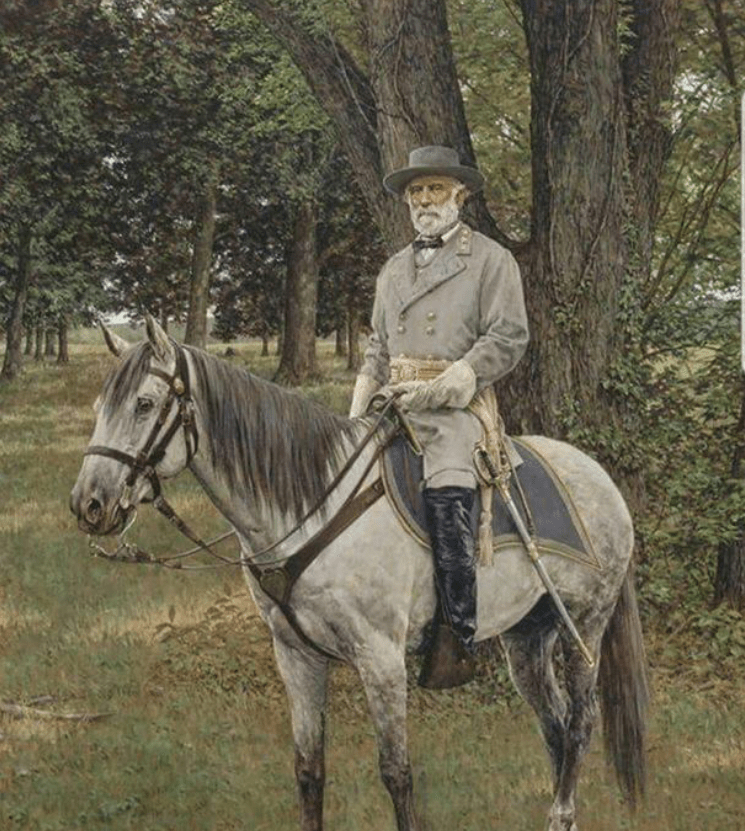
‘2 Tim. 2:3 – “Thou therefore endure hardness, as a good soldier of Jesus Christ.”
One writer called General Lee, “The portrait of a soldier.” Prime Minister Winston Churchill wrote of Lee: “His noble presence and gentle, kindly manner were sustained by religious faith and an exalted character.” His minister told him, “If you are as good a soldier of the cross as you are of the Army, Christ will have a great worker in His Church.” President Theodore Roosevelt described General Robert E. Lee as: “the very greatest of all the great captains that the English-speaking peoples have brought forth.”
General Lee was born January 19, 1807 in Stratford, Virginia, and died October 12, 1870 in Lexington. He was a son of Revolutionary War hero Henry “Light Horse Harry” Lee. He married the granddaughter of President George Washington. He graduated 2nd in his class at West Point, and has the distinction of being the only student to ever graduate without a demerit. When a Colonel stationed in Washington, DC, he was sent to put down a rebellion led by the radical abolitionist John Brown at Harper’s Ferry, Virginia (now West Virginia).
When Abraham Lincoln was elected President South Carolina seceded and was quickly followed by 6 more deep southern states: Georgia, Florida, North Carolina, Alabama, Mississippi, Louisiana, and Texas. At the behest of President Lincoln, Lee’s former commanding officer, General Winfield Scott, asked Colonel Robert E. Lee to take command of the United States Army to put down “the rebellion” in the South. He declined and instead offered his services to the newly formed Confederacy. The primary issue at stake for Lee was States’ Rights, not slavery. (As a matter of fact, Lee freed his slaves during the war, but General U.S. Grant, who fought the war to supposedly free the slaves did not free his until after the war was over: he lived in Maryland, a slave state that was not subject to the “Emancipation Proclamation.” It only applied to Southern states.)
After the war Lee applied to be reinstated as a U.S. citizen, but his paperwork was “lost” by a federal bureaucrat and was not “found” until over one hundred years after his death. His citizenship was finally reinstated by President Gerald Ford in 1974.
General Lee never felt hatred for his enemies, and exhorted the South to forgive and go on. He said: “Abandon your animosities, and make your sons Americans.”
His last words, when he knew his time was short, were: “Strike my tent; call for Hill.” (General A.P. Hill). The hymn sung at his modest funeral was, “How firm a foundation, ye saints of the Lord, is laid for your faith in His excellent Word.”
1. General Lee was a God-fearing Man. 2 Samuel 23:3 says: “He that ruleth over men must be just, ruling in the fear of God.”
General Lee feared God. He was a man of faith and prayer. One of his numerous General Orders he issued in 1862 read: “Habitually all duties except those of inspection will be suspended during Sunday, to afford the troops rest and to enable them to attend religious services.”
On one occasion when he issued one of these orders an Army chaplain wrote: “The work of grace among the troops widened and deepened and went gloriously on until there had been thousands of professions of faith in Christ as a personal Saviour.”
John Cooke said: “He had lived, as he died, with this supreme trust in an overruling and merciful Providence; and this sentiment, pervading his whole being, was the origin of that august [majestic] calmness with which he greeted the most crushing disasters of his military career. His faith and humble trust sustained him after the war, when the woes of the South well nigh broke his great spirit; and he calmly expired, as a weary child falls, asleep, knowing that its father is near.”
Lee had learned through personal hardship and tragedy to possess an unrelenting faith in the sovereign counsel of God, both in personal and national matters. Upon hearing of the death of his 23-year-old daughter, Annie, and unable to attend her funeral, he insisted that these words be carved on her tombstone: “Perfect and true are all His ways, Whom Heaven adores and earth obeys.”
Like Job of old in the Bible, he trusted in God no matter the situation or heartache. He did not get angry with God, but entrusted his life and circumstances with God.
2. General Lee was a Born Again Man.
The Bible teaches that we must be saved and born again through faith and trust in Christ and His shed blood on the Cross of Calvary. Salvation is by grace, not by works of righteousness which we have done. (Titus 3:5; Eph. 2:8,9; John 3:7)
General Lee was a saved, born-again, Christian man and everyone knew and respected him for it. He wrote to his chaplains who informed him of their prayers for him that he thanked them and needed all of the prayers they could offer in his behalf. And then he said: “I can only say that I am nothing but a poor sinner, trusting in Christ alone for salvation.”
Lee considered himself a sinner who had been saved, not by church attendance or by good works or by any other human endeavor, but solely by the grace of God and the blood of Christ. In his Personal Reminiscences, Anecdotes, and Letters of Gen. Robert E. Lee, the Rev. J. William Jones, who was Lee’s chaplain at Washington College, wrote: “If I ever came in contact with a sincere, devout Christian – one who, seeing himself to be a sinner, trusted alone in the merits of Christ, who humbly tried to walk the path of duty, ‘looking unto Jesus’ as the author and finisher of his faith, and whose piety constantly exhibited itself in his daily life – that man was General R. E. Lee.”
3. General Lee was a Bible-believing Man.
The Apostle Paul wrote in 2 Timothy 3:16-17 – “ALL scripture is given by inspiration of God, and is profitable for doctrine, for reproof, for correction, for instruction in righteousness: THAT the man of God may be perfect, thoroughly furnished unto all good works.”
General Lee accepted all of the Bible without claiming to understand all of it.
He once remarked to Chaplain William Jones: “There are things in the Old Book which I may not be able to explain, but I fully accept it as the infallible Word of God, and receive its teachings as inspired by the Holy Spirit.”
He was a constant reader and a diligent student of the Bible.
He obeyed the command of 2 Timothy 2:15 to “Study to shew thyself approved unto God…” He believed what the Bible said in Revelation 1:3, “Blessed is the that readeth the words” of God. He practiced what it spoke of in Psalm 1:2, and he meditated upon the Scriptures.
Those who knew him well said, “Even in the midst of his most active campaigns he made time to read a portion of God’s word every day.”
He was actively engaged in promoting the Word of God (KJV).
The Bible says in Psalm 68:11 – “The Lord gave the word: great was the company of those that published it.” General Lee was in that company. He paid for and bought Bibles and was actively engaged in distributing the word of God to the world.
During the War he helped to provide Bibles and prayer-books to the men at his own expense.
After the War, he was offered and accepted the presidency of the Rockbridge Bible Society in Lexington, VA (where he taught at the Washington College and served as its President). The primary objective of the Bible Society under his leadership, according to his own words, was to place a Bible in every home in the South. He admonished folks to “read the Bible, read the Bible.”
4. General Lee was a Lowly-minded Man.
The Bible says in Philippians 2:5-8 – “LET this mind be in you, which was also in Christ Jesus: WHO, being in the form of God, thought it not robbery to be equal with God: BUT made himself of no reputation, and took upon him the form of a servant, and was made in the likeness of men: AND being found in fashion as a man, he humbled himself, and became obedient unto death, even the death of the cross.” Jesus was a servant who ministered to others.
General Lee had this mindset. He was a lowly-minded man of humility. He said, “What do you care about rank? I would serve under a corporal if necessary!”
His ambition in life was to the best Christian he could be. Lee said: “My chief concern is to try to be a humble, earnest Christian…”
John Cooke, in his Life of General Robert E. Lee, wrote: “The crowning grace of this man, who was thus not only great but good, was the humility and trust in God, which lay at the foundation of his character.”
The Lord Jesus said in Matthew 11:28-30: “COME unto me, all ye that labour and are heavy laden, and I will give you rest.TAKE my yoke upon you, and learn of me; for I am meek and lowly in heart: and ye shall find rest unto your souls. FOR my yoke is easy, and my burden is light.”
General Lee was a meek man who was willing to learn from the Lord through the lessons of life: “We must expect reverses, even defeats. They are sent to teach us wisdom and prudence, to call forth greater energies, and to prevent our falling into greater disasters.”
He believed that “no human power can avail us without the blessing of God.”
For what it is worth, I like this quote from the General: “All I ever wanted was a Virginia farm, no end of cream and fresh butter and fried chicken-not one fried chicken, or two, but unlimited fried chicken.”
5. General Lee was a Church-goimg Man.
General Lee was an Episcopalian by denomination – but a saved, Bible-believing member of that church in the South of his day. (I seriously doubt he would be one today!)
“General Lee was a most active promoter of the interests of his church, and of the cause of Christ in the community; and all of the pastors felt that they had in him a warm friend.”
“He was a most regular attendant upon all the services of his own church.” Gen. Lee took heed to Hebrews 10:25 – “Not forsaking the assembling of ourselves together, as the manner of some is; but exhorting one another: and so much the more, as ye see the day approaching.”
“His pew was immediately in front of the chancel, his seat in the chapel was the second from the pulpit, and he always seemed to prefer a seat near the preacher’s stand. He always devoutly knelt during prayer, and his attitude during the entire service was that of an interested listener or a reverential participant.” While at Washington College, his seat in the chapel was never empty when services were being held.
His habit was to attend church wherever he was stationed. He would stop along the roadside to join his troops in prayer services. Once he was came upon a group of soldiers kneeling in prayer on the eve of a battle. He rode up, dismounted from his horse, Traveller, uncovered his head, and knelt in reverence to engage in prayer with them and their chaplain.
“He was a most liberal contributor to his church.” Gen. Lee was a giver. Not only did he tithe of his income, but It was not unusual for him to ask how much the balance was for a certain need of the church and then give the amount needed to make up for the lack of funds.
6. General Lee was a Soul-winning Man.
He was concerned for the souls of his soldiers & students. He had the heart of the Apostle Paul for those under his command and care (Rom. 10:1): “Brethren, my heart’s desire and prayer to God for Israel is, that they might be saved.”
“General Lee always took the deepest interest in the work of his chaplains and the spiritual welfare of his men.” He attended the Chaplains’ meetings and a faithful chaplain always had a friend at HQ’s in General Lee. While General of the Army, Lee supported his chaplains and urged them to preach the Gospel to his soldiers. He encouraged them to distribute Gospel tracts to the men under his command and try to win them to Christ.
After the war, he became President and instructor at Washington College (later renamed Washington & Lee University) in Lexington, Virginia. He told one of the local pastors: “I shall be disappointed, sir; I shall fail in the leading object that brought me here, unless these young men become real Christians; and I wish you and others of your sacred profession to do all you can to accomplish this.” He said to another: “I dread the thought of any student going away from the college without becoming a sincere Christian.”
Chaplain William Jones, the “Fighting Parson,” the author ofReligion in Lee’s Army, preached at the college, and afterwards General Lee told him: “I wish, sir, to thank you for your address; it was just what we needed. Our great want is a revival which shall bring these young men to Christ.”
Before he died, he said to one of the professors of the college:“Oh, doctor! If only I could know that all the young men in the college were good Christians, I should have nothing more to desire.”
7. General Lee was a Clean-living Man.
The Bible commands God’s people to be clean-living people. We are told to “cleanse ourselves from all filthiness of the flesh and spirit, perfecting holiness in the fear of God.” (2 Cor. 7:1)
General Lee was a man of high moral character. He strove to live an exemplary life. He did his best to live a holy life, one pleasing to God. He lived according to 2 Timothy 2:19 – “Let everyone that nameth the name of Christ depart from iniquity.”
General Lee did not smoke, drink, curse or indulge in crude humor. Once a soldier asked if there were any ladies present before he started to tell a dirty, off-color joke. Lee said, “There are no ladies present, but one gentleman is.” Needless to say, the joke was never told.
He said, “I think it better to do right, even if we suffer in so doing, than to incur the reproach of our consciences and posterity.” He practiced what Jesus and the Apostles taught, and was willing to suffer for doing right rather than to do wrong and avoid criticism and scorn.
As President and instructor at Washington College, he said:“We have only one rule here – to act like a gentleman at all times.”
When it came to honest dealings he remarked: “The trite saying that honesty is the best policy has met with the just criticism that honesty is not policy. The real honest man is honest from conviction of what is right, not from policy.” He believed what he Bible said about lying and liars, about honesty and integrity. With him it was a conviction, not a policy or preference. He believed that God judged men for their actions here and in eternity and he lived in view of that truth.
As a lasting tribute to a man of sterling Christian character and Southern patriotism, War-era Georgia Senator Benjamin Harvey Hill gave us these words in his address before the Southern Historical Society on February 18, 1874, just four years after Lee’s death: “When the future historian shall come to survey the character of Lee, he will find it rising like a huge mountain above the undulating plain of humanity, and he must lift his eyes high toward heaven to catch its summit. He was a foe without hate, a friend without treachery, a soldier without cruelty, a victor without oppression, and a victim without murmuring. He was a public officer without vices, a private citizen without wrong, a neighbor without reproach, a Christian without hypocrisy, and a man without guile. He was a Caesar without his ambition, a Frederick without his tyranny, a Napoleon without his selfishness, and a Washington without his reward. He was obedient to authority as a servant, and loyal in authority as a true king. He was gentle as a woman in life; modest and pure as a virgin in thought; watchful as a Roman vital in duty; submissive to law as Socrates, and grand in battle as Achilles!”
General Robert E. Lee was a Christian man, and not ashamed of his Savior or the Bible.
What if everybody lived like General Lee?Then everybody would be –God-fearing
Born-again
Bible-believing
Lowly-minded
Church-going
Soul-winning
Clean-living
What if you lived like General Lee?‘ http://www.solidrockbaptist.net/the-christian-character-of-general-robert-e-lee.html
A University education is not always the best education!
THESE chapters disclaim outright any pretension to biography. They deal with a weird, indescribable and mysterious genius, standing out in gloomy grandeur, and not needing the setting forth of ordinary incidents. At the same time, when an extraordinary man comes along and does masterful things, there be some who are ready to ask questions. Was he educated? Well, yes, he was. He had rare educational advantages, not in the schools; but what of that? A genius has no use for a school, except so far as it teaches him the art of thinking. If we run back to the boyhood of Jasper and look him over we find that he had, after all, distinct educational advantages.

It is another case of a good mother. We know that her name was Nina, and that she was the wife of Philip Jasper, and if tradition tells the truth she was the mother of twenty-four children–a premature applicant for the Rooseveltian prize. John was the last, and was not born until two months after his father’s death. Truly grace as well as genius was needed in his case, or he would have struck the wrong road.
That mother was the head of the working women on the Fluvanna farm and learned to govern by reason of the position she held. Her appointment bespoke her character, and her work improved it. Later on, she became in another home the chief of the servant force in a rich family. It was quite a good place. It brought her in contact with cultivated people and the imitative quality in the negro helped her to learn the manners and to imbibe the spirit of the lady. Later on still, she became a nurse to look after the sick at the Negro Quarters. There she had to do with doctors, medicines and counsellors and helpers. Add to all this, she was a sober, thoughtful, godly woman, and you will quite soon reach the conclusion that she was a very excellent teacher for John; and John coming latest in the domestic procession found her rich in experience, matured in motherliness, and enlarged in her outlook of life.
John’s father was a preacher. Harsh things, and some of them needlessly false, are said of the fact that there were no negro preachers in the times of the slaveholding. It is true, that the laws of the country did not allow independent organizations of negroes, and negro preachers were not allowed, except by the consent of their masters, to go abroad preaching the Gospel. They could not accept pastoral charges, and were hampered, as all must admit, by grievous restrictions, but there were negro preachers in that day just the same,–scores of them, and in one way and another they had many privileges and did good and effective service. One thing about the negro preacher of the ante bellum era was his high character. It is true that the owner of slaves was not in all cases adapted to determine the moral character of the slave who wanted to preach, and too often, it may be admitted, his prejudices and self-interest may have ruled out some men who ought to have been allowed to preach. It is a pity if this were true. But this strictness had one advantage. When the master of a negro man allowed him to preach it was an endorsement, acceptable and satisfactory, wherever the man went. If they thought he was all right at home, he could pass muster elsewhere.
Now, concerning John’s father, tradition has proved exceedingly partial. It has glorified Tina the mother with fine extravagance, but it has cut Philip unmercifully. John could get little out of his father, for they were not contemporaries, and as his brothers and sisters seemed to have been born for oblivion, we can trace little of his distinction to the old household in Fluvanna.
But we dare say that Philip, the preacher, remembered chiefly because he was a preacher, had something to do in a subtle way with John’s training. Nor must we fail to remember that Jasper himself grew up in contact with a fine old Virginia family. Fools there be many who love to talk of the shattering of the old aristocracy of Virginia. The First Families of Virginia
have been the sport of the vulgar, and their downfall has been a tragedy which the envious greedily turned into a comedy. But people ought to have some sense. They ought to see things in their proper relation. They ought to know that in the atmosphere of the old Virginia home the negroes, and especially those who served in person the heads of the family, caught the cue of the gentleman and the lady. I can stand on the streets of Richmond to-day and pick out the coloured men and women who grew up in homes of refinement, and who still bear about them the signs of it. Bent by age, and many of them tortured by infirmity, they still bear the marks of their old masters. They constitute a class quite apart from those of later times and are unequalled by them. I rejoice in all the comforts and advantages which have come to the negroes,–most heartily I thank heaven for their freedom and for all that freedom has brought them; but I do not hesitate to say that one of the losses was that contact with courtly, dignified, and royal people which many of them had before the Civil War. And even those on the plantations, while removed farther from the lights of the great castles in which their masters lived, walked not in darkness entirely, but unconsciously felt the transforming power of those times.
John Jasper was himself an aristocrat. His mode of dress, his manner of walking, his lofty dignity, all told the story. He received an aristocratic education, and he never lost it. Besides this, he had a most varied experience as a slave. He grew up on the farm, and knew what it was to be a plantation hand. He learned to work in the tobacco factory. He worked also in the foundries, and also served around the houses of the families with whom he lived; for it must be understood that after the breaking up of the Peachy family he changed owners and lived in different places. These things enlarged his scope, and with that keen desire to know things he learned at every turn of life.
After his conversion he became a passionate student. He acknowledges one who sought to teach him to read, and after he became a preacher he spelled out the Bible for himself. He was eager to hear other men preach and to talk with those who were wiser than he. And so he kept on learning as long as he lived, though of course he missed the help of the schools, and never crossed the threshold of worldly science in his pursuit of knowledge.
It may be well to say here that Jasper never lost his pride in white people. He delighted to be with them. Thousands upon thousands went to hear him, and while there was a strain of curiosity in many of them there was an under-note of respect and kindliness which always thrilled his heart and did him good. Time and again he spoke to me personally of white people, and always with a beautiful appreciation. It is noteworthy that the old man rode his high horse when his house was partly filled with white people, and it would be no exaggeration to say that not since the end of the war has any negro been so much loved or so thoroughly believed in as John Jasper. https://docsouth.unc.edu/church/hatcher/hatcher.html
There is such a thing as ‘The Good Ole Boy’s Club’ in ‘Christian’ ministries. The following article is too long for here but is a must read as it shows exactly how the Good Ole Boy’s Club works.
‘On May 30, 2018, Paige Patterson was terminated from his position as President of Southwestern Baptist Theological Seminary for, “the handling of an allegation of sexual abuse against a student during Dr. Paige Patterson’s presidency at another institution and resulting issues connected with statements to the Board of Trustees that are inconsistent with SWBT’s biblically informed core values.” (Source)
While there were undoubtedly many good friends serving on the SWBTS’s Board of Trustees, the fact that they were able to set aside their friendship with Patterson and do the right thing speaks to the integrity of the members of the Board of Trustees.
Now, two years later, a similar situation has arisen at Cedarville University primarily involving three proteges of Paige Patterson; Anthony Moore, recently terminated from Cedarville University for past incidents of paraphilia, Thomas White, the President of Cedarville University, and Jason Duesing, a member of the Cedarville University Board of Trustees.
Anthony Moore (whom Paige Patterson called “my sweet son, Anthony” in a foot-washing ceremony which took place at a chapel service at SWBTS) was terminated from The Village Church when a subordinate reported discovering multiple videos taken of him while showering at Anthony Moore’s home.
Thomas White was a long-time assistant of Paige Patterson, working at both Southeastern and Southwestern Seminaries. White is currently on administrative leave from his position as President of Cedarville University while his involvement with the Anthony Moore hiring is being investigated.’ http://thewartburgwatch.com/2020/06/18/jason-duesing-should-recuse-himself-from-thomas-white-investigation/
As I said in the beginning of this blog the whole article should be read to see how the Good Ole Boy’s Club operates. Those within the club are a protected species and are moved from one place to another without any questions being asked.
This is not the ministry that God has outlined for us in His Word.
The Australian Broadcasting Corporation (ABC or sometimes known as ‘aunty’) is one BIG Leftist Loony Lovie Marxist Australian Government sponsored waste of money.
Now, ‘Hundreds of jobs will be axed from the ABC as its executive team – clearly stricken with arithmophobia – struggles to balance its measly $1.1 billion budget. ABC Life has become the first causality. You might remember the lifestyle website cost taxpayers $3 million a year to run, and in return, produces articles about what might happen in a zombie apocalypse or how to cook tofu. The website will be rebranded ABC Local and those journalists will be redeployed to doing real journalism instead of the aforementioned strange lifestyle pieces. Still, ABC Life editor Bhakthi Puvanenthiran appears defiant in the face of imminent change. “We are losing up to half the ABC Life team as we rebrand as ABC Local,” she wrote today. “It’s devastating news and the details are unclear right now, but what I know for sure is I’m really proud of what we’ve built, telling diverse stories the ABC has never told before.” And despite the ABC putting out statements that the content would dramatically shift, she hopes to do the same sort of work with the new brand. “I hope we can keep doing that under a new banner but right now I am thinking of this incredible team of winners,” she said. While job losses in journalism are always sad and should never be celebrated the announcement by ABC Managing Editor David Anderson’s five-year plan is a step in the right direction. The national broadcaster only spends 20 per cent of its budget on news right now. That figure is disturbingly low when you consider what the core function of the ABC is supposed to be. Thankfully the reforms will put an end to ABC Comedy and redirect resources back to news gathering and breaking. Ironically, ABC Comedy, which has come under fire in the past for producing skits mocking religion, will be tasked with reporting on religious affairs and science. The changes have certainly ruffled the feathers of Ultimo’s elite – who have been told may have to vacate their prime real estate. Mr Anderson has promised to base 75 per cent of content creators outside of Sydney by 2025. The freed up space will then be leased to the private sector to return $40 million to the ABC’s poorly managed budget. In whole, the changes are a positive sign that Australia’s toxic culture of identity politics does not have to be supplemented by taxpayers. Instead many jobs will move to the regions and more people will be reporting stories of significance. Hopefully the culture continues to shift away from its churn-and-burn approach to digital journalism and returns to the days of boots-on-the-ground journalism in country towns. The ABC has morphed in recent years to become a Digital Monster. It now eclipses the largest news websites in the country. Granted the organisation breaks stories – many of national importance – but it also re-writes and publishes every good scoop journalists break from the private sector, drastically limiting the monetisation opportunities for that content. It is undoubtedly the best-resourced collective newsroom in the country and competes commercially against organisations for traffic and social media presence. One way it unfairly does this is by spending, millions of dollars boosting Facebook posts and paying Google to manipulate search algorithms to ensure its content stays at the top of searches. When the ABC was last questioned about this figure at Senate estimates it revealed the total cost each yeah of promoting its content online was $2 million. Roughly $1.4 million was handed over to Facebook while hundreds and thousands of dollars went to Google. It would seem that if the ABC wanted to save a few million dollars it could stop boosting its content and let its stories perform as they would naturally perform. In a coronavirus media environment marketing budgets are the first thing to go from a newsroom, but Aunty is not plagued by pesky limitations of COVID-induced funding cuts. Its budget remains untouched – impervious to advertising constraints which are being felt everywhere else in the industry. An industry which has been facing job cuts since this writer began his career. The ABC has never had to feel this burden on the same scale. Perhaps its current financial woes will serve as a lesson for the importance of learning to balance a budget.’ https://www.skynews.com.au/details/_6166816175001?utm_medium=email&utm_campaign=Viewpoint%2024-06-2020&utm_content=Viewpoint%2024-06-2020+CID_2e8c29f4eb8761b5b42bc652f89411ff&utm_source=Daily%20newsletter&utm_term=ABC%20Life%20axed%20as%20Aunty%20announces%20major%20editorial%20reforms
‘Does science rule out the possibility of miracles? Or does science – with its predictable physical laws – define miracles when one of these laws is seemingly broken? That is the intriguing topic of our “Science and Miracles” video.’ https://creationmoments.com/
2 Corinthians 5:17 Therefore if any man be in Christ, he is a new creature: old things are passed away; behold, all things are become new.
‘LET us bear in mind that at the time of his conversion John Jasper was a slave, illiterate and working in a tobacco factory in Richmond. It need hardly be said that he shared the superstitions and indulged in the extravagances of his race, and these in many cases have been so blatant and unreasonable that they have caused some to doubt the negro’s capacity for true religion. But from the beginning Jasper’s religious experiences showed forth the Lord Jesus as their source and centre. His thoughts went to the Cross. His hope was founded on the sacrificial blood, and his noisy and rhapsodic demonstrations sounded a distinct note in honour of his Redeemer.
Jasper’s conviction as to his call to the ministry was clear-cut and intense. He believed that his call came straight from God. His boast and glory was that he was a God-made preacher. In his fierce warfares with the educated preachers of his race,–“the new issue,” as he contemptuously called them–he rested his claim on the ground that God had put him into the ministry; and so reverential, so full of noble assertion and so irresistibly eloquent was he in setting forth his ministerial authority that even his most sceptical critics were constrained to admit that, like John the Baptist, he was “a man sent from God.”
And yet Jasper knew the human side of his call. It was a part of his greatness that he could see truth in its relations and completeness, and while often he presented one side of a truth, as if it were all of it, he also saw the other side. With him a paradox was not a contradiction. He gratefully recognized the human influences which helped him to enter the ministry. While preaching one Sunday afternoon Jasper suddenly stopped, his face lighted as with a vision, a rich laugh rippled from his lips while his eyes flashed with soulful fire. He then said, in a manner never to be reported: “Mars Sam Hargrove called me to preach de Gospel–he was my old marster, and he started me out wid my message.” Instantly the audience quivered with quickened attention, for they knew at once that the man in the pulpit had something great to tell.
“I was seekin’ God six long weeks–jes’ ’cause I was sich a fool I couldn’t see de way De Lord struck me fus’ on Cap’tal Squar’, an’ I left thar badly crippled. One July mornin’ somethin’ happen’d. I was a tobarker-stemmer–dat is, I took de tobarker leaf, an’ tor’d de stem out, an’ dey won’t no one in dat fac’ry could beat me at dat work. But dat mornin’ de stems wouldn’t come out to save me, an’ I tor’d up tobarker by de poun’ an’ flung it under de table. Fac’ is, bruthr’n, de darkness of death was in my soul dat mornin’. My sins was piled on me like mount’ns; my feet was sinkin’ down to de reguns of despar, an’ I felt dat of all sinners I was de wust. I tho’t dat I would die right den, an’ wid what I supposed was my lars breath I flung up to heav’n a cry for mercy. ‘Fore I kno’d it, de light broke; I was light as a feather; my feet was on de mount’n; salvation rol’d like a flood thru my soul, an’ I felt as if I could ‘nock off de fact’ry roof wid my shouts.
“But I sez to mysef, I gwine to hol’ still till dinner, an’ so I cried, an’ laffed, an’ tore up de tobarker. Pres’ntly I looked up de table, an’ dar was a old man–he luv me, an’ tried hard to lead me out de darkness, an’ I slip roun’ to whar he was, an’ I sez in his ear as low as I could: ‘Hallelujah; my soul is redeemed!’ Den I jump back quick to my work, but after I once open my mouf it was hard to keep it shet any mo’. ‘Twan’ long ‘fore I looked up de line agin, an’ dar was a good ol’ woman dar dat knew all my sorrers, an’ had been prayin’ fur me all de time. Der was no use er talkin’; I had to tell her, an’ so I skip along up quiet as a breeze, an’ start’d to whisper in her ear, but just den de holin-back straps of Jasper’s breachin’ broke, an’ what I tho’t would be a whisper was loud enuf to be hearn clean ‘cross Jeems River to Manchester. One man sed he tho’t de factory was fallin’ down; all I know’d I had raise my fust shout to de glory of my Redeemer.
“But for one thing thar would er been a jin’ral revival in de fact’ry dat mornin’. Dat one thing was de overseer. He bulg’d into de room, an’ wid a voice dat sounded like he had his breakfus dat mornin’ on rasps an’ files, bellowed out: ‘What’s all dis row ’bout?’ Somebody shouted out dat John Jasper dun got religun, but dat didn’t wurk ‘tall wid de boss. He tell me to git back to my table, an’ as he had sumpthin’ in his hand dat looked ugly, it was no time fur makin’ fine pints, so I sed: ‘Yes, sir, I will; I ain’t meant no harm; de fus taste of salvation got de better un me, but I’ll git back to my work.’ An’ I tell you I got back quick.
“Bout dat time Mars Sam he come out’n his orfis, an’ he say: ‘What’s de matter out here?’ An’ I hear de overseer tellin’ him: ‘John Jasper kick up a fuss, an’ say he dun got religun, but I dun fix him, an’ he got back to his table.’ De devil tol’ me to hate de overseer dat mornin’, but de luv of God was rollin’ thru my soul, an’ somehow I didn’t mind what he sed.
“Little aft’r I hear Mars Sam tell de overseer he want to see Jasper. Mars Sam was a good man; he was a Baptis’, an’ one of de hed men of de old Fust Church down here, an’ I was glad when I hear Mars Sam say he want to see me. When I git in his orfis, he say: ‘John, what was de matter out dar jes’ now?’–and his voice was sof’ like, an’ it seem’d to have a little song in it which play’d into my soul like an angel’s harp. I sez to him: ‘Mars Sam, ever sence de fourth of July I ben cryin’ after de Lord, six long weeks, an’ jes’ now out dar at de table God tuk my sins away, an’ set my feet on a rock. I didn’t mean to make no noise, Mars Sam, but ‘fore I know’d it de fires broke out in my soul, an’ I jes’ let go one shout to de glory of my Saviour.’
“Mars Sam was settin’ wid his eyes a little down to de flo’, an’ wid a pritty quiv’r in his voice he say very slo’: ‘John, I b’leve dat way myself. I luv de Saviour dat you have jes’ foun’, an’ I wan’ to tell you dat I do’n complain ’cause you made de noise jes’ now as you did.’ Den Mars Sam did er thing dat nearly made me drop to de flo’. He git out of his chair, an’ walk over to me and giv’ me his han’, and he say: ‘John, I wish you mighty well. Your Saviour is mine, an’ we are bruthers in de Lord.’ When he say dat, I turn ’round an’ put my arm agin de wall, an’ held my mouf to keep from shoutin’. Mars Sam well know de good he dun me.
“Art’r awhile he say: ‘John, did you tell eny of ’em in thar ’bout your conversion?’ And I say: ‘Yes, Mars Sam, I tell ’em fore I kno’d it, an’ I feel like tellin’ eberybody in de worl’ about it.’ Den he say: ‘John, you may tell it. Go back in dar an’ go up an’ down de tables, an’ tell all of ’em. An’ den if you wan’ to, go up-stars an’ tell ’em all ’bout it, an’ den down-stars an’ tell de hogshed men an’ de drivers an’ everybody what de Lord has dun for yor.’
“By dis time Mars Sam’s face was rainin’ tears, an’ he say: ‘John, you needn’ work no mo’ today. I giv’ you holiday. Aft’r you git thru tellin’ it here at de fact’ry, go up to de house, an’ tell your folks; go roun’ to your neighbours, an’ tell dem; go enywhere you wan’ to, an’ tell de good news. It’ll do you good, do dem good, an’ help to hon’r your Lord an’ Saviour.’
“Oh, dat happy day! Can I ever forgit it? Dat was my conversion mornin’, an’ dat day de Lord sent me out wid de good news of de kingdom. For mo’ den forty years I’ve ben tellin’ de story. My step is gittin’ ruther slo’, my voice breaks down, an’ sometimes I am awful tired, but still I’m tellin’ it. My lips shall proclaim de dyin’ luv of de Lam’ wid my las’ expirin’ breath.
“Ah, my dear ol’ marster! He sleeps out yonder in de ol’ cemetery, an’ in dis worl’ I shall see his face no mo’, but I don’t forgit him. He give me a holiday, an’ sent me out to tell my friends what great things God had dun for my soul. Oft’n as I preach I feel that I’m doin’ what my ol’ marster tol’ me to do. If he was here now, I think he would lif’ up dem kin’ black eyes of his, an’ say: ‘Dat’s right, John; still tellin’ it; fly like de angel, an’ wherever you go carry de Gospel to de people.’ Farewell, my ol’ marster, when I lan’ in de heav’nly city, I’ll call at your mansion dat de Lord had ready for you when you got dar, an’ I shall say: ‘Mars Sam, I did what you tol’ me, an’ many of ’em is comin’ up here wid da robes wash’d in de blood of de Lam’ dat was led into de way by my preachin’, an’ as you started me I want you to shar’ in de glory of da salvation. ‘An’ I tell you what I reek’n, dat when Mars Sam sees me, he’ll say: ‘John, call me marster no mo’; we’re bruthers now, an’ we’ll live forever roun’ de throne of God.’ “
This is Jasper’s story, but largely in his own broken words. When he told it, it swept over the great crowd like a celestial gale. The people seemed fascinated and transfigured. His homely way of putting the Gospel came home to them. Let me add that his allusions to his old master were in keeping with his kindly and conciliatory tone in all that he had to say about the white people after the emancipation of the slaves. He loved the white people, and among them his friends and lovers were counted by the thousand.’ https://docsouth.unc.edu/church/hatcher/hatcher.html
This is a segment on Sky’s Outsiders. The video is a tweet by President Trump that Twitter removed. Enjoy.
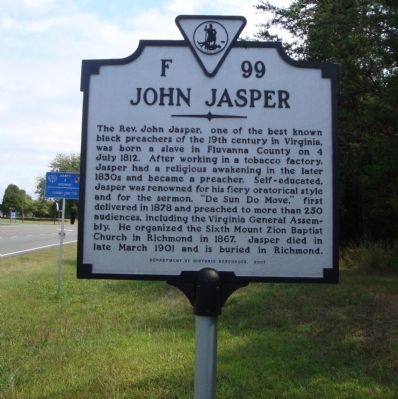
‘JOHN JASPER, the negro preacher of Richmond, Virginia, stands preëminent among the preachers of the negro race in the South. He was for fifty years a slave, and a preacher during twenty-five years of his slavery, and distinctly of the old plantation type. Freedom came full-handed to him, but it did not in any notable degree change him in his style, language, or manner of preaching. He was the ante bellum preacher until eighty-nine years of age, when he preached his last sermon on “Regeneration,” and with quiet dignity laid off his mortal coil and entered the world invisible. He was the last of his type, and we shall not look upon his like again. It has been my cherished purpose for some time to embalm the memory of this extraordinary genius in some form that would preserve it from oblivion. I would give to the American people a picture of the God-made preacher who was great in his bondage and became immortal in his freedom.
This is not to be done in biographic form, but rather in vagrant articles which find their kinship only in the fact that they present some distinct view of a man, hampered by early limitations, denied the graces of culture, and cut off even from the advantages of a common education, but who was munificently endowed by nature, filled with vigour and self-reliance, and who achieved greatness in spite of almost limitless adversities. I account him genuinely great among the sons of men, but I am quite sure that the public can never apprehend the force and gist of his rare manhood without first being made acquainted with certain facts appertaining to his early life.
Jasper was born a slave. He grew up on a plantation and was a toiler in the fields up to his manhood. When he came to Richmond, now grown to a man, he was untutored, full of dangerous energies, almost gigantic in his muscle, set on pleasure, and without the fear of God before his eyes. From his own account of himself, he was fond of display, a gay coxcomb among the women of his race, a fun-maker by nature, with a self-assertion that made him a leader within the circles of his freedom.
We meet him first as one of the “hands” in the tobacco factory of Mr. Samuel Hargrove, an enterprising and prosperous manufacturer in the city of Richmond. Jasper occupied the obscure position of “a stemmer,”–which means that his part was to take the well-cured tobacco leaf and eliminate the stem, with a view to preparing what was left to be worked into “the plug” which is the glory of the tobacco-chewer. This position had one advantage for this quick-witted and alert young slave. It threw him into contact with a multitude of his own race, and as nature had made him a lover of his kind his social qualities found ample scope for exercise. In his early days he went at a perilous pace and found in the path of the sinful many fountains of common joy. Indeed, he made evil things fearfully fascinating by the zestful and remorseless way in which he indulged them.
It was always a joy renewed for him to tell the story of his conversion. As described by him, his initial religious experiences, while awfully mystical and solemn to him, were grotesque and ludicrous enough. They partook of the extravagances of the times, yet were so honest in their nature, and so soundly Scriptural in their doctrines, and so reverential in their tone, that not even the most captious sceptic could hear him tell of them, in his moments of exalted inspiration, without feeling profoundly moved by them.
It ought to be borne in mind that this odd and forcible man was a preacher in Richmond for a half century, and that during all that time, whether in slavery or in freedom, he lived up to his religion, maintaining his integrity, defying the unscrupulous efforts of jealous foes to destroy him, and walking the high path of spotless and incorruptible honour. Not that he was always popular among his race. He was too decided, too aggressive, too intolerant towards meanness, and too unpitying in his castigation of vice, to be popular. His life, in the nature of the case, had to be a warfare, and it may be truly said that he slept with his sword buckled on.
Emancipation did not turn his head. He was the same high-minded, isolated, thoughtful Jasper. His way of preaching became an offense to the “edicated” preachers of the new order, and with their new sense of power these double-breasted, Prince-Albert-coated, high hat and kid-gloved clergymen needed telescopes to look as far down as Jasper was, to get a sight of him. They verily thought that it would be a simple process to transfix him with their sneers, and flaunt their new grandeurs before him, in order to annihilate him. Many of these new-fledged preachers, who came from the schools to be pastors in Richmond, resented Jasper’s prominence and fame. They felt that he was a reproach to the race, and they did not fail to fling at him their flippant sneers.
But Jasper’s mountain stood strong. He looked this new tribe of his adversaries over and marked them as a calcimined and fictitious type of culture. To him they were shop-made and unworthy of respect. They called forth the storm of his indignant wrath. He opened his batteries upon them, and, for quite a while, the thunder of his guns fairly shook the steeples on the other negro churches of Richmond. And yet it will never do to think of him as the incarnation of a vindictive and malevolent spirit. He dealt terrific blows, and it is hardly too much to say that many of his adversaries found it necessary to get out of the range of his guns. But, after all, there was a predominant good nature about him. His humour was inexhaustible, and irresistible as well. If by his fiery denunciations he made his people ready to “fight Philip,” he was quite apt before he finished to let fly some of his odd comparisons, his laughable stories, or his humorous mimicries. He could laugh off his own grievances, and could make his own people “take the same medicine.”
Jasper was something of a hermit, given to seclusion, imperturbably calm in his manner, quite ascetic in his tastes, and a cormorant in his devouring study of the Bible. Naturally, Jasper was as proud as Lucifer,–too proud to be egotistic and too candid and self-assertive to affect a humility which he did not feel. He walked heights where company was scarce, and seemed to love his solitude. Jasper was as brave as a lion and possibly not a little proud of his bravery. He fought in the open and set no traps for his adversaries. He believed in himself,–felt the dignity of his position, and never let himself down to what was little or unseemly.
The most remarkable fact in Jasper’s history is connected with his extraordinary performances in connection with his tersely expressed theory,–THE SUN DO MOVE! We would think in advance that any man who would come forward to champion that view would be hooted out of court. It was not so with Jasper. His bearing through all that excitement was so dignified, so sincere, so consistent and heroic, that he actually did win the rank of a true philosopher. This result, so surprising, is possibly the most handsome tribute to his inherent excellence and nobility of character. One could not fail to see that his fight on a technical question was so manifestly devout, so filled with zeal for the honour of religion, and so courageous in the presence of overwhelming odds, that those who did not agree with him learned to love and honour him.
The sensation which he awakened fairly flew around the country. It is said that he preached the sermon 250 times, and it would be hard to estimate how many thousands of people heard him. The papers, religious and secular, had much to say about him. Many of them published his sermons, some of them at first plying him with derision, but about all of them rounding up with the admission of a good deal of faith in Jasper. So vast was his popularity that a mercenary syndicate once undertook to traffic on his popularity by sending him forth as a public lecturer. The movement proved weak on its feet, and after a little travel he hobbled back richer in experience than in purse.
As seen in the pulpit or in the street Jasper was an odd picture to look upon. His figure was uncouth; he was rather loosely put together; his limbs were fearfully long and his body strikingly short,–a sort of nexus to hold his head and limbs in place. He was black, but his face saved him. It was open, luminous, thoughtful, and in moments of animation it glowed with a radiance and exultation that was most attractive.
Jasper’s career as a preacher after the war was a poem. The story is found later on and marks him as a man of rare originality, and of patience born of a better world. He left a church almost entirely the creation of his own productive life, that holds a high rank in Richmond and that time will find it hard to estrange from his spirit and influence. For quite a while he was hardly on coöperative terms with the neighbouring churches, and it is possible that he ought to share somewhat in the responsibility for the estrangement which so long existed;–though it might be safely said that if they had left Jasper alone he would not have bothered them. Let it be said that the animosities of those days gradually gave away to the gracious and softening influence of time, and, when his end came, all the churches and ministers of the city most cordially and lovingly united in honouring his memory.
It may betoken the regard in which Jasper was held by the white people if I should be frank enough to say that I was the pastor of the Grace Street Baptist Church, one of the largest ecclesiastical bodies in the city at the time of Jasper’s death, and the simple announcement in the morning papers that I would deliver an address in honour of this negro preacher who had been carried to his grave during the previous week brought together a representative and deeply sympathetic audience which overflowed the largest church auditorium in the city. With the utmost affection and warmth I put forth my lofty appreciation of this wonderful prince of his tribe, and so far as known there was never an adverse criticism offered as to the propriety or justice of the tribute which was paid him.
It is of this unusual man, this prodigy of his race, and this eminent type of the Christian negro, that the somewhat random articles of this volume are to treat. His life jumped the common grooves and ran on heights not often trod. His life went by bounds and gave surprises with each succeeding leap.’ https://docsouth.unc.edu/church/hatcher/hatcher.html
It doesn’t take many smarts to know biologically that there are ONLY two sexes. However, the result of this belief that a boy may be a girl or vice versa is that ‘Keira Bell can never get her childhood back. And her body, a scarred and mangled reminder, tells her every day. “I am living in a world where I don’t fit in as male or as female. I am stuck between two sexes.” Now 23, she’s dedicated her life to stop teenagers from making the same mistake. And suing the clinic responsible is step number one.
Keira was just a child when she walked into England’s Tavistock clinic and declared she wanted to be a boy. The staff didn’t blink. Despite just starting her periods and having no other real psychological evaluation or therapy, Tavistock prescribed her the puberty blockers that ultimately ruined her life.
“I should have been challenged on the claims that I was making for myself,” Keira told the judges. “And I think that would have made a big difference as well. If I was just challenged on the things I was saying.” If an adult had taken her aside, talked to her about her feelings, maybe none of this would have happened.
As soon as she started taking the drugs, Keira said “it was like turning off a tap.” Her development as a young woman just stopped. And nobody warned her. “I had symptoms similar to the menopause when a woman’s hormones drop. I had hot flushes, I found it difficult to sleep, my sex drive disappeared. I was given calcium tablets because my bones weakened. My female hormones had been flushing through my body and, suddenly, a curtain came down on them.” It felt awful she says.
Three years later, after having her breasts removed free of charge (courtesy of the government), she was filled with crushing regret. She stumbled on charities and advocates that help young people reverse the damage. Now that she’s gone public, trying to hold Tavistock accountable, Keira says she’s been contacted by “hundreds of young adults” who wish they’d never walked down this path. “The treatment has not solved their problems.”

Here in the U.S., the battle over puberty blockers and transgender advocacy is just as intense. Eight states are trying to impose age limits on the drugs — which would have spared teens like Keira years of horrible agony. But the reason lawmakers have had to step in, the Wall Street Journal’s Abigail Shrier says, is because “scientists aren’t engaging in honesty.”
In a powerful conversation with FRC’s Sarah Perry, she told the listeners of “Washington Watch,” “Look, I’m a journalist. I’m not an activist. My job is not to stop people from using puberty blockers on their children. My job is to tell the truth — and on this issue, not enough people are telling the truth. And the truth is… we have no idea what the long-term effects of these drugs will be.”
In the Left’s rush to medicalize kids and trap them into this lifestyle, there’s been an explosion of these prescriptions without any thought to the permanent consequences. “We’re going to see a lot of lawsuits,” Abigail predicted. “And the reason is — the doctors are being activists rather than being doctors.
I’ve interviewed a lot of doctors on this topic, and they’ll tell you that when they go to conferences, [whenever there’s] a new heart medicine or any other kind of medicine, there’s an open discussion of risks and benefits — because all medications have risks and benefits. But when it comes to transgender medicine… one researcher I interviewed said it was like an infomercial for trans. In other words, no discussion of risks were ever assessed.”
That’s a terrifying thought, she says when you consider how profoundly these puberty blockers affect the human body. “They shut down the part of the pituitary that stimulates puberty, so that eight-, nine-, and 10-year-olds will not go through the normal puberty.
The sexual organs will remain the size… and the capacity of a small child. They will not have the potential for orgasm, and they may … be permanently infertile.” Not to mention, Abigail goes on, that these hormones flood the brain. “So what’s we’re doing is an experiment that we don’t know the long term effects of. And patients aren’t being advised of that.”
And what if there are underlying mental health issues that no one knows about? When you attack the brain with these cross-sex hormones for a child struggling with conditions like depression, bipolar disorder, even high-functioning autism, which is sometimes the case for these girls, “one can only wonder,” Sarah pointed out, “what that kind of medical intervention does.”
And yet no one in the medical community seems to have the nerve to call everyone together and demand scientific research on this — something that would be routine on any other treatment.
Even more worrisome, Abigail says, America has gone from two gender clinics in the last decade to well over 50. But that doesn’t include groups like Planned Parenthood, who, believe it or not, are now one of the biggest dispensers of cross-sex hormones in the country. So along with killing unborn children, they’re also embracing a separate track to make generations completely infertile. All the while keeping parents — as they usually do — in the dark.
Yet, thanks to Obamacare, these pricey drugs and gender transitions are, in some cases, completely free for young people. Or, at the very least, of minimal cost. “So, all of the sudden, these were readily available. You could get these fancy surgeries, and it costs you almost nothing. So, unsurprisingly, you’re seeing a lot greater demand for it.”
But that demand must be met by a different demand from parents, citizens, and doctors: for safety, accountability, and caution. It’s time to stop the radical Left from experimenting on our children before, as Keria found out, it’s too late.’ https://www.prophecynewswatch.com/article.cfm?recent_news_id=4118
1 Corinthians 3:19 …For the wisdom of this world is foolishness with God.
 | Elise on NY Times Warns Companies From… |
 | Martin on School Boards, Hot Mics &… |
 | pacanter7 on Creation News and Views Januar… |
 | Scriptural Vision on Climate Change & Community… |
 | crisscross767 on Prophetic Signs in the He… |
 whatyareckon