
If I didn’t live in Australia I just might not believe this story!
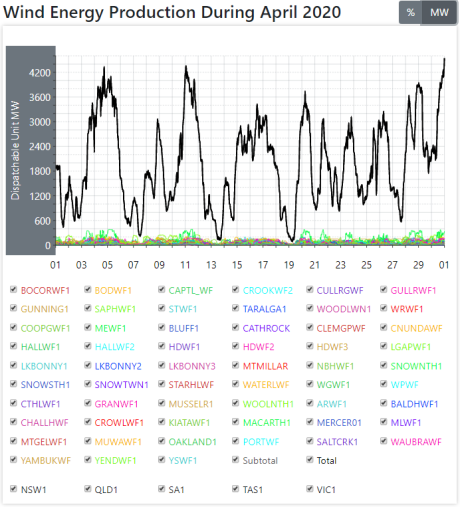
‘If you’re looking for the reason why wind power has never worked and never will? Here it is: THE WEATHER.
If you’re looking to wreck a grid and send power prices into orbit, then pin your power hopes to mother nature’s whims. South Australia did; it suffers the world’s highest retail power prices and became the butt of international jokes for a series of weather-related mass blackouts.
Looking for an example? Take a scan of what’s depicted above.
That’s the ‘performance’ of Australia’s wind power fleet during April – courtesy of Aneroid Energy
Spread from Far North Queensland, across the ranges of NSW, all over Victoria, Northern Tasmania and across South Australia its 6,960 MW of capacity routinely delivers just a trickle of that.
Collapses of over 3,000 MW or more that occur over the space of a couple of hours are routine, as are rapid surges of equal magnitude, which make the grid manager’s life a living hell, and provide the perfect set up for power market price gouging by the owners of conventional generators, who cash in on the chaos.
The Australian Energy Market Organisation (AEMO) – a body of wind and solar obsessed boffins – is tasked with keeping the lights on in Australia, notwithstanding the chaos delivered by their beloved windmills and solar panels.
Their most publicly visible ‘work’ occurs when they engage in what they euphemistically call “demand management”. Which is just another way of referring to controlled blackouts – increasingly common events that are engineered when the sun sets and/or calm weather sets in, and large power users get cut from the grid.
And when that forced reduction in ‘demand’ isn’t enough to keep the grid from collapsing entirely, they then slash the power supply to whole regions and suburbs. And all this in a notionally first world economy.
Apparently in an effort to come to grips with the power pricing and supply calamity they’ve helped create, AEMO released a report earlier this month, in which they tended to gloss over the effect that the unreliables have had on Australia’s power supply. However, the section extracted below caught STT’s attention.
Renewable Integration Study: Stage 1
AEMO
April 2020
6.2 Increase in Uncertainty (p59)
As variable renewable energy (VRE) becomes more prevalent, AEMO must be able to manage the unpredictability associated with weather to operate the system securely.
Variable events, such as changes in wind or cloud movements, are challenging to forecast accurately over both short and longer forecasting horizons. Technological development and innovation have resulted in significant improvements in weather forecast accuracy, however the level of accuracy and precision achievable by best practice weather forecasts can still lead to significant challenges in predicting VRE output and variability in the power system.
Figure 17 shows some of the challenges in forecasting wind and solar. It highlights that:
- The 24-hour and 8-hour ahead forecasts showed minimal prediction of the ramping event. These forecasts rely on global numeric weather prediction models (NWPs), and on this particular day the local effects of a prefrontal trough and a large band of precipitation were not well resolved by the NWP. This resulted in an increase in forecast inaccuracies during the ramping periods.
- While the 1-hour ahead forecast improves closer to real time as more up-to-date information is incorporated, the persistent component of these forecasts means they tend to lag actual real time generation. Recent wind and solar output gives a good indication of the level of future output (close to real time), but it does not give a reliable indication future variability. The 1-hour ahead forecast gives a reasonable indication of future output when variability is low (see Figure 17, 00:00 to 13:00), however is not actually predicting the variability. When variability is high (see Figure 17, 14:00 to 00:00), the performance of the model erodes and there is a higher margin of uncertainty. As shown in Figure 17, the 1-hour ahead forecast (yellow trace) has a similar shape to actual generation (purple trace), however it is offset (shifted to the right) by one hour.
Failure to forecast these large changes in VRE (and subsequent net demand requirements) will become increasingly operationally difficult. There is a need to improve the performance of weather forecasting and power forecasting models, or develop new dedicated operational tools, to appropriately manage and communicate uncertainty under variable or extreme weather conditions.
Flexible resources are also needed, to cover the residual uncertainty that cannot be addressed by forecasting improvements and variability that is characteristic of wind and solar resources.

Surprise, surprise! A group of purportedly expert engineers and power marketers have had to morph into shaman and soothsayers hoping to predict the weather.
Whether their weather predictions concern cloud cover (crushing solar output) or calm weather (sending wind power output to the floor), STT doubts that these characters are any better than the Bureau of Meteorology.
The Bureau is hard pressed to give any weather prediction that holds beyond about seven days hence.
Moreover, predictions about the strength and variability of wind at a given wind farm site have all the statistical power of picking the winning numbers for XLotto.
The only reason, of course, that they’re interested in predicting when wind and solar output might either surge or collapse, is to give some kind of notice to dispatchable generators to idle back their plants (in response to a surge) or to crank up their output (in response to a collapse).
At the heart of this nonsense is the notion that an industrial economy can meaningfully power itself on sunshine and breezes.
Once upon a time, before these clowns and their rent seeking mates got involved in Australia’s power market, this country had ample capacity to provide electricity, 24 x 7, on demand to all comers; and its supply had nothing to do with the weather.
If you’re any good at predicting the weather, then send your CV to the AEMO. Who knows, they might make you chief of operations. https://stopthesethings.com/2020/05/05/its-no-joke-australias-electricity-supply-now-depends-on-wind-cloud-forecasts/


 whatyareckon